Worried you might be losing your hair? The key is to look for gradual changes, not a sudden bald spot overnight. For most guys, the first signs are a slowly receding hairline, especially at the temples, and subtle thinning on the crown. A dead giveaway for many is suddenly noticing your scalp a lot more easily under bright lights.
Decoding the First Subtle Signs of Hair Loss

Spotting hair loss early isn't about finding a perfectly round bald patch one morning. It’s a much quieter process. You start noticing small, consistent shifts you might have otherwise ignored. Maybe you see a bit more forehead in recent photos, or the harsh fluorescent lights at the office suddenly seem to highlight your scalp in a new way.
This initial thinning is usually caused by something called hair follicle miniaturization. In simple terms, your individual hair strands are getting progressively thinner and shorter with each growth cycle. You aren't necessarily losing more hair, but the overall volume and density just isn't what it used to be.
Common Early Indicators to Watch For
Instead of panicking over every hair you find on your pillow, it's better to keep an eye out for these specific patterns. They're much more reliable signs of male pattern baldness.
- A Changing Hairline: The classic "M" shape starts to emerge as the corners of your hairline creep back faster than the center. For many, this is the first and most obvious sign.
- Thinning at the Crown: This spot on the top-back of your head is tough to monitor on your own. It usually starts as a small, less dense area that slowly gets larger over time.
- Your Hair Just Feels Different: You might run your hands through your hair and notice it doesn't have the same heft or thickness. It can feel lighter, wispier, or just less substantial than you remember.
If you're noticing these changes, you're definitely not alone. The American Hair Loss Association points out that by age 35, roughly two-thirds of American men will see some degree of hair loss. By the time they hit 50, about 85% of men have significantly thinning hair. This is almost always due to androgenetic alopecia, which is the culprit behind over 95% of hair loss cases in men. You can dig into the numbers yourself over at the American Hair Loss Association website.
To make it even easier, I've put together a quick reference table.
Quick Guide to Early Balding Signs
This table breaks down the most common early indicators of balding to help you quickly identify what to look for and where.
| Sign | What It Looks Like | Where to Check |
|---|---|---|
| Receding Hairline | The classic "M" shape forming at the temples. | Frontal hairline, especially the corners above your temples. |
| Crown Thinning | A small, sparse area on the top-back of your head. | The vertex or "crown" of your scalp. Use a second mirror to see. |
| Overall Thinning | Hair feels less dense; you can see your scalp more easily. | All over the top of your head, often noticeable under direct light. |
| More Hair Shedding | Finding more hairs than usual on your pillow, in the shower, or in your comb. | Check your pillowcase in the morning and the shower drain after washing. |
Keep this guide handy as a simple checklist. Catching these signs early gives you the best chance to take action and explore your options.
Your Family History Is a Major Clue
When you're trying to figure out if you're losing your hair, one of the best places to look for clues is your family tree. It’s an old myth that you should only look at your mom's dad—the truth is, the genes for male pattern baldness (androgenetic alopecia) can be passed down from either side of your family. It's a bit of a genetic lottery.
Take a good look at the men in your family. Your dad, your grandfathers, even your uncles. If a lot of them started thinning or went bald, the odds are stacked a bit higher for you. It’s not a guarantee, of course, but it’s a strong signal that you should be keeping a closer eye on things.
Reading Your Genetic Blueprint
Knowing your family's hair history gives you a real head start. Instead of being blindsided by a receding hairline one day, you can be proactive. For some guys, that means starting to monitor their hair earlier or even looking into options like genetic hair loss testing to get a clearer picture of their personal risk.
The genetic link here is no joke. Research has shown that about 70.5% of men with hair loss have a close family member who also went through it. That number really drives home how much genetics are in the driver's seat. If your dad or grandfather started losing hair in their 30s, it's smart to be extra vigilant as you get to that age. You can dig deeper into these numbers by checking out these hair loss statistics and their genetic links.
Knowing your genetic predisposition isn't a sentence—it's an early warning system. It allows you to shift from worrying about "if" to preparing for "when," putting you back in control of the situation.
Think of it as having some valuable inside information. It doesn’t mean you have to panic; it just means you’re equipped to act sooner, which can make a huge difference if you eventually decide to pursue any kind of treatment.
What Your Pillow and Shower Drain Are Telling You

It’s easy to get paranoid about every stray hair you find on your shirt or in your comb. But let’s be clear: everyone sheds hair every single day. The real question isn't if you're losing hair, but if the amount you're losing has started to tick upward.
Believe it or not, your pillowcase and shower drain are two of the most honest indicators you have.
Finding Your Normal
We all lose roughly 50 to 100 hairs daily. This is just part of a healthy, natural hair growth cycle, and it's usually not even noticeable. If you want to get into the nitty-gritty, our guide on how much daily hair loss is normal is a great resource. The goal here is simply to figure out what’s normal for you.
You don’t need to count every single strand. Just start paying attention for a week or two.
- The Pillow Check: Take a quick look at your pillow each morning. A couple of hairs? Totally normal. A small handful of 5, 10, or more every single day? That’s a pattern worth noting.
- The Shower Drain: This is where you’ll see the most evidence. After a shower, check the drain. You'll quickly get a feel for the size of your typical "hair clump." If that clump is consistently getting bigger, that's a sign.
It’s important to distinguish between the everyday shedding everyone experiences and a more significant increase that could point to hair loss.
Normal Shedding vs. Potential Hair Loss
| Characteristic | Normal Daily Shedding | Potential Balding Indicator |
|---|---|---|
| Quantity | 50-100 hairs per day, often unnoticeable. | A consistent increase; seeing noticeably more hair than usual. |
| Location | A few hairs on a brush, pillow, or in the shower. | Larger clumps in the drain or on the pillow every day. |
| Duration | Varies slightly but remains stable over months. | The increase in shedding lasts for several consecutive weeks. |
| Appearance | Hairs are full-length with a small white bulb at the end. | You might notice thinner, shorter, "miniaturized" hairs mixed in. |
Ultimately, this is about moving from a vague worry to a concrete observation.
Don't obsess over counting every single hair. You're looking for a consistent shift in the pattern. A few days of heavy shedding is one thing, but a few weeks of it could be your hair's way of telling you something has changed.
This simple monitoring helps turn "I think I'm losing more hair" into "I am definitely seeing more hair in the shower now than a month ago." And that is information you can act on.
How to Track Changes with Your Phone Camera

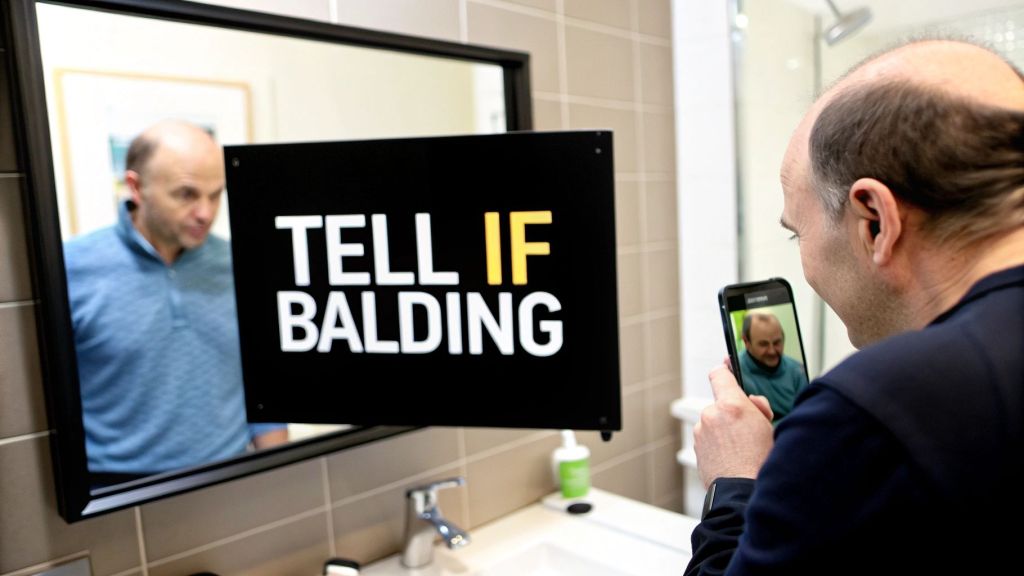
Relying on memory to track something as slow as hair loss just doesn't work. The change is so gradual day-to-day that you'll constantly second-guess yourself. The single best way to know for sure if you're balding is to create a visual record with the tool you already have in your pocket: your smartphone.
Think of it as building a case file on your hair. A few clear photos taken every few months can settle the debate once and for all, turning a nagging suspicion into undeniable evidence. The goal isn't to get obsessive, but to create a reliable timeline that shows what's really happening.
Setting Up for Consistent Photos
To make this work, consistency is everything. If your lighting and angles are all over the place, you won't be able to make a fair comparison. It’s pretty simple—just stick to a few rules.
- Same Place, Same Light: Find a spot with consistent, direct lighting. Your bathroom mirror is often perfect for this because the harsh overhead light makes it easier to see your scalp and any thinning.
- Consistent Angles: Try to hold your phone at the same angle and distance every time. If you can, prop it up against something to keep it steady and uniform.
- Key Areas to Capture: Snap clear shots of the areas that matter most: your temples, the very front of your hairline, and the crown of your head. You’ll probably need to use a second hand mirror to get a good look at the crown.
Set a reminder to take a full set of these pictures every three months. It's the perfect interval. Comparing a photo from January to one from April will give you a much clearer, more objective view than trying to recall what your hair looked like last winter.
This isn't just for your own peace of mind. This photo diary gives you concrete proof to show a specialist. It transforms "I think my hair is thinning" into "Here is visible evidence of progression over the last six months."
This simple habit takes all the guesswork out of the equation. And if you do decide to talk to a professional, walking in with a visual history is one of the most valuable things you can do.
Knowing When to Talk to a Doctor
https://www.youtube.com/embed/J7IZ2HsVpYY
Keeping an eye on things yourself is a great start, but there’s a time and a place to bring in an expert. Let's be clear: booking an appointment with a doctor isn't throwing in the towel. It's the smartest, most proactive thing you can do to get real answers and figure out what your options are.
Certain signs are more like red flags, signaling that you should probably pick up the phone sooner rather than later.
If your hair loss seems to have come out of nowhere and is happening fast, that’s a big one. Another tell-tale sign is finding distinct, circular bald patches, which could be a sign of something like alopecia areata that needs a professional eye.
Don’t forget about your scalp's condition, either. Is the thinning hair coming with a side of constant itching, flaking, or even pain? Those symptoms often point to an underlying scalp issue that a specialist needs to diagnose and treat.
What to Expect During a Consultation
Walking into a consultation might feel a little daunting, but it's really just a conversation. A dermatologist will likely kick things off by asking about your family history, your lifestyle, and when you first started noticing changes.
Then, they’ll do a physical check of your hair and scalp, sometimes using a special magnifying tool to get a close-up look at your hair follicles. This is how they can separate common male pattern baldness from other potential issues.
Getting that clear, professional diagnosis is the bedrock of any effective treatment plan. For more on this, our guide on when to see a dermatologist for hair loss is a great resource.
Don't ignore the mental side of this. If worrying about your hair is genuinely starting to affect your confidence or your day-to-day life, that's more than enough reason to seek professional guidance.
At the end of the day, seeing a doctor takes you from a place of guessing to a place of knowing. That clarity alone is a huge step forward.
Exploring Your Hair Loss Treatment Options

If you’ve started noticing the early signs of thinning, don't panic. The good news is that we're living in a time with more effective, scientifically-backed ways to tackle hair loss than ever before. Understanding what's out there is the first real step toward taking back control.
The Tried-and-True Go-Tos
For years, the gold standard for fighting male pattern baldness has revolved around two FDA-approved powerhouses: Minoxidil and Finasteride. You've probably heard of them. Minoxidil (often known by the brand name Rogaine) is a topical treatment that helps improve blood flow to the follicles, while Finasteride (Propecia) is a pill that targets the hormonal side of hair loss. They have a long track record for a reason—they work for a lot of guys.
A More Modern, Natural Approach
Lately, treatments like Platelet-Rich Plasma (PRP) therapy have become incredibly popular, and for good reason. PRP is a different kind of strategy. It uses a concentration of your own blood platelets, which are packed with growth factors, and injects them into the scalp to wake up dormant follicles. It’s a compelling option for men looking for a more natural approach that uses their body's own healing mechanisms.
The most important thing to remember is this: you are not out of options. Seeing some hair in the drain doesn't mean it's over. There are real, proven paths you can take.
Taking the time to explore the full spectrum of hair loss treatment options will give you a much better handle on what might fit your situation. While you're at it, some guys also find success with certain home remedies to regrow hair as a complementary or starting measure. Knowledge is power here, and it’s the best tool you have.
It’s normal to have a head full of questions when you’re worried about hair loss. Let’s tackle some of the most common ones I hear from guys trying to figure this out.
Can a Bad Haircut Make It Seem Like I’m Balding?
Oh, absolutely. A buzz cut or any style that’s cut super close to the scalp can definitely give the illusion of thinning, especially if you’re under bright lights. That’s why you can’t judge your hair based on a single, fresh haircut.
The only way to know for sure is to track the changes over time. Taking photos consistently over a few months will give you a much more accurate picture of what’s really going on with your hair density and hairline.
Is It Really Possible to Start Balding in My 20s?
You bet. It’s a tough pill to swallow, but for some guys, male pattern baldness kicks in during their late teens or early 20s. It’s more common than you might think.
According to the American Hair Loss Association, a staggering 25% of men who have hereditary male pattern baldness start seeing signs before they even hit 21. If thinning hair runs in your family, it pays to be vigilant about the early signs.
A quick note on stress: Intense stress can cause a condition called telogen effluvium, where you shed a lot of hair temporarily. This isn't the same as genetic balding, and the hair usually grows back once you get the stress under control. But, long-term stress might speed up hereditary hair loss, so getting a proper diagnosis from a doctor is always the best move.
If you’re looking for straightforward answers and want to learn about modern, effective treatments like PRP therapy, we're here to help. At PRP For HairLoss, we focus on providing the clear, reliable information you need.
Find out more at https://prpforhairloss.com.
 PRP For Hairloss
Leave a comment