If you're exploring PRP injections for hair loss, you've probably noticed the huge range in cost. Prices can swing from as low as $400 to over $3,000 for a single session.
So, what's the deal with that massive gap? While some sources quote a national average around $1,716, that number doesn't tell you the whole story. Let's break down what's really behind the price tag so you can figure out what a fair investment looks like for you.
Understanding The Real Cost Of PRP Injections For Hair Loss

Seeing the wide price range for PRP can be jarring at first. It’s important to remember you’re not just buying a product off a shelf—you're investing in a sophisticated medical service. The cost reflects a trained professional's time, highly specialized equipment, and a treatment plan designed just for you.
Think of it this way: the procedure is a multi-step process. A skilled clinician, often a dermatologist or plastic surgeon, draws your blood, uses a high-tech centrifuge to separate out the growth-factor-rich plasma, and then meticulously injects it into targeted areas of your scalp. That expertise, the sterile environment, and the advanced technology all factor into the final cost, which is why insurance almost never covers it. It's a true out-of-pocket investment in your hair.
PRP Hair Treatment Cost At A Glance
To give you a clearer picture, here's a quick look at what you can generally expect to pay. This table breaks down the costs from a single appointment to a full treatment plan. Just keep in mind that these are typical ranges; only a direct consultation will give you a precise quote for your specific needs.
| Cost Component | Typical Price Range (USD) |
|---|---|
| Single Session | $400 – $3,000 |
| Initial Package (3 Sessions) | $1,500 – $5,000 |
| Annual Maintenance (1-2 Sessions) | $600 – $3,000 |
This breakdown really highlights a crucial point about PRP.
The key takeaway is that PRP is not a one-and-done solution. For the best results, you need to think about the initial series of treatments and the follow-up sessions to maintain your progress.
Getting a handle on these numbers is the first step. The goal here is to demystify the pricing so you feel confident and informed in your decision. For a wider perspective on how medical treatments are priced, you can look at general medical service pricing information to see how it compares.
What Actually Happens During a PRP Treatment?
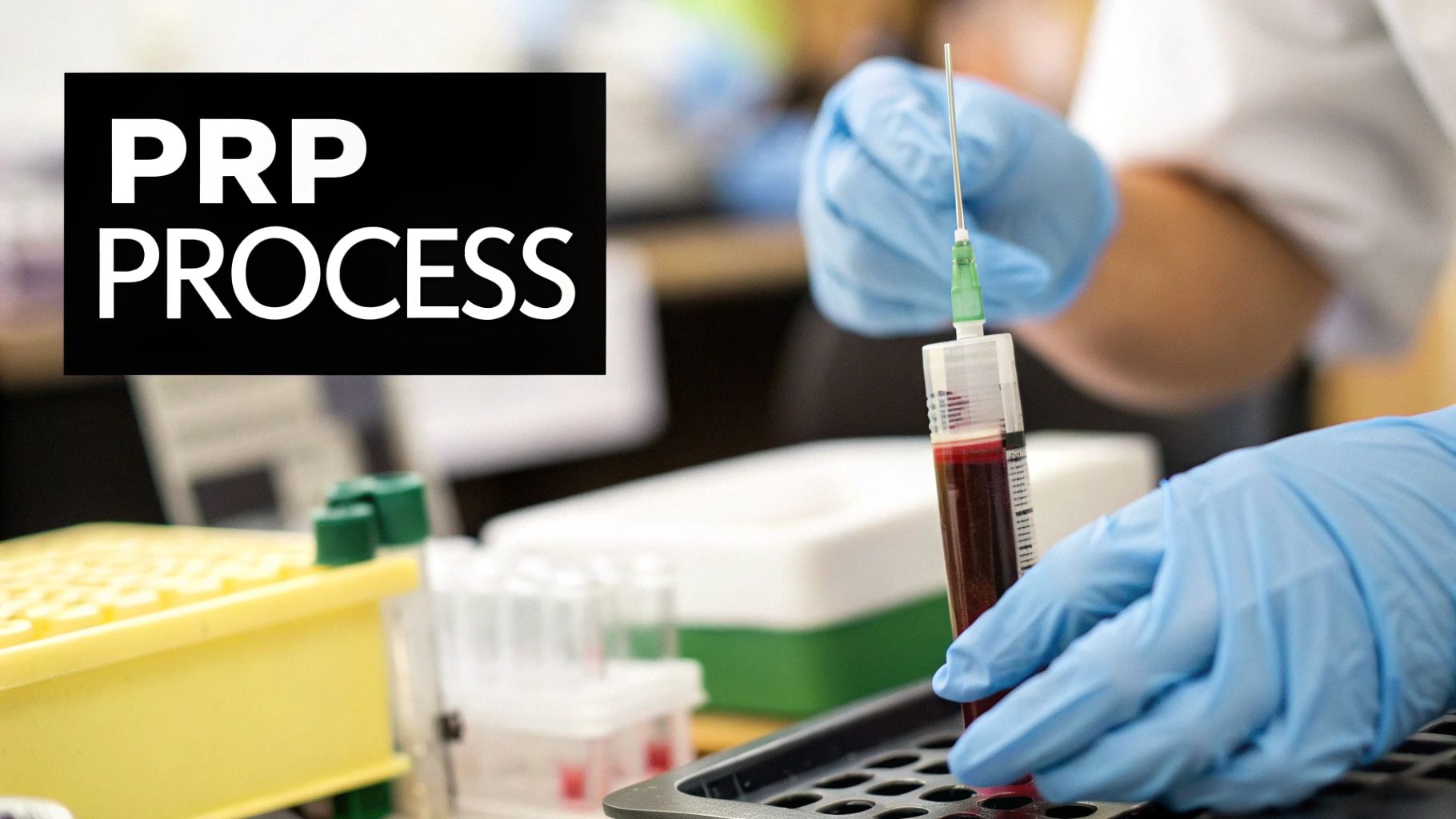
To really get why the prp injections for hair loss cost what they do, it helps to peek behind the curtain. This is so much more than just a quick shot. I like to think of it like a high-end craft brewery: they start with basic ingredients and use a very specific, controlled process to create something special. In this case, your own blood is the key ingredient, and it's carefully refined into a powerful hair growth treatment.
It’s not just about the needle. You're looking at a multi-step medical procedure that demands precision, specialized equipment, and time. Every single step adds to the final price tag—and more importantly, to how effective your results can be. Let's walk through what you can expect during your appointment.
Stage 1: The Blood Draw
It all kicks off with a simple blood draw, no different from what you’d get at a routine check-up. A nurse or phlebotomist will take a small vial of blood from your arm.
This first part is quick and pretty uneventful, but it's the foundation for the entire treatment. The quality of that sterile, professionally handled sample is everything. It’s the raw material for your own personalized hair-stimulating serum.
Stage 2: The Centrifugation Process
Next, that vial of blood goes into a highly specialized machine called a centrifuge. This device spins your blood at an incredibly high speed, which forces it to separate into different layers based on density.
Think of it as a high-tech salad spinner for your blood. The intense spinning isolates its three main components:
- Red blood cells: The heaviest part, which sinks to the very bottom.
- Platelet-poor plasma: The lightest liquid part that floats to the top.
- Platelet-rich plasma (PRP): The powerful, golden-hued layer concentrated right in the middle.
This middle layer is the "liquid gold" we're after. It's packed with a concentration of platelets and growth factors that is 5 to 10 times greater than what’s normally circulating in your blood. This is the good stuff that gets injected back into your scalp to wake up those hair follicles. If you want to get into the nitty-gritty, you can explore the full PRP procedure for hair restoration.
Stage 3: The Scalp Injections
Once the PRP is isolated and prepared, it's time for the final step. A skilled provider, like a dermatologist or a trained nurse, will meticulously inject this concentrated plasma into the areas of your scalp that need it most.
This is where real skill comes into play. The provider has to know exactly how deep to inject the PRP to reach the base of the hair follicles. Getting those growth factors precisely where they need to be is crucial for stimulating new growth.
When you look at the whole process—from the draw to the centrifuge to the final injection—it becomes clear why this isn't a cheap, one-off treatment. You're paying for a clinician's expertise, sophisticated medical equipment, and a custom-made treatment derived from your own body.
Why PRP Injection Costs Can Vary So Much
Ever wonder why a clinic in a major city might quote you a price that's double what you’d find in a smaller town? When it comes to PRP injections for hair loss, there’s no universal price tag. The final bill is a mix of several key variables.
Think of it like buying a car; the sticker price changes based on the brand, the engine, and even the dealership's zip code. It's the same idea with PRP. Understanding these factors will make you a much smarter consumer, helping you weigh your options and find a provider that hits the sweet spot between quality, safety, and price.
Let’s break down the three biggest things that move the needle on your final investment.
Geographic Location Matters
The most straightforward factor is simply where the clinic is located. A provider in a high-rent district like Los Angeles or New York City will almost always charge more than one in a quieter suburban town.
It all boils down to simple economics. Clinics in major metro areas are saddled with higher overhead—think rent, staff salaries, and insurance. Those expenses inevitably get passed on to patients. It's not at all unusual for the exact same procedure to cost 30-50% more in a big city.
The Provider’s Expertise and Credentials
Who performs your treatment is arguably the most critical factor, influencing both the cost and, more importantly, your results. You'll find a wide range of professionals offering PRP, from board-certified dermatologists specializing in hair restoration to nurses and technicians at medspas.
A highly experienced, board-certified physician who lives and breathes hair loss will command a higher fee. And for good reason. You aren't just paying for the injection itself; you're paying for their years of training, their deep understanding of scalp anatomy, and their skill in diagnosing the true cause of your hair loss. While a medspa might lure you in with a lower price, the person administering the treatment may lack that specialized experience, which can absolutely impact the outcome.
Your takeaway here is simple: Real expertise comes at a premium. Paying more for a seasoned professional often translates to a safer, more effective treatment designed specifically for your condition.
Quality of Technology and Preparation
Here’s a secret not everyone knows: not all PRP is created equal. The equipment used to spin your blood and isolate the platelets plays a huge role in the final quality of the concentrate.
Top-tier, FDA-cleared centrifuge systems are engineered to produce a much higher concentration of those precious growth factors, which is what fuels better results. These advanced systems are a major investment for any clinic, and that cost is naturally reflected in the treatment price.
A clinic cutting corners might use a basic, less efficient centrifuge that yields a lower-quality PRP. While it saves them money, it could mean you're not getting the full potential from your treatment. To see just how vital this part of the process is, you can learn more about proper platelet-rich plasma preparation. Ultimately, choosing a clinic that invests in quality technology is a smart move for your hair and your wallet.
Budgeting for Your Full PRP Treatment Plan
When you’re looking into the prp injections for hair loss cost, it's a mistake to think about it as a single price tag. This isn't a one-and-done fix. It's a journey, one that starts with a series of treatments to get things going and then requires upkeep to protect your investment and maintain the results. Looking at the big picture from the start helps you plan your finances and avoids sticker shock later.
A typical treatment plan kicks off with what's called an "induction phase." This usually means coming in for three or four sessions, spaced about a month apart. The goal here is to really wake up those dormant hair follicles and get new growth cycles started. Once you've completed this initial push, you'll transition to a maintenance schedule, with follow-up appointments every six to twelve months to keep everything on track.
Mapping Out Your First-Year Investment
Let's walk through a realistic example. Say a single session at your chosen clinic is $700. Your initial three-session series would come to $2,100. Then, if you come back for one maintenance treatment six months later, you'd add another $700. That puts your total first-year investment at around $2,800. The good news is that many clinics offer package deals for that initial series, which can save you a good chunk of money compared to paying for each visit individually.
This infographic does a great job of highlighting the key factors that will shape the final cost of your treatment plan, from your geographic location to the clinic's reputation and the specific equipment they use.
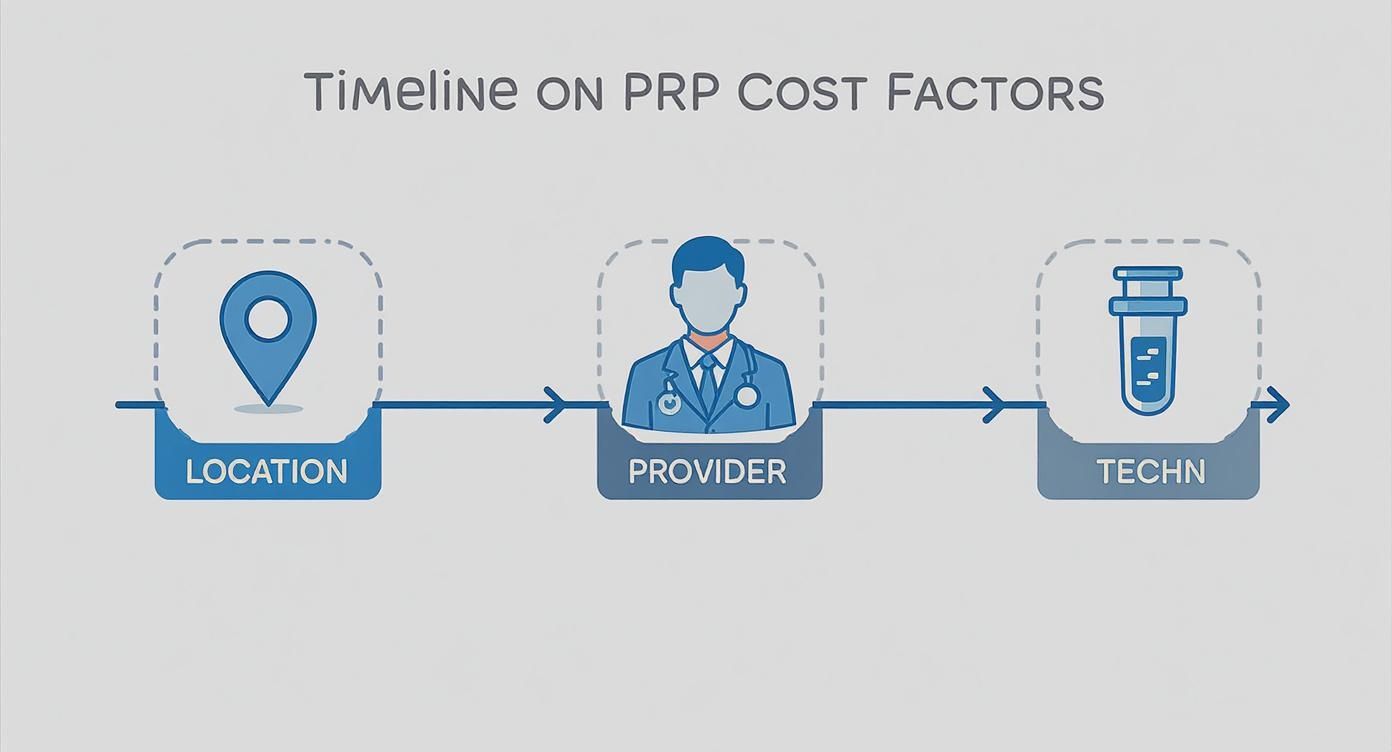
As you can see, all these elements play a role in determining what you'll ultimately pay for the entire course of treatment.
Looking at the Numbers
The prices you'll encounter can be all over the map. For example, you might find a clinic in Rochester Hills, Michigan, offering single sessions for $350 or a package of six for $1,800—a perfect illustration of how buying in bulk can lower the per-session cost. On the other hand, clinics in states like California often have higher prices simply because their overhead is more expensive.
When you zoom out and look at the bigger financial picture, it helps to see how PRP stacks up. One economic analysis found the average cost per session landed around $717.67. But, it also pointed out that PRP has a high cost-effectiveness ratio compared to other treatments, suggesting it can be a worthwhile long-term investment despite the upfront commitment.
Since this is almost always an out-of-pocket expense, it's smart to ask clinics about payment plans or financing options they might offer. For a deeper dive into your payment options, check out our guide that answers the common question: is PRP covered by insurance?.
Comparing PRP Costs to Other Hair Loss Solutions
When you’re looking at the PRP injections for hair loss cost, it's smart to see how it stacks up against other popular treatments. Is it a huge financial leap or a more manageable middle ground? Honestly, it depends on what you're comparing it to.
Every hair restoration journey has its own price tag. Some treatments demand a big upfront investment, while others are more of a slow-and-steady drip of smaller costs that add up over time. Let's put PRP in context with the other common options to give you a real-world sense of its value.
Surgical Hair Transplants
First, let’s talk about the heavy hitter: the surgical hair transplant. This is often seen as the gold standard for permanent results because it involves physically moving your own healthy hair follicles to areas where you’re thinning. It's incredibly effective, but it also comes with the highest price tag, by far.
The upfront cost is no small thing, typically falling somewhere between $6,000 to $15,000, and sometimes even higher. Think of it as a one-time, major investment for a solution that’s built to last. While the results are compelling, the steep cost and the fact that it's a surgical procedure mean it’s not the right fit for everyone. If you're weighing these two, our article on hair transplant vs PRP dives much deeper into the pros and cons.
Daily Medications
At the complete other end of the cost spectrum, you have daily medications like finasteride and minoxidil. For many people, these are the first line of defense against hair loss because they're easy to get and don't cost a lot each month.
Here’s a quick look at what you can expect to spend:
- Topical Minoxidil: This is an over-the-counter solution and the most budget-friendly option, usually costing between $20 to $60 per month. The trade-off is that you have to apply it every single day, forever, to keep any results you get.
- Oral Finasteride: As a prescription drug, finasteride costs a bit more, generally from $30 to $100 a month. Just like minoxidil, it only works as long as you keep taking it.
These options look cheap on the surface, but those monthly payments add up. Over a decade, you could easily spend thousands of dollars, turning what seemed like a small expense into a significant long-term financial commitment.
The key difference is the payment structure. Medications are a recurring subscription model for your hair, whereas PRP and transplants involve larger, less frequent investments.
So where does PRP fit in? It occupies a unique space as a mid-range, non-surgical treatment that bridges the gap between daily foams and major surgery. While a single PRP session runs between $500 to $2,500, it doesn't demand the daily lifelong chore of medications or the huge upfront financial hit of a transplant.
To give you a clearer picture, let's lay out the numbers side-by-side.
Hair Loss Treatment Cost Comparison
Here's a simplified overview of how these treatments compare in terms of cost and commitment over the first year.
| Treatment | Average Upfront Cost | Ongoing Monthly Cost | Total First-Year Estimate |
|---|---|---|---|
| Daily Minoxidil | $0 | $20 – $60 | $240 – $720 |
| Daily Finasteride | $0 | $30 – $100 | $360 – $1,200 |
| PRP Injections | $1,500 – $3,500 | $0 (after initial series) | $2,000 – $6,000 (incl. boosters) |
| Hair Transplant | $6,000 – $15,000+ | $0 | $6,000 – $15,000+ |
This balance of cost, minimal downtime, and an excellent safety profile is exactly why PRP has become so popular. It offers a powerful, effective option for people who want real results without committing to daily pills or going under the knife. You can explore a deeper analysis of how PRP costs compare to other hair loss solutions for more insights.
Making a Smart Investment in Your Hair
Getting a handle on the prp injections for hair loss cost is the first part of the puzzle. The next, and arguably more important part, is turning that knowledge into a smart, confident decision for your hair.
Investing in yourself isn't just about chasing the lowest price tag. It's about finding real value—the kind that comes from proven expertise, uncompromising safety, and a provider who gives you a realistic picture of the results you can expect.
I always tell people to shop around. Don't be shy about booking consultations at a few different clinics. This gives you a feel for their entire approach, not just their pricing sheet. If a deal seems too good to be true, it probably is. Super low prices can be a red flag for inexperienced technicians or older equipment, both of which can seriously impact your outcome.
Your Pre-Treatment Checklist
Before you commit your time and money, you need to go in armed with the right questions. This is your chance to vet the clinic and make sure they’re the real deal.
Here’s a quick checklist to guide your consultations:
- Ask About Their Equipment: Get specific and ask what kind of centrifuge system they use. Top-tier, FDA-cleared systems are designed to produce a higher concentration of platelets, which is exactly what you want for the best results.
- Verify Provider Credentials: Find out who, exactly, will be performing your injections. What are their qualifications? How much experience do they have specifically with PRP for hair restoration? Don't settle for vague answers.
- Request Before-and-After Photos: A reputable clinic will be proud to show you their work. Seeing a portfolio of real patient results is the best way to understand what's achievable and set your own expectations.
At the end of the day, knowledge is power. When you've done your homework, you can move forward feeling great about your choice. You're not just spending money; you're making a calculated investment in your confidence and your hair's future.
For a deeper dive into weighing the pros and cons, check out our guide on if PRP is worth it for your specific situation.
A Few More Questions About PRP Costs
Even with all the numbers laid out, a few common questions always seem to pop up when people get serious about investing in PRP. This is where we clear up any lingering doubts about insurance, payment plans, and how to spot a good deal. Getting these last few details sorted is key to moving forward with confidence.
Let's dive into the three things I hear most often in my consultations.
Will My Insurance Pay For PRP Hair Treatments?
I'll be direct with this one: almost certainly not. Insurance providers classify most hair loss treatments, including PRP, as cosmetic procedures rather than medically necessary ones.
Because of this, you should plan for this to be an out-of-pocket investment in yourself. The full cost, from the first meeting to your final follow-up, will be your responsibility.
Are There Financing Plans Available For PRP?
Yes, absolutely. Most reputable clinics know that the total cost can be a lot to handle at once, so they offer ways to spread it out. It's standard practice for dermatology offices and hair restoration centers to work with medical financing companies.
These plans function much like a personal loan, letting you bundle the entire treatment package into a series of predictable monthly payments. When you go in for a consultation, make sure to ask the patient coordinator about their financing partners. They can usually help you with the application on the spot.
A fair price isn't just the lowest number you can find. It's a price that reflects the provider's experience, the quality of their technology, and the level of care you receive throughout the entire process.
How Do I Know If I Am Getting A Fair Price?
This is a great question. A "fair price" is less about the sticker price and more about the overall value you're getting. The single best way to figure this out is to do your research and book consultations with at least two or three different clinics.
Doing this lets you compare more than just quotes—you get a feel for their entire approach. A good clinic will be totally transparent about their pricing structure, what kind of equipment they use, and the credentials of the person performing your injections. If a provider is vague about details or offers a price that seems too good to be true, trust your instincts. That can be a red flag for outdated technology or an inexperienced technician. Go with the clinic that makes you feel the most comfortable and informed.
At PRP For HairLoss, our goal is to give you all the information you need to make a smart, confident decision about your hair restoration journey. Explore our resources to learn more about how PRP can work for you at https://prpforhairloss.com.

 PRP For Hairloss
Leave a comment