It's so easy to miss the first whispers of hair loss. You might just brush it off as nothing—a few extra strands circling the shower drain or left on your pillow in the morning. Maybe your part seems a little wider these days, or your forehead looks a bit more prominent at the temples. These tiny changes are exactly where the story of hair loss often begins, and actually noticing them is the first, most powerful step you can take.
Identifying the Early Warnings of Hair Loss
Coming to terms with the first signs of thinning hair can be tough, but it's a reality for millions of us. The key is knowing what to look for so you can stop guessing and start understanding what's really going on. For most people, this isn't some sudden, dramatic event; it's a slow, almost invisible shift that happens over months or even years.
This gradual process is typically rooted in a combination of your genes and hormones. In cases like male pattern baldness (also known as androgenetic alopecia), thinning can kick off as early as your late teens or early twenties. The infographic below highlights the three classic indicators that something is changing up top.
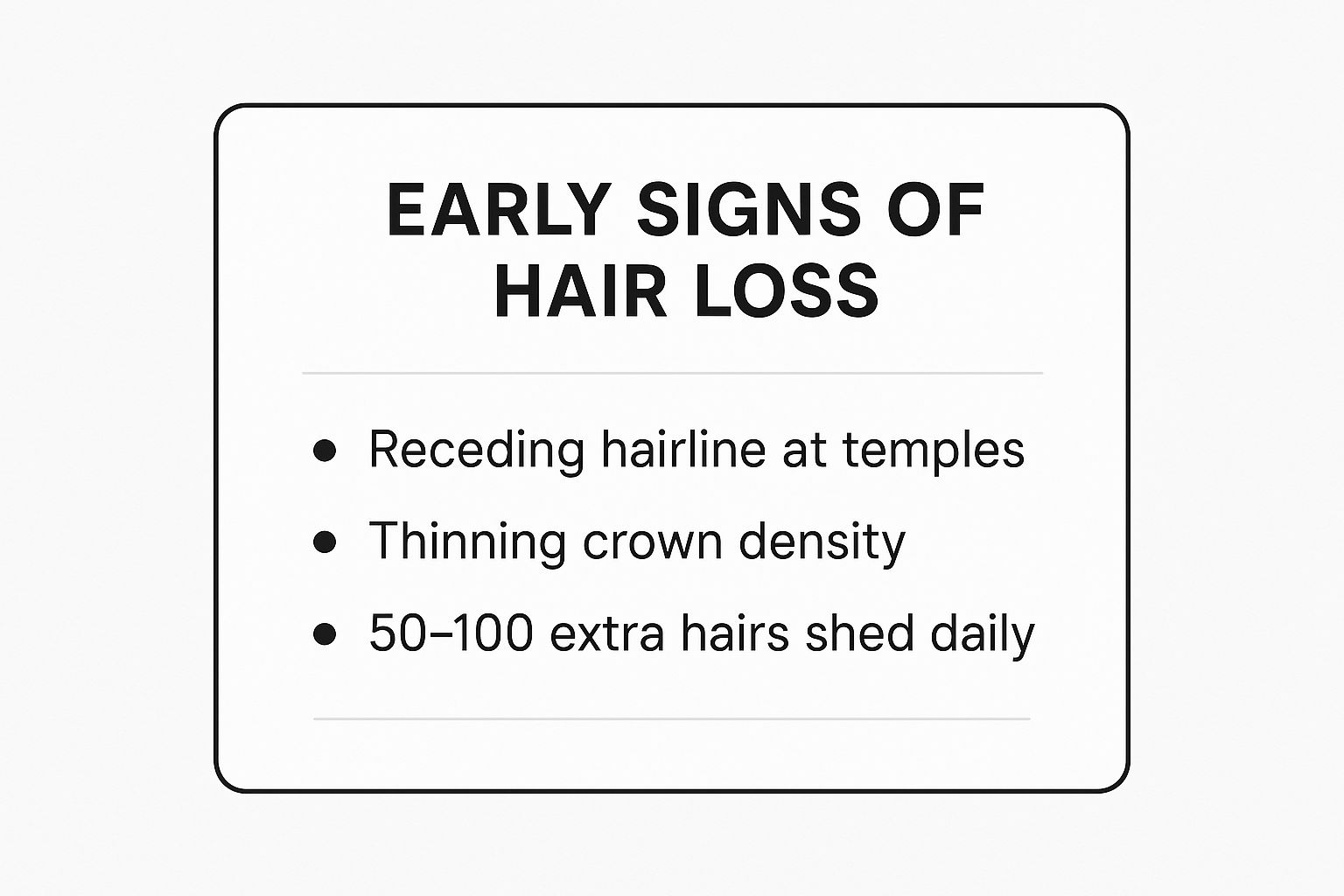
As you can see, the big three are a receding hairline, thinning at the crown (the classic "bald spot"), and a noticeable increase in the amount of hair you shed every day. Keeping an eye on these specific areas will give you a reliable way to track your hair's health over time.
The Most Common Initial Indicators
While everyone's hair loss journey is unique, a few patterns show up time and time again. The most classic sign is temporal recession—that's when the hairline starts creeping back at the temples, often carving out an "M" shape. This is incredibly common, affecting 96% of mature Caucasian males, even many who never go on to experience significant balding. That just goes to show how widespread these initial changes really are.
Of course, it's not always about the hairline. Other subtle clues can tell you something is up:
- Your Hair Feels Different: You might run your fingers through your hair and notice it feels finer or less dense than it used to.
- Slower Growth: It may feel like it takes forever for your hair to grow back after a haircut.
- Less Volume: Your go-to hairstyle might suddenly look flat or lack the body it once had.
To make spotting these signs a little easier, here’s a quick summary of what to look for.
Key Early Warning Signs of Hair Loss at a Glance
| Sign | Common Location | What It Looks Like |
|---|---|---|
| Receding Hairline | Temples and front of scalp | The hairline moves backward, often creating an "M" or "V" shape. |
| Crown Thinning | Top, back of the head (vertex) | Hair becomes less dense, revealing more of the scalp in a circular pattern. |
| Increased Shedding | All over | Noticeably more hair on your pillow, in the shower drain, or on your brush. |
| Wider Part | Along your natural part line | The line of scalp visible through your part becomes more prominent. |
Seeing any of these signs can be concerning, but remember that early awareness gives you power. The sooner you spot the changes, the more proactive you can be.
For a more comprehensive look, you can learn more about how to tell if you're going bald in our in-depth guide.
A Closer Look at Your Changing Hairline and Scalp
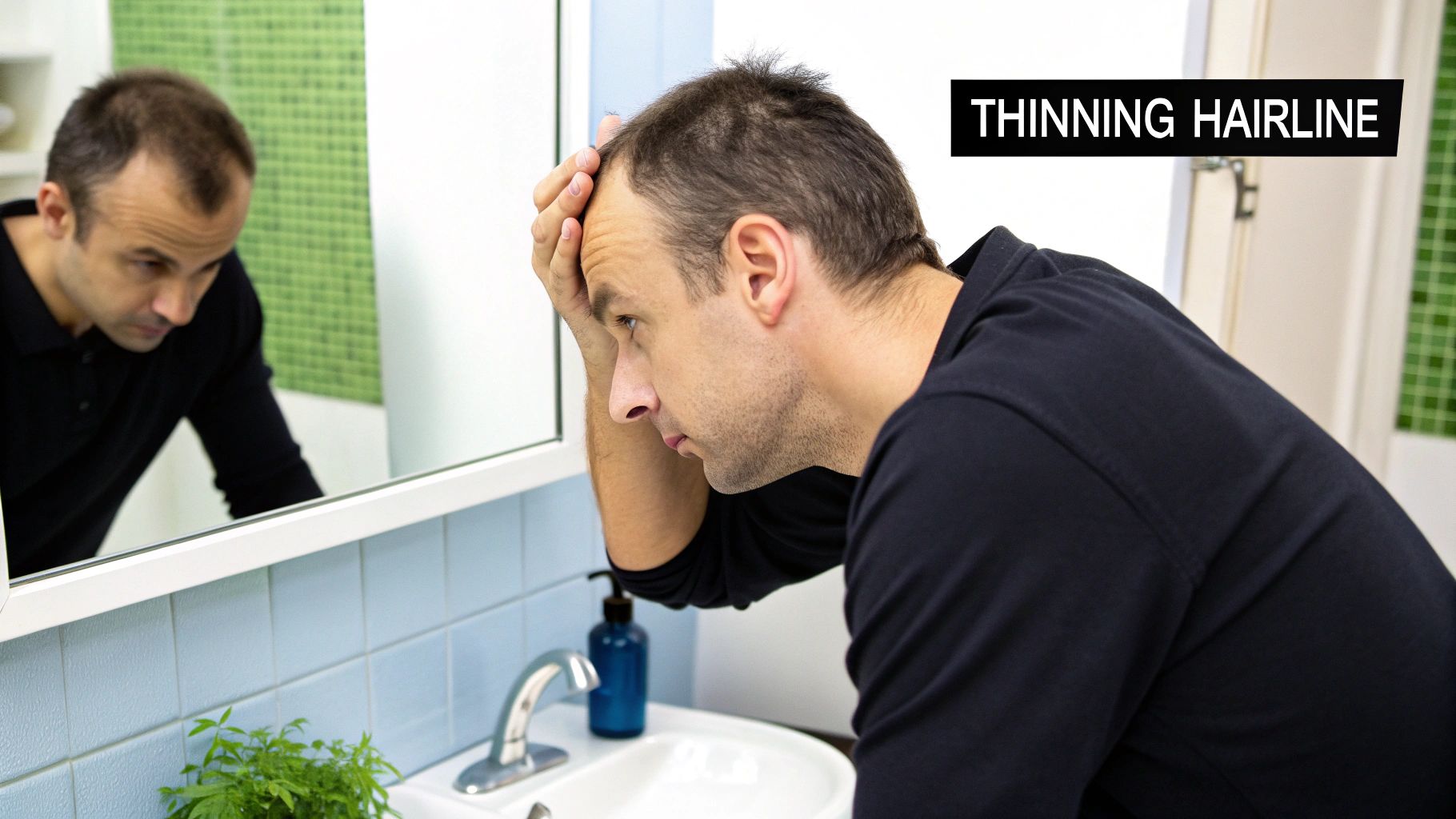
It’s one thing to read about the signs of hair loss, but it's a whole different ball game trying to spot them on your own head. The process can be so subtle, unfolding so gradually that you might start to question what you're even seeing in the mirror. For most guys, the first place to look is the hairline—it's often the earliest and most reliable indicator that things are changing.
Think of your hairline like a shoreline slowly being reshaped by the tide. You'll often see the first changes at the corners, right above your temples. This gradual retreat can start to form a more defined "M" shape, which is the hallmark of male pattern baldness. You might only catch it at first under bright bathroom lights or when your hair is wet and slicked back from your forehead.
Beyond the Hairline Itself
While the front gets all the attention, it’s definitely not the only spot to keep an eye on. Thinning at the crown—that spot at the very top and back of your head—is just as common. This one is trickier to monitor yourself, so it’s often discovered in a photograph or mentioned by a friend or barber.
It typically begins as a small, seemingly insignificant patch where your hair just isn't as dense as it used to be. Over time, that spot can slowly widen, making your scalp more visible. For a deeper dive into what to look for, this guide on the signs your hairline is receding offers some great visual cues.
The real trick is learning to tell the difference between everyday shedding and a consistent, ongoing pattern of loss. A few hairs in the shower drain is nothing to worry about. But if you're seeing clumps or a noticeable uptick over several weeks, it’s time to take a closer look.
Distinguishing Normal Shedding from Hair Fall
Losing hair every day is completely normal. In fact, shedding anywhere from 50 to 100 strands a day is just part of your hair’s natural growth and renewal cycle. But genuine hair fall feels different. You’ll notice your hairbrush is collecting way more hair than usual, or you’ll see a surprising amount on your pillow in the morning.
The goal is to observe these changes without panicking. Focus on a few key indicators:
- Overall Density: When you run your hands through your hair, does it feel less full or substantially lighter than it used to?
- Visual Cues: Can you see more of your scalp peeking through your hair now compared to six months ago?
- Styling Changes: Are your go-to hairstyles suddenly falling flat or not providing the same coverage they once did?
Developing this kind of awareness helps you get a clear, honest picture of what’s going on. And if you're looking for ways to support a healthy scalp, holistic practices like an Indian head massage can be a fantastic way to improve circulation and promote stronger hair from the root.
Understanding the Root Causes of Hair Thinning
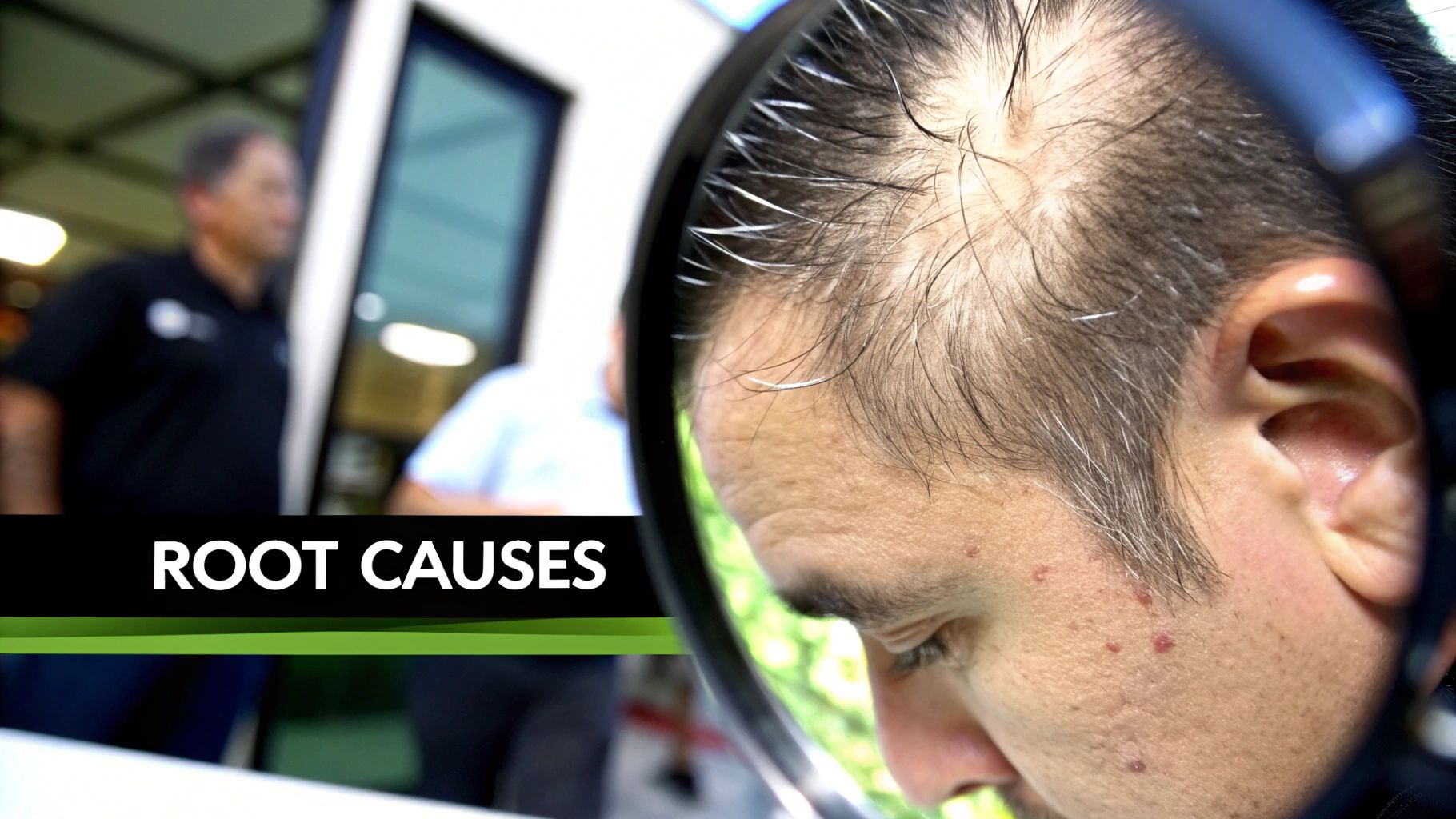
Once you start noticing the early signs of hair loss, the next big question is always, "Why me?" For the vast majority of men, the answer comes down to a one-two punch of genetics and hormones. This common condition is officially known as androgenetic alopecia, but most of us just call it male pattern baldness.
Imagine each hair follicle on your scalp is a tiny factory designed to produce a single strand of hair. When everything is running smoothly, these factories churn out healthy, thick hairs for years. But for those with a certain genetic makeup, a hormone called dihydrotestosterone (DHT) starts to sabotage the production line.
The Role of DHT in Hair Loss
DHT is a natural byproduct of testosterone, so it's a normal part of being a man. The trouble starts when your hair follicles inherit a sensitivity to it. Over the years, DHT latches onto receptors in these sensitive follicles, causing them to shrink. This process is called miniaturization.
As the follicle gets smaller, it can no longer produce the robust hair it once did. With each growth cycle, the hair that emerges is a little thinner, shorter, and weaker than the last. Eventually, the follicle shrinks so much that it either produces a tiny, invisible hair or just gives up and stops producing hair altogether. This is what's happening behind the scenes when you see a receding hairline or a thinning crown. For a deeper dive, our guide explains what DHT is and its connection to hair loss in more detail.
DHT doesn't kill the hair follicle overnight. Instead, it slowly chokes the life out of it over years, which is why hair loss often feels so gradual and hard to notice at first.
Other Contributing Factors to Consider
While genetics and DHT are the main culprits for most men, they aren't the only things that can cause your hair to thin. Sometimes, other factors can kickstart shedding or speed up the process.
It's smart to keep these other possibilities in mind, as they can sometimes look a lot like the first signs of male pattern baldness:
- Significant Stress: A major life event, illness, or even chronic anxiety can shock your hair follicles into a resting phase, causing a sudden increase in shedding a few months later.
- Nutritional Gaps: Your hair needs fuel to grow. A diet lacking key nutrients like iron, zinc, and certain vitamins can absolutely impact the health and strength of your hair.
- Underlying Health Issues: Sometimes, hair loss can be a red flag for another health problem, like a thyroid condition, which can throw your body's hormones out of whack.
Getting a handle on these root causes is the first step toward understanding what’s really going on with your hair.
How Hair Loss Looks Different for Everyone
Let's get one thing straight: there's no single "right" way for hair loss to start. What you see in the mirror is a unique story written by your genetics, hormones, age, and even your ethnic background.
So, if your experience doesn't match what you've seen elsewhere, that's completely normal. Understanding these differences is the first step to figuring out what's happening and what you can do about it.
For a lot of guys, the first hint is often a receding hairline. You might notice your temples creeping back, slowly forming a classic "M" shape. For others, the thinning starts at the crown—that spot on the back of your head.
Women's hair loss tends to be much more subtle. It usually shows up as a general, diffuse thinning all over the scalp. The most common first sign is often a widening part line, rather than a disappearing hairline.
Male vs. Female Patterns
The way male pattern baldness progresses is so common, it actually has its own roadmap. We break down the different stages and what they look like in our guide to the Norwood Scale for hair loss. This scale is a great tool for understanding where you are in the process and what might come next.
Female pattern hair loss, on the other hand, is measured differently (using the Ludwig Scale). It almost never leads to complete baldness. Instead, the frontal hairline usually stays put while the hair thins out behind it, making the scalp more visible through the hair.
Here's an interesting bit of insight: the age you first notice thinning can sometimes hint at how quickly it might progress. If it starts early, say in your late teens or early 20s, it can sometimes signal a faster journey down the road.
Global and Ethnic Differences
Believe it or not, where you're from can play a role, too. Genetically and environmentally, the first signs of baldness tend to show up earlier and more often in Western countries.
For instance, the Czech Republic has the highest rate, with nearly 43% of its male population experiencing some form of hair loss. Here in the United States, that number is close behind at around 42.7% of men. By the time American men hit 50, roughly half will have noticeable thinning.
It's fascinating to see how these numbers stack up. If you're curious, you can check out a full breakdown of baldness by country. It just goes to show that while your experience feels incredibly personal, it’s part of a very common, very human story.
What to Do When You Spot These First Signs
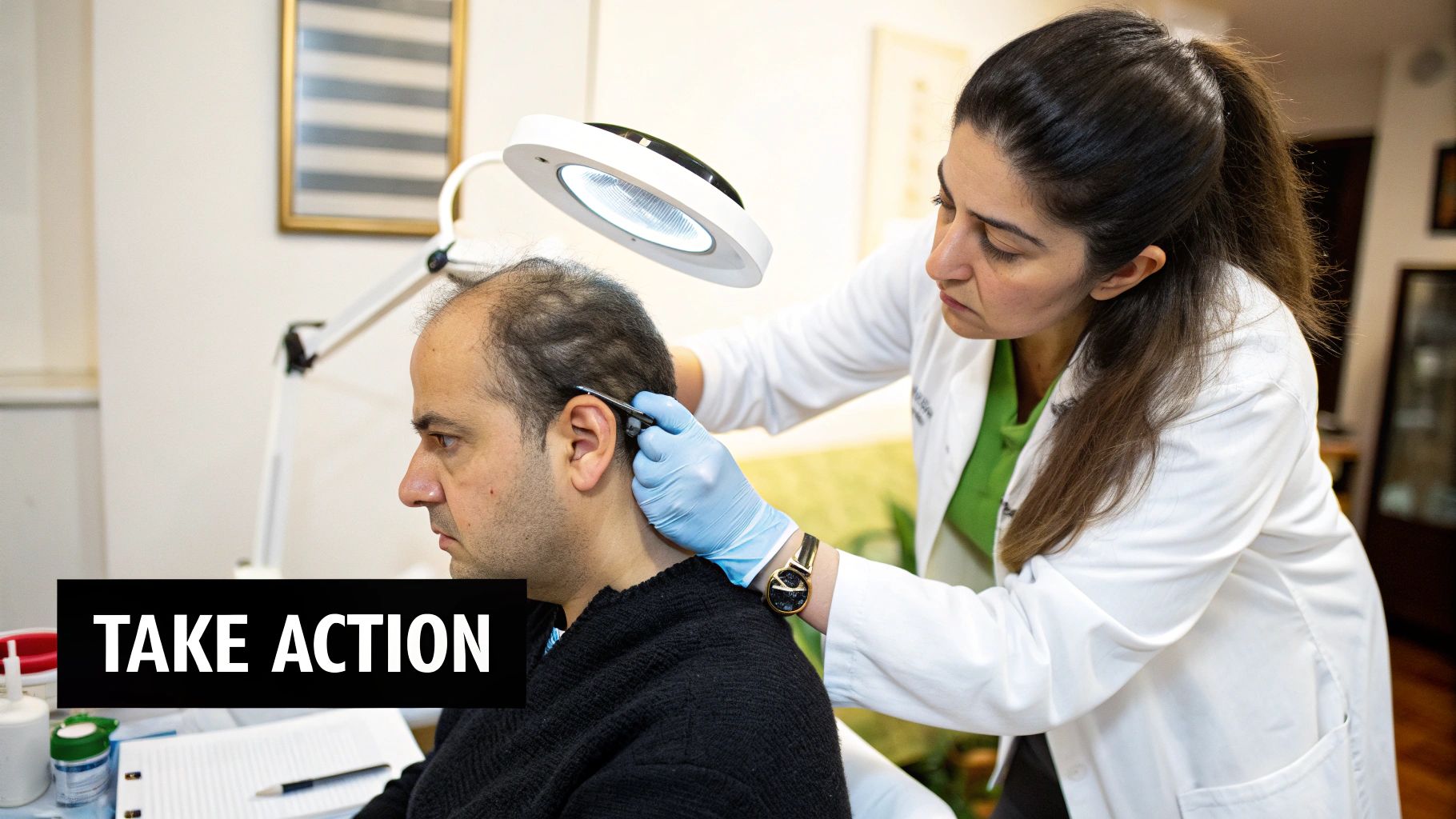
Seeing those first hints of thinning hair or a receding hairline can be jarring, but it's not a reason to panic. Think of it as an early warning—a signal to get proactive and take control of the situation. The best thing you can do right now is become a careful observer of your own hair.
A really simple but effective first step is to start documenting. Take clear photos of your hairline and the top of your head every few months. Make sure you use the same lighting and angle each time so you have a consistent record. This transforms your vague worries into something you can actually track over time.
While keeping an eye on things yourself is a great start, the most important step is to see a professional. A dermatologist or a doctor specializing in hair loss can give you a real diagnosis and figure out if it's male pattern baldness or something else entirely.
Your First Medical Consultation
When you go in for a consultation, the process is pretty straightforward. The doctor will probably ask about your family's hair history, your lifestyle habits, and when you first started noticing changes. They'll then examine your scalp, sometimes using a magnifying scope to get a close-up look at your hair follicles.
It's completely normal to feel the emotional weight of seeing the first signs of baldness hair loss, especially if you're younger. What’s interesting is that 74.34% of people say their hair loss actually began over five years ago, which tells us that the early stages are often subtle and progress slowly. Considering that 85% of men will deal with noticeable hair loss at some point, acting early makes all the difference.
Proven Treatment Pathways
Once you have a diagnosis, you and your doctor can talk about treatment options. The two most common and well-researched medications are minoxidil and finasteride. They essentially work as a support system for your struggling hair follicles.
-
Minoxidil (Rogaine): This is a topical solution you apply directly to your scalp. It helps by boosting blood flow to the follicles, which can wake them up and extend their growth phase.
-
Finasteride (Propecia): This is a prescription pill that targets the problem at its hormonal source. It works by reducing the levels of DHT, the hormone that causes follicles to shrink in male pattern baldness.
Both of these are designed to slow down or even stop hair loss, and for many guys, they can trigger some regrowth. Just remember that results don't happen overnight; consistency is everything.
Of course, there are many other non-surgical hair loss treatments worth looking into. Combining medical treatments with smart lifestyle choices and strategies to promote healthy hair growth can give you the best possible shot at keeping your hair.
Answering Your Top Questions About Early Hair Loss
When you first start noticing changes in your hair, a million questions can race through your mind. It’s only natural to feel concerned. Let’s cut through the noise and tackle some of the most common worries with clear, expert-backed answers.
How Much Hair Shedding Is Normal?
Seeing hair in the shower drain or on your brush is a daily reality, but it isn't always a red flag. Your hair goes through a natural cycle of growth, rest, and shedding. In fact, it's completely normal to lose between 50 to 100 hairs a day.
The real signal to watch for isn't the shedding itself, but a sudden, sustained increase in shedding. If you find yourself cleaning out your drain more often or waking up to a pillow covered in hair for weeks at a time, that’s your cue to pay closer attention.
Can Stress Really Make You Go Bald?
The short answer is yes, stress can cause hair loss—but it's not the same as permanent genetic balding.
Intense stress, whether from a major life event, illness, or chronic anxiety, can throw your hair's growth cycle out of whack.
This can trigger a temporary condition known as telogen effluvium, where a large number of hairs are prematurely pushed into the resting (telogen) phase. A few months later, you'll notice significant shedding all at once. The good news? This type of hair loss is almost always reversible once the source of stress is managed.
It's important to remember this is different from male or female pattern baldness, which is a permanent process driven by genetics and hormones like DHT. While stress won’t cause genetic baldness, it can sometimes speed things up if you're already predisposed.
Will A Healthier Lifestyle Stop Hair Loss?
Eating a nutritious diet, managing stress, and being gentle with your hair are all cornerstones of your overall health. These habits create the perfect environment for your hair follicles to thrive and can absolutely improve the quality of the hair you have.
However, we need to be realistic. A healthy lifestyle is a fantastic supportive measure, but it usually can't stop genetically driven hair loss on its own. Think of it as part of a complete strategy—essential for maximizing your hair’s potential, but best paired with treatments proven to address the root cause.
At PRP For HairLoss, we know that getting straight answers is the first step toward taking control. To learn more about your options, explore our resources.
 PRP For Hairloss
Leave a comment