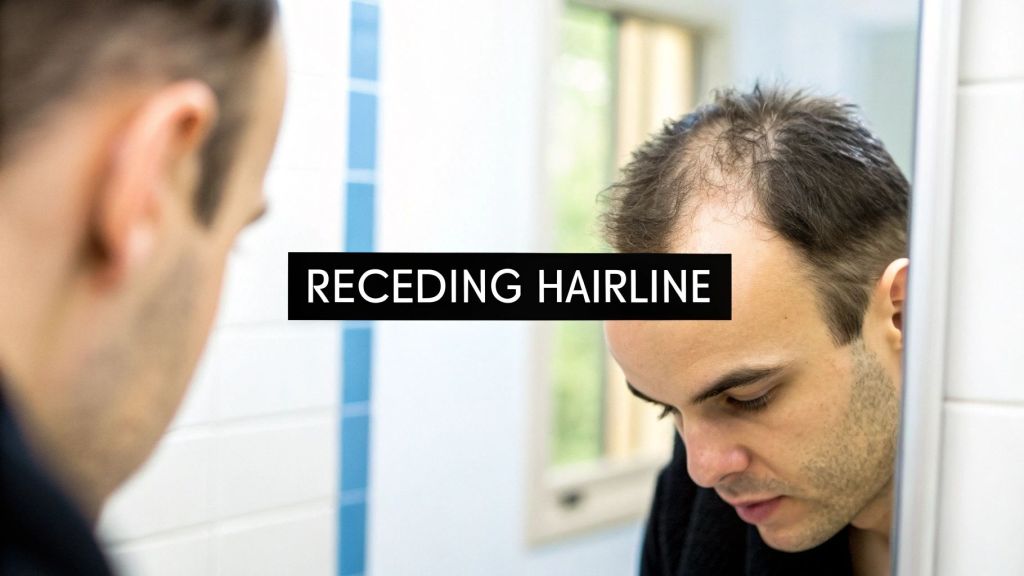
Catching a glimpse of your reflection and thinking something looks… different? It's a common, quiet worry for a lot of people. The thought, "is my hairline receding?" can be unnerving, but knowing what to look for is your best defense. Hair loss isn't something that happens overnight; it’s a gradual process with early warning signs you can learn to spot.
This isn’t about jumping to conclusions or panicking over a few extra hairs in the sink. Think of this as a practical, no-nonsense guide to understanding the subtle (and not-so-subtle) changes that actually matter. We'll walk through six specific signs your hairline is receding, helping you tell the difference between a normal, maturing hairline and the early stages of real hair loss. By learning to spot these clues early, you’re not just identifying a potential problem—you're taking the first, most important step toward addressing it with effective, modern solutions before it becomes more obvious. Let's get started.
1. M-Shaped Hairline Formation
One of the most classic and recognizable signs that your hairline is receding is the slow formation of an "M" or "V" shape. This pattern, often the very first stage of male pattern baldness, happens when the hair at your temples starts to thin and pull back faster than the hair in the middle. This leaves the central part of your hairline lower, creating that distinct widow's peak.
This isn't a sudden shift; it's a slow burn. The recession on both temples is usually symmetrical, creating the two upper points of the "M." This development is a hallmark of the early stages of androgenetic alopecia, often classified as Stage 2 or 3 on the Norwood Scale—a tool dermatologists use to measure hair loss. You've probably seen it on celebrities like Jude Law and Matthew McConaughey over the years, which has made it a well-known indicator.
How to Identify an M-Shaped Recession
The best way to confirm this change is by comparing photos. Dig up some pictures of yourself from a year or two ago and hold them next to a current one taken in good lighting. Look specifically at the corners of your forehead. Can you see that the temple points have crept higher, making the peak in the middle more pronounced? A simple, consistent check like this can help you track these changes.
For a more objective take, stand in front of a mirror and raise your eyebrows. The highest wrinkle on your forehead is a good reference point. Measure the distance from that wrinkle to the center of your hairline and then to your temples. If the temple measurements are getting noticeably larger over time, it's a strong sign of recession.
This summary box highlights the key indicators of an M-shaped hairline.
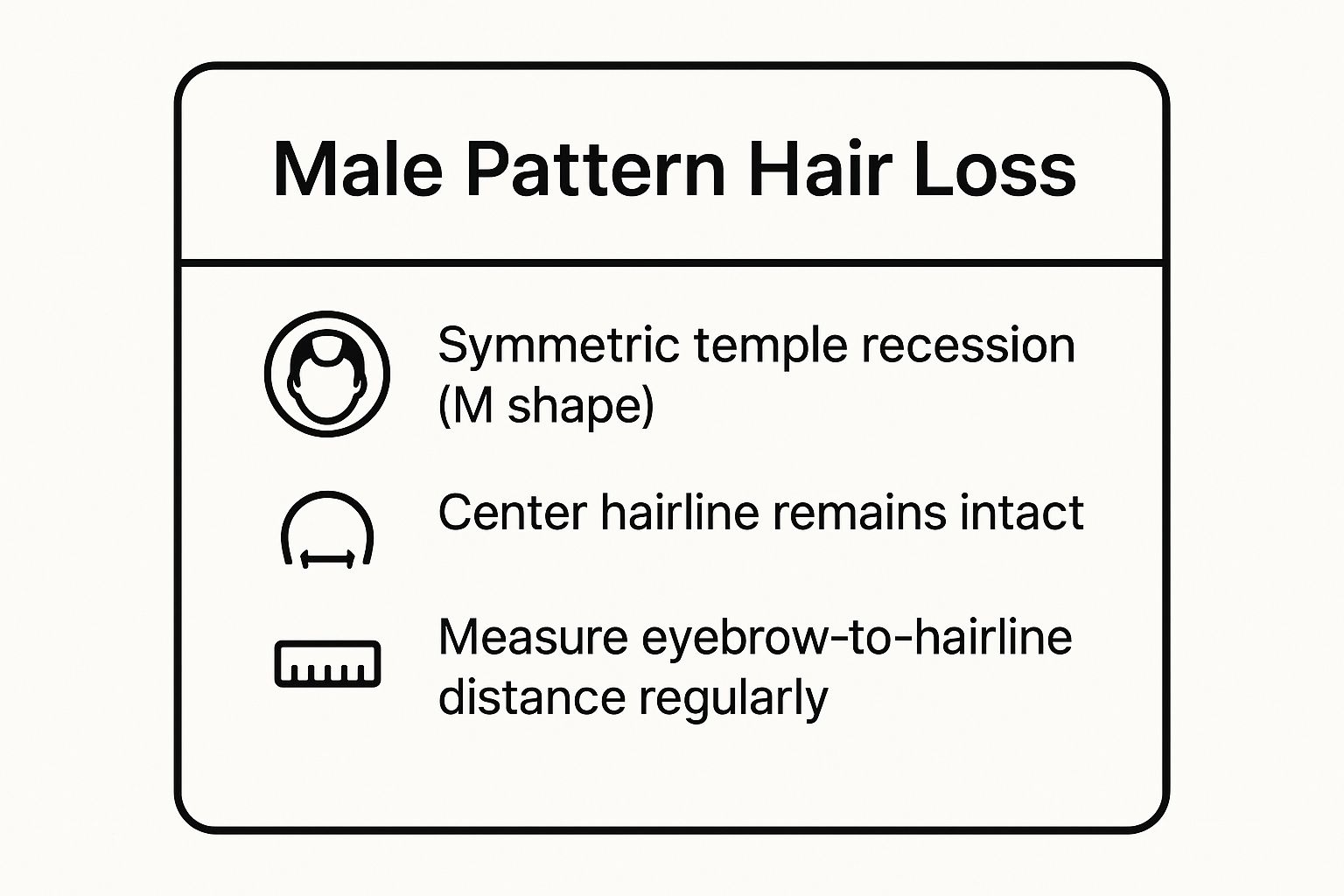
As the visual shows, focusing on symmetrical temple loss and regular measurement gives you a clear, actionable way to monitor your hairline. If you notice these changes, understanding how it typically progresses is the next step. You can learn more about how male pattern baldness progresses to see what might be next. And of course, talking to a dermatologist for a professional opinion is always a smart move if you're concerned.
2. Increased Hair Shedding in Shower and on Pillow
Finding a few strands of hair on your pillowcase or seeing a small clump in the shower drain is totally normal. But if you're noticing a sudden and consistent increase in shedding, it can be an early warning sign of a receding hairline. The average person loses between 50 and 100 hairs a day as part of the natural hair growth cycle. When you start finding way more than your personal "normal," it signals a potential shift.

This excessive shedding, sometimes called telogen effluvium, can be triggered by a number of things, but when it happens along with a receding hairline, it often points to androgenetic alopecia. Clinical studies have shown that a noticeable increase in hair fall can show up several months before you see visible thinning or recession. This happens because hair follicles that are sensitive to DHT (dihydrotestosterone) start to shrink, producing shorter, weaker hairs that fall out more easily.
How to Identify Increased Shedding
Tracking shedding means you first have to know your baseline and then watch for changes. Vague feelings of "losing more hair" are common, so creating a system to measure it can give you some solid evidence. This is one of the most proactive signs your hairline is receding because you can catch it before the shape of your hairline really starts to change.
A practical method is to do a gentle "pull test" on a small section of dry, clean hair. If you consistently pull out more than two or three strands with each gentle tug, your shedding rate might be above average. For more consistent tracking, count the hairs on your pillow each morning for a week to get an average. Snapping a quick photo of the shower drain after each wash can also create a visual log you can compare over time, helping you confirm if what you're seeing is a real increase.
If you're seeing a rapid and significant jump in shedding, it's important to understand what might be causing it. You can learn more about the various causes of sudden hair loss to get a better handle on the situation. A chat with a trichologist or dermatologist can give you a professional diagnosis and help you figure out the best course of action.
3. Widening Part Line
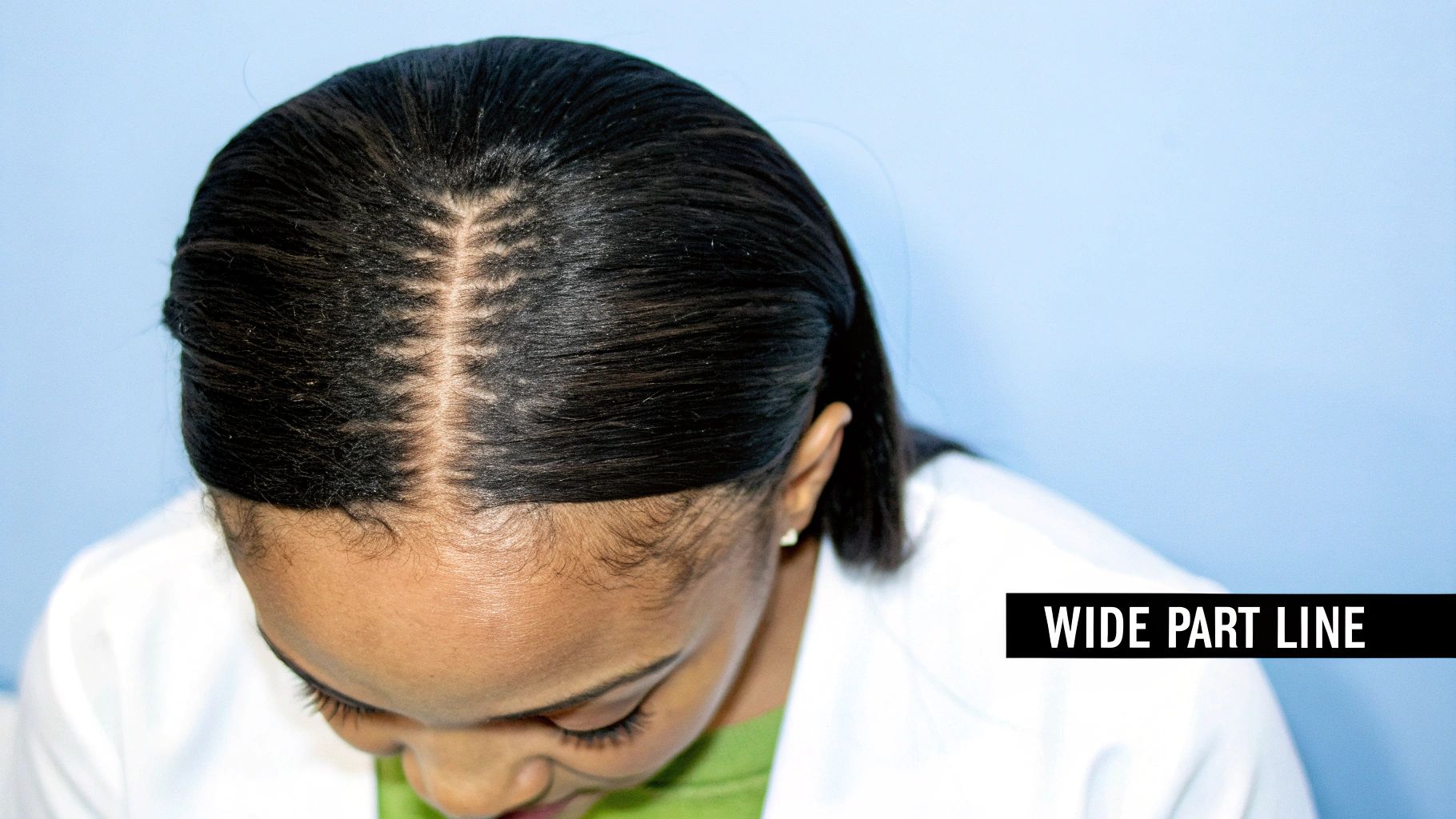
While a receding hairline often makes us think of the temples, another crucial indicator is a widening part line. This sign is especially common in female pattern hair loss but also affects many men, signaling a drop in hair density across the top of the scalp. As individual hair strands become finer and fall out without being replaced, the scalp becomes more visible, making your part look wider than it used to.
This change is gradual and often goes unnoticed until it becomes pretty obvious. Unlike the dramatic M-shape, a widening part is a more diffuse kind of thinning that can be one of the subtler signs your hairline is receding. This phenomenon is a key diagnostic feature in tools like the Ludwig Scale, which is used by trichologists to classify female pattern hair loss. The change can be tiny, sometimes just a millimeter or two, but it’s a clear sign of underlying hair thinning.
How to Identify a Widening Part
Keeping a consistent eye on it is the best way to catch this sign early. The key is to create a baseline so you have something to compare against over time, which makes tracking a lot more reliable.
To do this, take a clear, well-lit photo of your part line from directly above once a month. Use the same lighting and angle each time to make sure it's an accurate comparison. After a few months, compare the photos. Is that strip of visible scalp getting wider? You could even use a ruler in the photo for a more objective measurement. If you're not sure, ask a trusted friend or family member if they've noticed a difference in your hair's thickness.
This summary box highlights the key indicators of a widening part line.
Key Indicators:
- More scalp is visible along your normal hair part.
- Your hair seems "flatter" or has less volume at the roots.
- Before-and-after photos show a clear increase in the width of your part.
- Your ponytail feels thinner if you have long hair.
As the key indicators suggest, paying attention to both what you see and how your hair feels can provide strong evidence of thinning. If you think your part is widening, you can discover more about the different ways to evaluate hair thinning to get a clearer picture. Talking with a dermatologist can help confirm what you're seeing and offer professional guidance.
4. Thinning Crown or Vertex Area
While most people focus on the front, another one of the common signs your hairline is receding actually starts at the back of your head. Hair thinning at the crown, also called the vertex, is a classic giveaway of androgenetic alopecia (male pattern baldness). It often starts as a small, circular patch of thinning hair that slowly gets bigger, making the scalp more visible from above.
This happens because the hair follicles in this specific spot are often highly sensitive to dihydrotestosterone (DHT), the hormone that gets the blame for hair loss. The progression is well-documented on the Norwood Scale, where crown thinning becomes a major feature from Stage III Vertex and beyond. It's a subtle change at first, and you might not even notice it until it becomes more significant—which is why catching it early is so important.
How to Identify Thinning at the Crown
Keeping an eye on the top of your head is harder than watching your hairline, but it's just as important. The trick is to be consistent and use tools to get a clear view.
To check for a thinning vertex, use a two-mirror system: hold a handheld mirror while standing with your back to a larger, fixed mirror. This will give you a clear, well-lit view of your crown. Another great way is to take monthly photos from an overhead angle, which gives you a reliable visual record to track any changes over time. Don't be surprised if your barber or hairstylist is the first one to mention it; they have a direct line of sight every time you get a haircut and can be a fantastic early warning system.
This summary box highlights the key indicators of a thinning crown.
As the video demonstrates, knowing how to monitor this hard-to-see area is key. If you notice more scalp showing, especially under bright lights, it's a strong signal of progressive thinning. For those who are worried, it's helpful to learn more about the specifics of crown thinning and what treatment options are out there. A consultation with a hair loss specialist can give you a definite diagnosis and a personalized plan.
5. Changes in Hair Texture and Thickness
Beyond just the shape of your hairline, the actual quality of your hair can be a huge clue. One of the more subtle signs your hairline is receding involves a change in the texture and thickness of individual hair strands. This process, known as miniaturization, happens when hair follicles that are sensitive to the hormone DHT gradually shrink. With each growth cycle, they produce finer, weaker, and shorter hairs.
This change isn't sudden. It's a slow, almost unnoticeable process that happens over months and years. A healthy terminal hair might have a diameter of around 80 micrometers (μm), but as miniaturization takes hold, that same follicle might start producing hair with a diameter closer to 40 μm. This shift not only makes the hair look thinner but also feel softer and less substantial, which often makes it harder to style the way you want. This gradual weakening of the hair shaft is a core part of how androgenetic alopecia works.
How to Identify Changes in Hair Texture
Tracking your hair texture requires paying close attention to your hair over time. Unlike a photograph that captures a single moment, identifying miniaturization is about noticing a developing pattern of change.
A handy method is to compare hairs from different parts of your scalp. Gently take a hair from the top or front of your scalp and compare it to one from the back or sides, which are typically more resistant to DHT. Hold them up to the light. Do you see a clear difference in thickness or coarseness? Another useful tip is to save a few shed hairs in a small bag every month. Over several months, you can compare the old hairs to the new ones to see if there's a trend toward finer strands.
Your hairstylist or barber is also an excellent resource. Since they handle your hair regularly, they're often the first to notice subtle shifts in density and texture that you might miss. Asking them if they've seen any changes during your appointments can provide valuable, objective feedback. If you are noticing these changes, it's a good time to explore your options. You can learn more about how to improve hair thickness and health to counteract these early signs.
6. Longer Time for Hair to Grow Back
It's not just about losing hair; a key sign your hairline is receding can be a noticeable slowdown in how quickly it grows back. This change in growth rate often points to weakening hair follicles, which is a precursor to more significant thinning. Normal, healthy hair typically grows about half an inch per month, so a major drop from that rate, especially around the temples and frontal scalp, is a red flag.
This happens because the anagen, or active growth phase, of the hair cycle gets shorter in follicles affected by androgenetic alopecia. Instead of growing for several years, hairs in receding areas might only grow for a few months before they fall out. This results in hair that doesn't reach its previous length and takes much longer to show any new growth after a haircut. A lot of people first notice this when their usual six-week haircut looks freshly cut for way longer than it used to.
How to Track Your Hair Growth Rate
Monitoring your hair's growth speed requires a bit of patience and consistency. The key is to establish a baseline and track changes over several months to confirm you're seeing a trend, not just a one-off fluctuation.
A straightforward way to do this is to start documenting right after a haircut. Take a clear, well-lit photo of your hairline and temples. Then, mark your calendar and take another photo from the same angle and distance one month later. Compare the photos to see how much regrowth there is. If areas at the hairline are growing visibly slower than the hair on the back or sides of your head, it’s a strong indicator that those follicles are weakening. You can also bring this up with your barber or hairstylist; they see your hair regularly and are often the first to notice changes in texture and growth speed.
6 Key Signs of a Receding Hairline Comparison
| Indicator | Implementation Complexity 🔄 | Resource Requirements ⚡ | Expected Outcomes 📊 | Ideal Use Cases 💡 | Key Advantages ⭐ |
|---|---|---|---|---|---|
| M-Shaped Hairline Formation | Low – Visual inspection and comparison | Minimal – Photos and measurements | Early detection of male pattern baldness; recognizable pattern | Early diagnosis and intervention in androgenetic alopecia | Easy identification; multiple treatments options |
| Increased Hair Shedding in Shower and on Pillow | Low – Simple daily monitoring and counting | Minimal – Home observation | Identifies excessive shedding before visible thinning | Early-stage hair loss monitoring; useful for tracking progression | Easy at-home monitoring; timely intervention |
| Widening Part Line | Low – Regular photography and measurement | Minimal – Camera or smartphone | Detects thinning density, especially in female pattern hair loss | Monitoring female or male thinning; reversible with treatment | Reversible with treatment; easy photographic tracking |
| Thinning Crown or Vertex Area | Moderate – Requires mirrors/photos | Moderate – Mirrors, photos, possible clinical evaluation | Visible thinning in crown area; classic male pattern baldness sign | Monitoring male pattern baldness progression at crown | Responsive to treatments; effective transplant area |
| Changes in Hair Texture and Thickness | Moderate – Requires close observation and comparison | Minimal to moderate – may involve expert evaluation | Early sign of miniaturization; gradual reduction in hair quality | Early intervention to strengthen hair; quality improvement | Can be reversed early; nutritional and treatment options |
| Longer Time for Hair to Grow Back | Moderate – Measuring growth over time | Minimal to moderate – photos, measurement tools | Slower hair growth signaling follicle weakening | Detecting slowed regrowth; assessing treatment effectiveness | Early detection; measurable treatment response |
From Noticing to Acting: Your Next Steps for a Fuller Hairline
Recognizing the subtle shifts in your hairline, from an emerging M-shape to more hair on your pillow, is a huge first step. You've moved beyond passively worrying and into actively observing, which is where real change begins. The goal of identifying these signs your hairline is receding isn't to self-diagnose in a vacuum but to arm yourself with the knowledge you need for a productive conversation with a professional.
The most important takeaway from this guide is the power of acting early. Hair loss is often a progressive condition, and stepping in sooner rather than later can make a big difference in your results. Whether you’ve noticed a widening part, thinning at the crown, or a change in your hair's texture, these are signals to explore your options, not to accept defeat. Taking a proactive stance puts you back in control of the situation.
Your Actionable Path Forward
So, what are your immediate next steps? The journey from observation to solution involves a few key actions:
- Document Your Changes: Take clear, well-lit photos of your hairline and crown every month from the same angles. This visual record is invaluable when you're talking about your concerns with a specialist.
- Consult a Professional: Schedule an appointment with a dermatologist or a hair loss specialist. They can give you an accurate diagnosis, rule out any underlying health issues, and create a treatment plan tailored to your specific type of hair loss.
- Explore Modern Treatments: Ask about advanced, non-surgical options like Platelet-Rich Plasma (PRP) therapy. This treatment uses growth factors from your own blood to stimulate dormant hair follicles, which can potentially improve hair density and slow down the thinning process.
Understanding the root causes is also a big part of the journey. While male pattern baldness is a primary driver, different factors can contribute. For a broader perspective, it can be helpful to look into related topics, such as understanding what causes hair loss in women, which highlights just how complex hair health can be. By taking these proactive steps now, you can make a meaningful difference in the health and future of your hair, turning concern into confident action.
If you’re ready to move from noticing the signs to actively addressing them, explore how PRP therapy can help. Discover a personalized and effective approach to hair restoration with PRP For HairLoss. Learn more about this innovative treatment by visiting PRP For HairLoss today.


Leave a Reply