If you've ever glanced in the mirror and noticed your hair isn't quite as thick as it used to be, you're certainly not alone. What you're likely seeing is androgenic alopecia, the official name for the most common type of hair loss on the planet: male or female pattern baldness. It's a reality for an estimated 1.0 to 1.5 billion people worldwide.
What Is Androgenic Alopecia

So, let's break down what's actually happening here. Androgenic alopecia isn't some sudden illness where your hair falls out in clumps. It’s a much slower, more predictable process. Think of it like a dimmer switch being gradually turned down on certain hair follicles.
Over many years, genetically sensitive follicles begin to shrink in a process called miniaturization. Each new hair that grows from these follicles is a little thinner, shorter, and less pigmented than the one before it. Eventually, the follicle just gives up and stops producing a visible hair. It’s a slow fade-out, not a sudden departure.
The key takeaway here is that this condition is a natural, inherited trait for many people, not the result of something you did wrong. Understanding this simple fact helps remove a lot of the guesswork and anxiety that often comes with thinning hair.
Who Is Affected by Pattern Hair Loss
Androgenic alopecia can affect anyone, but it's far more common in men. The likelihood climbs steadily with age. Around 50% of men will see signs of it by the time they hit 50, and that figure can jump to as high as 80% by age 70 for Caucasian men.
Women experience it too, though typically less often and with a different pattern. Studies show a prevalence of around 19% in Caucasian women. For a closer look at the numbers, you can find more global data about AGA on Keratin.com.
At its core, this type of hair loss really boils down to two key ingredients:
- Androgens: These are hormones, and the main culprit in hair loss is Dihydrotestosterone (DHT).
- Genetics: You inherit a specific sensitivity to these hormones from your family tree. This sensitivity is what tells your hair follicles to begin the miniaturization process.
This genetic and hormonal dance is exactly why pattern baldness runs in families. Getting a handle on this foundation is the first step, and our guide on what causes hair loss goes into much more detail. With this understanding, we can now look at how the condition progresses and what can be done about it.
The Genetic and Hormonal Roots of Hair Loss
If you're dealing with pattern hair loss, the single most important thing to know is this: you didn't do anything to cause it. It's not the shampoo you use, the hat you wear, or your diet. The real culprits are your genes and the hormones that have been with you your whole life.
At the heart of it all is a hormone called Dihydrotestosterone (DHT). The easiest way to think about this is to picture DHT as a key and your hair follicles as having tiny keyholes, or androgen receptors. For people genetically wired for hair loss, those keyholes are just incredibly sensitive to that specific DHT key.
When DHT fits into the receptor, it sends a signal that tells the hair follicle to shrink. This process, known as follicle miniaturization, is the fundamental cause of androgenic alopecia.
The Miniaturization Process Explained
Follicle miniaturization is a slow-motion process—it doesn't just happen overnight. With each hair growth cycle, the affected follicles produce hairs that are a little bit weaker and thinner than the ones before. That's why you often notice your hair thinning out long before you ever see an actual bald spot.
It unfolds in a pretty predictable sequence:
- The Growth Phase Shrinks: A healthy hair can grow for years (this is the anagen phase). DHT signals the follicle to drastically shorten this growth window.
- Hairs Become Weaker: With less time to mature, each new hair comes in finer, shorter, and often lighter in color.
- "Peach Fuzz" Takes Over: Eventually, the follicle can only produce tiny, fuzzy hairs known as vellus hairs, much like the ones on your arm.
- The Follicle Goes Dormant: In the final stage, the miniaturized follicle may give up entirely and stop producing any visible hair.
Your genes are essentially the instruction manual for this entire process. Some people inherit follicles with highly sensitive receptors, while others have receptors that barely react to DHT at all. This genetic lottery is what determines if you'll lose your hair, when it starts, and how far it goes. To get a better handle on the science, you can learn more about the connection between DHT and hair loss in our detailed guide.
The key insight here is that androgenic alopecia is an inherited sensitivity. It's not about having "too much" testosterone; it's about how your specific hair follicles are genetically programmed to react to the DHT that is naturally produced from it. This is why treatments often focus on blocking DHT's effects.
Recognizing the Patterns of Hair Loss
Androgenic alopecia doesn't just show up one day. It’s a slow, gradual process that follows very distinct, well-documented paths—and these paths look quite different for men and women. The first step to getting a handle on your situation is learning to recognize these classic signs.
How Male Pattern Hair Loss Progresses
For most men, the first clue is a receding hairline. It often starts at the temples, slowly carving out that familiar "M" shape. Around the same time, you might notice thinning at the vertex—that spot on the top, back of your head. As time goes on, these two areas can spread until they meet, leaving a significant area of baldness across the top of the scalp while the sides and back remain.
To standardize this process, experts created a classification system called the Norwood Scale. Think of it as a visual roadmap with seven stages, charting the entire journey from a full head of hair to the most advanced stages of hair loss.
Knowing where you land on this scale can be incredibly helpful. It takes the guesswork out of the equation and shows you that this is a predictable, mapped-out process. You can find out more about pinpointing your own stage in our guide on the Norwood Scale for hair loss.
Understanding these patterns confirms that what you're experiencing is common and has been documented for decades. It's not a random event but a specific genetic expression that follows a known script.
This infographic gives a great side-by-side look at how common androgenic alopecia is for men and women and the typical ways it appears.
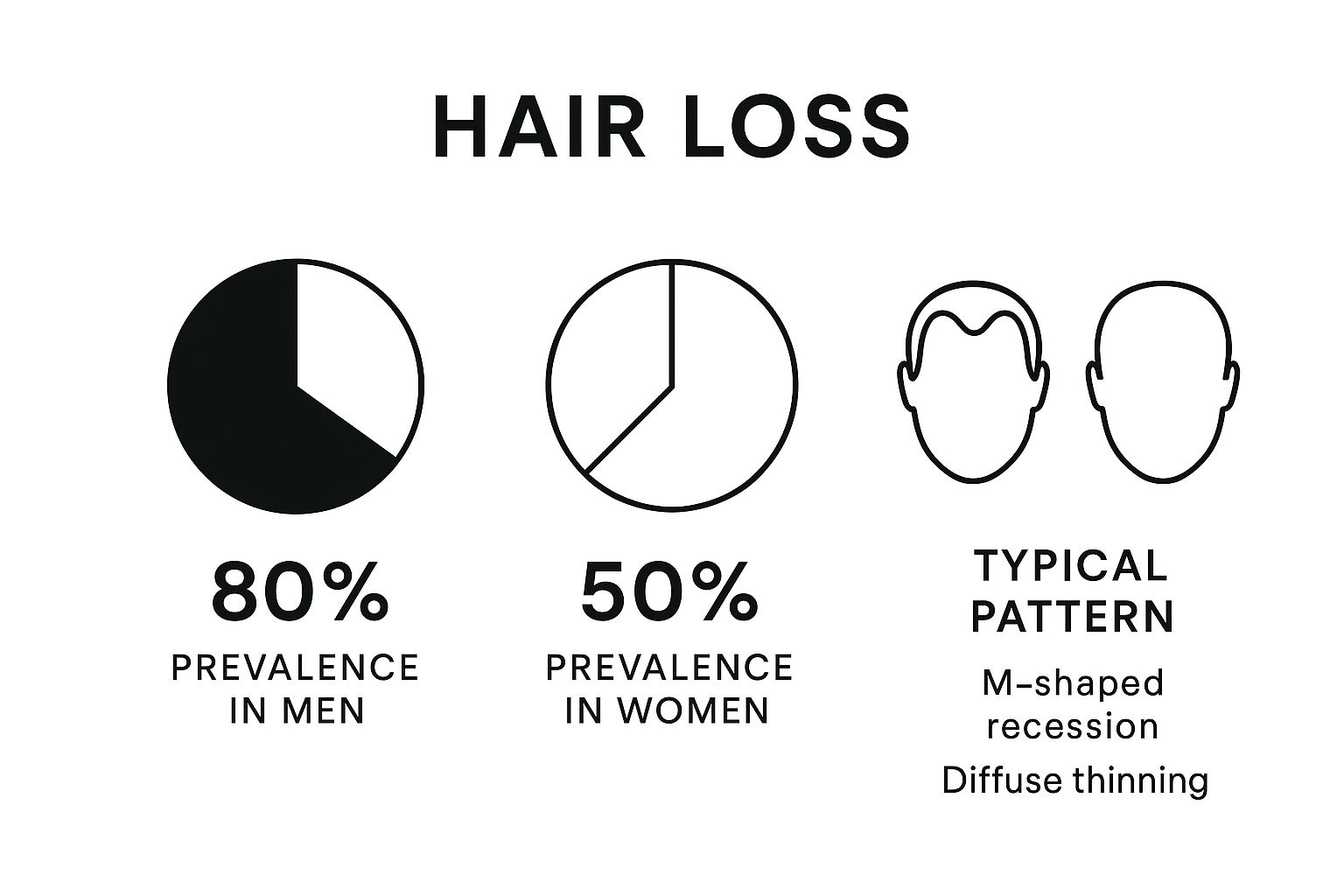
As you can see, men are more frequently affected and tend to see that frontal recession, but for women, the experience is quite different.
How Female Pattern Hair Loss Progresses
In women, the progression is usually much more subtle and spread out. Instead of a receding hairline, the most common sign is a slow, gradual widening of the center part. This is measured using the Ludwig Scale, which lays out three stages of thinning that are concentrated on the top of the scalp.
With female pattern hair loss, a few key things stand out:
- The frontal hairline usually stays put.
- Thinning becomes most obvious when parting the hair down the middle.
- It very rarely leads to total baldness; instead, it causes a widespread loss of hair density on the crown.
To make this even clearer, here's a quick comparison of how these patterns typically play out.
Common Hair Loss Patterns Men vs Women
| Feature | Male Pattern Hair Loss (Norwood Scale) | Female Pattern Hair Loss (Ludwig Scale) |
|---|---|---|
| Starting Point | Receding hairline (temples) and/or thinning at the crown (vertex). | Diffuse thinning, often noticed first as a widening center part. |
| Main Affected Area | Frontal hairline, temples, and crown. | Top and crown of the scalp. |
| Frontal Hairline | Typically recedes, creating an "M" shape. | Usually remains intact. |
| End Result | Can progress to significant or total baldness on top of the scalp. | Rarely results in complete baldness; leads to overall lower hair density. |
By learning to spot these distinct male and female patterns, you get a much clearer picture of what androgenic alopecia looks like in the real world. This insight is crucial for catching the signs early and getting on the path toward an effective plan.
How Professionals Diagnose Hair Loss
https://www.youtube.com/embed/iGQ8XG6BWyE
Getting a proper diagnosis is the first, and most important, step you can take. While it might be tempting to self-diagnose online, seeing a professional like a dermatologist is the only way to be sure you're dealing with androgenic alopecia and not something else entirely.
The process usually starts with a conversation and a close look at your scalp. Your doctor will ask about your family history—since genetics are the biggest piece of the puzzle—and then carefully examine your hair and scalp for the tell-tale signs of patterned thinning and follicle miniaturization.
For an experienced specialist, this visual check is often all it takes to make a confident diagnosis, particularly if your hair loss fits the classic patterns.
Ruling Out Other Causes
Sometimes, hair loss is a symptom of another underlying issue. That’s why a good doctor will do their due diligence to make sure they're not missing anything. This part of the process is crucial because treating the wrong problem is just a waste of time and money.
To get a complete picture, they might use a few other tools:
- Blood Tests: A standard blood draw can reveal a lot. It helps check for common culprits like thyroid problems, iron deficiencies, or other hormonal imbalances that can mimic or worsen genetic hair loss.
- Pull Test: This sounds simple, but it’s an effective way to gauge the severity of shedding. Your doctor will gently tug on a small bunch of hairs to see how many come out.
- Scalp Biopsy: In more complex or unclear cases, a scalp biopsy might be necessary. A tiny sample of skin is taken from your scalp to look at the follicles under a microscope. This can definitively confirm androgenic alopecia or uncover other scalp disorders.
An accurate diagnosis is non-negotiable. Mistaking another condition for androgenic alopecia can lead to ineffective treatments and a lot of frustration. A professional gives you the clarity to build a plan that actually works.
If you’re curious about the more in-depth diagnostic methods, you can learn more about what a scalp biopsy for hair loss involves and why a doctor might recommend one.
Once you have that confirmed diagnosis, you're finally in a position to explore the right treatments for you.
Exploring Effective Treatment Options

Once you have a professional diagnosis, you can finally move from worry to action. Thankfully, managing androgenic alopecia today is a world away from the limited options of a few decades ago. We now have several clinically-proven treatments that can slow down, stop, or in some cases, even help reverse the miniaturization process.
The key is to understand how each one works. Think of it like a toolbox—different tools are designed for different jobs, and often, the best approach is using a combination of them to get the job done right.
FDA-Approved Medications That Work
Two treatments stand out as the cornerstones of medical therapy for hair loss, mainly because they've been rigorously tested and approved by the FDA. They come at the problem from two completely different angles.
Minoxidil (The Growth Stimulant)
Originally a blood pressure medication, doctors noticed Minoxidil had a very welcome side effect: hair growth. It’s a topical solution or foam (you probably know it as Rogaine®) that you apply directly to your scalp. While its exact mechanism is still a bit of a mystery, we believe it works by:
- Increasing blood flow to the hair follicles, delivering more nutrients.
- Extending the hair's anagen (growth) phase, which gives it more time to grow thicker and longer before shedding.
Minoxidil doesn't actually block DHT, but it helps counteract its damaging effects by giving the follicles a much-needed boost. Consistency is everything here; if you stop using it, the benefits will eventually fade.
Finasteride (The DHT Blocker)
This is a daily oral pill (sold as Propecia®) that tackles the root hormonal cause of male pattern baldness head-on. It works by inhibiting the 5-alpha reductase enzyme—the culprit responsible for converting testosterone into DHT. By lowering DHT levels in the scalp, Finasteride can effectively put the brakes on follicle miniaturization.
Many men see fantastic results with Finasteride. In fact, studies show it can stop hair loss progression in the vast majority of users and even regrow some hair in over 60% of them. It's a powerful tool for anyone serious about addressing the underlying hormonal driver of their hair loss.
Procedural and Non-Invasive Therapies
Beyond daily medications, a few in-office procedures offer a different path to hair restoration.
One of the most promising is Platelet-Rich Plasma (PRP) therapy. This treatment uses the healing power of your own body to your advantage. A small sample of your blood is spun in a centrifuge to separate and concentrate the platelets, which are packed with powerful growth factors. This "liquid gold" is then injected back into the scalp to nourish follicles and kickstart cellular repair.
Other non-invasive approaches like LED light therapy are also gaining traction. The idea is that specific wavelengths of light can stimulate cellular activity in the scalp, creating a healthier environment for hair to grow.
This intense search for solutions has fueled a massive industry. The global market for hair loss treatments was valued at around USD 52.37 billion in 2022 and is projected to climb to over USD 88 billion by 2030.
For those with more advanced hair loss, hair transplant surgery remains a permanent and effective solution. Modern techniques like Follicular Unit Extraction (FUE) allow surgeons to move individual, DHT-resistant follicles from the back and sides of your head to the thinning or bald areas. When done by a skilled surgeon, the results can be incredibly natural-looking and last a lifetime.
To figure out what path might be right for you, check out our guide on the best hair loss treatments available today.
What Are Your Personal Risk Factors?
While androgenic alopecia is a fact of life for many, it doesn't play by the same rules for everyone. Your own personal risk comes down to a few key factors, but the biggest one by far is the genetic hand you were dealt.
Think of it this way: your DNA contains the blueprint for your hair follicles. For some, that blueprint includes a high sensitivity to DHT, the hormone that triggers hair loss. This is why looking at your family tree is often the most accurate crystal ball you can find. If your father, grandfathers, or uncles experienced hair loss, there’s a strong chance that trait has been passed down to you.
Ethnicity's Role in Hair Loss
Where your ancestors came from plays a surprisingly big role in your likelihood of experiencing hair loss, and even the pattern it might take. It’s not just anecdotal; scientific studies consistently show that different ethnic groups have very different experiences with androgenic alopecia.
Caucasians, for instance, have the highest rates of androgenic alopecia in the world. Research consistently shows that by age 50, about 50% of Caucasian men will have some degree of male pattern baldness. In contrast, men of African and Asian descent generally have a much lower prevalence. Not only that, but the pattern of loss often differs, with many retaining a stronger frontal hairline for longer. You can see the full research on these disparities on Dermatol Journal.
Understanding this context is empowering. It helps you see your own hair loss not as a personal failing, but as part of a well-understood genetic story.
Knowing where you stand genetically is the first step. It gives you a realistic baseline for what to expect and helps you make more informed decisions about your own hair loss journey.
Answering Your Lingering Questions About Androgenic Alopecia
Even after covering the causes, progression, and treatments, you probably still have a few questions rattling around. It's completely normal. Let's tackle some of the most common ones to help clear up any final confusion.
Can Androgenic Alopecia Be Cured Completely?
In a word, no. There isn't a one-and-done cure that can flip a switch and turn off your genetic predisposition to hair loss. It’s better to think of androgenic alopecia like a chronic condition, such as high blood pressure, that needs consistent management rather than a cold you can simply get over.
But don't let that discourage you. It can be managed incredibly well with the right approach. Proven treatments like Minoxidil, Finasteride, and PRP can effectively stop hair loss in its tracks and often spark regrowth. The catch? You have to stick with them. The moment you stop treatment, the underlying genetic process fires back up, and the hair loss will likely resume.
Does Stress Cause Androgenic Alopecia?
This is a big one, and it's easy to get confused here. While intense stress can absolutely cause you to shed hair, that condition is called telogen effluvium. It’s a temporary, all-over shedding that's very different from the patterned loss of androgenic alopecia.
Androgenic alopecia is a genetic and hormonal issue at its core. Stress doesn't cause it, but it can certainly pour gasoline on the fire. If you’re already genetically wired for hair loss, a period of high stress can sometimes speed things up or make the shedding more noticeable. So, managing stress is great for your overall health—and your hair—but it won't stop the progression of AGA on its own.
Are Natural Remedies and Shampoos Effective?
You’ve seen them everywhere: shampoos, serums, and supplements all promising to be the magic bullet for hair loss. While many of these products can definitely improve the health of your scalp and make the hair you have look thicker and shinier, they just can't stop the biological process happening at the follicle level.
The real problem in androgenic alopecia is DHT shrinking your hair follicles. A special shampoo, no matter how great it smells, can't intervene in that complex hormonal process.
That’s why it’s always best to focus on treatments backed by solid clinical evidence. Talk to a dermatologist before spending your time and money on products with big promises but little proof. They can help you build a plan that delivers real, measurable results.
At PRP For HairLoss, we believe that clear, accurate information is the best tool for tackling hair loss. To continue learning and explore advanced treatment options like Platelet-Rich Plasma therapy, visit us at https://prpforhairloss.com.

 PRP For Hairloss
Leave a comment