Losing your hair can be tough, but platelet-rich plasma (PRP) therapy offers a real, science-backed way to fight back. It’s a clever approach that uses your body's own natural healing power to kick-start dormant hair follicles. By concentrating the growth factors found in your blood and delivering them right to your scalp, it encourages genuine hair regrowth.
Using Your Body’s Own Blueprint to Fight Hair Loss
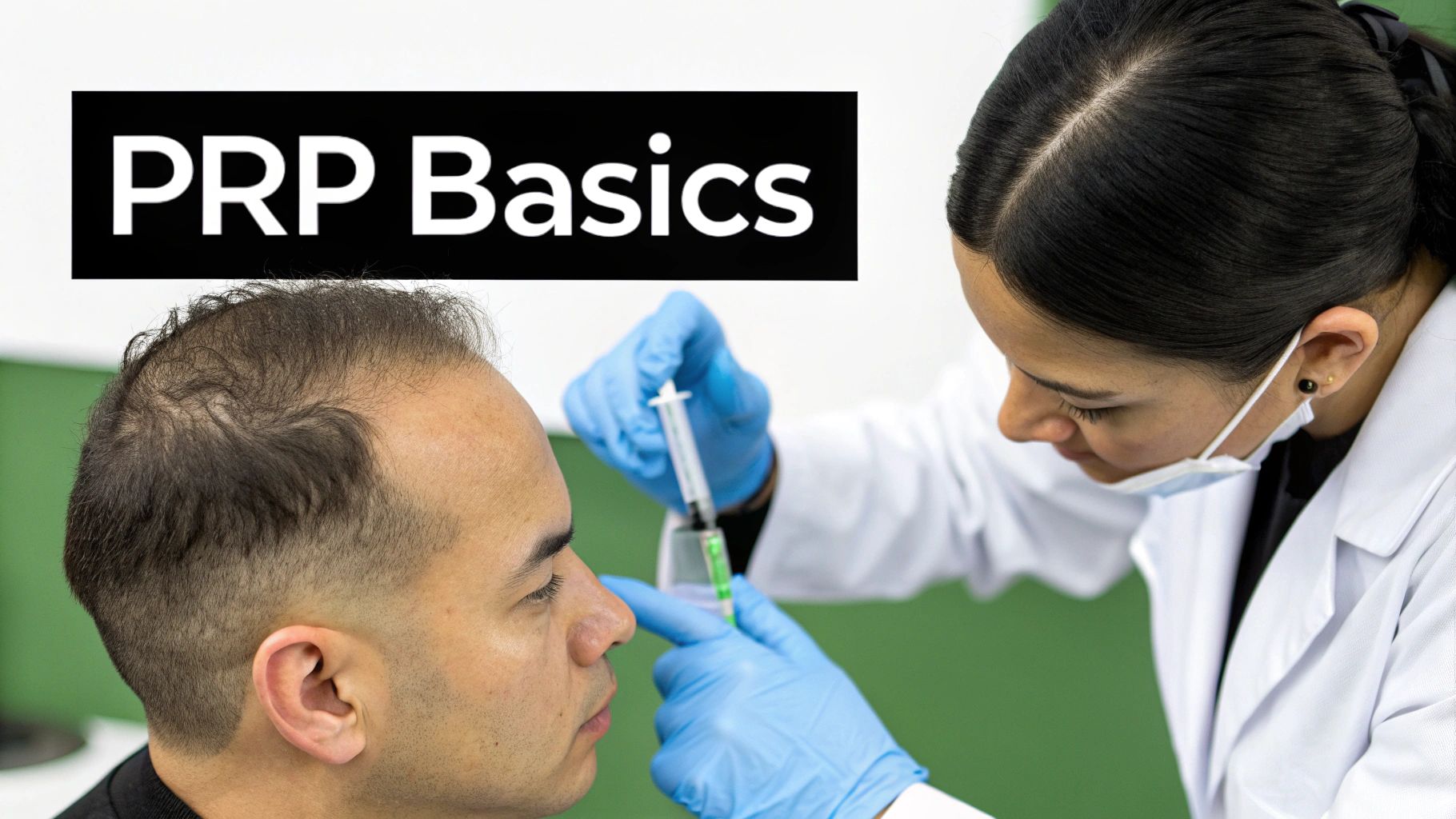
Watching your hair thin out day after day can feel pretty helpless, sending you on a search for a solution that actually works and is safe. There are countless treatments out there, but what if the answer wasn't in some bottle or a complicated surgery? What if the key to getting your hair back was already inside you?
That’s the whole idea behind platelet-rich plasma therapy for hair loss. It's not magic; it’s a logical, natural process that taps into your body's built-in repair systems. Your blood is full of platelets, which are tiny cells that act like first responders when you get injured. These platelets are loaded with powerful proteins called growth factors.
Your Personal Repair Team
Think of those growth factors as your own personal repair crew. PRP therapy is all about gathering this team from a small sample of your blood, concentrating them into a powerful serum, and then sending them directly to where they're needed most—your scalp. This delivers a potent, revitalizing boost right to the hair follicles that have weakened or gone dormant over time.
This guide will walk you through everything, no jargon, no fluff. We'll get into the simple science of how it all works, what the treatment actually feels like, and what kind of results you can realistically expect. For some local perspectives on how this treatment is being used, you can explore PRP for hair loss and see its real-world applications.
PRP therapy isn't new. It has a solid track record, and studies have shown it can help increase both the number of hairs and their thickness. Because it uses your own biological material, it’s a well-tolerated treatment with almost no downtime.
Our goal is to arm you with all the information you need, including:
- The science of using your own platelets to stimulate hair growth.
- A step-by-step breakdown of what happens during a session.
- Who is—and isn't—a good candidate for this therapy.
- What to expect for results and how long it might take.
By the time you're done reading, you'll have a clear understanding of whether this could be the right move for you. If you want to dive even deeper into the basics, our post on what is platelet rich plasma provides some great foundational context.
How PRP Therapy Works to Restore Hair
So, how does PRP therapy actually work? The answer is already flowing through your veins. Your blood might look like a simple red liquid, but it’s really a complex mixture, and for hair restoration, we’re interested in one specific part: the platelets.
Think of platelets as your body's dedicated first responders. When you get a cut, they rush to the scene, plugging the wound and kickstarting the healing process. They’re packed with powerful proteins called growth factors—the biological signals that tell your cells to repair damage and build new tissue.
PRP therapy cleverly takes this natural healing system, concentrates it, and puts it to work right where you need it most: your scalp.
Concentrating Your Body's Healing Power
The whole thing starts with a simple blood draw, no different than what you’d get at a routine physical. We take that small sample and place it into a centrifuge. If you’ve never seen one, just imagine a machine that spins vials at an incredibly high speed.
This spinning action separates your blood into layers based on density. The heavier red blood cells drop to the bottom, while the lighter plasma and platelets rise to the top. The goal is to isolate that platelet-rich layer, which is often called "liquid gold" for good reason.
What you're left with is a serum containing 5 to 10 times the concentration of growth factors found in regular blood. It's a supercharged dose of your body's own healing power, ready to be applied directly to your hair follicles.
This concentration step is absolutely crucial. For a deeper dive into the specifics, our guide on platelet-rich plasma preparation walks through exactly how this potent serum is created.
Awakening Dormant Hair Follicles
Once the PRP is ready, it's carefully injected into the areas of the scalp where hair is thinning. This is where the real work begins. The concentrated growth factors act like a powerful wake-up call for hair follicles that have become sluggish or gone dormant.
I like to use a garden analogy. Normal blood flow is like a gentle daily misting—it helps, but it may not be enough to revive struggling plants. Injecting PRP is like giving that garden a targeted, nutrient-dense soaking. It delivers a powerful boost of the exact biological signals follicles need to shift back into an active growth phase.
This targeted stimulation gets a few key things done:
- It boosts blood supply to the hair follicles, delivering more oxygen and essential nutrients.
- It strengthens the hair shaft, which results in thicker, healthier-looking individual hairs.
- It extends the anagen (growth) phase of the hair cycle, allowing hair to grow longer before it sheds.
- It encourages dormant follicles to "wake up" and start producing hair again.
This isn't just theory; the science backs it up. A major meta-analysis looked at 30 different studies with a total of 687 patients. The findings were clear: PRP therapy significantly increases both hair density and thickness. In fact, 29 of the 30 studies reported positive results, showing just how consistent the evidence is. You can read the full research about these PRP findings for yourself.
At its core, PRP therapy isn’t about adding a foreign substance or a chemical to your system. It's about harnessing, concentrating, and redirecting your body's own natural healing ability to revive your hair from the inside out.
Your PRP Session From Consultation to Completion
Walking into a clinic for a new procedure can feel a bit nerve-wracking. I get it. The unknown is often the biggest source of anxiety, but understanding exactly what’s going to happen can make all the difference. A platelet-rich plasma therapy for hair loss session is actually a very straightforward and well-established process, designed with your comfort and results in mind.
Let's walk through the entire experience, from the moment you step into the clinic to the moment you walk out. Knowing what’s coming takes the mystery out of it.
The Initial Consultation and Goal Setting
Your journey doesn't start with a needle—it starts with a conversation. This first consultation is all about getting on the same page. You'll sit down with a specialist to talk about your hair loss history, your concerns, and what you’re hoping to achieve.
This is also where the expert assessment comes in. The practitioner will take a close look at your scalp to confirm you're a good candidate and identify the specific areas that need the most help. Think of it as an open dialogue. It's your prime opportunity to ask every question you have and get a clear picture of the whole process.
The Three-Step Treatment Process
Once you've had your consultation and are ready to move forward, the treatment itself is surprisingly efficient. It really boils down to three simple phases: the blood draw, separating the PRP, and the injections into your scalp. Most people are in and out of the office in about an hour.
This image gives a great high-level view of how we turn your own blood into a powerful hair growth treatment.
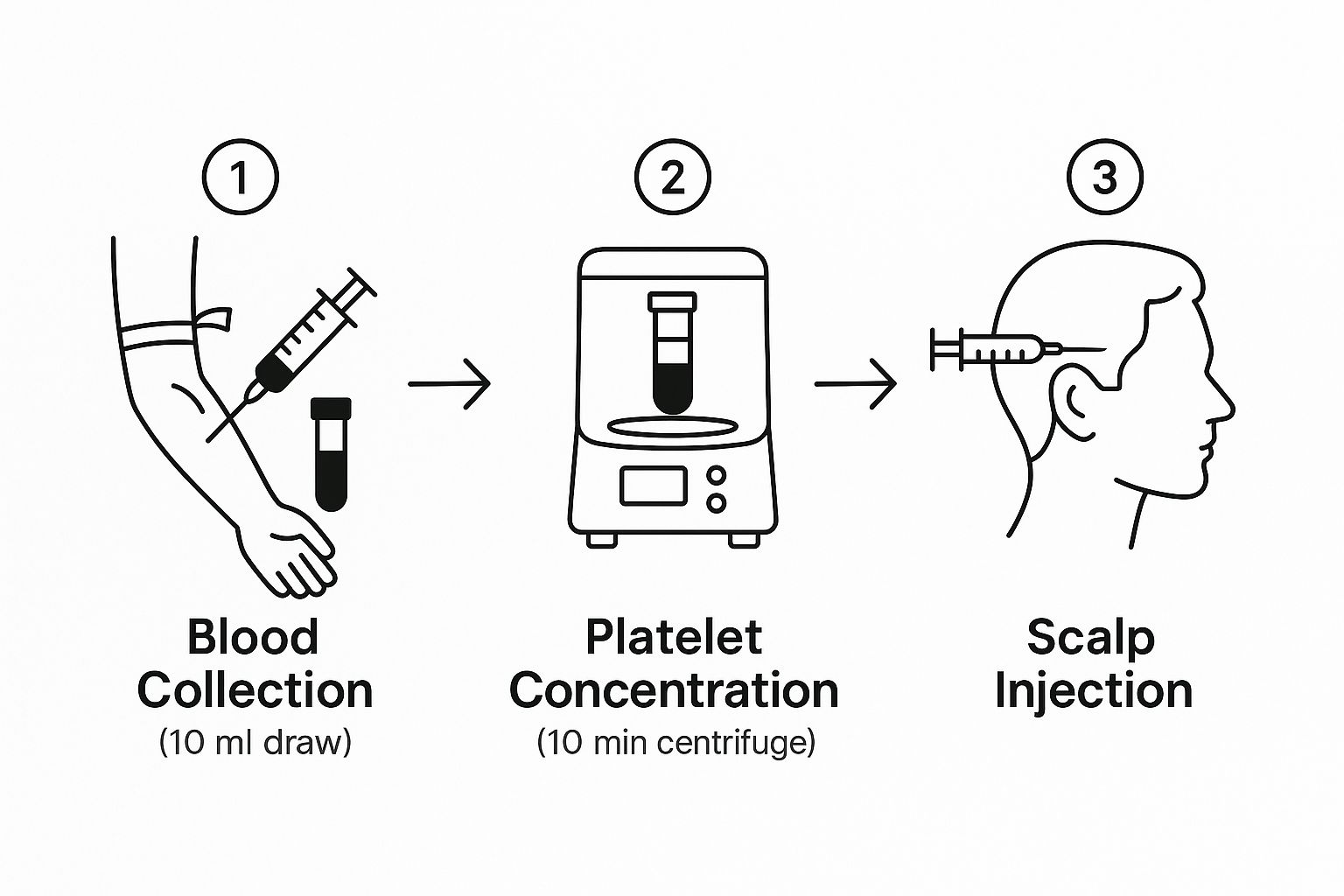
As you can see, it’s a streamlined loop: we collect the blood, concentrate the platelets, and then reintroduce that concentrated serum directly where you need it.
To give you an even clearer picture of your time in the chair, here's a breakdown of what a typical appointment looks like.
A Typical PRP for Hair Loss Appointment
This table breaks down what you can expect during each phase of your PRP hair therapy session.
| Phase | What Happens | Typical Duration |
|---|---|---|
| Preparation | A topical numbing cream is applied to your scalp to ensure comfort during the injections. | 15-20 minutes |
| Blood Draw | A small sample of blood (10-20 mL) is drawn from your arm, just like a routine lab test. | 2-3 minutes |
| Centrifuge | The blood is spun in a centrifuge for about 10 minutes to separate the platelet-rich plasma from other blood components. | 10 minutes |
| Injections | The concentrated PRP is carefully injected into the targeted areas of your scalp using a very fine needle. | 15-20 minutes |
| Final Steps | The scalp is cleaned, and your practitioner will review simple aftercare instructions with you. | 5 minutes |
All in all, the hands-on part of the procedure is over before you know it, and you're ready to head out with minimal fuss.
The Blood Draw: A Quick and Simple Start
The first active step is a quick blood draw—no different than what you’d experience at your doctor’s office. A small amount of blood, usually around 10-20 milliliters, is taken from your arm. It’s a tiny sample and is over in a minute or two.
This blood contains everything we need for the treatment. It’s the raw material that we’ll soon refine into your own personalized hair-boosting serum.
The Centrifuge: Spinning for Liquid Gold
Next, your vial of blood goes for a spin in a specialized medical device called a centrifuge. For about 10 minutes, the machine spins your blood at an incredibly high speed.
This rapid rotation uses centrifugal force to separate the blood into three distinct layers based on density:
- The heavy red blood cells sink to the bottom.
- The light platelet-poor plasma floats to the top.
- The platelet-rich plasma—the "liquid gold"—settles right in the middle.
That middle layer is exactly what we're after. It’s a highly concentrated collection of your body’s own platelets, packed with the powerful growth factors essential for stimulating hair follicles.
The Scalp Injections: Precise and Targeted Application
This is the part everyone asks about. Before we begin, the numbing cream that was applied earlier will have taken full effect, making sure you’re comfortable. Most patients don't describe it as painful at all.
A lot of people say the sensation is more like a series of slight pressures or tiny pinpricks. The numbing agent really does its job, making the whole thing very easy to tolerate.
Your practitioner will then take the prepared PRP and, using a very fine needle, inject it precisely into the areas of your scalp where hair is thinning. The injections are strategically placed to target the hair follicles at the dermal level, which is where they can have the biggest impact. If you want to dive deeper into this final, critical step, you can learn all about PRP injections for hair loss in our detailed guide.
And that's it! Once the injections are done, you’re all set. There’s practically no downtime, and you can get right back to your day. Your practitioner will give you a few simple aftercare tips, like avoiding harsh hair products for a day or two, but it’s an incredibly smooth process from start to finish.
Are You a Good Candidate for PRP Hair Treatment?
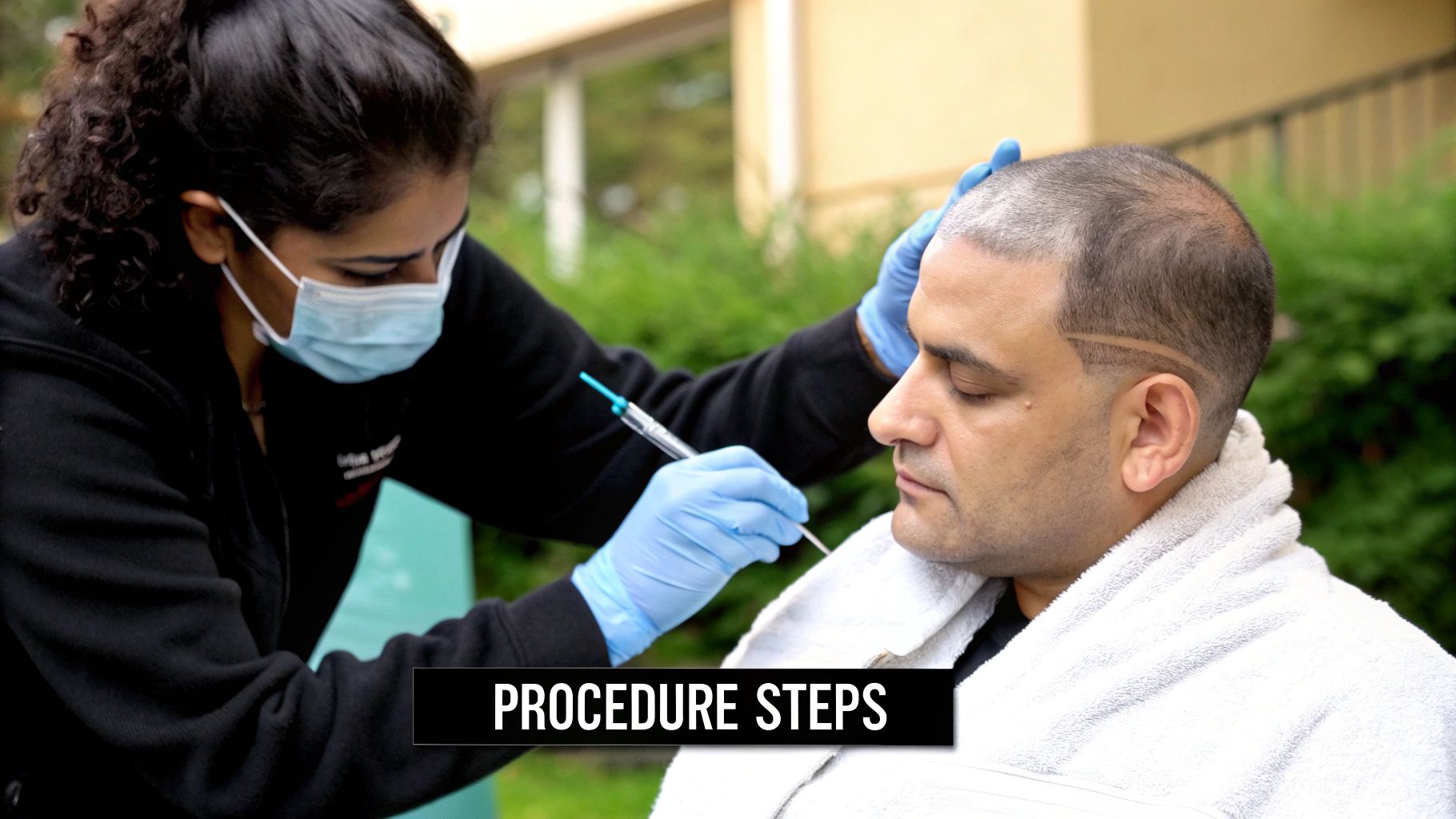
While PRP therapy is a fantastic tool in our fight against hair loss, it’s not a one-size-fits-all solution. The real secret to getting great results is making sure you’re the right person for the treatment in the first place.
Figuring out if you're a good fit is the most important first step, as it sets the stage for everything that follows. Think of it like trying to save a struggling plant. If the roots are gone, no amount of special fertilizer will bring it back. PRP works in a similar way—it needs hair follicles that are weakened but still have some life left in them.
The Ideal Profile for PRP Success
So, who typically gets the best results with PRP? The ideal candidate is usually someone who has noticed their hair is thinning but hasn't lost it all. It’s most effective for people in the earlier stages of their hair loss journey.
The best candidates often have a few things in common:
- Early-Stage Hair Loss: People just starting to see the effects of androgenetic alopecia (male or female pattern baldness) are prime candidates. At this point, the hair follicles are usually dormant, not completely dead.
- Existing but Weakened Hair: If you can see those fine, fuzzy, vellus hairs in thinning areas, that’s a fantastic sign. It means the follicles are still there, just waiting for a wake-up call from the growth factors in your PRP.
- Good Overall Health: Your general health matters. A healthy body produces high-quality blood and platelets, which gives us the best possible material to work with for your treatment.
At its core, the goal of PRP is to strengthen and revive struggling hair follicles, not to magically grow hair on a completely smooth scalp. Catching it early gives you a huge advantage.
Who Might Not Be a Good Fit
It's just as important to know who isn't a good candidate. Being honest about this from the start helps set realistic expectations and saves you from investing time and money into a treatment that might not work for you.
Candidacy is all about matching the right solution to the right problem. For some people, PRP isn't the best first step, and a good specialist will always be upfront about that.
Certain health issues can get in the way of the treatment's safety or effectiveness. PRP therapy might not be the right choice for you if you have:
- Chronic Skin or Scalp Conditions: Any active infections, severe psoriasis, or dermatitis on the scalp need to be cleared up before starting treatment.
- Certain Blood Disorders: Conditions that affect platelet function or blood clotting can compromise the quality of the PRP itself.
- Active Autoimmune Diseases: For those with conditions like lupus or alopecia areata, where the immune system attacks hair follicles, PRP may not be the most effective approach.
- Extensive, Long-Term Baldness: If the hair follicles have been gone for a long time and the scalp is smooth, there’s simply nothing for the PRP to stimulate.
The only way to know for sure is to sit down for a consultation with a hair restoration expert. They'll take a close look at your scalp, understand your specific type of hair loss, review your medical history, and give you a straightforward, honest opinion on whether platelet-rich plasma therapy for hair loss is the right move for you.
When Will I Actually See PRP Results?
It’s the number one question on everyone's mind: "How long until I see a real difference?" And it's a perfectly reasonable question to ask. You're investing your time and money, and you deserve to know what to expect.
Let's set the right expectations from the start. PRP therapy is a biological process, not a quick fix. Think of it like nurturing a garden—you plant the seeds, but they need time to sprout and grow. The powerful growth factors in your own platelets are working to wake up dormant hair follicles, and that process takes a little patience.
Your body is performing some incredible work just beneath the surface of your scalp. The visible results will come, but they follow a gradual, natural timeline.
The First Signs of Progress
During the first couple of months after your initial treatments, you probably won't see a dramatic influx of new hair. Instead, the first real sign that things are working is often a reduction in hair shedding.
Many of our patients report seeing less hair in their brush or the shower drain within the first one to three months. This is a fantastic early indicator. It tells us that the growth factors are strengthening your existing hair follicles, anchoring them more securely and helping them stay in their growth phase longer.
Before your body can focus on growing new hair, it first has to stop the excessive shedding. Seeing less hair fall is the first major milestone and a clear sign you're on the right track.
This initial phase is all about building a healthier foundation on your scalp. It's the essential first step before the more visible growth kicks in.
The Growth and Thickening Phase
This is where things get exciting. Generally, around the three to six-month mark, you'll start to see and feel tangible changes in your hair.
Here’s what people typically notice during this stage:
- New "Baby Hairs": Fine, new hairs often begin to appear along the hairline and in areas that were thinning.
- Thicker Hair Strands: Existing hairs start to feel stronger and look more robust as the follicles get healthier.
- Better Scalp Coverage: As new hairs sprout and existing ones thicken, you'll notice an overall improvement in density.
This isn't just anecdotal; the science backs it up. A key study that tracked patients getting monthly PRP injections found significant improvements in hair count and density at both the three and six-month follow-ups. Patient satisfaction was also impressively high, averaging 4.23 out of 5. You can discover more insights about these PRP study findings.
Seeing the Full Effect
The improvements don't just stop at six months. Because hair grows in slow cycles, your results will continue to mature. The best and most significant results from your initial round of treatments usually become apparent between six months and one year.
By this point, those fine baby hairs have had time to grow into thicker, longer strands, contributing to a noticeably fuller head of hair.
Of course, everyone's journey is unique. Your age, the severity of your hair loss, genetics, and overall health all influence your personal timeline. For a more detailed breakdown, check out our guide on the PRP hair treatment timeline. Remember, sticking with your recommended maintenance plan is the key to protecting your investment and enjoying your results for years to come.
Understanding the Investment in Your Hair

Alright, let's talk about the practical side of things—the cost. It helps to think of platelet-rich plasma therapy not just as a procedure, but as a genuine investment in your confidence. Getting a clear picture of the financial side is a crucial step in making a smart decision.
The price tag for PRP isn't a simple, flat number. Several key things can move the needle on cost. One of the biggest factors is your geographic location; clinics in bustling urban centers typically have higher operating costs, and that can be reflected in their pricing. The experience level of your practitioner and the specific technology they use to prepare the PRP also play a major role.
Breaking Down the Price Structure
PRP therapy is almost always priced on a per-session basis. This is important to remember because effective hair restoration is a process, not a one-shot deal. Most people start with an initial series of three to four sessions, usually spaced about a month apart. This "loading phase" is designed to kickstart the hair follicles and build momentum for new growth.
After that initial burst, you'll shift to a maintenance plan. This typically involves follow-up sessions every six to twelve months to keep your results going strong. So, when you get a quote, always clarify if the price is for a single treatment or a discounted package for the initial series. You can get a much clearer picture by looking at our detailed breakdown of the PRP hair treatment cost.
Think of the cost not as an expense for a fleeting cosmetic fix, but as a long-term investment in a clinically recognized, mainstream treatment for hair restoration. This isn't an experimental fad; it's a trusted option.
A Growing and Trusted Market
You’re not just jumping on a bandwagon; you’re considering a treatment with a solid track record and widespread acceptance. The global market for these treatments was valued at around USD 434.1 million in 2023 and is expected to continue growing. This isn't just a number—it reflects real clinical confidence and patient trust in the results.
Many clinics understand this is a significant investment and offer ways to make it more manageable. It's worth exploring various plastic surgery financing options that can help fit the treatment into your budget. By weighing the cost against the proven value and potential outcome, you can decide if it's the right path for you.
Common Questions About PRP for Hair Loss
Even after getting the full rundown, it's natural to have a few more questions pop up. Let's tackle some of the most common ones we hear from people considering platelet-rich plasma therapy for hair loss.
My goal here is to give you straight-up, clear answers so you can feel completely confident about your decision.
Is PRP Therapy a Painful Procedure?
This is easily the number one question on everyone's mind, and the answer is almost always a pleasant surprise. Most people find the discomfort to be very minor. We start by applying a topical numbing cream to your scalp, which does a great job of dulling the sensation.
Because of that prep work, you'll likely just feel a bit of pressure during the injections, not actual pain. Afterwards, your scalp might feel a little tender for a day or two—kind of like a mild sunburn—but it fades quickly.
How Many PRP Sessions Will I Need for Hair Loss?
PRP isn’t a one-shot fix; think of it more like a workout plan for your follicles. A typical starting point is a series of 3 to 4 sessions, spaced about a month apart. This initial phase is all about waking up those follicles and kicking off a new growth cycle.
To keep your hair looking great, you’ll need to think about maintenance. Your provider will likely recommend a follow-up treatment every 6 to 12 months. This schedule is always customized based on your specific pattern of hair loss and how well you respond.
Are There Any Side Effects or Risks with PRP Therapy?
PRP is known for being incredibly safe, and the main reason is simple: it uses your own blood. Since we're just concentrating and re-injecting your body's own healing components, the risk of an allergic reaction or rejection is practically zero.
The side effects you might see are all mild and temporary. These include:
- A little bit of swelling around the treated areas.
- Some minor redness or bruising where the injections were made.
- A feeling of tightness on the scalp, which usually goes away within a day.
Like any procedure that involves a needle, there's a tiny risk of infection. This is why it’s so critical to choose a skilled, reputable professional who follows strict sterile protocols. Your safety comes first.
Can I Combine PRP with Other Hair Loss Treatments?
Absolutely. In fact, combining treatments often leads to the best results. PRP plays very well with other established hair loss therapies like topical minoxidil (Rogaine) or oral finasteride (Propecia).
Think of it as attacking the problem from multiple angles. Each treatment works differently, and when used together, they create a stronger, more comprehensive defense against hair loss. Just be sure to talk it over with your doctor to build a combined strategy that’s right for you.
At PRP For HairLoss, we're committed to giving you the clear, straightforward information you need to tackle male pattern hair loss head-on. To learn more about your options, visit us at our official website.
 PRP For Hairloss
Leave a comment