Finding a few stray hairs on your pillow or circling the shower drain can spark a moment of panic. We’ve all been there. But before you spiral, remember that losing between 50 to 100 hairs every day is a completely normal part of your hair's life cycle. The real question is, are you starting to see a lot more than that?
Is Your Hair Shedding More Than Usual?

It’s easy to get fixated on every single hair you lose once the thought of balding crosses your mind. But the first, most important step is figuring out if you're dealing with normal shedding or the first signs of actual hair loss. Think of normal shedding as routine maintenance; old hairs fall out to make way for new growth. It's been happening your whole life.
Excessive shedding, on the other hand, feels different. It's not just a few strands here and there. It’s when you start finding noticeable clumps of hair in the shower, on your clothes, or scattered across your pillow day after day.
Spotting the Real Warning Signs
So, how can you tell for sure? The trick is to look for a consistent increase in shedding over a few weeks, not just one or two bad hair days. To get a handle on it, you can try a few simple self-checks.
- The Pillow Test: When you wake up, take a look at your pillow. A couple of hairs is no big deal. A small collection every single morning? That's a pattern worth paying attention to.
- The Shower Drain Check: After you shower, glance at the drain. Is there a lot more hair caught in it than there was a few months ago? This is often the first place people notice a change.
- The Hand Test: Run your hands gently through your dry hair. If you consistently pull out more than a couple of strands with each pass, it’s a sign to pay closer attention.
You don't need to count every single strand. This is about establishing what’s normal for you and then identifying a real, sustained shift from that baseline.
For many guys, this increased shedding is the prelude to more obvious signs of androgenetic alopecia (pattern baldness). This might look like thinning at the crown or a hairline that’s starting to move back. If you’re seeing more of your scalp when you style your hair, or if the "M" shape at your temples is becoming more pronounced, these are classic early indicators. If you're curious about the numbers, you can read more about the clinical signs of hair loss and how it affects men globally.
The goal here is to become your own detective. By tracking your shedding for a couple of weeks, you can trade anxiety for answers and make a clear-headed judgment based on a real pattern.
This initial self-assessment is key. Sometimes, a sudden increase in shedding can be caused by other things like stress or diet. If the hair fall seems to have come out of nowhere, our guide on sudden hair loss causes can help you explore other possibilities.
Quick Guide to Spotting Early Balding Signs
To help you put it all together, here’s a simple table summarizing the key things to look out for. Use this as a quick reference to assess what you're seeing.
| Sign to Watch For | What It Looks Like | What It Means |
|---|---|---|
| Increased Shedding | Finding more hair than usual on your pillow, in the shower drain, or on your brush over several weeks. | Could be the first signal that your hair follicles are entering a prolonged resting phase, a precursor to thinning. |
| Receding Hairline | The "M" shape at your temples becomes more defined, or your overall hairline starts moving higher up your forehead. | This is a classic sign of male pattern baldness (androgenetic alopecia) as follicles at the hairline become sensitive to DHT. |
| Thinning Crown | The hair on the top of your head (the vertex) becomes less dense, making your scalp more visible. | Another hallmark of pattern baldness, this often happens at the same time as a receding hairline or can occur on its own. |
| Slower Growth | Your hair just doesn't seem to grow as long or as quickly as it used to. | A sign that your hair's anagen (growth) phase is shortening, which means more hairs are in the resting/shedding phase. |
This table isn't a diagnosis, but it's a solid starting point. If you’re ticking off one or more of these boxes, it’s a good indication that it might be time to look into your options.
Checking Your Hairline and Temples
When you're trying to figure out if you're losing your hair, the mirror is your most honest friend. Your hairline and temples are almost always the first places to show signs of change, so that's exactly where you should start looking.
Most guys go through what’s called a maturing hairline in their late teens or twenties. This is totally normal—it's just a slight, natural recession that gives you a more defined, adult hairline. It’s a completely different ballgame from the more aggressive thinning that comes with male pattern baldness.
From Mature Hairline to M-Shape
The real giveaway is often the shape. A mature hairline tends to move back pretty evenly across the forehead, maybe by half an inch or so. Male pattern baldness, on the other hand, often carves out a very distinct "M" shape. This happens because the corners of your hairline start receding much faster than the middle, a classic sign that the follicles at your temples are more sensitive to DHT.
Want a clear, undeniable look at what's happening? Try this simple trick:
- Find a photo of yourself from two or three years back.
- Take a new picture today. Make sure the lighting is similar and pull your hair back so your whole forehead is visible.
- Put them side-by-side. The difference—or lack of one—can be startlingly clear when you compare them directly.
The infographic below breaks down the main culprits behind these changes, starting with your own genetics.
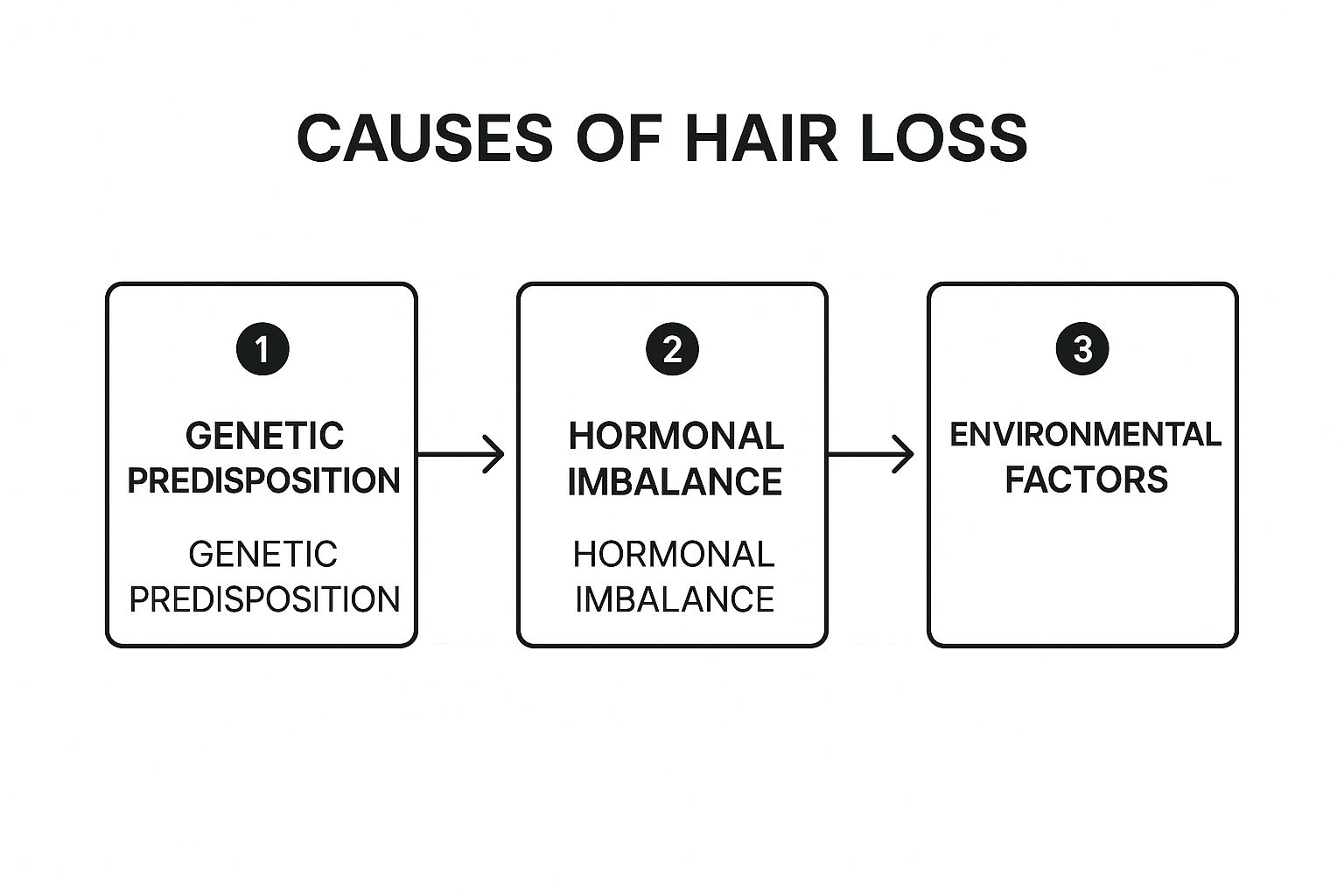
As you can see, it's usually a combination of your genes, hormones, and even lifestyle factors that can trigger hair loss over the years.
Spotting any changes at the hairline early is a huge win. The sooner you notice what's going on, the more effective your options will be for slowing things down or stopping further loss.
Remember to look closely at the hair at your temples, not just where the hairline sits. This area can start to thin out subtly at first. You might notice finer, shorter hairs popping up long before the hairline itself actually moves back. For a much closer look, our guide on the signs your hairline is receding dives deeper into what to watch for in this critical spot.
The Crown and Scalp Visibility Test

While everyone seems to fixate on the hairline, hair loss often starts somewhere else entirely. For a lot of guys, the first real sign of trouble is thinning on the crown—that spot right at the top and back of your head. It's a tricky area to monitor simply because you can't see it yourself.
You might catch an unflattering glimpse in a shop window's reflection or have a well-meaning friend drop a hint. But waiting for that to happen isn't the best strategy. The most reliable way to get a good, hard look is to either use two mirrors or just snap a few pictures with your phone.
Getting a Clear View
Consistency is everything when you're trying to track hair loss. The whole point is to establish a baseline so you can spot actual changes over time, not just guess.
- Use your phone: Once a month, find a spot with consistent, bright lighting and take a clear photo of the top of your head. Keep these pictures in a specific album on your phone. This makes side-by-side comparisons incredibly easy.
- The two-mirror method: This is the old-school way. Stand with your back to your main bathroom mirror and hold a smaller hand mirror in front of you. You'll need to play with the angle a bit, but you'll be able to get a clear, well-lit view of your crown.
Remember, you're not just looking for a bald spot. The early signs are much more subtle. You're trying to tell the difference between a normal cowlick and genuine thinning, where more of your scalp starts to show through. Look for a widening part or a general see-through appearance.
Thinning on the crown can feel a lot more gradual than a receding hairline. That’s why a simple monthly check-in is so powerful—it gives you real evidence and takes the guesswork out of the equation.
What to Look and Feel For
Be warned: lighting can be deceptive. Harsh, direct overhead light will expose every bit of scalp, while softer lighting can make your hair look much thicker. To get an honest comparison, always check your hair under the same lighting conditions.
Beyond just looking, use your sense of touch. Run your fingers through the hair on your crown. Now, compare that to the hair on the sides or the very back of your head. Does the hair on top feel noticeably finer or less dense? This subtle change in texture is often one of the very first clues.
If you want to understand more about this specific pattern of hair loss, our guide on crown thinning hair gets into much more detail.
Why Male Pattern Hair Loss Happens
If you're noticing your hair thinning, the first thing to understand is why it's happening. It's easy to feel like it's just you, but the truth is, male pattern hair loss is an incredibly common biological process. For most guys, it's a story that was written into their DNA long before they were born.
The main culprit is a genetic sensitivity to a hormone called dihydrotestosterone (DHT). Think of DHT as a potent byproduct of testosterone. While testosterone handles things like muscle growth, DHT can unfortunately have a negative effect on certain hair follicles—specifically the ones on your scalp.
The Role of Genetics and DHT
If you have the genes for it, DHT attaches to receptors in your hair follicles. Over time, this constant hormonal signaling causes the follicles to shrink, a process known as miniaturization. With each new growth cycle, the hair that emerges is a little thinner, shorter, and weaker than the one before it.
Eventually, the follicle becomes so small it can no longer produce a visible hair. This is what creates the classic signs of a receding hairline or a thinning crown. This genetic lottery is the reason an estimated 42% of men worldwide deal with noticeable hair loss. Interestingly, these numbers vary by ethnicity; men of European descent tend to have a higher prevalence than men of African or East Asian descent. You can read more about how common baldness is on kopelmanhair.com.
At its core, male pattern baldness isn't about hair suddenly falling out. It's a slow-motion replacement of your normal, thick hairs with tiny, fine, almost invisible ones. This is a process that plays out over years, not overnight.
This gradual shrinking is precisely why catching it early makes such a difference. Stepping in before those follicles give up for good gives you the best shot at slowing things down. You can get a deeper understanding of the condition by reading our article on what is androgenetic alopecia.
Can Other Factors Speed It Up?
Genetics definitely load the gun, but certain lifestyle factors can pull the trigger and speed things up. These things don't cause male pattern baldness by themselves, but they can absolutely make a bad situation worse.
- Chronic Stress: High cortisol levels from stress can disrupt the natural hair growth cycle, pushing more hairs into the shedding phase.
- Poor Diet: Your hair follicles need fuel. A diet lacking in key nutrients like iron, protein, and certain vitamins can starve them of what they need to thrive.
- Lifestyle Habits: Things like smoking are known to constrict blood vessels, which can reduce the vital blood flow your scalp needs for healthy hair growth.
When It's Time to Talk to a Professional
Checking your hair in the mirror is a good first step, but let's be honest, self-diagnosis can easily lead you down a rabbit hole of worry and what-ifs. If what you're seeing is causing you real stress, or if the shedding seems sudden and patchy, it's time to get a definitive answer.
That's where a dermatologist comes in. This is your single most important next step. They have the experience to see beyond just a receding hairline and can tell the difference between male pattern baldness and other culprits like stress, nutritional deficiencies, or scalp conditions. Getting a clear diagnosis takes away the guesswork and anxiety.
What a Consultation Actually Looks Like
Seeing a specialist for the first time can feel a bit daunting, but the process is usually pretty straightforward and designed to get to the root of the problem.
They'll start by talking with you, asking about your general health, lifestyle, and, importantly, your family's history with hair loss. Then comes the physical exam. They might use a dermatoscope—think of it as a high-powered magnifying glass for your scalp. This lets them get a close-up look at your hair follicles to spot any signs of miniaturization, which is the classic giveaway for genetic hair loss.
A professional consultation isn't just about confirming hair loss; it's about getting clarity. You'll finally know if it's common genetic thinning or something else entirely, which is the first step toward an effective plan.
It's also worth remembering you're not alone in this. Male pattern baldness is incredibly common, especially in Western countries. Spain, for example, has the highest rate with 44.5% of its male population affected. Italy and France aren't far behind, and the U.S. comes in at 42.68%. You can dig into more of these global baldness statistics on market.us.
If you're on the fence, our guide on when to see a dermatologist for hair loss breaks down the specific signs that mean it's time to book that appointment.
Common Questions About Hair Loss

Even after you've checked your hairline and taken a peek at your crown, you probably still have some nagging questions. It's totally normal. Let's tackle a few of the most common concerns and myths that come up when you first start wondering if you're losing your hair.
Getting the facts straight can help quiet the anxiety so you can focus on what's actually going on.
Does an Itchy Scalp Mean I'm Going Bald?
An itchy scalp by itself usually isn't a sign of male pattern baldness. More often than not, the culprit is something much simpler, like dandruff, a product reaction, or just dry skin.
That being said, if you're dealing with a relentless itch and you're noticing a lot more hair on your pillow or in the shower drain, it's worth getting a professional opinion. Some conditions that cause hair loss can also cause itching, so it's best to rule them out.
Is Balding from My Mother's Side of the Family?
This is a classic old wives' tale, and it’s only a small piece of the puzzle. It’s true that a primary gene for baldness is carried on the X chromosome, which you get from your mother. But the reality is that your hair's future is written by genes from both sides of your family tree.
You can’t just look at your mom’s dad and think you’re in the clear (or doomed). A much better forecast comes from looking at the hair on all the men in your family—your dad, your uncles, and your grandfathers on both sides.
Can I Reverse Hair Loss Once It Starts?
This is the big one. Once a hair follicle has completely died off and stopped producing hair, you can't bring it back. But that's not the whole story. The real secret is to intervene before that happens.
FDA-approved treatments are out there, and they can be incredibly effective at slowing or even stopping hair loss. In some cases, they can even help regrow some hair by reviving follicles that have shrunk but aren't gone for good. The sooner you start, the more hair you have to save and the better your chances for a great result.
At PRP For HairLoss, we know that understanding your hair loss is the first and most important step. When you're ready to take control, we have the resources to help you explore your options. Find out more about our approach.

 PRP For Hairloss
Leave a comment