Let’s get straight to it: yes, smoking can absolutely cause hair loss. While your genes often get the most blame for thinning hair, lighting up is a major—and entirely controllable—factor that can seriously speed up the process. It does this by wrecking your hair follicles and choking off the blood supply your scalp is crying out for.
The Undeniable Link Between Smoking and Your Hair
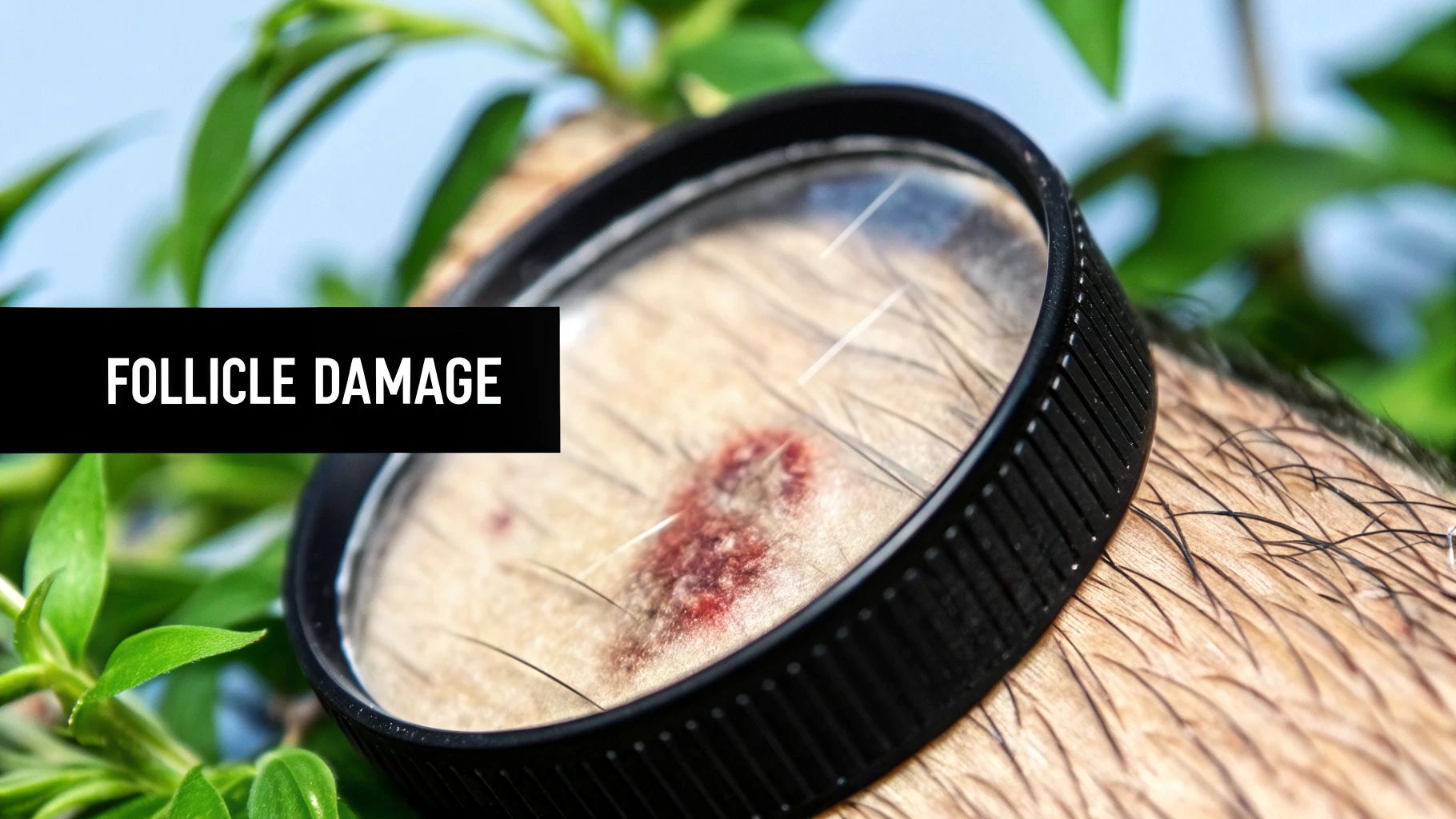
When we list the dangers of smoking, lung cancer and heart disease usually steal the spotlight. But the damage runs much deeper, reaching parts of your body you might never suspect—including your hair. And this isn't just an old wives' tale; it's a connection backed by solid scientific evidence.
Imagine your hair follicles as tiny, high-powered factories. To churn out strong, healthy hair, they need a constant delivery of oxygen and nutrients. Smoking throws a massive wrench in the whole operation, completely disrupting that critical supply chain.
Let's quickly break down the main ways smoking sabotages your hair before we dive deeper.
How Smoking Impacts Your Hair at a Glance
| Mechanism of Damage | Impact on Hair Follicles |
|---|---|
| Vasoconstriction | Nicotine narrows blood vessels, starving follicles of the oxygen and nutrients they need. |
| DNA Damage | Toxins from smoke can mess with the DNA of the hair follicle, throwing the growth cycle off track. |
| Oxidative Stress | Free radicals speed up the aging of follicles, which leads to weaker, thinner hair. |
| Hormonal Imbalance | Smoking can interfere with key hormones that are essential for healthy hair growth. |
This table gives you the snapshot, but really understanding the specifics is key to seeing just how damaging this habit can be for your hair.
How Smoking Systematically Sabotages Your Scalp
From the inside out, smoking wages a quiet war on your hair. With over 1 billion smokers across the globe, this habit is one of the biggest preventable risk factors for premature hair loss. The heart of the problem lies in how smoking messes with blood flow and floods your system with toxins, leading to something called oxidative stress.
This internal damage shows up in a few distinct ways:
- Restricted Blood Flow: Nicotine is a vasoconstrictor, which means it literally causes your blood vessels to tighten and shrink. This drastically cuts down on the amount of nutrient-rich blood that can get to your scalp.
- Toxic Chemical Soup: The thousands of chemicals in cigarette smoke don't just hang out in your lungs. They get into your bloodstream, creating a hostile environment that directly weakens your hair follicles.
- Accelerated Aging: Smoking unleashes a flood of free radicals in your body. These unstable molecules attack healthy cells—including the ones that build your hair—causing them to age and fail way too early.
In short, smoking starves your hair follicles while simultaneously poisoning them. It's a devastating one-two punch that creates the perfect storm for thinning, shedding, and ultimately, hair loss.
Of course, smoking is often just one piece of the puzzle. It's important to understand all the potential hair loss causes to get a full picture of what’s going on with your hair. Now, let’s dig a bit deeper into the science behind how this all happens.
How Smoking Systematically Weakens Hair Follicles
Think of your hair follicles as tiny, intricate factories. For these factories to run smoothly and produce healthy hair, they need a constant supply line of oxygen, nutrients, and vital building blocks. Smoking, however, launches a multi-pronged attack on this delicate system, slowly but surely shutting down production.
It's not something that happens overnight. Instead, it’s a gradual breakdown of your body's ability to support the very foundation of hair growth.
Constricting Your Blood Vessels
The most immediate hit your hair takes from smoking comes from nicotine. Nicotine is a potent vasoconstrictor, which is just a fancy way of saying it tightens and narrows your blood vessels. Picture someone pinching a garden hose—the water flow instantly drops to a trickle.
That's exactly what's happening to the tiny capillaries feeding your scalp. This restricted blood flow means less oxygen, fewer vitamins, and not enough essential minerals can reach your hair follicles. Over time, this nutrient deficit essentially starves the follicles, making them weaker and less capable of producing strong, healthy hair.
This is the direct link: nicotine enters your system, blood flow slows to a crawl, and the risk of hair loss shoots up.
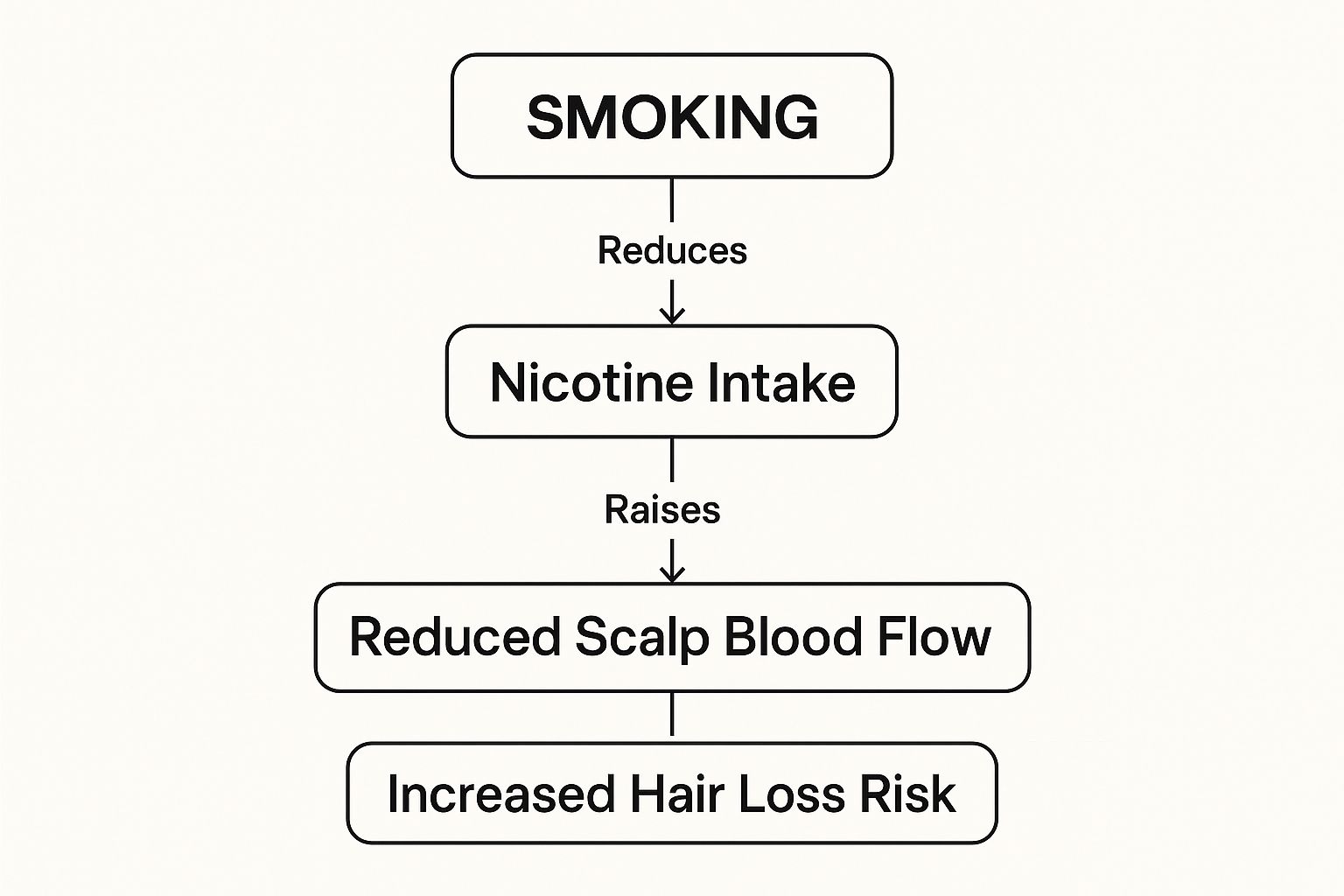
As you can see, the problem starts with nicotine intake, which directly compromises the circulatory system responsible for nourishing your entire scalp.
Triggering Oxidative Stress
Beyond just choking off the blood supply, cigarette smoke unleashes thousands of toxic chemicals into your body. This chemical bombardment triggers a state known as oxidative stress.
You can think of oxidative stress like rust forming on metal. It’s a damaging process where unstable molecules called free radicals attack and degrade healthy cells, including the cells that make up your hair follicles. This widespread cellular damage forces the follicles to age faster, disrupting the natural hair growth cycle.
To put it simply, smoking puts your hair follicles on the fast track to premature aging. They become less resilient, more prone to damage, and eventually, they just can't keep up with producing hair at all.
This sustained stress is a key driver of hair follicle miniaturization, the process where follicles shrink over time, producing progressively thinner and weaker hairs. You can learn more about how https://prpforhairloss.com/hair-follicle-miniaturization leads to visible thinning.
Damaging Your DNA
The attack doesn't stop at the cellular level. Some of the toxins in cigarette smoke are genotoxic, meaning they can directly damage the DNA inside your hair follicles. Your DNA is the master blueprint for building every part of your body, including your hair.
When this genetic code gets corrupted, the instructions for creating strong, healthy hair strands become flawed. This can lead to a few serious problems:
- Weaker Hair Structure: Hairs grow in brittle and become much more prone to breakage.
- Disrupted Growth Cycles: The natural rhythm of hair growing, resting, and shedding gets thrown completely off-kilter.
- Reduced Follicle Function: Over time, the follicle's ability to regenerate and produce new hair is seriously impaired.
To really grasp how this happens, it's worth understanding the 7 dangerous chemicals found in cigarettes that are responsible for this internal damage.
Upsetting Your Hormonal Balance
Finally, smoking can throw a wrench into your endocrine system—the complex network that regulates your hormones. For men, this is a big deal because smoking has been shown to increase levels of dihydrotestosterone (DHT), the primary hormone linked to male pattern baldness (androgenetic alopecia).
A spike in DHT can cause hormone-sensitive hair follicles to shrink and, eventually, stop producing hair altogether. By messing with this delicate hormonal balance, smoking can hit the accelerator on the exact type of genetic hair loss that many men are already predisposed to.
The Visible Evidence of Smoking on Your Hair
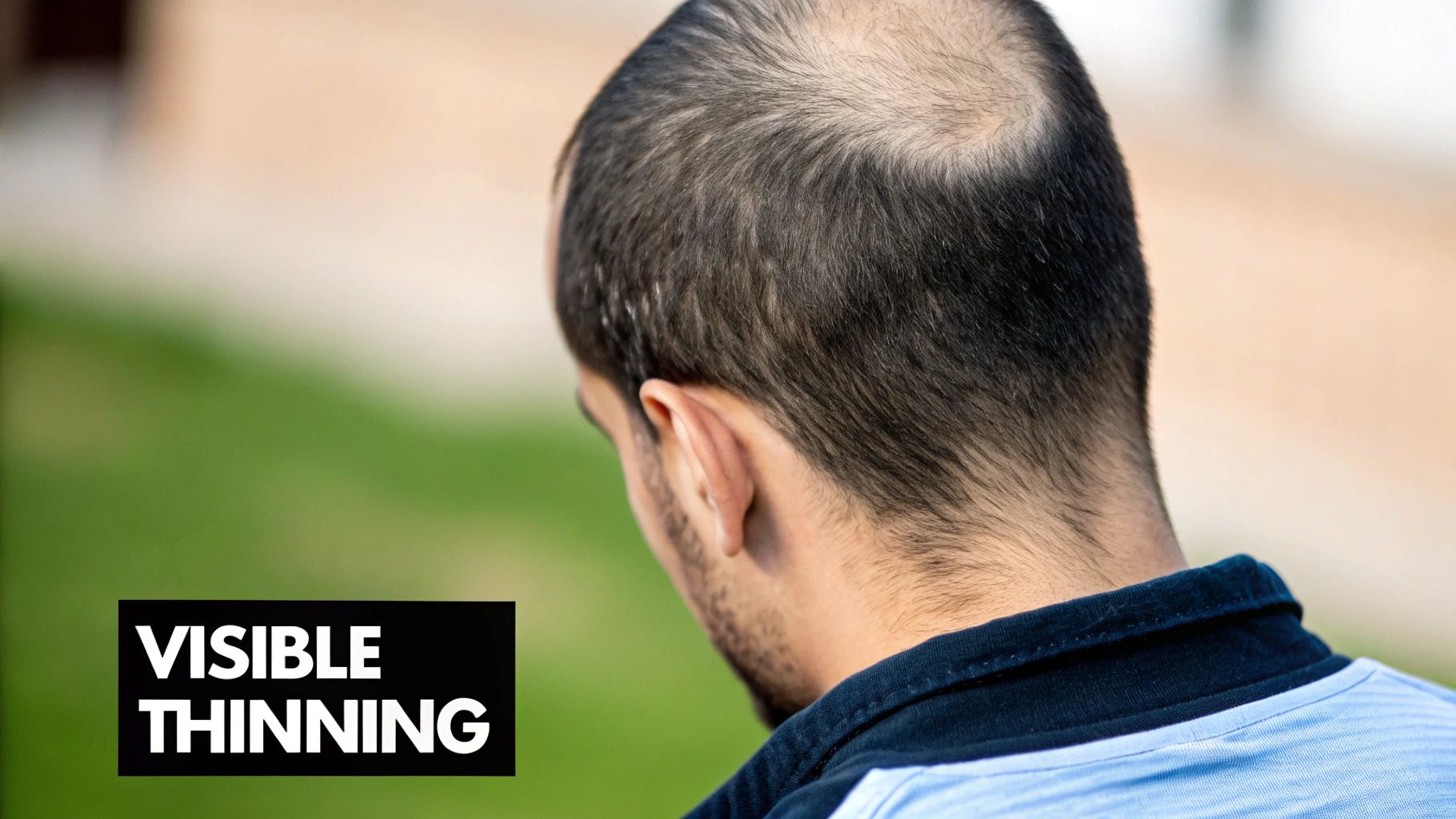
The internal havoc that smoking wreaks isn't just a quiet, invisible battle. Sooner or later, the consequences show up where you can’t miss them—in the mirror. All that systemic damage to your follicles eventually translates into real, tangible changes to your hairline and the overall quality of your hair.
This is where the connection between smoking and hair loss becomes impossible to ignore. Two of the most common signs you'll see are a dramatic acceleration of male pattern baldness and the unwelcome, early arrival of gray hair.
Speeding Up Pattern Baldness
For a lot of guys, androgenetic alopecia (your classic male pattern baldness) is simply in the cards, genetically speaking. But smoking is like pouring gasoline on that fire. It can take a process that might have unfolded over decades and put it on the fast track.
When scientists study balding, they use grading scales to measure its progression. A "grade 3" hair loss, for example, isn't just some abstract number. It's that distinct, M-shaped recession at your temples. It’s the stage where thinning stops being subtle and starts becoming a noticeable feature.
This acceleration happens because smoking cranks up the very issues that drive pattern baldness in the first place—poor scalp circulation and hormonal disruptions. Your genetic blueprint might be the roadmap, but smoking is the foot slamming on the accelerator, racing you toward significant hair loss much faster than nature intended.
A revealing 2020 study focusing on men aged 20 to 35 painted a stark picture. Out of 500 smokers in the study, a staggering 425 showed some degree of hair loss. In the group of 500 nonsmokers, only 200 did. Diving deeper, the researchers found that 47% of the smokers had already reached grade 3 hair loss, and another 24% were at grade 4, which includes significant balding at the crown. You can find more details on these findings over at Healthline.com.
The Premature Graying Effect
The other dead giveaway is going gray way too early. The same oxidative stress that hobbles a follicle's ability to grow hair also assaults the melanocytes. These are the tiny pigment factories in your follicles that produce the color for your hair.
When these cells are under constant siege from the toxins in cigarette smoke, they start to wear out. Their pigment production sputters and declines, resulting in gray and white hairs popping up years, or even decades, ahead of schedule.
In essence, smoking ages your hair follicles from the inside out. This accelerated aging shows up as both a loss of hair and a loss of color, hitting your appearance with a one-two punch.
The proof is right there to see. Smoking isn't some abstract health risk; it actively contributes to the very things most men worry about as they get older—a receding hairline and premature graying—making it a direct and powerful driver of the visible signs of aging.
Is Vaping a Safer Bet for Your Hair?
With e-cigarettes everywhere you look, a lot of people are asking a pretty reasonable question: is switching to vaping any better for my hair? On the surface, it seems like a no-brainer. Vaping gets rid of the tar and a whole cocktail of chemicals found in regular cigarettes, which sounds like a huge step up.
But here’s the catch. When we're talking about smoking and hair loss, the smoke isn't the only villain—it's the nicotine. And guess what? Vapes and e-liquids are almost always loaded with it, sometimes in even higher concentrations. That one ingredient is what really does a number on the circulatory system that feeds your hair follicles.
So even though you're dodging tar, you're still getting a direct hit of the substance that clamps down on your blood vessels and chokes off blood flow to your scalp. You’ve changed the delivery system, but the core problem for your hair hasn’t gone anywhere.
Nicotine Doesn't Care How It Gets There
Nicotine is a potent vasoconstrictor. That’s a fancy way of saying it makes your blood vessels tighten up, and it does this whether you inhale it from a cigarette or a vape.
Think of it like pinching a garden hose. Even if the water is perfectly clean, the flowers at the end will wither because they aren't getting enough. Your hair follicles are those flowers. Reduced blood flow means they're constantly starved of the oxygen and nutrients they need to produce strong, healthy hair.
This puts your scalp under chronic stress. While vaping certainly cuts down on your exposure to some nasty toxins, it doesn't solve the fundamental circulation issue that leads directly to thinning and hair loss.
The Honest Truth About Vaping and Your Hair
Let's be clear: vaping is probably less damaging to your overall health than smoking. You're dodging a long list of carcinogens, and that's a good thing. But when it comes to your hair, it's definitely not a get-out-of-jail-free card.
The reality is simple: any form of nicotine is a major risk for your hair. As long as you're consuming it, the damage to your circulatory system continues, and so does the threat to your hair follicles.
Let’s break down how each one impacts your hair:
- Cigarettes: These hit you with a one-two punch. You get the nicotine, which restricts blood flow, and thousands of toxins that cause DNA damage and oxidative stress.
- Vaping: This method mainly delivers nicotine. While you skip the tar and smoke, you still get the vasoconstriction that suffocates your hair follicles.
At the end of the day, if you’re serious about protecting your hair, the goal has to be quitting nicotine altogether. Moving from smoking to vaping might feel like a healthier choice, but it’s critical to realize you’re not eliminating the main threat that nicotine poses to a full, healthy head of hair.
Can Your Hair Truly Recover After Quitting?

This is where the conversation shifts from damage to hope. The human body has an incredible capacity for healing, and that absolutely includes the complex ecosystem that is your scalp. The moment you stop smoking, you call off the constant assault on your hair follicles, finally giving them a fighting chance to recover.
The great news? The benefits kick in almost immediately. When you quit, you stop any further damage in its tracks and allow healthy circulation to begin its slow journey back to normal. Think of it like finally unkinking a garden hose—water (or in this case, blood and nutrients) can once again flow freely to the roots, giving your hair the resources it desperately needs to grow.
Of course, it’s crucial to have realistic expectations. The degree of recovery really depends on two big things: how long you’ve been smoking and just how much damage your follicles have sustained over that time. Some follicles might just be sleeping (dormant) and can be woken up, but others, unfortunately, may be damaged beyond repair.
Setting a Realistic Timeline for Recovery
Recovering your hair isn't an overnight fix. It’s a marathon, not a sprint, and the timeline syncs up with your body's natural healing and hair growth cycles. While you might not see a full, thick mane in the first few weeks, rest assured that positive changes are happening under the surface.
Here's a general idea of what you can expect on the road back to healthier hair:
- Immediate (First Few Days to Weeks): Your circulation gets a major boost. More oxygen and vital nutrients start reaching your scalp, creating a much better environment for your hair to grow.
- Short-Term (1-3 Months): You'll probably notice you’re shedding less. The hair you already have might even start looking healthier and feeling stronger as your follicles finally get the nourishment they've been missing.
- Long-Term (6+ Months): This is the magic window where new growth often becomes noticeable. If your follicles were only dormant and not permanently damaged, they may re-enter the growth phase. Over time, this can lead to a visible increase in hair density.
The most powerful step you can take is quitting. Every single day you stay smoke-free, you're giving your hair a better shot at bouncing back and rebuilding its strength from the inside out.
What Science Says About Reversing the Damage
The link between smoking, hair loss, and even going gray prematurely is not just anecdotal; it's backed by a ton of research. A major 2021 review that looked at 32 different studies found a significant connection between smoking and alopecia. The research showed that compounds like nicotine build up in the hair follicles, throwing the entire growth cycle out of whack.
You can dig into the specifics of these findings in this comprehensive hair health review on PMC NCBI.
What this all means is that by getting these toxic chemicals out of your system, you allow your hair's natural cycle to find its rhythm again. While quitting can't reverse something like genetic baldness, it removes a massive roadblock that was putting it into overdrive. To get the full picture, you can learn more about the other factors that explain why hair stops growing.
Ultimately, putting down the cigarettes is the single best decision you can make to give your hair a real chance at recovery.
A Practical Plan to Help Your Hair Bounce Back
Kicking the smoking habit is the single biggest win for your hair, but the work doesn't stop there. You can actively help your follicles recover and encourage stronger, healthier regrowth by giving your body and scalp exactly what they need.
Think of it as a three-pronged strategy: fueling your body from the inside, revitalizing your scalp from the outside, and knowing when it's time to bring in a professional.
Refuel Your System with Hair-Building Nutrients
Smoking doesn't just damage your lungs; it robs your body of essential nutrients and unleashes a flood of damaging free radicals. Your first mission is to counteract that damage by reloading your system with the right foods.
- Go big on Vitamin C: This isn't just for colds. Vitamin C, found in citrus, bell peppers, and strawberries, is a master antioxidant and crucial for building collagen—the protein that gives your hair its strength.
- Bring in Biotin: Often called the "hair growth vitamin," biotin is a B-vitamin that's essential for healthy hair. You'll find it in eggs, nuts, and whole grains.
- Don't forget Iron and Zinc: Your hair follicles are like tiny factories, and they need raw materials to work. Lean meats, spinach, and lentils are packed with the iron and zinc required to build strong hair strands.
A nutrient-rich diet does more than just support your overall health. It directly delivers the building blocks your recovering follicles are crying out for.
Revitalize Your Scalp
Now, let's get that blood flowing again. A simple, daily scalp massage can make a world of difference. It’s a hands-on way to stimulate circulation, coax dormant follicles back to life, and ensure all those great nutrients you're eating actually get to where they need to go.
Just use the pads of your fingers to make gentle, circular motions across your entire scalp for a few minutes each day. It feels great, reduces stress (another hair loss culprit), and gets that blood moving.
Know When to Call in the Experts
Making these changes is a huge step, but sometimes, years of damage require a more targeted solution. If you’ve been smoke-free for several months and aren't seeing the results you’d hoped for, it might be time to chat with a dermatologist.
A specialist can properly assess your hair and scalp and suggest more advanced treatments. For many people, therapies like Platelet-Rich Plasma (PRP) can be a game-changer. It's worth learning about the PRP hair treatment benefits to see if it’s a good fit for your situation.
Got Questions? We've Got Answers
Even with all the science, you probably still have a few specific questions buzzing around. It's only natural. Let's break down some of the most common things people ask about the connection between smoking and their hair.
How Quickly Does Smoking Cause Hair Loss?
This is a tough one because there’s no magic number. Think of it less like a switch and more like a slow burn. The damage starts on the inside from the very first cigarette, but when you see it depends on your unique situation—your genes, your overall health, and how much you smoke.
For some, noticeable thinning might creep in after a few years. For others, it could take a decade or more before the effects become obvious. The real takeaway is this: smoking hits the fast-forward button on hair loss, kicking off a process that might have stayed dormant for years.
What About Secondhand Smoke? Is My Hair Safe?
Unfortunately, no. While puffing on a cigarette yourself delivers the biggest blow, the toxins in secondhand smoke are still a serious problem. When you breathe in that smoke-filled air, carbon monoxide and other nasty chemicals find their way into your bloodstream.
From there, they can still restrict blood flow and crank up the oxidative stress that harms your follicles. It might be less direct, but constant exposure is far from harmless for your scalp.
Simply put, any contact with tobacco smoke—whether you’re the smoker or just in the room—makes it harder for your hair to thrive.
If I Quit, Will My Gray Hair Go Back to Its Original Color?
This is one of those changes that is almost always permanent, I'm afraid. Smoking speeds up the graying process by unleashing oxidative stress on the pigment-producing cells in your follicles, called melanocytes. Once these cells are damaged or die off, they’re gone for good.
But it’s not all bad news. When you quit, you slam the brakes on that damage. You stop the assault, helping you hold onto the natural color you still have and slowing down the appearance of new grays. It's also worth noting that stress can be a big factor in hair health; we cover this in our guide on how anxiety can cause hair loss.
At PRP For HairLoss, we're dedicated to providing men with the information they need to understand and address hair loss. Explore our resources to find the right path forward for you. https://prpforhairloss.com
 PRP For Hairloss
Leave a comment