It's a common assumption that if your hair is thinning, your testosterone levels must be dropping. It makes sense on the surface, but the real story is a bit more complicated. So, does low testosterone cause hair loss? Surprisingly, the answer is no, not really.
The true culprit behind male pattern baldness isn't the amount of testosterone you have, but rather how your body processes it.
The Hormone and Hair Loss Paradox
One of the biggest myths in men's health is that a receding hairline is a direct sign of tanking testosterone. While it seems logical, the science points to a far more nuanced connection. Your total testosterone level isn't the direct villain here.
The real driver behind genetic hair loss is a much more potent hormone called Dihydrotestosterone (DHT). Think of testosterone as the base ingredient. An enzyme in your body takes about 5% of that testosterone and converts it into DHT. For men with a genetic predisposition to hair loss, this is where the problem starts.
Testosterone vs DHT A Quick Comparison
While both are male hormones (androgens), the way your hair follicles react to each one is worlds apart. Grasping this difference is crucial to understanding why male pattern baldness happens.
Here’s a simple breakdown of their roles:
| Hormone | Primary Role in the Body | Effect on Scalp Hair Follicles |
|---|---|---|
| Testosterone | Builds muscle mass, maintains bone density, and regulates libido. | Has very little direct effect on hair loss. It mainly acts as the precursor to DHT. |
| DHT | Essential for male development before birth and during puberty. | For genetically susceptible men, it latches onto hair follicles, causing them to shrink and eventually stop growing hair. |
This process is why it's a paradox. You can have completely normal (or even low) testosterone levels and still experience significant hair loss if your follicles are sensitive to DHT.
Decades of research back this up. Male pattern baldness impacts up to 50% of men by age 50, yet study after study fails to find a consistent link between low testosterone and hair loss. You can dive deeper into these findings in the comprehensive Endotext review published by the NCBI.
Ultimately, it’s not about how much testosterone you have, but about a genetic lottery. This genetic sensitivity dictates whether your follicles will miniaturize when exposed to normal amounts of DHT.
If you want to explore how other hormonal shifts can affect your hair, check out our guide on if a hormone imbalance can cause hair loss.
Meet DHT: The Real Culprit Behind Male Pattern Baldness
So, if testosterone isn't the direct villain in your hair loss story, who is? The answer is a potent byproduct called Dihydrotestosterone (DHT). It's helpful to think of testosterone as crude oil—it has potential, but it needs to be refined to become high-octane fuel. In your body, that refinery is an enzyme known as 5-alpha reductase.
This enzyme takes a small amount of your circulating testosterone and converts it into DHT, an androgen that is significantly more powerful. While DHT plays a vital role in male development, it becomes a major problem for hair follicles later in life, but only for those who are genetically predisposed to baldness. This conversion is the first domino to fall in the chain reaction that leads to thinning hair.
This infographic breaks down the common misconception, showing how testosterone gets the blame when DHT is the actual trigger.
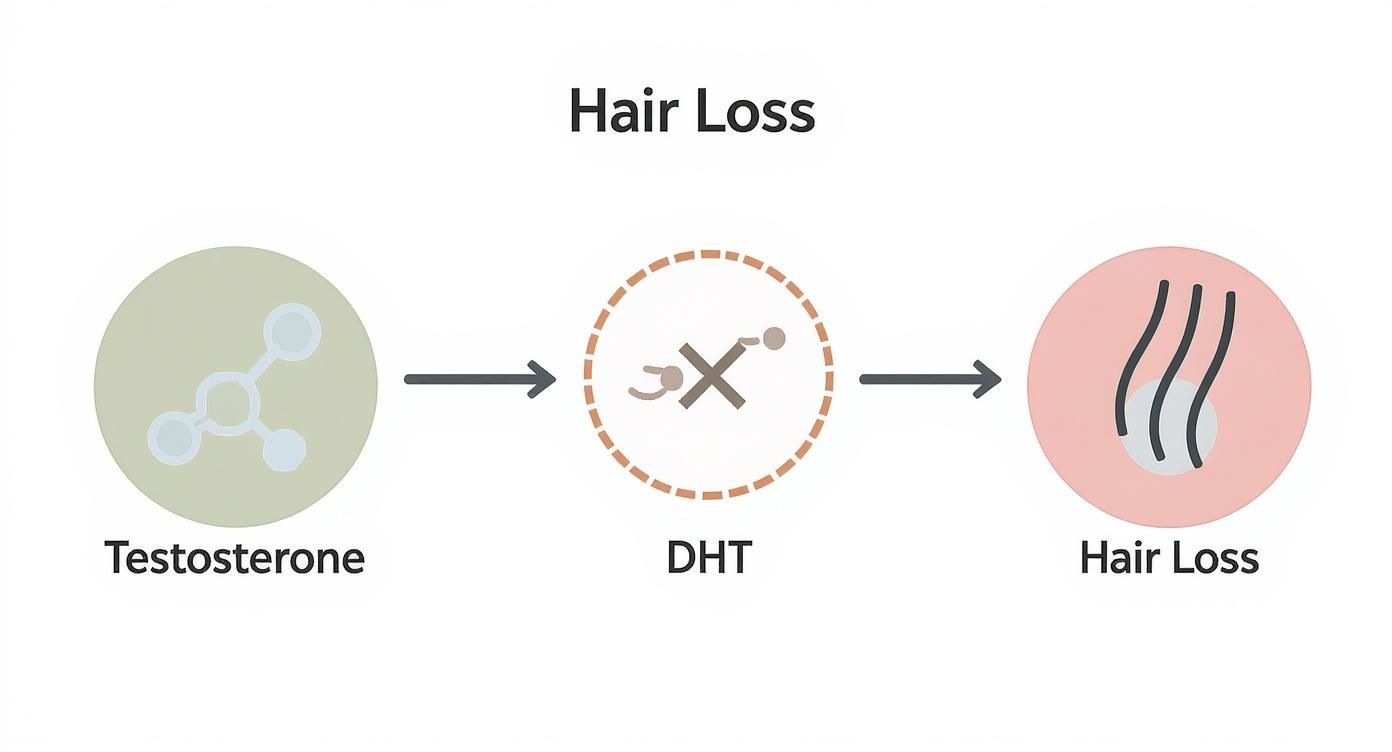
As you can see, the idea that testosterone levels alone cause hair loss is a myth. The real story is all about DHT and how your follicles react to it.
How DHT Actually Causes Hair Loss
The heart of the matter isn't how much testosterone you have, but how sensitive your hair follicles are to DHT. It’s an inherited trait. For men with the genes for baldness, the follicles on their scalp are loaded with receptors that DHT can easily bind to.
Once DHT latches onto these receptors, it sends a signal that kicks off a destructive process called miniaturization. This is a gradual, relentless shrinking of the hair follicle.
Miniaturization doesn't happen overnight. It's a slow, progressive cycle where each new hair that grows from the affected follicle is thinner, shorter, and weaker than the one before it.
This process also shortens the hair's growth phase. Over years, the follicle shrinks so much that it can no longer produce a visible hair. This is what creates the classic signs of male pattern baldness, like a receding hairline or a thinning crown.
Ultimately, whether you have high, normal, or even low testosterone levels doesn't really matter. It all boils down to two things: the presence of DHT and your follicles' genetic programming. Grasping this is the first real step toward finding treatments that work because they target the true source of the problem.
For a deeper dive into this hormone, you can learn more about what DHT is and its connection to hair loss in our detailed guide.
What the Clinical Evidence Actually Shows
So, what happens when we move past the biological theories and look at what the actual scientific research says? When we dig into the clinical studies, a very clear pattern emerges, and it consistently unravels the myth connecting low testosterone to hair loss. The evidence points away from low T and shines a bright light back on DHT sensitivity.
Countless studies have put this to the test, comparing testosterone levels in men with significant male pattern baldness against men with a full head of hair. For anyone holding onto the low T theory, the results are often a surprise. Researchers repeatedly find no significant difference in the average testosterone levels between the two groups.
This is a critical piece of information. It shows us that a man can have high, normal, or even low testosterone and still lose his hair. It reinforces the idea that the total amount of testosterone in your system isn't the real driver—it’s how your hair follicles are genetically programmed to react to DHT that truly matters.
Insights from Hormone Therapies
Some of the most powerful evidence comes from a seemingly unlikely place: men undergoing testosterone replacement therapy (TRT). You’d think that if low testosterone caused hair loss, then giving men more testosterone would fix the problem, right?
In reality, the opposite can happen.
For men who are already genetically prone to baldness, starting TRT can sometimes accelerate hair loss. It’s like adding fuel to a fire. The therapy introduces more raw testosterone, which the 5-alpha reductase enzyme then happily converts into more DHT. This surge in DHT simply speeds up the hair follicle miniaturization that was already destined to happen.
This finding is a cornerstone of our understanding. It proves that increasing testosterone doesn't protect against hair loss. In fact, for those who are genetically susceptible, it can make things worse by cranking up DHT production.
This clinical observation lands a heavy blow to the idea that low testosterone is the culprit. Instead, it powerfully supports the scientific consensus that DHT is the primary trigger for androgenetic alopecia. You can dive deeper into this process in our guide on what causes this common form of hair loss.
What Large-Scale Studies Reveal
Looking at bigger population studies only solidifies this conclusion. For example, one important cross-sectional study analyzed men with different types of hair loss. The researchers discovered that while 19% of men with a less common, female-pattern of hair loss had low testosterone, zero men with classic male pattern baldness had low T.
This strongly suggests that low testosterone isn't the cause behind the typical receding hairline or thinning crown we associate with male hair loss. You can read the full research about these findings to see the data for yourself.
When Other Hormonal Issues Can Affect Your Hair
While we've established that low testosterone doesn't directly cause male pattern baldness, your body's hormonal system is a complex and interconnected web. It’s like a finely tuned orchestra—if one instrument plays out of key, the whole performance can sound off. Your hair health works the same way; other hormonal imbalances can definitely trigger hair thinning.
This is where a condition called telogen effluvium often enters the picture. Unlike the slow, predictable pattern of genetic baldness, this is a sudden, all-over shedding. It's usually triggered by a significant shock to your system, and that shock is very often hormonal.
Thyroid Issues and Hair Loss
One of the most common culprits behind hormone-related hair shedding is the thyroid gland. Whether it's underactive (hypothyroidism) or overactive (hyperthyroidism), an imbalance can seriously disrupt your normal hair growth cycle.
When thyroid hormones are out of whack, they can prematurely push a large number of hair follicles into their resting (telogen) phase. A few months later, you’ll start to see noticeable, widespread shedding. The good news? This kind of hair loss is typically reversible once the underlying thyroid problem is properly treated. We dive deeper into this connection in our article on thyroid-related hair loss in men.
The Role of Stress Hormones
Ever notice more hair in the shower after a particularly tough month? That’s not a coincidence. Major life events, a serious illness, or just chronic emotional stress can cause a spike in cortisol, your body's main stress hormone.
High cortisol levels can interfere with follicle function and, much like a thyroid imbalance, trigger telogen effluvium. It's your body's survival mechanism, redirecting energy away from non-essential tasks like growing hair to focus on dealing with a perceived threat.
It's important to see that while testosterone gets most of the attention, maintaining overall hormonal health is a critical piece of the puzzle for keeping your hair. The body's balance is delicate, and many factors can influence it.
This complex hormonal link is also clear in women. Interestingly, most women who experience hair loss actually have normal testosterone levels, further debunking the myth that low T is the primary cause.
In fact, one study found that testosterone therapy actually helped 63% of women with androgen deficiency regrow hair. This surprising result shows just how nuanced the role of hormones can be, and you can explore more insights about pattern hair loss on Wikipedia to get more context. It all comes back to the same core principle: a balanced, holistic approach to health is vital.
Decoding the Real Symptoms of Low Testosterone
If hair loss isn't a dead giveaway for low testosterone, what is? That’s the million-dollar question. It's incredibly important to know the difference between the signs of genetic baldness and clinically low testosterone, often called hypogonadism. Getting it wrong means you could be chasing hormone solutions when the real problem is sitting right on your scalp with your hair follicles.
The clues your body gives for low T are usually systemic—they impact your whole system, not just one isolated spot. Think of it this way: a thinning crown is a cosmetic change you see in the mirror. Low testosterone is something you feel throughout your entire day, hitting your energy, mood, and even your physical strength. The two send completely different signals.
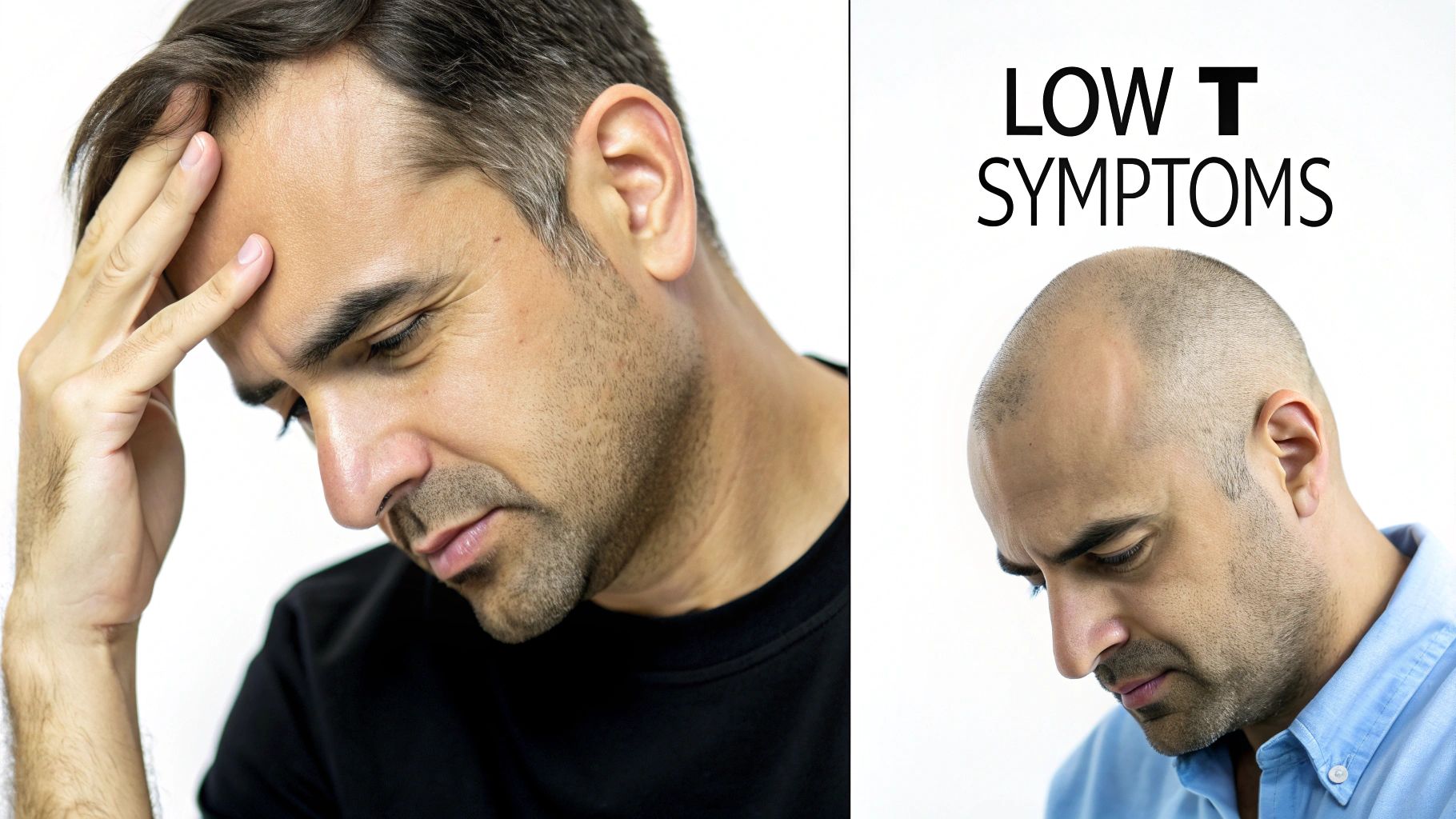
Unpacking the True Indicators of Low T
So, what should you actually be looking for? Low testosterone often shows up as a bone-deep fatigue that no amount of sleep seems to fix. It can also manifest as a nosedive in your sex drive or finding it tougher to build or even maintain muscle, no matter how hard you hit the gym. These signs are far more telling of a hormonal issue than the shape of your hairline.
The classic signs of low testosterone are related to energy, mood, and physical function. These include chronic fatigue, reduced libido, loss of muscle, increased body fat, and even mood swings or feelings of depression.
Grasping these differences is the first step. To get a better handle on how testosterone levels naturally shift over time, it's worth reading up on what's normal and what might be a red flag. This guide on Testosterone Levels by Age: What Men Need to Know offers some fantastic context.
Low T vs. Male Pattern Hair Loss: A Clear Comparison
Let’s cut right through the noise and put the symptoms side-by-side. This direct comparison makes it crystal clear why male pattern baldness and low testosterone are two separate issues demanding two very different game plans. One is a story about your genes and DHT sensitivity; the other is about a hormone shortfall affecting your whole body.
Here's a straightforward checklist to help you figure out which symptom profile sounds more like what you're going through. This should help you walk into a doctor's office feeling more prepared and informed.
Symptoms Checklist: Low Testosterone vs. Male Pattern Hair Loss
| Symptom Area | Commonly Associated with Low Testosterone | Commonly Associated with Male Pattern Hair Loss |
|---|---|---|
| Energy & Mood | Pervasive fatigue, irritability, difficulty concentrating, or symptoms of depression. | No direct impact on energy levels or overall mood. |
| Physical Changes | Decreased muscle mass, increased body fat (especially around the midsection), and reduced body hair. | Specifically scalp hair loss, typically at the temples (receding hairline) or the crown. |
| Sexual Health | A significant drop in libido (sex drive) and potential erectile dysfunction. | No direct effect on libido or sexual function. |
| Onset & Pattern | Symptoms often develop gradually and affect overall well-being. | Follows a predictable pattern (like the Norwood scale) and is isolated to the scalp. |
Seeing it laid out like this really highlights the distinction. While both can be frustrating, understanding the root cause is the only way to find a solution that actually works.
Effective Hair Loss Treatments That Target DHT
Once you grasp that DHT, not low testosterone, is the real driver behind your hair loss, finding a solution becomes much clearer. The most effective treatments don't mess with your overall testosterone levels. Instead, they go straight to the source, either blocking DHT's creation or giving the follicles a direct boost.
The gold-standard treatments for androgenetic alopecia all zero in on disrupting this hormonal process. They work by throwing a wrench into the chain of events that causes your hair follicles to shrink and give up.

Interrupting the DHT Conversion Process
One of the most proven medical strategies is to block the 5-alpha reductase enzyme. This is the catalyst that supercharges testosterone into the much more aggressive DHT. If you can inhibit this enzyme, you dramatically lower the amount of DHT available to attack your follicles.
It’s like shutting down the factory that produces the ammunition. The fewer DHT molecules that make it to your scalp, the less damage they can inflict. This is exactly how medications like Finasteride operate. If you're considering this path, it's worth digging into the details of how Finasteride works to stop hair loss.
Minoxidil, another very common treatment, takes a different angle. It’s a vasodilator, meaning it helps widen blood vessels. The idea is to improve blood flow and nutrient delivery to the follicles, which can coax them out of their resting phase and back into active growth.
Stimulating Follicles Through a Different Pathway
But not every effective treatment is about hormones. You can also tackle hair loss by stimulating the follicles directly, helping them resist the shrinking process and encouraging new, healthier hair to grow.
Platelet-Rich Plasma (PRP) therapy is a perfect example. This treatment uses the powerful growth factors found in your own blood. We isolate them, concentrate them, and then inject this "liquid gold" back into your scalp to wake up dormant follicles.
PRP completely sidesteps the hormonal route. Instead of fighting DHT, it focuses on cellular regeneration and healing from within. It’s a targeted strike aimed at revitalizing follicles that have been weakened by DHT, offering a powerful, non-hormonal tool in the fight against hair loss.
Common Questions About Testosterone and Hair Health
Even with the science laid out, a few practical questions almost always pop up. It's a tricky subject, and getting clear, straightforward answers is crucial before you make any decisions. Let's tackle some of the most common things people ask about testosterone, treatments, and their hair.
If I Start Testosterone Replacement Therapy, Will It Make My Hair Loss Worse?
This is a big one, and the short answer is: it can speed things up. Think of Testosterone Replacement Therapy (TRT) as adding more fuel to the fire, but only if the fire is already lit.
TRT boosts your body's overall testosterone levels. If you're genetically predisposed to male pattern baldness, this just gives your body more raw material to convert into follicle-shrinking DHT. So while TRT isn’t directly attacking your hair, the inevitable spike in DHT can definitely accelerate hair loss that was already in your future.
Can Lowering My Testosterone Stop My Hair Loss?
In a word, no. This is a common misconception, but trying to solve hair loss by intentionally tanking your testosterone is a bad idea on every level. Male pattern baldness is about how sensitive your follicles are to DHT, not about how much testosterone is floating around in your system.
Dropping your testosterone into an unhealthy range won't stop the thinning, but it will open the door to a host of serious health problems. We're talking chronic fatigue, loss of muscle and bone density, and a tanked libido. Effective treatments focus on the real culprits—managing DHT or stimulating the follicles themselves—not on disrupting your core hormones.
I'm Worried About Both Issues. What's My First Step?
Start with a conversation. The best first move is to book an appointment with a medical professional, whether that’s your family doctor or a dermatologist who specializes in hair loss.
They'll do a proper workup, which usually involves checking your hormone levels with a blood test and getting a close look at your scalp. This is the only way to get a real diagnosis and figure out what’s actually causing your symptoms. From there, you can build an effective treatment plan that’s right for your specific situation.
For a deeper dive into managing hair thinning, you can find some great information on comprehensive strategies to stop hair loss.
At PRP For HairLoss, our goal is to give you clear, science-backed information so you can navigate your hair health journey with confidence. To learn more about how solutions like PRP therapy fit into the picture, explore our resources at https://prpforhairloss.com.
 PRP For Hairloss
Leave a comment