An itchy scalp that comes with hair loss isn't just a minor irritation—it’s a clear signal that something is off with your scalp's health. While the itch itself doesn’t pull your hair out, the constant scratching absolutely can. Think of the itch as a flashing warning light for an unhealthy environment where your hair is struggling to grow.
Why Your Itchy Scalp Can Lead to Hair Loss
It’s a vicious cycle that so many people get trapped in. Your scalp is on fire, you scratch it for a little relief, and before you know it, you’re seeing more hair in the shower drain. This isn't your imagination; there's a real connection between the two. It all comes down to the health of your hair follicles, which are the tiny anchors holding each strand of hair in place.
Let's use an analogy. Your scalp is like the soil in a garden. If that soil becomes inflamed, diseased, or irritated, the plants just can't flourish. It’s the same with your hair. When your scalp is inflamed from some underlying condition, it throws the hair growth cycle out of whack and weakens the follicles from the root.
The Scratching Dilemma
Constant, aggressive scratching is the most direct way we turn an itch into actual hair loss. That friction and pressure can literally snap the hair shaft, leading to breakage. Over time, this mechanical stress weakens the hair's structure, making it much more likely to fall out.
The real problem is that the inflammation or infection causing the itch is weakening your hair's foundation. Scratching just accelerates the damage, turning a temporary issue into a more noticeable problem with thinning and shedding.
Common Conditions Linking Itch and Shedding
Several well-known scalp conditions are notorious for causing both an intense itch and, consequently, hair loss. Getting to the bottom of which one you have is the first step toward getting relief. Here are the usual suspects:
- Seborrheic Dermatitis: A very common cause of stubborn dandruff, characterized by greasy, yellowish scales. You can learn more about how seborrheic dermatitis contributes to hair loss in our detailed guide.
- Scalp Psoriasis: An autoimmune condition that creates thick, silvery plaques on the scalp that can be intensely itchy.
- Fungal Infections: Things like tinea capitis, also known as ringworm, can directly invade the hair follicles, causing severe inflammation and patchy hair loss.
- Allergic Reactions: Sometimes the culprit is a sensitivity to an ingredient in your shampoo or styling products, which triggers an inflammatory reaction called contact dermatitis.
If you're dealing with this, you are far from alone. Market research shows that an itchy scalp is a major concern, with approximately 22.03% of people reporting it as a problem. Digging a bit deeper, another study found that around 13% of people specifically connected their itchy scalp to hair loss. You can find more details on these hair loss statistics and their causes. This just goes to show how intertwined these two symptoms really are.
To make things clearer, let's break down how these common conditions connect an itchy scalp to hair loss.
Common Causes of Itchy Scalp and Hair Loss at a Glance
| Condition | Primary Cause of Itch | How It Can Lead to Hair Loss |
|---|---|---|
| Seborrheic Dermatitis | Overgrowth of Malassezia yeast and inflammation. | Inflammation weakens hair follicles; scratching causes hair breakage and shedding. |
| Scalp Psoriasis | Autoimmune-driven inflammation causing rapid skin cell turnover. | Thick plaques can smother follicles; intense scratching leads to significant breakage. |
| Fungal Infections | Fungi directly invade the hair shaft and follicles. | Inflammation damages the follicle directly, causing hair to break off at the scalp, resulting in patchy loss. |
| Allergic Reactions | An inflammatory response to chemicals in hair products. | Widespread scalp inflammation disrupts the hair growth cycle and weakens roots; scratching worsens the damage. |
This table gives you a quick snapshot of the "why" behind your symptoms. Identifying the root cause is the only way to find a treatment that works for both the itch and the hair loss.
What Your Itchy Scalp Is Trying to Tell You
That nagging itch on your scalp is more than just an annoyance—it's your body's way of sending up a flare. Think of it as a check-engine light for your scalp's health. Figuring out what that signal means is the first step toward getting real relief and stopping any related hair loss dead in its tracks.
The connection between scalp irritation and thinning hair is direct and often mechanical. You feel an itch, you scratch, and that scratching can do a lot more damage than you think.
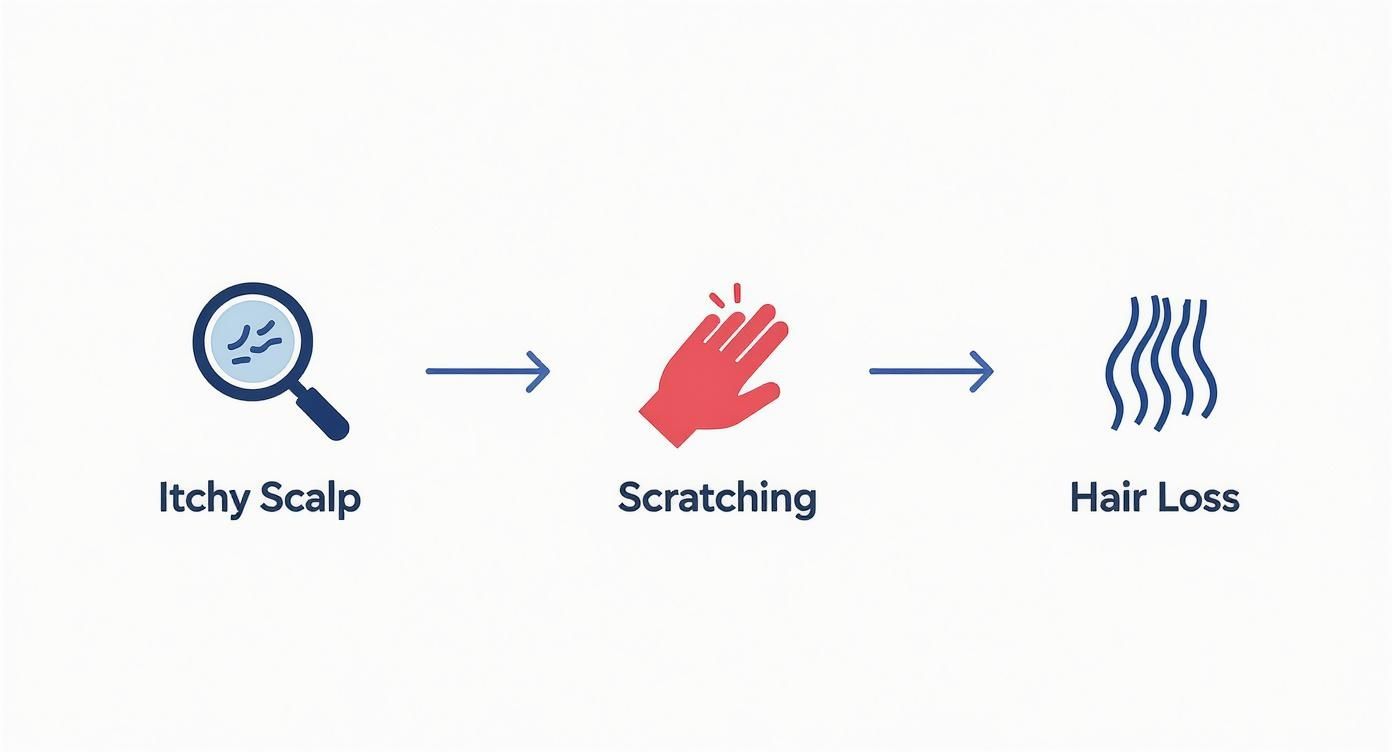
This cycle of itching and scratching weakens hair follicles, making them vulnerable to shedding and breakage. But what’s causing the itch in the first place? Let's break down the most common culprits.
Seborrheic Dermatitis: The Oily Overgrowth
One of the most common reasons for an itchy scalp is seborrheic dermatitis. This is basically dandruff on steroids—a more severe, inflammatory version. It kicks off when a yeast-like fungus called Malassezia, a normal resident on our skin, starts to multiply out of control, feeding on the natural oils (sebum) your scalp produces.
Your immune system spots the overgrowth and launches an inflammatory counter-attack. This battle leaves you with a red, itchy scalp covered in greasy, yellowish flakes that cling to your hair and skin. If your flakes seem more oily than dry and powdery, this is a likely suspect. For a deeper dive, check out our guide on how dandruff can cause hair loss.
The constant inflammation puts stress on your hair follicles. Add in the scratching, and you've created a perfect storm for hair thinning.
Scalp Psoriasis: An Autoimmune Response
With scalp psoriasis, the problem isn't an external invader but your own body's defense system. It’s an autoimmune condition where your immune system gets its signals crossed and attacks healthy skin cells. This triggers them to reproduce way too fast. The result is thick, well-defined red patches topped with silvery scales.
The itch from psoriasis can be intense and relentless. Worse, these thick plaques can physically block and smother hair follicles, disrupting normal growth.
The real danger to your hair with psoriasis isn't the condition itself—it's the scratching. Trying to force the scales off can pull out clumps of hair and cause serious breakage. The good news? This hair loss is usually temporary once the flare-up is under control.
Fungal Infections: A Direct Attack on the Follicle
Some fungal infections, like tinea capitis (also known as scalp ringworm), are a more direct assault. Despite the name, there’s no worm involved. It’s a fungus that invades the hair shaft and follicle directly. This causes severe itching, inflammation, and often leaves behind distinct, circular patches of scaly skin.
Because the fungus attacks the hair’s structure, it causes strands to become brittle and snap off right at the scalp's surface, leaving bald spots. It's more frequent in kids but can definitely affect adults, and it requires a targeted antifungal treatment to eliminate.
Allergic Reactions and Irritants
Sometimes, the culprit is hiding in plain sight—in your shower caddy. Contact dermatitis is an allergic reaction to an ingredient in your shampoo, hair dye, or styling product. This can trigger a widespread, red, itchy rash that turns your scalp into a hostile environment for healthy hair growth.
On the other hand, a simple case of a very dry scalp can also be the cause. Harsh shampoos, cold weather, and low humidity can strip your scalp of its natural protective oils, leaving it tight, flaky, and begging to be scratched. If you suspect dryness is the issue, it’s worth understanding the causes of dry skin to find the right way to rehydrate it. Pinpointing your specific trigger is the key to breaking the itch-scratch-hair loss cycle for good.
When It's Time to See a Doctor About Your Scalp
We've all been there—standing in the pharmacy aisle, trying to figure out which special shampoo will finally stop the itch. While a good home care routine can often soothe minor irritation, some symptoms are more than just a nuisance. They're your scalp's way of telling you it's time to call in a professional.
Ignoring these signs can let a manageable problem spiral into something more serious, potentially leading to significant hair loss or even permanent follicle damage. Knowing when to trade your self-diagnosis for a dermatologist's expertise is the single most important step you can take.
The Itch That Just Won't Quit
You’ve tried the medicated shampoos. You’ve been using that bottle of ketoconazole or selenium sulfide for weeks, but the itch is as stubborn as ever. What gives?
This is a classic sign that you’re dealing with something more than a simple case of dandruff. A persistent itch that laughs in the face of over-the-counter treatments often points to a deeper inflammatory issue, like severe seborrheic dermatitis or psoriasis. These conditions simply don't respond to drugstore solutions and require a targeted prescription from a doctor.
Visible Signs of a Bigger Problem
Your scalp should never be painful. If you start seeing or feeling any of the following, it's a clear signal that it’s time for medical attention:
- Open sores or bumps filled with pus: These are tell-tale signs of a bacterial or fungal infection, like folliculitis. If you don't treat them, they can easily damage the hair follicles and cause scarring.
- Serious pain or tenderness: A scalp that’s sore to the touch is a sign of intense inflammation, which can throw your entire hair growth cycle out of whack.
- Oozing or crusty patches: Any kind of weeping fluid is a major red flag for infection. This needs a doctor's evaluation, and fast.
These symptoms are way beyond simple irritation. They mean your body is fighting an infection that over-the-counter products just can't handle. Getting professional help is crucial to stop it from getting worse.
Here's a simple rule of thumb: if your scalp is painful, looks infected, or is actively getting worse instead of better, book that appointment. Don’t wait for things to escalate.
Alarming Changes in Your Hair
Of course, the most worrying symptom is seeing more hair in your brush or on your pillow. While a little daily shedding is perfectly normal, certain kinds of hair loss are a clear call to action.
A major red flag is the sudden appearance of perfectly smooth, coin-sized bald spots. This is the hallmark of Alopecia Areata, an autoimmune condition where your body gets confused and attacks its own hair follicles. Getting an early diagnosis is absolutely key to managing it.
Similarly, if you're noticing rapid, widespread thinning all over your head, it could point to a systemic problem like telogen effluvium, which is often kicked off by major stress, an illness, or even a nutritional deficiency. A dermatologist can play detective, figure out the trigger, and get you on the right track. For more guidance, you can read about when to see a dermatologist for hair loss concerns. Seeing a specialist takes the guesswork out of the equation and gives you a clear path forward.
Your Action Plan for a Calm Scalp and Healthy Hair
Alright, we’ve covered the why. Now, let's get into the how. Moving from understanding the problem to actively solving it is a powerful step, and this section is your practical roadmap to relief. We’ll break down the most effective ways to tackle an itchy scalp and the hair loss that can come with it, starting with options you can find today and moving up to more specialized care.
Think of this as your complete toolkit for taking back control. It’s time to calm that itch and give your hair the healthy foundation it needs to thrive.
Navigating the Pharmacy Aisle for Scalp Relief
Your first line of defense is often right in the pharmacy aisle. The right medicated shampoo can make a world of difference, but the key is matching the active ingredient to your specific problem. Grabbing the wrong one won't just be ineffective—it could even make things worse.
Think of these ingredients as specialized tools. You wouldn't use a hammer to turn a screw, right? Same logic applies here. Let's decode those labels so you can find the right tool for your scalp.
Common Over-the-Counter Ingredients
- Ketoconazole: This is a potent antifungal. It’s your go-to for seborrheic dermatitis, which is usually driven by an overgrowth of the Malassezia fungus. By knocking back the fungal population, ketoconazole gets right to the source of the inflammation and flaking. To learn more about its role, you can dig into how ketoconazole shampoo can help with hair loss.
- Selenium Sulfide: If you're dealing with stubborn, greasy flakes, selenium sulfide is a fantastic choice. It works by slowing down the rate at which your skin cells turn over, and it has antifungal properties, too. This one-two punch helps clear up severe dandruff fast.
- Salicylic Acid: Think of this as a gentle chemical exfoliant for your scalp. It does a great job dissolving and lifting away the thick scales and plaques you see with scalp psoriasis. By clearing away that buildup, it also paves the way for other medicated treatments to penetrate the skin and work better.
- Zinc Pyrithione: A classic ingredient in countless anti-dandruff shampoos for a reason. Zinc pyrithione has both antifungal and antibacterial properties, helping control the yeast that fuels dandruff while also calming inflammation.
A quick pro-tip: when you use these shampoos, follow the instructions. Most need to be left on your scalp for 3 to 5 minutes. That’s the magic window where the active ingredients really get to work before you rinse.
When You Need Prescription-Strength Solutions
If you’ve given over-the-counter options a fair shot for several weeks and aren’t seeing results, it's time to call in the professionals. A dermatologist can bring out the bigger guns with prescription-strength treatments that tackle the moderate-to-severe conditions the milder stuff can't touch.
Getting a proper diagnosis is the most important step. It puts you on the right path from the start.
A professional diagnosis is invaluable. Self-treating a condition like a fungal infection with a psoriasis shampoo won’t work and only delays proper treatment, potentially making hair loss worse.
Your doctor might prescribe one of the following:
- Topical Steroids: These are heavy-hitting anti-inflammatory agents that come in foams, solutions, or creams. They are incredibly effective at shutting down the intense redness, irritation, and itching from scalp psoriasis and severe seborrheic dermatitis.
- Oral Medications: For issues that are widespread or just won't quit, you might need an oral treatment. This could be anything from oral antifungals for an infection like tinea capitis to systemic anti-inflammatory drugs for severe autoimmune conditions.
These treatments absolutely require medical supervision, as they are stronger and come with potential side effects. Always use them exactly as your doctor directs.
Powerful Home Care and Lifestyle Strategies
Medical treatments are a huge piece of the puzzle, but what you do every day matters just as much. Building simple, consistent habits into your routine can support your treatment, help prevent flare-ups, and create a healthier scalp environment overall.
Think of these strategies as building a strong foundation. A healthy scalp is simply harder for problems to take root in.
Adopt a Gentle Hair Care Routine
Harsh products and rough handling can really aggravate an already sensitive scalp. A few small tweaks here can lead to big improvements.
- Choose the Right Daily Shampoo: Hunt for formulas that are sulfate-free and fragrance-free. Sulfates can strip your scalp of its natural, protective oils, leading straight to dryness and irritation.
- Wash with Lukewarm Water: Super hot water feels good, but it can dry out your scalp and ramp up inflammation. Stick to cool or lukewarm temperatures to keep things calm.
- Minimize Heat Styling: Blow dryers, flat irons, and curling wands are tough on both your hair and scalp. Let your hair air-dry whenever you can to give your scalp a much-needed break.
Identify and Avoid Triggers
That itch might be your scalp’s way of telling you it doesn't like something. Playing detective for a bit can help you pinpoint the culprits.
- Check Ingredient Lists: Common irritants lurking in products include fragrances, certain alcohols, and preservatives. If a flare-up happens right after you start using something new, you may have found your cause.
- Manage Stress: Stress is a massive, well-known trigger for inflammatory conditions like psoriasis and dermatitis. Making time for stress-busters like exercise, meditation, or yoga can make a real difference.
- Eat for Scalp Health: A balanced diet rich in omega-3 fatty acids, zinc, and B vitamins is fantastic for your skin—and that includes your scalp. Foods like salmon, nuts, and leafy greens can help reduce inflammation from the inside out.
Many people also turn to natural remedies to soothe and moisturize the scalp. For example, some find success by using aloe vera juice as a leave-in conditioner. By combining smart product choices with a mindful lifestyle, you create a truly comprehensive plan for lasting relief.
A Closer Look at Advanced Hair Loss Treatments
While medicated shampoos and lifestyle changes are fantastic first-line defenses for an itchy, irritated scalp, they don't always address the root cause of hair loss itself. It's common for conditions like male pattern baldness to coexist with scalp irritation. In those cases, even if you solve the itch, the underlying thinning continues.
This is where it makes sense to explore more advanced treatments designed to directly kickstart hair growth. One of the most promising and talked-about options available today is Platelet-Rich Plasma (PRP) therapy.
What Exactly Is PRP Therapy?
At its core, PRP therapy is a way of harnessing your body's own natural healing power and concentrating it right where you need it most—your hair follicles.
The process is surprisingly straightforward. It starts with a simple blood draw, just like you’d have at a regular doctor's visit. That blood sample is then placed into a centrifuge, a machine that spins it at an incredibly high speed. This spinning action separates the components of your blood.
What we're after are the platelets and plasma. Your platelets are like a team of emergency medics, packed with powerful growth factors that rush in to repair and regenerate tissue. The centrifuge isolates this "liquid gold," creating a super-concentrated serum. This platelet-rich plasma is then meticulously injected into the areas of your scalp where the thinning is happening.
Think of it like this: you're delivering a high-potency, all-natural fertilizer directly to the roots of your hair. This gives dormant or weakening follicles a powerful nudge to wake up and get back to growing.
For any man considering a non-surgical approach to hair loss, digging into the details of a PRP injection for hair loss is a great next step to understand what the treatment really involves.
Who Is a Good Candidate for PRP?
PRP isn't a silver bullet for everyone, but for the right person, it can be incredibly effective. It generally delivers the best results for men who are in the earlier stages of hair loss—those who've noticed their hair thinning but still have functioning, even if weakened, follicles.
Here’s who typically sees the most benefit:
- Men with Androgenetic Alopecia: This is the clinical name for male pattern baldness, and it's the number one reason men lose their hair. PRP is a fantastic tool for slowing this process down.
- Those with General Thinning: If you're seeing more scalp through your hair but don't have completely smooth, bald patches, you're likely a prime candidate. The goal is to thicken and strengthen what's already there.
- People in Good Overall Health: Since the treatment uses your own blood, your general health matters. A healthy body produces high-quality platelets loaded with growth factors.
On the other hand, PRP is less likely to work for someone who has large areas of complete baldness. At that point, the follicles may have shut down permanently. The only way to know for sure is to have a proper consultation with a hair restoration specialist.
What the PRP Process Feels Like
The entire procedure is pretty quick, usually wrapped up in about an hour. It’s a simple, step-by-step process.
- Blood Draw: First, a small amount of blood is drawn from your arm.
- Centrifugation: Your blood is spun down for about 10-15 minutes to isolate the precious PRP.
- Scalp Prep: While the PRP is being prepared, your scalp is cleaned. A local anesthetic or a strong numbing cream is usually applied to make sure you're comfortable.
- Injections: Using a very fine needle, the practitioner will make a series of small injections, delivering the PRP across all the areas of thinning.
Most guys say they feel a bit of pressure or a minor stinging sensation, but the numbing agent does a great job of keeping it manageable. The best part? There’s virtually no downtime. You can head back to your day right after, though you might be told to take it easy and skip the gym for 24 hours.
Realistic Results and Expectations
It’s crucial to understand that PRP is a process, not a one-time fix. The results show up gradually as your hair follicles respond to the boost of growth factors.
A typical treatment plan starts with a series of 3-4 sessions, scheduled about a month apart. After that, you'll likely need maintenance treatments every 6-12 months to keep the momentum going.
Many men first notice a significant reduction in hair shedding within a couple of months. The more visible results—thicker, denser-looking hair—usually start to appear around the three-to-six-month mark. Ultimately, the aim of PRP is to reignite healthier growth cycles and put the brakes on thinning, giving you a powerful way to manage your hair loss.
How to Prevent Future Flare-Ups and Maintain a Healthy Scalp
Getting rid of the itch is a huge win, but the real goal is to keep it from coming back. This is where you shift from a reactive mindset to a proactive one. With a few consistent habits, you can create a balanced scalp environment that wards off those frustrating flare-ups of itching and shedding.
Think of it like tending to a garden. You can’t just pull the weeds once and expect them to stay gone. You have to maintain the soil to keep it healthy. A calm, well-cared-for scalp is the best foundation you can give your hair.
Building Your Proactive Scalp Care Routine
Your daily routine is your first line of defense. The products you use, and how you use them, can either support your scalp's natural defenses or strip them away, leaving you open to irritation.
It starts with picking the right shampoo and conditioner for daily use. I always tell my clients to look for formulas that are sulfate-free and fragrance-free. These are two of the biggest offenders for stripping natural oils and causing inflammation. Ingredients like chamomile or aloe vera are great for keeping sensitive skin calm.
Beyond the bottle, your washing schedule matters. Over-washing can lead to dryness and irritation. Under-washing lets oil and skin cells build up, which is basically an all-you-can-eat buffet for the yeast behind seborrheic dermatitis. For most guys, washing every 1-3 days with lukewarm—not hot—water is the sweet spot.
Managing Lifestyle Triggers to Keep Your Scalp Calm
Your scalp’s health is often a mirror of your overall well-being. What happens in your life—from stress at work to a poor diet—can show up on your head as itching and hair loss.
Stress is a massive trigger for inflammatory scalp conditions. When you're under pressure, your body pumps out cortisol, a hormone that ramps up oil production and inflammation. It's the perfect storm for a flare-up.
Learning to get a handle on your stress isn't just good for your mental health; it's critical for your scalp. You don't need a huge overhaul, just simple, consistent practices.
- Move Your Body: Regular exercise is one of the best ways to lower cortisol and blow off steam.
- Practice Mindfulness: Taking just a few minutes for deep breathing or meditation can do wonders for calming your nervous system.
- Get Good Sleep: Aiming for 7-8 hours a night gives your body—including your skin and scalp—the time it needs to repair itself.
When you combine a smart, gentle hair care routine with these kinds of mindful lifestyle choices, you're not just treating symptoms. You're building a foundation for long-term scalp health.
Got Questions? We've Got Answers.
When you're dealing with an itchy scalp and thinning hair, it's natural to have questions. Let's tackle some of the most common ones head-on.
Can Stress Alone Really Make My Scalp Itch and My Hair Fall Out?
Absolutely. Stress is a major player in both issues. It can directly trigger a condition called telogen effluvium, where a significant stressful event causes your hair to enter the shedding phase all at once, leading to noticeable thinning a few months later.
Beyond that, stress acts like an accelerant for existing scalp problems. If you're prone to dermatitis or psoriasis, stress can cause a major flare-up, intensifying the itch and inflammation. The more you scratch, the more you damage the follicles, and the worse the hair loss gets. This is why managing your stress—whether through exercise, meditation, or just making time for a hobby—is one of the best things you can do for your scalp.
Once I Fix the Itch, How Long Until My Hair Grows Back?
Patience is key here. Once the underlying cause is treated and the inflammation is under control, your hair follicles can get back to their primary job: growing hair.
It's a slow process, though. Hair grows at an average rate of about half an inch per month. You likely won't see significant, visible regrowth for 3 to 6 months. This timeline holds true as long as the hair loss wasn't caused by a scarring condition that permanently damages the follicle.
What About Natural Remedies? Is Tea Tree Oil a Real Solution?
Some natural options can provide a bit of relief, especially for mild irritation. Tea tree oil, for example, has some well-known antimicrobial properties. When it's properly diluted with a carrier oil like coconut or jojoba, it can help soothe a slightly irritated scalp.
But—and this is a big but—think of these as supportive players, not the main solution. They are not a substitute for proven medical treatments, particularly when you're already experiencing hair loss. It's always best to get a professional diagnosis first, because some "natural" remedies can cause allergic reactions or further irritation, which only makes the problem worse. Getting the right diagnosis from the start is the fastest way to get real relief.
At PRP For HairLoss, we know that having the right information is the first step toward getting your hair—and your confidence—back. For men navigating hair thinning, advanced therapies can open up new possibilities. Find out more about how Platelet-Rich Plasma therapy could be the right path for you at https://prpforhairloss.com.


Leave a comment