Let's get straight to it: finding more hair in the drain than on your head is a major source of frustration. The good news is that the best hair vitamins for men can make a real difference, but only if they contain the right, scientifically-backed ingredients. I'm talking about power players like Biotin, Vitamin D, and Zinc that fortify hair from the inside out.
This guide is designed to cut through the marketing fluff and help you pinpoint a supplement that actually gets the job done.
Why Men Are Turning to Hair Vitamins
If you've started looking into hair vitamins, you're definitely not alone. It seems like every guy dealing with thinning hair is searching for a solution that isn't just another slick marketing campaign with an empty promise. While the market is absolutely saturated with options, the basic idea is pretty simple: give your body the essential building blocks it needs to support a healthy hair growth cycle.
This isn't just a passing fad; it's a real shift in how men are approaching hair wellness. The global market for these supplements hit USD 830.6 million in 2024 and is expected to explode to nearly USD 1,939 million by 2030. That kind of growth shows a massive worldwide pivot away from strictly pharmaceutical approaches toward nutraceuticals, as more men look for safer, more natural ways to support their hair. You can read more about this market surge on Grand View Research.
Getting to the Root of It All
So, what actually makes one hair vitamin effective while another is just a waste of money? It all boils down to the specific ingredients and how they target the unique factors behind male hair loss. For most of us, thinning is linked to genetics and hormones—especially that pesky hormone dihydrotestosterone (DHT).
While a vitamin can't rewrite your genetic code, it can create the ideal internal environment for your hair follicles to fight back and thrive.
The right formula supports your hair in a few critical ways:
- Feeds the Follicles: It delivers vital nutrients right to the hair's root system.
- Fortifies the Strands: This helps reduce breakage and improves the overall texture and resilience of your hair.
- Extends the Growth Cycle: It works to keep your hair in the anagen (active growth) phase for longer.
Think of it like this: You can't change the type of plant you're growing, but you can give it the absolute best soil, water, and fertilizer. You're simply creating the perfect conditions for it to grow as strong and healthy as it possibly can.
To help you get started, here's a quick look at the most important nutrients your hair needs. This table breaks down what they do and why they're particularly important for men.
Essential Nutrients for Men's Hair Health at a Glance
| Nutrient | Role in Hair Health | Why It Matters for Men |
|---|---|---|
| Biotin (Vitamin B7) | Essential for keratin production, the protein that makes up hair. | Helps strengthen hair strands and can reduce breakage, a common complaint with thinning hair. |
| Zinc | Plays a key role in hair tissue growth and repair. Helps keep the oil glands around the follicles working properly. | Zinc deficiency is directly linked to hair loss, and men are sometimes more prone to it. |
| Vitamin D | Helps create new follicles (the tiny pores where new hair can grow). | Low levels of Vitamin D are often found in people with alopecia, and men often don't get enough from sun exposure alone. |
| Iron | Crucial for producing hemoglobin, which carries oxygen for the growth and repair of cells, including hair follicle cells. | Iron deficiency can disrupt the hair growth cycle, pushing hair into the shedding phase prematurely. |
| Saw Palmetto | A plant extract believed to help block the enzyme that converts testosterone to DHT. | DHT is the primary hormonal driver of male pattern baldness, so inhibiting its effects is a key strategy for men. |
This isn't an exhaustive list, but it covers the heavy hitters you should be looking for on a product label. Understanding these core components is your first step toward making a smarter choice.
Instead of getting bogged down by confusing jargon, you now have a solid foundation. By focusing on what your hair is actually craving, you can move from feeling frustrated to creating a proactive, effective plan.
How to Read a Supplement Label Like an Expert
When you flip a bottle of hair vitamins over, that "Supplement Facts" panel can feel a bit like trying to read a foreign language. You're met with a wall of ingredients, percentages, and scientific names. What does it all actually mean for your hair?
Learning to read this panel is the single most important skill for separating truly effective formulas from cleverly marketed junk.
First rule: ignore the flashy marketing promises on the front of the bottle. The real story is always on the back. If you're new to this, it helps to first understand the basics of how to read nutrition labels effectively in general, since many of the principles carry over.
When you're scanning that list, you're looking for specific ingredients known to support men's hair health. And while Biotin often gets all the attention, it’s just one piece of a much larger puzzle. The best supplements bring a whole team of nutrients to the table.
Key Ingredients for Men (Beyond the Obvious)
You'll see Biotin everywhere, but for male pattern thinning, you need to look for ingredients that address the hormonal side of the equation—specifically, the hormone DHT (dihydrotestosterone).
Here are a few power players to look for:
- Saw Palmetto: For men, this is a non-negotiable. It’s a plant extract studied for its ability to help block 5-alpha-reductase, which is the enzyme responsible for converting testosterone into the DHT that shrinks hair follicles.
- Keratin: This is what your hair is made of. When a supplement provides a soluble, absorbable form of keratin, it’s giving your body the direct raw materials needed to build stronger, healthier hair.
- Collagen (Marine or Bovine): Think of collagen as the support structure. It’s packed with the amino acids your body uses to produce keratin. It also helps protect follicles from damage and can counter some of the age-related thinning we all face.
Finding these on a label—with clear, specific dosages—is a great sign the formula was actually designed with men in mind.
Separating Quality Formulas from Cheap Fillers
Okay, now for the nitty-gritty. What really separates a premium supplement from a cheap one? It comes down to the "active" versus "inactive" ingredients.
You want to see high-potency active ingredients and very few fillers. Flip to the "Other Ingredients" list. Things like "Magnesium Stearate" or "Silicon Dioxide" are common and generally harmless flow agents. But if that list is long and full of things you can't pronounce, it's often a red flag for a low-quality product.
A well-formulated supplement is like a skilled chef's recipe—every ingredient has a purpose and is included in the right amount. A poorly formulated one is like a cheap frozen dinner, packed with fillers and preservatives just to fill the box.
Dosage is everything. A product can scream "CONTAINS BIOTIN!" on the front, but if the dose is minuscule, it's not going to do a thing for you. To get a better sense of what really works, you can check out our deep dive into the right Biotin dosage for hair growth.
Ultimately, learning to read the label puts you in the driver's seat. You get to choose a product based on science, not just marketing hype.
Understanding What Your Hair Is Telling You
Hair loss rarely follows a predictable script. For some guys, it starts as a slow retreat at the temples. For others, it’s a thinning patch on the crown that seems to appear out of nowhere. And sometimes, it’s just a general, all-over shedding that leaves more hair in your brush than on your head.
Each of these patterns is a clue. Think of them as signals from your body, pointing toward the root cause of your hair loss. Learning to read these signals is the first, most crucial step in finding a solution that actually works, especially when choosing the best hair vitamins for men.
Is your thinning genetic? Is it triggered by stress, or is it a sign that your diet is missing something?
The answer to that question changes everything. It tells you which nutrients will make a real difference, so you’re not just throwing random vitamins at the problem and hoping for the best. You're not the only one looking for a smart approach, either.
Nearly 70% of American men use dietary supplements, showing just how many guys are actively seeking targeted health solutions. Since androgenic alopecia—male pattern baldness—affects about 50% of men by age 50, it’s easy to see why the US is the biggest market for hair growth supplements. You can dig into more of the data in this men's health supplement market report.
Decoding Different Hair Loss Scenarios
Let's walk through a few common situations I see all the time and connect them to specific nutritional strategies. This will help you stop guessing and start making informed decisions.
-
The Genetic Factor (Receding Hairline & Thinning Crown): If your hair loss pattern looks eerily similar to your dad's or grandfather's, genetics are almost certainly at play. This is classic male pattern baldness, driven by the hormone DHT. Your strategy should be to find ingredients known to counter DHT's effects. As we’ve mentioned, Saw Palmetto is a non-negotiable in this case.
-
The Stress Shed (Diffuse Thinning): Have you been through a ridiculously stressful period at work or a major life change recently? That can often trigger telogen effluvium, a temporary but often shocking amount of hair shedding. Your body is basically diverting energy away from "non-essential" functions like growing hair. Here, B-complex vitamins become your best friends, helping to support your adrenal system and manage your body's response to stress.
-
The Lifestyle Link (Overall Lackluster Hair): Maybe your hair just looks weak, brittle, and isn't growing like it used to. If this sounds familiar, your diet and lifestyle are likely the culprits. A deficiency in key minerals can directly impact hair structure. For this scenario, you’ll want to look for ingredients like Zinc, Iron, and Keratin—the literal building blocks your hair needs to get its strength and vitality back.
Think of it this way: You wouldn't use a wrench to fix a faulty electrical wire. By first identifying the source of the problem, you can apply the right tool for the job and get much better results.
Getting a handle on your specific hair loss pattern is the first real step. For a more detailed walkthrough, check out our guide on how to tell if your hair is thinning.
This kind of diagnostic thinking ensures you’re not just grabbing any bottle labeled "hair vitamins." Instead, you're choosing a formula designed to give your hair exactly what it’s asking for.
What to Expect and When to Expect It
So, you’ve started a new supplement. The big question on your mind is probably, "How long until I actually see a difference?" It's a perfectly reasonable thing to ask. After all, you're putting in the time and money, and you want to know it's working.
When it comes to hair, though, patience is key. Hair growth is a marathon, not a sprint. To really get a handle on what to expect, you have to understand the natural hair growth cycle. Your hair follicles cycle through three main phases: Anagen (growth), Catagen (transition), and Telogen (rest). The best hair vitamins for men are designed to support and extend that all-important Anagen phase, helping your hair grow stronger for longer.
This isn’t about some miracle overnight transformation. It’s about seeing small, steady improvements that add up over time.
A Realistic Timeline for Hair Growth
To give you a clearer picture, let's walk through a practical timeline of what you can likely expect when you stick with a quality hair supplement.
This isn't just about new hairs popping up. The first signs are much more subtle, starting with less shedding and moving toward stronger existing hair before new growth even begins.
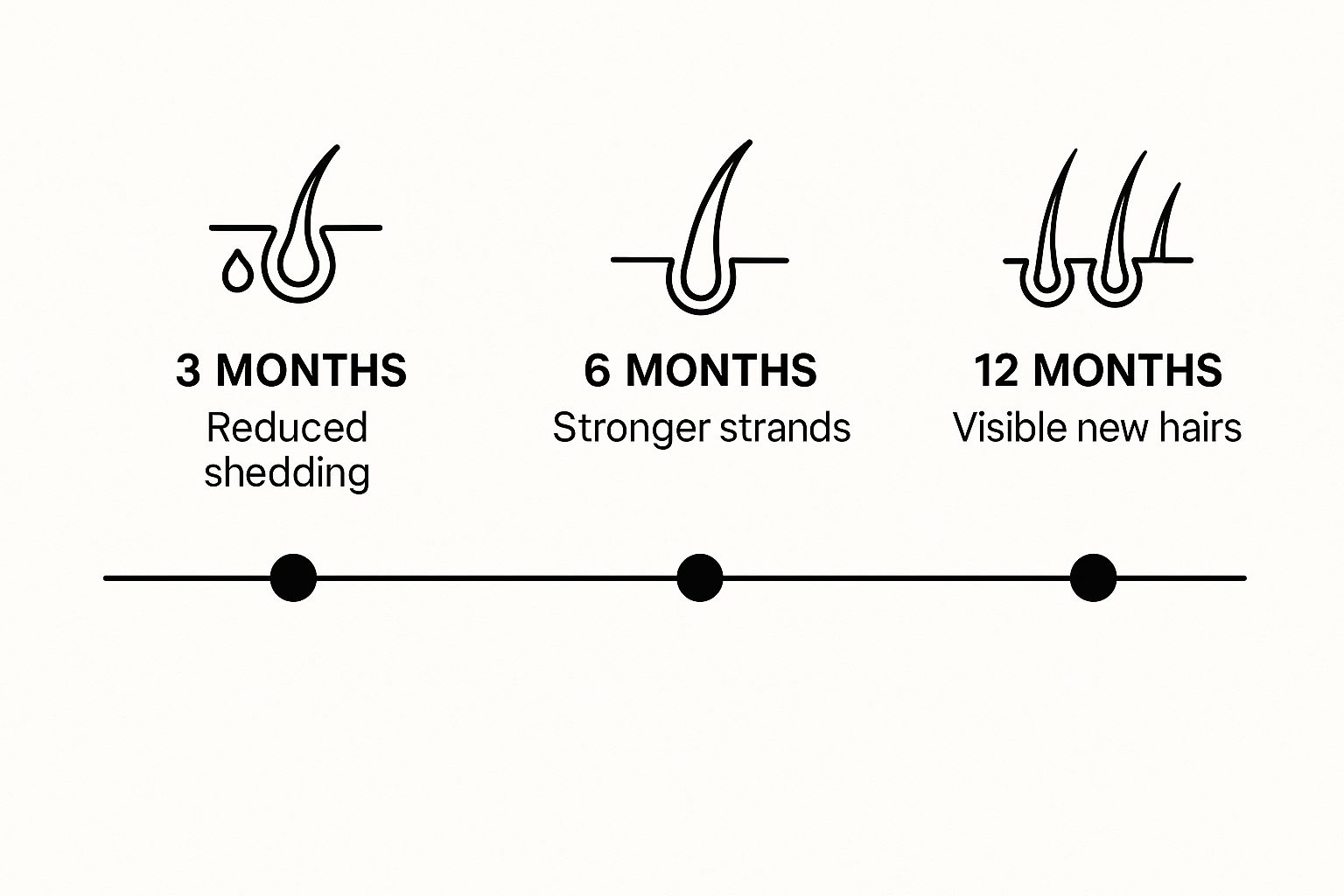
As you can see, the journey starts with shoring up your defenses before you go on the offense.
-
Months 1-3: The Shedding Slows Down. One of the first positive signs you’ll likely notice is less hair in the shower drain or on your brush. This means the vitamins are starting to nourish the follicles, strengthening the hair you already have and making it less prone to breaking or falling out.
-
Months 4-6: Stronger, Thicker-Feeling Hair. By this point, your existing hair should start to feel more robust. You might notice it has a better texture or even looks a bit fuller. That’s because the nutrients have had enough time to work their way into the new hair being formed inside the follicle.
-
Months 7-12: New Growth Begins to Appear. This is the milestone many guys are waiting for. You may start to see fine, new "baby hairs" emerging along your hairline or filling in thinning spots. They're often soft and light at first, but they are a fantastic sign that dormant follicles are waking up.
Here's a pro tip: track your progress. Seriously. Take a clear, well-lit photo of your hairline and crown on day one, and then snap another one every month in the same spot with the same lighting. When you compare them after six months, you’ll be amazed at the subtle changes you would have otherwise missed just by looking in the mirror each day.
This focus on targeted solutions is a massive trend. The market for men’s hair support supplements alone hit USD 1.62 billion in 2024. That's a significant chunk of the total men’s health supplement market, which itself topped USD 72 billion. It just goes to show how seriously men are taking specific health goals, with hair right at the top of the list.
By understanding the timeline and celebrating the small wins along the way, you’ll stay motivated. Get familiar with the subtle signs that your hair is growing back so you know exactly what to look for on your journey.
Pairing Vitamins with Other Hair Loss Treatments

Think of hair vitamins as laying a solid foundation before you start building a house. They're beneficial on their own, absolutely, but their real power comes out when you combine them with other proven hair loss treatments. For something as stubborn as male pattern thinning, a multi-front attack is usually the smartest way to go.
This isn't about blindly throwing every possible solution at your scalp and hoping for the best. It's about creating synergy—where each part of your routine makes the others work even better. By giving your body the right nutritional fuel, you’re priming your scalp to respond more effectively to medical and topical treatments.
Creating a Supportive Foundation for Treatments
Let's take a common treatment like Minoxidil (Rogaine) as an example. Its main job is to act as a vasodilator, which is a fancy way of saying it widens blood vessels to improve blood flow to your hair follicles. This boost in circulation delivers more oxygen and nutrients, waking up dormant follicles and pushing them back into the growth phase.
But what happens if that newly increased blood supply is running on empty? If your body is low on key hair-building nutrients like iron or zinc, improved blood flow won't do much good. It's like building a new superhighway for delivery trucks, but the trucks have no cargo.
This is where a high-quality hair vitamin makes all the difference. It ensures the blood being delivered by Minoxidil is actually loaded with the good stuff.
- Zinc: A crucial mineral for hair tissue growth and repair. It helps keep the oil glands around the follicles working properly.
- Iron: Your body needs iron to produce hemoglobin, the protein in red blood cells that carries oxygen. Every cell in your body, including the ones in your hair follicles, needs oxygen to grow.
- Biotin: Famous for its role in producing keratin, the very protein that makes up your hair.
When your levels of these nutrients are solid, you’re not just stimulating your follicles; you’re handing them the exact materials they need to build stronger, healthier hair.
Minoxidil opens the door to the factory. The vitamins are the raw materials and the workers inside. You need both to get the production line running at full steam.
Combining with Prescription and Clinical Options
The same logic applies to prescription medications. Finasteride, for instance, works by lowering the levels of DHT, the hormone that attacks hair follicles. While Finasteride is busy dealing with the hormonal problem, vitamins provide the nutritional support for the recovery. Your follicles, now under less stress from DHT, need those building blocks to repair damage and get back to growing.
This kind of combined approach is also essential if you’re looking into more advanced procedures. It's a good idea to get familiar with the full range of hair loss treatment for men to understand how all the pieces can fit together for a comprehensive plan.
Before you start mixing and matching any treatments, the most critical step is to have a conversation with your doctor or dermatologist. They can run blood work to pinpoint any deficiencies and help you map out a strategy that is safe and personalized. A quick consultation can ensure your supplements won’t interfere with any medications and that your approach is designed for your specific situation.
Common Questions About Men's Hair Vitamins
Guys are always asking if hair vitamins are a miracle cure or just another supplement. Let's cut through the noise and answer the 4 biggest questions I hear from men about getting the most out of their hair supplements.
No fluff, just straight answers and real-world advice to help you make the right call.
Can They Actually Regrow Hair on Bald Spots?
Here's the honest truth: hair vitamins are incredible for waking up dormant follicles and beefing up the hair you already have. But, they're not going to magically sprout new hair on a spot that's been bald for years.
Think of it like this: a supplement is like fertilizer for your lawn. It can make thinning grass thicker and healthier, but it can't grow new grass where the soil is completely barren. If an area is smooth and shiny, the follicles are likely gone for good, and a vitamin alone won't bring them back.
- Pro Tip: Concentrate your efforts on areas that are thinning, not completely bald.
- For the best shot at regrowth, pair supplements with proven treatments like PRP or Minoxidil.
- Look for early signs of success, like less hair in the shower drain or around your hairline.
Are There Any Side Effects I Should Worry About?
For most guys, hair vitamins are perfectly safe as long as you stick to the label's dosage. The most common hiccup is some mild stomach upset, but that usually goes away if you take the supplement with a meal.
Where you can run into trouble is overdoing it. Taking way too much Vitamin A or zinc can ironically lead to more hair loss or mess with how your body absorbs other essential minerals. A quick label check is all it takes—if a nutrient is listed at over 100% of the Daily Value (DV), be mindful.
If you feel a little nauseous or crampy, try taking your supplement with food or splitting the dose between morning and night. It often solves the problem.
I actually ran into this myself. I switched to a new, more potent formula and started getting an upset stomach. I simply cut the dose in half for a week, and the issue disappeared. It’s often a simple fix.
Should I Take a Multivitamin or a Specific Hair Supplement?
A standard multivitamin is great for your overall health, but it's usually not potent enough to make a real difference for thinning hair. Dedicated hair growth supplements are formulated with heavy-hitting doses of ingredients like Biotin and Saw Palmetto, which are specifically aimed at supporting your follicles.
Now, if you check your multivitamin and it already has high levels of those key hair nutrients, adding another dedicated supplement might be overkill. But for most guys, a specialized formula is the way to go to fill those specific gaps.
- General Multivitamin: Great for baseline health, but often too weak for targeted hair support.
- Dedicated Hair Supplement: Packs a powerful punch with high-potency Biotin and Saw Palmetto, but check for overlap with other supplements.
I once had a client who was taking both a multivitamin and a hair supplement, and he just felt tired and sluggish all the time. We realized he was getting way too much of certain B-vitamins. He switched to just the specialized hair formula, his energy returned, and he still got the hair benefits he was looking for.
How Long Do I Need to Take These For?
If your hair loss is genetic (and for most guys, it is), you need to think of supplementation as a long-term commitment. It's not a one-and-done fix. If you stop, the follicles will likely revert to their previous state, and the thinning and shedding will creep back in.
Treat your hair supplement like any other part of your daily health routine, like brushing your teeth. Consistent, daily use is what protects your follicles from DHT and the aging process over the long haul. A simple phone reminder to reorder before you run out can make all the difference.
For more deep dives into general health, wellness, and what to look for in supplements, Salthea's health and wellness blog is a solid resource full of useful articles and insights.
Ready to see if PRP For HairLoss can amplify your hair growth journey? Visit PRP For HairLoss at https://prpforhairloss.com to learn more and book your consultation today.


Leave a Reply