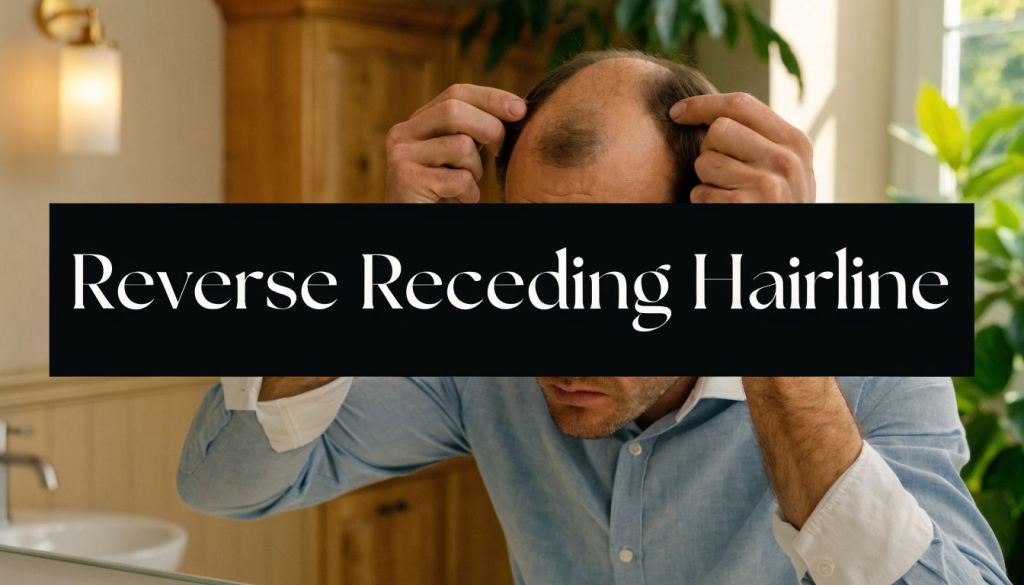
A lot of men notice it the same way. One day the bathroom mirror looks normal, then a photo taken in harsh light shows the temples sitting a little farther back. You compare it with an older picture, tilt your head, pull the front hair forward, and wonder if you’re overreacting.
Usually, you’re not.
A changing hairline has a very specific emotional weight. Crown thinning can stay hidden for a while. Frontal recession can’t. It changes the way your face is framed, the way you style your hair, and sometimes the way you feel walking into work, a date, or the gym. That doesn’t make you vain. It makes you aware.
Most men who start searching for ways to reverse receding hairline loss run into the same problem. The internet is full of miracle oils, recycled advice, and generic hair loss content that talks about the crown more than the temples. The frontal hairline is different. It often needs earlier action, better planning, and more honesty about what can and cannot come back.
That’s what this guide is for.
That Moment in the Mirror a Plan for Your Hairline
The first sign is often subtle. A barber leaves the fringe a bit longer because the corners are thinning. A friend tags you in a photo and your hairline looks uneven. You run your hand through wet hair and the temple area looks lighter than it used to. Once you see it, it’s hard to unsee.

I see this in clinic all the time. Men don’t usually come in because they’re completely bald. They come in when the front corners have started to move, when styling takes more effort, or when the hairline no longer matches how they see themselves. Early concern is useful. It gives you more room to work with.
What most men need first
Not hype. A plan.
That plan starts with figuring out whether you’re dealing with early male pattern hair loss, a maturing hairline, shedding from stress or illness, inflammation around the scalp, or a mix of those. From there, treatment gets more practical. Some men do well with medication alone. Some need a procedure-based approach. Some are already at the point where surgery belongs in the conversation.
Practical rule: The earlier the follicles are treated, the more options you usually have.
If you want a straightforward primer on grooming and recovery habits that support healthier strands, this piece on expert hair care from XO Medical is a useful companion to medical treatment. It won’t replace proper diagnosis, but it can help you stop making the common grooming mistakes that make thinning look worse.
It also helps to know what you’re comparing yourself to. A naturally high or mature front hairline isn’t the same thing as active recession. This guide to a normal hairline for men can help you judge that more realistically before you panic.
Understanding Why Your Hairline Is Receding
Most frontal hair loss in men comes down to androgenetic alopecia, better known as male pattern baldness. The short version is simple. Certain follicles, especially around the temples and frontal scalp, are genetically sensitive to DHT. Over time, DHT pushes those follicles to shrink. Each cycle produces finer, shorter hair until the area starts to look sparse.
That’s why the hairline and temples are often the first places to change. They’re usually less forgiving than the crown.

Use the pattern, not your mood, to judge it
A quick self-check helps:
- Temple change: The corners move back first and the hairline starts forming an M shape.
- Density shift: The front hairs look softer, thinner, or more see-through under bathroom lighting.
- Photo comparison: Older photos show a denser, lower outline at the front.
- Styling change: You suddenly need product, length, or clever combing to hide the corners.
Clinically, men often describe this using the Norwood scale. Early frontal recession usually sits around Norwood 2 to 3. That matters because early-stage loss responds better than advanced, smooth bald areas where follicles may no longer be viable.
A broader explanation of the mechanics is in My Transformation's guide to hair loss, which gives a helpful overview of the common causes men mistake for “just stress.”
It’s not only about DHT
The biology isn’t always clean and simple. Hairlines can worsen faster when irritation, inflammation, or scalp health problems are part of the picture.
The psychological side matters too. Anxiety affects up to 60% of men who notice recession by age 25, and 2025 research also reports chronic scalp fibrosis in 50% of receding cases, reducing response to treatments like minoxidil by 35% if not addressed (Hairmax). Men often dismiss this, but the stress of watching your hairline change is real.
A receding hairline isn’t only a cosmetic issue when it starts affecting how often you check mirrors, avoid photos, or second-guess your appearance.
What this means in practice
If your temples are thinning, don’t assume every treatment will work equally well just because it works somewhere else on the scalp. The frontal zone is usually the most demanding area to treat. It often needs earlier intervention, more consistency, and better follow-through than men expect.
For a deeper look at the biology behind androgen sensitivity and follicle miniaturization, this article on male pattern baldness causes is worth reading.
Your First Line of Defense Medical Treatments
For most men with early recession, the first serious options are Minoxidil and Finasteride. They aren’t glamorous, and they don’t offer instant gratification, but they remain the standard starting point because they target the process in different ways.
Minoxidil is usually applied to the scalp. It supports the growth phase and can help weak follicles produce stronger hair. Finasteride is an oral prescription medicine that lowers DHT activity, which matters because DHT is the main driver in male pattern hair loss. One aims to stimulate. The other aims to protect.
Where each one helps, and where each one disappoints
Minoxidil can be useful when the front still has miniaturized hairs that are hanging on. It’s often better at maintaining and thickening than rebuilding a crisp, youthful hairline. Men sometimes expect it to redraw the temples. That’s where disappointment starts.
Finasteride does a better job addressing the cause of ongoing recession. In practical terms, it’s often the stronger “hold the line” treatment. But it doesn’t physically move hair back into place overnight, and some men are uneasy about potential side effects, which is a conversation worth having with a qualified prescriber rather than with internet forums.
Clinic reality: Men who want a lower hairline usually think in terms of regrowth. Men who keep their existing hairline often thank themselves later.
Minoxidil vs. Finasteride At a Glance
| Feature | Minoxidil (Rogaine) | Finasteride (Propecia) |
|---|---|---|
| Main role | Stimulates weaker follicles | Reduces DHT-related follicle shrinkage |
| How it’s used | Topical treatment | Oral prescription treatment |
| Best fit | Men with thinning and miniaturized hairs still present | Men with active male pattern recession who need to slow progression |
| Strength for temples | Can help, but often modest at the frontal edge | Better for stopping further loss than visibly rebuilding the line |
| Big limitation | Results usually depend on continued use | Requires medical review and discussion of side effects |
| What happens if you stop | Gains usually fade | Protection against ongoing loss also fades |
My practical view on choosing
If you’ve caught the recession early, many men benefit from starting with a medically grounded plan rather than spending months on shampoos, serums, and supplements that don’t address the root issue. The hairline doesn’t usually reward delay.
A sensible first discussion with a clinician often includes:
- Whether the recession is active: A stable mature hairline is different from ongoing temple loss.
- Whether miniaturized hairs are still present: Those are the hairs most worth trying to rescue.
- Whether medication is enough: Some men need procedural support rather than waiting on topical treatment alone.
- Whether expectations are realistic: Stabilizing loss is a win, even if your teenage hairline doesn’t fully return.
If you want a broader breakdown of standard treatment pathways, this guide on FDA approved hair loss treatment is a useful place to compare the mainstream options before you commit.
A Deeper Dive into PRP Therapy for Hairlines
When the main concern is the frontal hairline and temples, PRP deserves more attention than it usually gets. It’s one of the few treatments that directly targets weak but still living follicles with concentrated growth factors from your own blood. For the right patient, that makes it a strong option for trying to reverse receding hairline loss before surgery enters the picture.

What the procedure actually involves
PRP stands for platelet-rich plasma. A clinician draws a small amount of blood, processes it in a centrifuge, and isolates the platelet-rich portion. That concentrate is then injected into thinning areas of the scalp.
For hairline work, technique matters. The frontal zone is visible, anatomically tight, and less forgiving than broader crown treatment. Proper placement across the frontal-temporal area is a big part of why results differ between clinics.
According to Skin Artistry Clinic, a typical PRP protocol for reversing a receding hairline involves 3 to 4 sessions at 4-week intervals, uses a double-spin centrifuge to concentrate platelets to 4 to 6 times baseline, and shows a 70 to 80% success rate in early-stage recession with a 30 to 40% increase in hair density.
Why PRP suits the temples better than many men expect
The men who tend to do best are those with early-stage recession, not shiny bald skin. If the follicles are miniaturized but still alive, PRP may help push them into stronger growth activity. If the area has been slick bald for a long time, expectations need to come down.
This is one reason PRP fits men in their 20s and 30s so well. They often haven’t lost everything at the front. They’ve lost strength, caliber, and density. That’s exactly the stage where a regenerative approach can make more sense than waiting for surgery.
If you want another plain-English look at the treatment flow and candidacy, this PRP hair restoration guide offers a decent patient-facing overview.
What a good PRP session should look like
The details matter more than the label. “PRP” isn’t one identical treatment everywhere.
A better protocol usually includes:
Proper assessment first
The clinician checks pattern, stage, scalp quality, and whether the follicles still look salvageable.Controlled preparation
The blood is processed carefully, not rushed, to produce a usable platelet concentration.Targeted injection pattern
The frontal-temporal zones need deliberate spacing and coverage, not random placement.Planned follow-up
PRP works as a series, not as a one-off experiment.
Here’s a useful explainer on the mechanics and expectations before you book a session:
What PRP does well, and what it doesn’t
PRP is good at improving density, hair caliber, and shedding control in men who still have active follicles. It isn’t magic. It doesn’t create unlimited new follicles, and it won’t reliably rebuild a long-lost hairline in advanced baldness.
That trade-off needs to be said clearly. The best candidates are usually men who say, “My corners are thinning and moving back,” not men who say, “My front has been bald for years.”
Good PRP is less about replacing surgery and more about preserving and strengthening what surgery can’t give back naturally.
For a closer look at whether this approach makes sense specifically for the front of the scalp, read does PRP work for frontal hair loss.
Combining Treatments for Maximum Results
Single-treatment thinking is where many men lose time. A receding hairline is usually not a one-tool problem. If you want the strongest chance of holding the front, thickening weak hairs, and reducing the odds of sliding backward again, combination therapy is often the smarter route.

Why combinations beat isolated treatment
Think of the problem in layers. One treatment may reduce DHT. Another may stimulate weak follicles. Another may improve the scalp environment or support graft survival if surgery is involved. When those layers line up, results tend to hold better.
The strongest hard numbers in your source set support that. According to Wimpole Clinic, when PRP was used with hair transplants, 100% of patients saw more than 75% hair regrowth after six months, compared with 20% in the non-PRP group. At 12 months, 71% of patients on traditional treatments alone had relapse compared with 31% of the PRP group.
That matters because a lot of men judge treatment too early. They see a few new hairs, stop the plan, then wonder why the hairline slides again.
What a serious combination plan might include
In practice, the stronger combinations often look like this:
- Medical protection plus stimulation: Finasteride to slow ongoing loss, with Minoxidil to support weaker follicles.
- PRP layered on top: Useful when the frontal hairs are still there but clearly miniaturizing.
- Microneedling in the right setting: Some clinics use it to support penetration and scalp response, especially around the hairline.
- Transplant support when needed: PRP may complement surgery, but it doesn’t replace the need for good surgical planning.
Men who get the best long-term outcomes usually stop asking, “Which one treatment is best?” and start asking, “What combination fits my stage of loss?”
What doesn’t count as a real combination plan
Buying five cosmetic products isn’t a strategy. Neither is bouncing between clinics every few months because each one promised a shortcut. The right combination should have a clear purpose. One part protects. One part stimulates. One part maintains.
If your treatment plan can’t explain what each piece is doing, it probably isn’t a plan. It’s just activity.
When to Consider Surgical Hair Restoration
A transplant becomes worth discussing when the hairline has moved beyond what non-surgical treatment can realistically recover, and when the pattern of loss is stable enough to design a hairline that will still look sensible years from now.
That last point matters. A surgeon can move follicles. He can’t stop male pattern baldness from continuing in the native hairs around them.
Who tends to be a good candidate
A strong transplant candidate usually has:
- Stable or stabilizing loss: Rapid ongoing recession makes planning harder.
- Good donor hair: The back and sides need enough quality to supply the front.
- Realistic expectations: Density, direction, and age-appropriate design matter more than trying to recreate a teenage line.
- A long-term plan: Surgery works best when paired with a strategy to protect surrounding native hair.
For men with early change at the front, surgery is often premature. That’s especially true in younger men who still have salvageable follicles. According to Venus Treatments, PRP uses a patient’s own growth factors to rejuvenate follicles non-invasively, making it appealing for men in their 20s and 30s who want to address early hairline change without surgery, and studies show PRP can increase frontal hair density by 25 to 30% in early-stage cases.
Where surgery fits honestly
A transplant is powerful when the front is too far gone to regrow convincingly. It’s less impressive when used as a shortcut before the underlying loss pattern is managed. Men sometimes think the operation ends the story. In reality, it often begins a maintenance phase.
One of the most useful mindset shifts is this: surgery rebuilds shape. It does not cure the tendency to keep losing hair.
For a practical overview of how the procedure fits into a broader restoration plan, read what is a hair transplant.
Your Long-Term Plan Lifestyle and Realistic Timelines
The men who do best with hairline treatment usually do two things well. They stay consistent, and they stop expecting instant cosmetic transformation from biological treatments.
Hairline recovery is slower than men want. The front of the scalp tends to demand patience. Early improvement may show up as reduced shedding, less see-through density at the corners, and better styling before it shows up as obvious visual regrowth. That still counts as progress.
What helps in the background
Lifestyle won’t overpower genetics, but it does support treatment:
- Scalp care: Keep irritation down and avoid harsh routines that inflame the front hairline.
- Stress control: Stress can worsen shedding and make active loss feel even more dramatic.
- Diet and general health: Hair is metabolically active tissue. Poor nutrition and poor recovery don’t help.
- Reasonable styling: Tight pulling and aggressive heat at the front can make fragile hairs look worse.
The biggest mistake I see is not choosing the wrong treatment. It’s quitting a sensible plan before the follicles have had time to respond.
If your temples are changing quickly, if the scalp looks inflamed, if the hairline has been steadily retreating despite over-the-counter treatment, or if you’re no longer sure what’s salvageable, stop self-treating and get assessed by a dermatologist or hair loss specialist. The earlier you get a clear diagnosis, the easier it is to build a plan that fits your stage of loss.
If you want practical, men-focused guidance on PRP, male pattern baldness, and what realistic hairline recovery looks like, visit PRP For HairLoss. It’s a solid place to keep learning before you decide whether medication, PRP, combination therapy, or a surgical consult makes the most sense for your hairline.


Leave a comment