You’ve probably had this thought already.
You apply minoxidil every day, you’ve seen at least some improvement, and now the routine feels heavy. Maybe your scalp is irritated. Maybe you’re tired of planning your day around a bottle on the bathroom shelf. Maybe you’re wondering whether you still need it. Then the obvious question hits: what happens if I stop?
That question matters because stopping minoxidil rarely feels neutral. Most men aren’t just deciding whether to end a grooming habit. They’re deciding whether to risk visible shedding, whether they’ll lose the gains they fought for, and whether they’re about to trigger something worse than the hair loss they started with.
Considering a Break from Minoxidil Here's the Reality
I hear the same version of this story often. A man starts minoxidil because his temples are thinning or the crown is opening up. He sticks with it long enough to finally notice better coverage. Then real life gets in the way. Travel, irritation, inconsistency, frustration with daily use, or the simple fatigue of a treatment that never really ends.
At that point, most men aren’t asking whether minoxidil works. They’re asking whether they can stop without paying for it later.
That concern is reasonable. Minoxidil isn’t like changing shampoo. Once a treatment has shifted how your follicles behave, stopping it can create a very visible adjustment period. The uncertainty is usually the hardest part. Men don’t know if shedding means damage, if the loss is temporary, or if they’ve just undone months of work.
Most of the panic around stopping minoxidil comes from not knowing the timeline. The biology is slower than people expect, and that delay makes the process feel random when it isn’t.
If you’re in that spot now, the useful question isn’t “Will anything happen?” Something usually does. The better question is: what is likely to happen, when does it tend to happen, and what can you do about it?
That’s where clear expectations help. If you already know how minoxidil gains are maintained, and how long results usually take to build in the first place, this guide on how long minoxidil takes to work gives helpful context for why stopping also unfolds gradually rather than overnight.
For most men, stopping minoxidil doesn’t create a mystery disease. It starts a predictable sequence. Some parts are annoying. Some are unsettling. Very little of it is surprising once you understand the roadmap.
Why Your Hair Depends on the Minoxidil Routine
Minoxidil helps because it supports weak follicles while you keep using it. That’s the key point. It is not a cure for male pattern baldness. It is ongoing support.
A simple way to think about it is this: minoxidil acts like a crutch for vulnerable follicles. If a follicle is miniaturizing but still alive, minoxidil can help it stay productive longer. Remove the crutch, and that follicle goes back to behaving like the underlying condition says it should.

The hair cycle matters more than the bottle
Hair doesn’t grow in a straight line. Each follicle moves through a cycle. The useful version to remember is simple:
- Growth phase. The hair keeps actively growing.
- Transition phase. The follicle slows down.
- Resting and shedding phase. The hair is released and a new cycle begins.
Minoxidil mainly matters because it helps keep some hairs in the growth phase longer than they would stay there on their own. That’s why men often see better density while using it. It doesn’t erase the tendency toward androgenetic alopecia. It temporarily changes how some follicles perform.
If you want a solid overview of the biology behind that process, this guide to the hair growth cycle is worth reading alongside this one.
Why stopping changes the outcome
When you stop minoxidil, the support disappears. The follicles don’t “panic.” They return to their original program.
That’s why the phrase minoxidil side effects after stopping can be a little misleading. The main event is not toxicity leaving the body. The main event is follicles losing a stimulus they had come to rely on. Hair that looked stable on treatment may not stay stable off treatment.
Here’s the practical trade-off:
| While using minoxidil | After stopping minoxidil |
|---|---|
| Some follicles stay in a more favorable growth pattern | Those follicles return to their natural pattern |
| Density can look better in responsive areas | Supported hairs may shed |
| Daily commitment is required | Convenience improves, but maintenance ends |
That’s why I tell patients to separate convenience from outcome. Stopping may simplify your routine, but it usually changes your hair trajectory too.
For men who want a broader consumer-friendly explanation of the treatment itself before deciding what to do next, it helps to understand minoxidil effectiveness in plain language, especially if you’re trying to weigh daily maintenance against longer-term strategies.
What doesn’t work
What doesn’t work is assuming your best minoxidil result becomes your new natural baseline. It doesn’t. If a follicle was only performing better because of the medication, that benefit usually doesn’t persist when the medication is gone.
Clinical mindset: Minoxidil is a maintenance treatment. If you stop, the hair doesn’t negotiate. It follows biology.
That idea is uncomfortable, but it makes the rest of the timeline much easier to understand.
The Post-Minoxidil Timeline What Happens and When
You stop minoxidil on a Sunday because the routine is wearing you down. By Wednesday, your scalp may already feel calmer. By the end of the month, your hair can still look similar. Then several weeks later, the density drops and it feels abrupt.
That sequence is typical. It follows hair biology more than drug chemistry.

The first few days
Minoxidil itself clears relatively quickly after you stop applying it. The visible hair response does not. Those are separate processes.
In the first few days, the changes are usually about the scalp, not the hair shaft count. If the liquid or foam was causing dryness, itching, or a tight irritated feeling, that often starts to settle early. The follicles, however, do not switch behavior overnight. They are still in the growth cycles that were set in motion earlier.
A practical review from SingleCare on what happens when you stop minoxidil describes the same basic pattern. The medication leaves first. The cosmetic change shows up later.
Weeks 1 to 8
This is the deceptive part of the roadmap.
Many men expect an immediate reaction. Instead, there is often a quiet period where the mirror looks stable enough to create false confidence. Under the surface, follicles that were being kept in a longer growth phase begin drifting back toward their baseline rhythm. That shift is slow. Hair only becomes visible once enough follicles have changed state and enough fibers have been shed or miniaturized to alter density.
This is why I tell patients not to judge the decision in the first two weeks. Early calm does not mean the follicles have become independent of treatment.
The shedding window, usually over the next few months
The shedding phase tends to arrive later. That is the part that unsettles people, because it feels disconnected from the day they stopped.
What happens is more orderly than it looks. Minoxidil helps prolong anagen, the active growth phase. Once that support is removed, some hairs shift out of that phase earlier than they would have with continued treatment. Those hairs shed, and the areas that depended most on the medication start looking thinner again. In men with androgenetic alopecia, the crown and mid-scalp often show this first, though the frontal area can soften as well.
If you want a visual reference for how much treatment-supported density can change expectations, reviewing minoxidil before and after examples helps explain why coming off treatment can look more dramatic than the biology really is.
One detail matters here. The mirror can make a synchronized shed look worse than a gradual decline. A modest drop in diffuse density under bright light often feels like a major setback, especially if you had become used to seeing the improved on-treatment version every day.
What the shed usually looks like
In most cases, this does not look like scarring hair loss or sudden bald patches. It looks like the supported hair gradually disappearing from the zones where minoxidil had been helping.
Three mechanisms are usually happening at once:
- Follicles that were held in growth for longer return to their baseline cycle.
- Miniaturizing follicles lose a support signal and produce weaker hairs again.
- Ongoing male pattern hair loss continues in the background, so the baseline itself may be lower than it was when treatment began.
That last point is why some men feel they have fallen behind their original starting point. Part of that impression comes from losing minoxidil-supported hairs. Part comes from the fact that androgen-driven thinning did not pause while time passed.
The stabilization phase
After the active shed, the pattern usually becomes easier to read. The dramatic part settles. What remains is closer to what your follicles can maintain without minoxidil.
That is the stage where decisions become clearer. If the loss is acceptable, some men stay off treatment. If the density drop is not acceptable, that is usually the point to act rather than waiting for more decline. In clinic, this is often where I discuss alternatives that do not depend on daily topical use, including PRP, prescription options, or a broader maintenance plan based on the pattern of loss and scalp tolerance.
Here is the timeline in a practical format:
| Time after stopping | What often happens |
|---|---|
| First days | The medication clears. Irritation or dryness may improve. |
| First several weeks | Hair may look similar, which can be misleading. Follicles are shifting back toward baseline cycling. |
| Next few months | Shedding becomes more noticeable as treatment-supported hairs are lost. |
| Later months | The shed slows, and your untreated pattern becomes easier to assess. |
How to read this timeline correctly
This roadmap does not suggest toxicity, permanent follicle injury, or a body-wide withdrawal effect. It describes a support being removed from susceptible follicles, followed by a delayed cosmetic response.
That distinction matters. Once patients understand the timeline and mechanism, the process feels less random and much easier to manage.
Common and Rare Side Effects of Stopping Minoxidil
You stop minoxidil because the routine is wearing on you, your scalp is irritated, or the results no longer feel worth the daily effort. A few weeks later, the mirror starts to feel less predictable. That sequence alarms people, but it usually follows a recognizable biological pattern.
The practical way to read this stage is not as a random list of side effects. It is a roadmap of what improves first, what often gets cosmetically worse for a period, and what falls outside the expected pattern.
The main effect is loss of support, not injury
For topical minoxidil, the most likely result of stopping is gradual loss of the benefit the medication was maintaining. Follicles that were staying in a longer growth phase under treatment start cycling without that support. The visible result is shedding or thinning over time, not follicle death.
That trade-off is real. Men often stop because the treatment itself has become the problem. A review in the International Journal of Trichology describes contact dermatitis, irritation, dryness, and unwanted hair growth as known reasons topical minoxidil becomes hard to continue for some patients (International Journal of Trichology).
What commonly improves after stopping
The first changes are often on the scalp or skin, not in the hair density.
If the liquid vehicle or propylene glycol was irritating your skin, you may notice less burning, itching, flaking, or residue once you stop. If you developed unwanted facial hair from transfer or oversensitivity, that usually fades gradually after the medication is no longer being used. Those improvements can be encouraging, but they often happen on a different timetable than the hair.
That mismatch is what confuses people. The scalp may feel better while the hair starts to look worse.
What commonly feels worse before it stabilizes
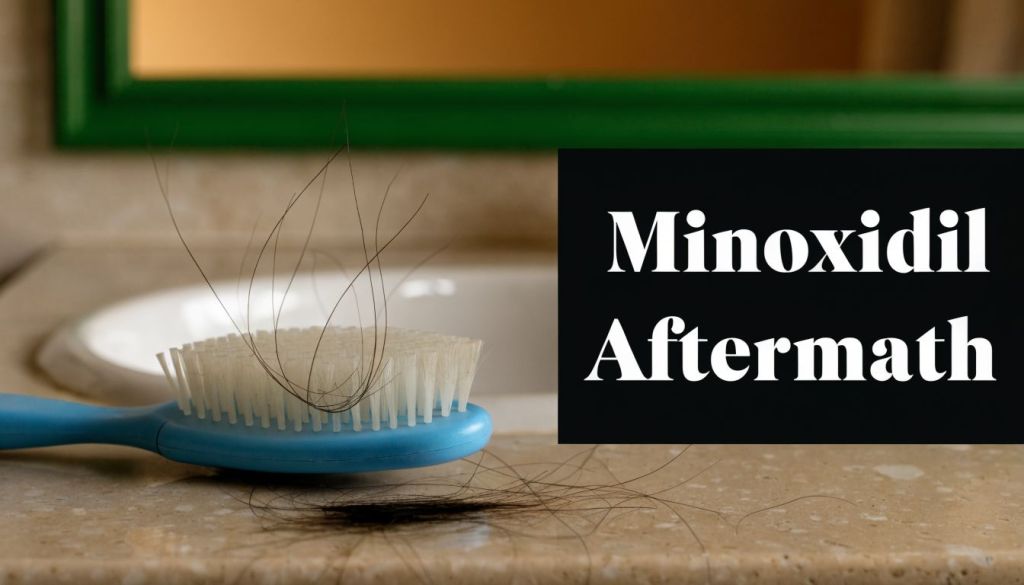
The most common post-minoxidil problem is increased shedding. In practice, patients often describe this as sudden damage, but the mechanism is simpler than that. Hairs that were being maintained by treatment are no longer being maintained, so density can drop until your untreated pattern becomes visible again.
Some people also notice that the hair looks flatter, finer, or less full even before obvious shedding shows up in the sink or shower. That does not mean something dangerous is happening. It usually means the cosmetic support minoxidil was giving to susceptible follicles is fading.
Less common symptoms need context
Systemic symptoms after stopping topical minoxidil are not the usual story. Topical use has limited absorption in most users, so persistent palpitations, chest symptoms, significant dizziness, or feeling faint should not be written off as a normal part of stopping. Those symptoms deserve a medical review, especially if they are new, strong, or clearly continuing.
Oral minoxidil is different and carries a different side-effect profile. If you are comparing the two, this guide to oral minoxidil side effects explains why the risks should not be lumped together.
What I want patients to remember: a shed after stopping is common, relief from irritation is common, and ongoing cardiovascular symptoms are not something to self-diagnose.
A few myths cause unnecessary panic
Stopping does not usually create permanent bald patches.
The expected pattern is a return toward your underlying hair loss pattern, often through diffuse thinning or shedding.
A heavy shed does not mean the follicles have been destroyed.
It means pharmacologic support has been withdrawn from follicles that were responsive to it.
Looking worse for a period does not automatically mean you will keep worsening at that pace.
There is often a temporary visual dip before things settle into a clearer baseline.
The practical takeaway
Hair changes and symptom changes do not run on the same clock. Skin irritation may settle fairly quickly. Hair density usually takes longer to declare itself, and that delay is why stopping can feel more dramatic than it is biologically.
Repeatedly stopping and restarting without a plan usually makes the picture harder to read. A more useful approach is to treat this as a transition point. If the shed is unacceptable, that is often when I discuss a steadier maintenance strategy, including PRP or other options that do not depend on daily topical use.
How to Manage the Transition Away from Minoxidil
A common scenario is this: a man stops minoxidil because the routine has become irritating, inconvenient, or unsustainable, then gets caught off guard when his hair does not respond on the same schedule as his scalp. The way through that period is to treat it like a monitored transition, not a daily verdict on whether your hair is “failing.”

Taper if you can, stop immediately if you must
The right exit depends on why you are stopping.
If you are stopping because of chest symptoms, significant dizziness, or another reaction that worries you, stop and speak with a clinician. If you are stopping because the upkeep is wearing you down, a gradual reduction is often easier to tolerate than a hard stop. Some dermatology practices recommend stepping down over a few weeks to make the shift less abrupt, as described by Dr. Michele Green’s overview of stopping minoxidil.
Tapering does not “save” all of the hair that was being maintained by the drug. What it can do is reduce the sense that everything changed at once.
Keep the scalp quiet while the follicles reset
This is the phase where simple care usually works best. A scalp that has just come off minoxidil does not benefit from a pileup of oils, scrubs, acids, or new growth serums.
Use a gentle shampoo. If the scalp is itchy or inflamed, treat that problem directly instead of pushing through it. Your clinician may recommend short-term anti-inflammatory treatment if dermatitis is part of the reason you are stopping. The American Academy of Dermatology’s guidance on hair loss diagnosis and treatment is a useful reference for when scalp symptoms deserve medical review.
Small habits matter here. Rough towel drying, constant brushing, and checking the hairline under bathroom spotlights make the transition feel worse than it is.
Track the timeline, not your mood
Hair biology moves slowly. Anxiety moves fast.
The most useful approach is boring and consistent. Take photos once every 2 to 4 weeks in the same room, under the same light, with dry hair. Do not judge density after a shower or after running product through it. Wet hair and overhead lighting exaggerate scalp show-through.
A haircut can help more than another bottle. Slightly shorter, more even length often makes diffuse thinning less obvious while things settle.
Avoid the usual mistakes
I see the same problems repeatedly after patients stop minoxidil:
| Better approach | Usually makes the transition harder |
|---|---|
| Gradual taper when appropriate | Abrupt stopping with no plan |
| Gentle scalp care | Starting several new “hair growth” products at once |
| Photos on a fixed schedule | Daily mirror checks and wet-hair inspections |
| Early discussion of alternatives | Waiting for a major shed before making decisions |
The goal is not to freeze your hair in place. The goal is to understand what is happening, reduce avoidable irritation, and decide what support you want next.
Know when the pattern is no longer routine
Expected post-minoxidil change is usually diffuse shedding or a gradual drop back toward your baseline pattern. That is different from signs that need medical assessment.
Get reviewed if you notice:
- Persistent palpitations
- Chest pain
- Dizziness or faintness
- Patchy hair loss
- Marked scalp tenderness, swelling, crusting, or signs of infection
Those findings widen the differential diagnosis. They should not be sorted out by forum advice.
Put the next treatment in place early
The men who handle this transition best usually make their next decision before the shed peaks. If daily topical treatment was the weak point, it makes sense to look at options that do not depend on nightly compliance. A practical next step is learning how platelet-rich plasma therapy for hair loss works and whether it fits your pattern of thinning, tolerance for procedures, and maintenance goals.
Some clinics also discuss PRP in broader aesthetic care, including luxury facial and body PRP treatments, but for scalp treatment, the core question is simpler. Do you want another daily medication, or do you want a structured plan that matches how you will consistently follow treatment?
That decision usually matters more than the stop itself.
Your Next Move Reclaiming Control with PRP and Other Options
Stopping minoxidil feels like an ending only if you think daily topical treatment is the only way to support your hair. It isn’t.
For many men, this moment is useful. It forces a more honest decision. Do you want a routine you’ll realistically maintain long term, or do you want to move toward a strategy that doesn’t depend on daily application?

Why PRP makes sense after minoxidil
PRP, or platelet-rich plasma, works from a different logic than minoxidil. Instead of providing an external daily signal, PRP uses concentrated components from your own blood to support a healthier scalp environment around vulnerable follicles.
That distinction matters. Minoxidil is maintenance-heavy. PRP is procedural. For the right patient, that feels more sustainable.
Men often ask whether PRP can replace minoxidil one-for-one. The better way to frame it is this: PRP is not the same category of treatment. It’s a regenerative support approach, not a daily vasodilator. If you want a grounded overview of how it’s used for male pattern thinning, this explanation of platelet-rich plasma therapy for hair loss is a strong place to start.
Who tends to consider PRP at this stage
PRP is especially worth discussing if you fall into one of these groups:
- You responded to minoxidil but hate daily use
- You stopped because of scalp irritation
- You want a non-surgical next step
- You’re trying to preserve existing hair rather than chase unrealistic regrowth
That last point matters. The best candidates are usually trying to stabilize and improve the quality of miniaturizing hair, not resurrect long-dead follicles.
How it fits into a broader plan
PRP doesn’t have to exist in isolation. Depending on the man, it can sit alongside other options such as DHT-focused treatment, low-level light therapy, or a more conservative watch-and-track approach. The right choice depends on your pattern, your pace of loss, your tolerance for maintenance, and what bothered you about minoxidil.
Some men stop minoxidil because of side effects. Others stop because they’re done with indefinite topicals. Those are different patients, and they need different plans.
For readers who are also curious how PRP is used more broadly in aesthetics, not just on the scalp, this overview of luxury facial and body PRP treatments gives a useful sense of how the technology is applied in other clinical settings.
What a smarter transition looks like
A strong plan after stopping minoxidil usually includes three pieces:
An honest baseline
Take clear photos in consistent lighting. Not daily. Just enough to judge the trend without guessing.A replacement strategy
If you’re stopping support, decide what will replace it. That might be PRP, another medical route, or a conscious decision to accept your natural progression.A timeline with patience
Hair treatments fail in people’s minds long before they fail biologically. Men abandon good plans because they expect instant visual proof.
A useful clinical discussion on that treatment mindset is in the video below.
What doesn’t make sense
What doesn’t make sense is stopping minoxidil, doing nothing else, then feeling blindsided when your hair follows its untreated pattern. That isn’t a treatment failure. It’s an absence-of-plan problem.
PRP isn’t right for every man. Neither is finasteride. Neither is staying on minoxidil forever. But if you’ve reached the point where the routine no longer fits your life, that’s often a sign to choose a more deliberate long-term strategy instead of drifting into one.
Good hair-loss care is rarely about one miracle product. It’s about choosing the support you can actually stick with.
Making an Informed Decision About Your Hair's Future
Stopping minoxidil can feel dramatic, but it usually isn’t mysterious. The process follows a biological pattern. The drug clears. The follicles lose support. Shedding may follow. Then things settle into the course your hair can sustain without that treatment.
That perspective matters because it turns panic into planning. You’re not watching random damage unfold. You’re watching a treatment-dependent result unwind over time.
If you’re deciding what comes next, think less about fear and more about fit. Some men stay on minoxidil because the routine is manageable. Others decide the maintenance burden, irritation, or inconsistency isn’t worth it and move toward alternatives. If you want another patient-friendly read on PRP as a form of hair restoration therapy, it offers a useful overview from a different angle.
The important thing is this. Don’t make the decision blindly. If you stop, know why. If you continue, know what you’re signing up for. If you switch, do it with a plan.
Frequently Asked Questions About Stopping Minoxidil
Can you restart minoxidil after stopping
Yes, many men do. But restarting doesn’t erase the interruption. If shedding has already begun, the timeline may still feel messy before things restabilize.
Is the hair loss after stopping permanent
The loss of minoxidil-supported hair is expected if the treatment is withdrawn. That doesn’t mean the follicles were permanently damaged. It means the support was removed and your underlying pattern became visible again.
Is PRP doing the same job as minoxidil
No. Minoxidil is a daily topical support treatment. PRP is a regenerative in-clinic approach that aims to improve the follicular environment rather than replace a daily external signal.
Can you use PRP and minoxidil together
In some treatment plans, yes. That depends on your scalp tolerance, your goals, and why you wanted to stop minoxidil in the first place. If irritation or adherence is the main problem, combining treatments only makes sense if the plan is still realistic for you.
What if the shed feels worse than expected
That’s often the hardest part emotionally, but it doesn’t automatically mean something abnormal is happening. Diffuse shedding after withdrawal can look severe. If the pattern becomes patchy, painful, or accompanied by systemic symptoms, get assessed.
If you’re weighing whether to stay on minoxidil, taper off, or transition into a different approach, PRP For HairLoss offers practical guidance for men dealing with male pattern baldness and exploring PRP as a next step.


Leave a Reply