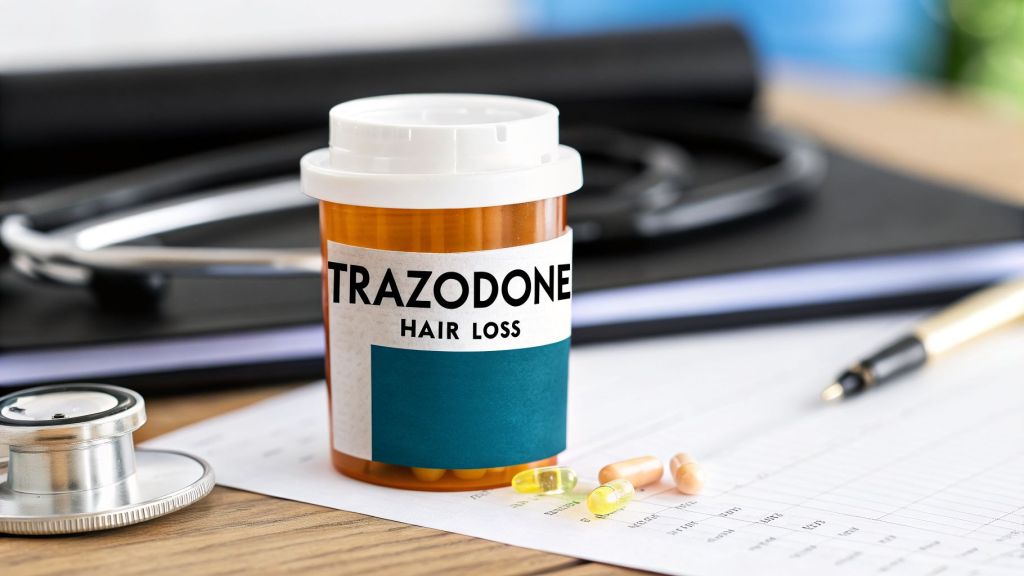
If you're asking, "Can trazodone cause hair loss?" the straightforward answer is yes—but it's important to understand just how rare this is. For the vast majority of people taking this medication, hair-related side effects simply aren't an issue.
A Closer Look at Trazodone and Hair Thinning

It’s completely normal to feel a bit worried about side effects when starting a new medication, and the idea of an antidepressant impacting your hair can be especially concerning. So let's put this particular risk into perspective.
Hair loss from any drug, trazodone included, is never a given. It’s an uncommon reaction that only shows up in a small fraction of people. It's also helpful to remember that many things can cause shedding, from stress to genetics, so it's a good idea to understand the common reasons why does my hair fall out before zeroing in on one medication.
The Science Behind How a Medication Can Trigger Shedding
When a medication is the culprit behind hair loss, it almost always causes a specific condition known as telogen effluvium. This isn't the same thing as genetic pattern baldness. Instead, it’s a diffuse, all-over shedding that feels like you're losing more hair than usual from every part of your scalp.
Think of your hair's growth cycle like a well-organized factory line. A shock to your system—like a new medication—can disrupt that line, suddenly pushing a large number of hairs into the shedding phase all at once.
The good news? This type of hair loss is nearly always temporary and reversible once the trigger is removed. Trazodone is just one of many medications that cause hair loss through this mechanism.
To make things clearer, here’s a quick rundown of the essential facts.
Trazodone and Hair Loss At a Glance
| Aspect | Summary |
|---|---|
| Is it common? | No, hair loss is considered a very rare side effect of trazodone. |
| What type of hair loss? | If it occurs, it's typically telogen effluvium, a temporary, diffuse shedding. |
| Is it permanent? | No, drug-induced telogen effluvium is usually reversible after stopping the medication. |
| What's the evidence? | It's listed as a potential side effect in post-marketing reports, but not a significant finding in major clinical trials. |
Essentially, while the connection exists on paper, it's not a big concern in clinical practice.
While hair loss has been noted in reports after trazodone was approved, it doesn't stand out as a major issue in large-scale studies, especially when you look at common side effects like drowsiness. If you do notice increased shedding while taking trazodone, a doctor will first want to rule out other common causes like thyroid issues, nutritional gaps, or hormonal shifts before pointing the finger at your medication.
How a Medication Can Disrupt Your Hair Growth Cycle
It’s a fair question: how could a pill you swallow possibly make you shed hair? The connection might not seem obvious at first, but it all comes down to the delicate, synchronized rhythm of your hair follicles.
Think of your hair follicles as being on a strict biological clock. Each one follows a predictable cycle of growing, resting, and eventually shedding. The vast majority of your hair—somewhere around 85-90% at any given moment—is in the active growth stage. This is called the anagen phase, and it's a long-term process, lasting for years as your hair gets longer and stronger.
The Cycle's Delicate Balance
After the growth phase comes a short transition, and then the resting (or shedding) stage, known as the telogen phase. On a normal day, only a tiny fraction of your follicles are in this phase. That's why seeing 50 to 100 hairs in your brush or shower drain is perfectly normal and doesn't lead to visible thinning.
This constant, staggered cycle is what keeps your scalp covered with a full head of hair. It’s a beautifully balanced system where shed hairs are always being replaced by new ones just starting their growth phase.
But what happens when something throws a wrench in the works? A major shock to your system—like a serious illness, surgery, major life stress, or even a new medication—can disrupt this carefully timed process.
This shock can signal a large number of hair follicles to stop growing all at once and jump straight into the shedding phase. This synchronized, widespread shedding is a condition known as telogen effluvium, and it's the most common reason for medication-related hair loss. If you want to get into the nitty-gritty of this process, our guide on the hair growth cycle breaks it down even further.
Trazodone and Telogen Effluvium
So, where does trazodone come in? In rare instances, trazodone can be the "shock" that triggers telogen effluvium. The key thing to understand is that the drug isn't damaging the follicle itself or causing permanent baldness. It’s simply scrambling the signals that keep the hair growth cycle on schedule.
The result is a sudden, noticeable increase in shedding that usually shows up about two to four months after you start taking the medication. Because this is such an uncommon side effect, trazodone-induced hair loss is officially listed with a "frequency not known" in medical literature. There just isn't enough data to pin a reliable number on the risk. As you can discover more insights about these findings on Hims.com, this rarity is why it's tough to give a simple "yes" or "no" answer to whether trazodone causes hair loss.
Where Trazodone Fits in the Grand Scheme of Hair Loss Risk
When you're dealing with a potential side effect, perspective is everything. So, let's get right to it and see where trazodone actually stands in the wide world of psychiatric medications and their connection to hair. The real question isn't just "can trazodone cause hair loss?" but "how likely is it compared to other options?"
The short answer is that while trazodone is on the list of medications that can potentially trigger shedding, it’s considered a very minor player. Understanding this helps separate reasonable caution from unnecessary worry.
A Look at Higher-Risk Medications
Some psychiatric drugs are well-known for causing noticeable hair loss. They set the benchmark for what "high risk" really means, and comparing trazodone to them is an eye-opener.
When it comes to medication-induced hair loss, the consensus is clear: trazodone is one of the safer options out there, particularly when measured against certain older mood stabilizers.
Let’s talk numbers. Some medications have a pretty significant track record. For instance, lithium, a common mood stabilizer, is linked to hair loss in 12-19% of people who use it long-term. Another drug, valproic acid, can cause shedding in around 12% of patients, with some studies showing that number climbing as high as 28% at larger doses.
Trazodone, on the other hand, isn't in the same league. Its risk profile is much, much lower. If you're interested in the data, you can review the research comparing these medications for a deeper dive.
To put this into a clearer context, let's compare the reported hair loss incidence across a few common medications.
Hair Loss Risk: A Medication Comparison
The table below shows just how different the risk levels can be from one drug to another. It helps visualize why trazodone is not typically a primary concern for hair loss.
| Medication | Reported Incidence of Hair Loss | Risk Level |
|---|---|---|
| Lithium | 12–19% | High |
| Valproic Acid | 12% (up to 28% at high doses) | High |
| Bupropion (Wellbutrin) | 1–10% | Moderate |
| SSRIs (e.g., Prozac, Zoloft) | < 1% | Low |
| Trazodone | Very Rare (< 0.1%) | Very Low |
As you can see, trazodone falls into a category where hair loss is an exceptionally rare event, making it a much less worrying option compared to the heavy hitters like lithium and valproic acid.
The kind of hair loss we're talking about with these medications is usually a temporary shedding event called telogen effluvium. It happens when a stressor—in this case, the medication—disrupts the hair's natural growth cycle.
This flowchart illustrates the basic process.

The key thing to notice is that this is a disruption, not permanent destruction of the hair follicle. While many drugs can theoretically cause this, the data shows the odds are incredibly low with trazodone.
So, while no medication comes with zero risk, the evidence puts trazodone in a very favorable light. For the overwhelming majority of men, hair loss simply won't be part of their experience with it. That fact alone should provide some significant peace of mind.
Is It Trazodone or Male Pattern Baldness?

When you start seeing more hair on your pillow or in the shower drain, it’s natural to feel a jolt of concern. If you’ve recently started taking trazodone, your mind might jump straight to the medication. But the big question is: is this new shedding caused by the drug, or is it the start of good old-fashioned male pattern baldness?
Figuring this out is crucial because they look very different and are treated in completely different ways.
Medication-related hair loss, a condition called telogen effluvium, doesn’t creep up on you. It tends to show up suddenly. It’s not a slow retreat of your hairline but an alarming, all-over shedding that makes your hair feel less dense everywhere.
You might just wake up one day and notice your part looks wider, or you see a shocking amount of hair come out in your brush. This widespread, diffuse thinning is a classic sign that an internal trigger—like a new medication—could be the culprit.
Telltale Signs of Each Type
The best way to tell them apart is to look at the "what, where, and when" of your hair loss. Each condition has a distinct signature.
Trazodone-Induced Shedding (Telogen Effluvium):
- Speed: The hair loss is sudden and rapid. You’ll notice a very real increase in shedding over just a few weeks or months.
- Pattern: The thinning is diffuse, affecting your entire scalp—front, top, sides, and back—all at once.
- Timing: It usually kicks in about two to four months after you start the medication that triggered it.
Male Pattern Baldness (Androgenetic Alopecia):
- Speed: This is a slow, gradual process. It can take years, even decades, for the thinning to become obvious.
- Pattern: It follows a predictable pattern, typically starting with a receding hairline at the temples and a thinning patch on the crown (the classic bald spot).
- Timing: It's driven by genetics and hormones and can start anytime after puberty, though it becomes more common as you get older.
The bottom line is this: trazodone-related shedding is a temporary, system-wide event that hits your whole scalp at once. Male pattern baldness is a localized, progressive process that follows a genetic roadmap.
Creating a Clear Picture for Your Doctor
Noticing these details on your own doesn’t replace a professional diagnosis, but it provides you with incredibly valuable information to share with your doctor.
Being able to clearly describe how and when the hair loss started helps your doctor narrow down the possibilities. Saying, "I've been shedding a ton of hair from all over my head for the past month," points to a very different cause than, "My hairline has been creeping back for the last five years."
For a deeper dive into these differences, our article on telogen effluvium vs. male pattern baldness offers a more detailed comparison. Arming yourself with this knowledge helps you and your healthcare provider team up to pinpoint the cause and find the right solution.
Your Action Plan If You Suspect Hair Loss From Trazodone

Finding more hair in your shower drain or on your pillow is unnerving, and it’s natural to connect the dots if you’ve recently started taking trazodone. But before you panic or make any changes on your own, it’s best to take a deep breath and work through a logical plan.
The absolute first rule here is simple: do not stop taking your medication. Trazodone is prescribed for serious health reasons, and stopping it cold turkey can cause withdrawal symptoms or a relapse of your condition. Your one and only first step should be to book an appointment with your prescribing doctor.
Starting the Conversation With Your Doctor
When you see your doctor, your job is to be the best witness you can be. You’re bringing the evidence, and they’ll act as the lead investigator to figure out what’s really going on with your hair.
They'll likely begin with a close look at your scalp and may perform a simple "pull test." This involves gently tugging on a small section of about 50-60 hairs to see how many come loose. It’s a quick way to gauge if your shedding is outside the normal range.
From there, the investigation broadens. The next step is to rule out all the usual suspects for hair loss with a few blood tests. They’ll be checking for common culprits like:
- Thyroid problems: Both an overactive and underactive thyroid are notorious for disrupting the hair growth cycle.
- Nutritional deficiencies: Hair follicles are hungry, and a lack of iron, zinc, or key vitamins can easily trigger shedding.
- Hormonal imbalances: Fluctuations in your body's hormones can also be a direct cause of hair loss.
Think of it as a process of elimination. Before pointing the finger at trazodone, you have to be sure another issue isn’t the real problem. For a deeper dive into this diagnostic process, take a look at our guide on when to see a dermatologist for hair loss.
Possible Outcomes and Next Steps
Once all the test results are in, you and your doctor will have a much clearer picture. If all other potential causes have been ruled out, and the timing points squarely at trazodone, you can start discussing what to do next.
Since trazodone-related hair loss is so uncommon, it’s absolutely critical to confirm another health issue isn't the true cause. Being patient during this diagnostic phase is your best bet for finding the right long-term solution.
Depending on your unique situation, your doctor may walk you through a few options:
- Wait and See: Sometimes, the body simply needs time to adjust to a new medication. The shedding might slow down and resolve on its own within a few months.
- Adjust the Dose: Your doctor might propose lowering your trazodone dosage. This could be enough to stop the hair loss while still managing your underlying condition effectively.
- Switch Medications: If the shedding is severe and causing you significant distress, the most likely path is to switch to a different antidepressant that has an even lower risk of causing hair loss.
If the final decision is to adjust or stop the medication, you should see the shedding slow down within a few months as your hair cycles get back on track. Regrowth, however, is a marathon, not a sprint. Be prepared to wait several months before you see a noticeable difference in your hair's thickness and density.
Could PRP Therapy Support Your Hair Recovery?
Once you and your doctor have a solid plan for addressing what's causing your hair loss, the conversation can shift toward recovery. This is where treatments designed to kickstart regrowth come into play, and one of the most talked-about options is Platelet-Rich Plasma (PRP) therapy.
So, what is it? In simple terms, PRP uses the healing power of your own blood to wake up tired hair follicles. We take a small blood sample—no more than a standard lab test—and spin it in a centrifuge. This process separates and concentrates the platelets, creating a golden serum packed with natural growth factors. This powerful liquid is then carefully injected into the areas of your scalp that need it most.
PRP's Role in Medication-Related Hair Loss
It’s really important to get the timing right with PRP. It's not a magic wand that can stop trazodone-related shedding while it's still happening. If the medication is actively pushing your hair into the shedding phase, PRP can't override that signal.
Think of it this way: you can’t fertilize a garden during a flood. You have to wait for the water to recede first.
Once the underlying cause of the shedding is handled—whether that means stopping the drug, changing the dose, or giving your body time to adjust—PRP can act like that powerful fertilizer. It enriches the soil of your scalp to help new growth come in healthier and more robust.
PRP gives your follicles a direct infusion of the resources they need to bounce back from the stress they've been under. It stimulates blood flow and delivers a rush of your body's own healing components right to the follicle's doorstep.
For many people, this translates into a much stronger recovery phase:
- It nurtures the follicles: PRP creates a healthier, more supportive environment for weakened hair follicles to recover and thrive.
- It encourages active growth: The concentrated growth factors can help nudge follicles out of their resting state and back into the active growth (anagen) phase.
- It can improve hair quality: Patients often notice that the hair that grows back is thicker, stronger, and healthier than before.
If your main goal is to give your hair the best possible chance to recover after a bout of medication-induced shedding, PRP is definitely worth considering. To get a deeper understanding of what the treatment involves, check out our guide on how effective PRP is for hair loss and see if it feels like the right fit for your recovery plan.
Answering Your Top Questions About Trazodone and Hair
If you're connecting the dots between your trazodone prescription and thinning hair, you probably have a few big questions on your mind. Let's walk through the answers to the most common concerns.
Is Hair Loss From Trazodone Permanent?
Let's start with the most pressing question: is this permanent? The good news is, almost never.
When a medication like trazodone is the culprit, the hair loss is typically a temporary condition called telogen effluvium. This isn't the kind of hair loss that damages the follicle itself. Instead, it's a widespread shedding event. Once you and your doctor address the trigger—the medication—your hair's natural growth cycle should get back on track.
How Long Does It Take for Hair to Grow Back?
This is where patience becomes so important. After your doctor helps you stop or adjust the medication, the excessive shedding should slow down noticeably within two to three months.
Actually seeing thicker hair takes longer. Think about it: a new hair has to sprout and grow long enough to contribute to your overall hair density. Real, visible regrowth often takes six months to a full year to become apparent.
The single most important thing to remember is to always talk to your doctor first. Suddenly stopping an antidepressant like trazodone can cause withdrawal symptoms or a relapse of your condition. Never change your dose or medication on your own.
Should I Just Stop Taking It if My Hair Is Thinning?
Absolutely not. While it's alarming to see your hair thinning, your first and only move should be to call your prescribing doctor.
Stopping cold turkey is risky. Your doctor will help you figure out if trazodone is truly the cause and then create a safe plan. This might mean adjusting your dosage, switching to a different medication, or exploring other solutions that don't compromise your mental health.
Once the underlying issue is handled, some people look into treatments to help support the recovery process. If you're curious about therapies that can nurture follicles and encourage regrowth, this guide on PRP Treatment for Hair Loss is a great resource for understanding how it works.
At PRP For HairLoss, we believe in empowering you with clear, evidence-based information to help you understand your options. Learn more about how targeted treatments can support your hair recovery journey at https://prpforhairloss.com.
 PRP For Hairloss
Leave a comment