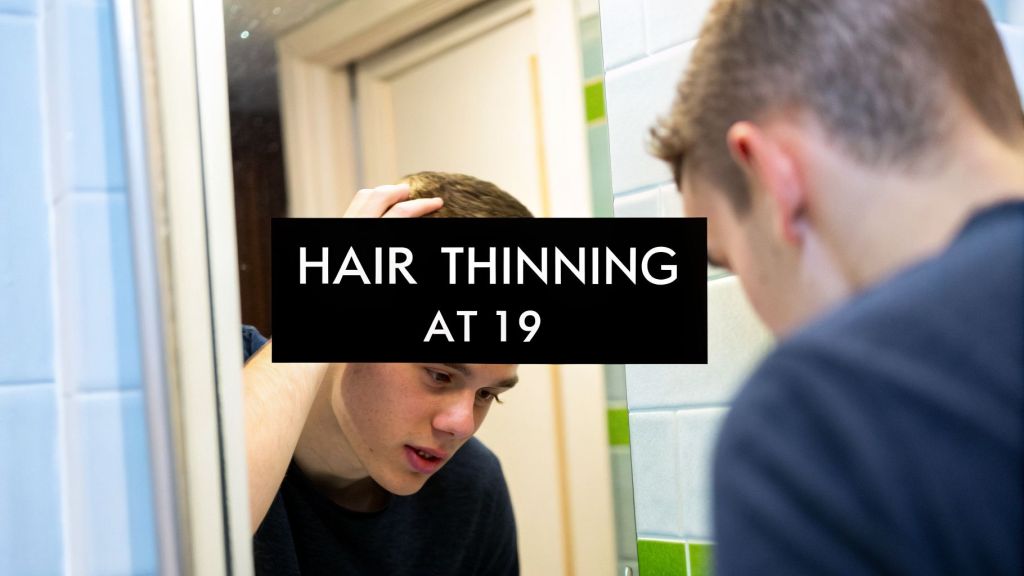
Finding your hair is thinning before you’ve even hit your twenties can be a real shock, but it’s important to know you aren’t imagining things. The simple truth is, hair thinning at 19 is a real—and surprisingly common—issue that affects a lot of young men. It's almost always a story of genetics and hormones doing their thing.
Why Am I Suddenly Losing Hair at 19

If you’ve started noticing more hair in the shower drain or a hairline that looks less dense than it used to, your first reaction is probably a wave of panic. But it’s crucial to understand this isn't some random event or a sign you did something wrong. For the vast majority of guys your age, this is the very beginning of androgenetic alopecia, which is just the clinical term for male pattern baldness.
Think of it like this: your hair follicles have a genetic "timer." For those susceptible to hair loss, a hormone called DHT (dihydrotestosterone) eventually comes along and pushes that timer's start button. This signals the follicles to shrink in a process called miniaturization. Each new hair that grows back is a little finer, shorter, and weaker, until eventually, the follicle just gives up and stops producing hair altogether.
You Are Not Alone in This
The feeling of being the only one dealing with this is often the hardest part. But you are so far from alone. In fact, research from the American Hair Loss Association shows that about 25% of men who experience male pattern baldness start noticing the signs before they even turn 21. For a huge number of guys, seeing thinner hair at 19 is their reality.
While genetics is the main driver, it's not always the only factor. Other things can sometimes trigger or speed up hair loss, making the situation a bit more complex. If your hair loss has felt particularly abrupt, you might want to explore the different sudden hair loss causes we cover in another article.
To help you get a clearer picture, here’s a quick breakdown of the main culprits behind early hair thinning.
Quick Guide to Causes of Hair Thinning in Young Men
This table breaks down the main things that can lead to hair loss at a young age, helping you make sense of what might be happening.
| Factor | How It Contributes to Hair Thinning | Common Signs |
|---|---|---|
| Genetics (Androgenetic Alopecia) | An inherited sensitivity to the hormone DHT causes hair follicles to shrink and eventually stop producing hair. | A receding hairline, thinning at the crown, or just a general thinning across the whole scalp. |
| Medical Conditions | Things like thyroid disorders, autoimmune diseases, or scalp infections can mess with the hair growth cycle. | Sudden patchy hair loss, a scaly or red scalp, or hair loss along with other symptoms like feeling tired all the time. |
| Extreme Stress | Major physical or emotional stress can push a ton of hair follicles into a "resting" phase, leading to noticeable shedding a few months later. | Abrupt, diffuse shedding all over your head, often noticed when you're washing or brushing your hair. |
| Nutritional Deficiencies | A lack of key nutrients like iron, zinc, or protein can seriously impact hair growth and strength. | Brittle, weak hair and increased shedding, often paired with other signs like fatigue or pale skin. |
Getting a handle on these factors is the first real step toward taking action. Once you recognize that hair thinning at 19 is a known biological process—not a personal failing—you can shift your mindset from worry to empowerment.
What's Actually Going On Up There? The Science of Early Hair Loss
When you first notice your hair thinning, it's easy to get caught up in the "why me?" of it all. But getting a handle on what's happening at a biological level can be incredibly empowering. The science isn't as intimidating as it sounds, and it's the first step toward taking control.
For the vast majority of guys experiencing hair thinning at 19, the root cause is genetics. It’s a condition called androgenetic alopecia, more commonly known as male pattern baldness.
The key player in this story is a hormone called DHT (dihydrotestosterone). Think of your hair follicles as tiny, individual power sources for each strand of hair. If you've inherited the genes for hair loss, some of your follicles—usually at the temples and crown—are genetically programmed to be hypersensitive to DHT. It's not about having too much of the hormone; it's about how your follicles react to it.
When DHT latches onto these sensitive follicles, it starts a process called miniaturization. The follicle begins to shrink, its growth phase gets shorter, and the hair it produces becomes weaker, finer, and lighter in color. Eventually, it just stops producing hair altogether.
This gradual shrinking is why you see progressive thinning rather than a sudden bald spot overnight. It's a slow-motion process that can start much earlier than most people think. For a more detailed look into this, you can get a great breakdown by understanding the science behind male pattern baldness.
It's Not Just About Your DNA
While your genes might load the gun, other factors can definitely pull the trigger, especially when you're young. These triggers don't cause male pattern baldness, but they can act as accelerants, speeding up the thinning that your genetics already had in store.
Think of it like this: if your hair follicles are already vulnerable, things like intense stress or a poor diet can push them over the edge much faster.
The good news? Many of these contributing factors are things you can influence. By getting them in check, you can create a much healthier environment for your hair and potentially slow down the thinning process. To get more specific on how this all works, check out our guide that asks, what is DHT and how does it relate to hair loss?
Common Triggers That Can Speed Up Hair Loss in Your Teens
Several things can pour fuel on the fire of genetic hair loss. See if any of these sound familiar, because identifying them is a huge first step toward building a plan.
-
Intense Stress: The pressure from school, life changes, or just being a 19-year-old can spike cortisol levels. This can shock your system and push a large number of hairs into the "shedding" phase all at once, a condition known as telogen effluvium. You might notice a sudden, dramatic increase in hair falling out a few months after a stressful period.
-
Nutritional Deficiencies: Let's be honest, a diet of pizza and energy drinks isn't exactly a recipe for strong hair. Your hair follicles need specific nutrients to thrive. Deficiencies in iron, zinc, and protein are especially tough on hair, as these are the literal building blocks for every strand.
-
Underlying Medical Issues: While less common, sometimes hair loss is your body's way of signaling that something else is wrong. Thyroid disorders or certain autoimmune conditions can disrupt the hair growth cycle. If you have other symptoms that you can't explain, it's worth considering.
Remember, these factors are usually collaborators, not the main culprits. They take an already sensitive situation and make the effects of genetic hair thinning at 19 appear faster and feel more severe.
How to Realistically Assess Your Hair Loss

It's one thing to worry your hair is thinning, but it’s another thing entirely to know for sure. That constant "is it or isn't it?" cycle can be draining. So, the very first step is to move past that gut feeling and start gathering some real, objective information.
Think of it as becoming a neutral observer of your own hair. The goal here isn't to self-diagnose, but to collect clear evidence so you can understand what’s actually going on.
Your Best Tool: The Photo Test
Your memory is surprisingly unreliable when it comes to gradual changes. What you think you see can be easily influenced by your mood or anxiety. That’s why photos are, without a doubt, the single most powerful tool you have. They don't lie.
Here’s how to create a reliable visual record:
- Be Consistent: Snap your photos once a month, maybe on the 1st of every month to make it easy to remember.
- Use the Same Setup: Always stand in the same spot with the same lighting. Natural daylight from a window is great, but harsh overhead bathroom lighting can be especially revealing for seeing your scalp.
- Get Every Angle: You need pictures from the front (to see your hairline), the top (for the crown), and both sides (to check the temples).
This simple routine cuts through the emotional noise. After a few months, you’ll have a clear, undeniable timeline that shows whether your hair thinning at 19 is a progressive pattern or if your perception was just getting the better of you.
Other Simple At-Home Checks
Beyond just taking pictures, a couple of other quick checks can add more detail to your assessment. These aren’t medical diagnostics, but they provide more clues to help you differentiate between normal daily shedding and something more significant.
The Wet Hair Check is a classic for a reason. After you shower, comb your hair straight back while it's still damp. Hair clumps together when it's wet, which makes your scalp more visible and gives you an honest look at your hair's true density.
A quick word of caution: don't freak out just because you can see your scalp. That’s normal for everyone with wet hair. What you’re looking for are changes over time—like your part line getting wider or your crown looking sparser than it did a month or two ago.
You can also get a more hands-on feel for your hair's thickness. We've put together a straightforward guide on how to perform a hair density test at home, giving you another piece of objective data for your toolkit.
Using the Norwood Scale as a Guide
You’ve probably seen the Norwood Scale—that chart with all the different stages of male pattern baldness. It can look intimidating, but it’s best to think of it simply as a map. It’s just a standardized way to describe and categorize how hair loss typically progresses.
For a lot of young men, the earliest signs line up with Stage 2 (a slight V-shape recession at the temples) or Stage 3 (a more defined M-shape or a noticeable thinning spot on the crown). This is far from unusual. In fact, a major study found that a surprising 16% of men aged 18-29 already had moderate to extensive hair loss. You can dive into the research on early hair loss patterns yourself to see just how common this is.
Knowing where you might fall on this scale doesn't make you a doctor, but it gives you a clear way to describe what you're seeing if you decide it's time to talk to a specialist.
Your First Action Plan: Lifestyle and Nutrition
Before you even start looking at medical treatments for hair thinning at 19, let's talk about what you can control right now. The way you eat, sleep, and handle stress creates the very foundation for your hair's health. Getting these fundamentals right can make a huge difference, no matter what’s causing your hair to thin.
Think of it like this: you can't change the plot of land you were given (your genetics), but you absolutely control how you water and fertilize the soil. Your daily habits are that water and fertilizer for your hair follicles.
Fueling Your Follicles From the Inside Out
A packed schedule often leads to grabbing whatever food is quick and easy. Unfortunately, your hair is one of the first things to suffer when your diet is missing key nutrients. Hair itself is made of protein and needs a steady stream of specific vitamins and minerals to grow strong.
When your body runs low on resources, it has to make tough choices. It sends nutrients to your vital organs first, and non-essential functions like hair growth get put on the back burner. This is why your diet is your first line of defense.
Here are the most important nutrients your hair is counting on:
- Protein: Hair is mostly made of a protein called keratin. Without enough protein from things like lean meats, fish, eggs, or beans, your hair can become weak and brittle.
- Iron: This mineral helps red blood cells carry oxygen everywhere, including to your hair follicles to fuel their growth. Low iron is a classic, well-known cause of hair shedding. You can find it in red meat, spinach, and fortified cereals.
- Zinc: Zinc is a workhorse. It helps with hair tissue growth and repair, and it also keeps the oil glands around your follicles functioning correctly. Good sources include beef, pumpkin seeds, and lentils.
- Biotin (Vitamin B7): Often called the "hair vitamin," biotin helps your body produce keratin. While a true deficiency is rare, ensuring you get enough from eggs, nuts, and whole grains is a smart move.
You don't need a drastic diet overhaul. Small, consistent changes are what truly count. Try swapping one fast-food meal for a grilled chicken salad or grabbing a handful of nuts for an afternoon snack. For a deeper dive, check out our complete guide on building a hair loss diet that actually works.
Taming the Stress That Accelerates Thinning
Being 19 can be incredibly stressful. Between exams, a social life, and figuring out your future, the pressure can feel constant. This kind of chronic stress can raise your levels of cortisol, a hormone that can shock a large number of hair follicles into a resting phase, leading to noticeable shedding a few months later.
The goal isn't to get rid of stress—that's just not realistic. The key is to build resilience so it doesn't completely overwhelm your system.
Think of your stress tolerance as a bucket. Everyday pressures slowly fill it up. If you don't find ways to empty it, it will eventually overflow, and your body will show the signs—sometimes through your hair.
Simple, practical techniques can help empty that bucket before it overflows:
- Mindful Breathing: Feeling overwhelmed? Stop for just two minutes. Breathe in slowly for a count of four, hold for four, and then exhale slowly for a count of six. This simple exercise can instantly calm your nervous system.
- Consistent Sleep: Getting 7-9 hours of quality sleep isn't a luxury; it’s a biological command. Your body does most of its repair work—including on your hair follicles—while you're in deep sleep.
- Physical Activity: You don't have to become a gym rat. A simple 20-minute walk outside is enough to lower cortisol and boost endorphins, which directly counters the physical toll of stress.
Gentle Hair Care to Minimize Breakage
Finally, what you do to your hair on the outside is just as important. Aggressive styling and harsh products create physical stress that can break strands, making already thin hair look even thinner. A gentler routine helps you hang on to every hair you have.
Start by looking at the ingredients in your shampoo. Try to avoid products with harsh sulfates (like Sodium Lauryl Sulfate), which strip your scalp of its protective oils, and drying alcohols that leave hair brittle.
Instead, wash with lukewarm water and gently massage your scalp with your fingertips—never your nails. When you get out of the shower, pat your hair dry instead of rubbing it aggressively with a towel. Little adjustments like these protect your hair from unnecessary breakage and help create a healthier scalp for future growth.
Medical Treatments That Actually Work for Young Men
When you've cleaned up your diet, managed your stress, and are still seeing more hair in the drain, it’s time to consider stronger options. Diving into medical treatments for hair thinning at 19 can feel like a lot to take in, but a few proven solutions have become the go-to for a reason. Let's cut through the noise and talk about what really works.
The goal isn't just about damage control; it's about finding a sustainable strategy that puts you back in the driver's seat. The most effective treatments are those backed by science that get right to the root of the problem.
The FDA-Approved Frontliners: Minoxidil and Finasteride
Walk into any dermatologist's office to discuss male pattern hair loss, and you'll almost certainly hear two names: Minoxidil and Finasteride. These are the only two treatments approved by the FDA for this specific issue, and they tackle hair loss from two very different angles.
Minoxidil (Rogaine): You've probably seen this one on pharmacy shelves. It's a topical foam or liquid you apply directly to your scalp. Think of Minoxidil as a support system for your hair follicles—it works by increasing blood flow, which brings a fresh supply of oxygen and nutrients to the scalp. This can help wake up dormant follicles and even thicken existing hairs. It’s a great first step.
Finasteride (Propecia): This is a daily pill, available only by prescription, that attacks the problem at its hormonal source. Finasteride works by blocking the enzyme that converts testosterone into dihydrotestosterone (DHT), the primary hormone responsible for shrinking hair follicles. It's like building a barricade to stop the very thing causing the damage.
For many young men, a combination of both is the most effective approach, delivering a powerful one-two punch against thinning. Of course, since Finasteride is a prescription drug with potential side effects, a conversation with your doctor is essential to know if it's the right choice for you.
A Deeper Look at the Options
To have a productive talk with your doctor, it helps to know how these treatments compare. Here’s a quick breakdown of what to expect from the most common medical solutions.
Comparing Popular Hair Loss Treatments for Young Men
The table below breaks down the most common medical treatments for hair loss, explaining how they work, who they're best for, and the kind of results you can realistically expect.
| Treatment | How It Works | Best For | Expected Results |
|---|---|---|---|
| Minoxidil | A topical solution that boosts blood flow to the scalp, helping to revive follicles. | General thinning, especially at the crown. An excellent starting point. | Can slow hair loss and, in some cases, lead to regrowth. Requires consistent, twice-daily application. |
| Finasteride | An oral pill that lowers DHT levels in the body to stop follicles from shrinking. | Slowing progressive hair loss and preserving the hair you currently have. | Very effective at halting hair loss and thickening hair over time. Requires a prescription. |
| PRP Therapy | Uses your own concentrated platelets, injected into the scalp to stimulate follicles with growth factors. | Early-stage thinning where follicles are weak but not completely gone. | Can increase hair thickness and density. Performed in a clinic over multiple sessions. |
This comparison shows there's no single "best" option—it's about finding the best fit for your specific type of hair loss and lifestyle.
This flowchart maps out a logical way to approach your hair health, starting with simple self-assessment and moving toward more targeted actions.

The takeaway here is that taking action is a process. You start with the basics and can escalate to more direct interventions if needed.
Platelet-Rich Plasma (PRP): Recharging Your Hair Follicles
Beyond daily medications, Platelet-Rich Plasma (PRP) therapy is another powerful option that’s getting a lot of attention. This treatment cleverly uses your body's own natural healing mechanisms to give hair growth a serious boost. It's an especially good option for hair thinning at 19 because it works best when follicles are just weakened, not gone for good.
The process itself is surprisingly straightforward:
- A small sample of your blood is drawn, just like in a routine lab test.
- That blood is spun in a centrifuge, which separates the platelets into a highly concentrated plasma.
- This PRP, which is full of powerful growth factors, is then carefully injected into the areas of your scalp where you're seeing thinning.
Think of a dormant hair follicle like a phone on 1% battery. PRP acts like a power bank, injecting a concentrated burst of energy and growth signals directly where they're needed to "wake up" the follicle and get it working properly again.
Starting PRP early can make a huge difference. The whole idea is to preserve the hair you have and revitalize those weakened follicles before they shut down permanently. To see if this could be the right avenue for you, exploring a detailed overview of hair loss treatment for men can provide deeper insights into all the available options.
Emerging Technologies in Hair Restoration
The science behind hair restoration is constantly evolving, with new and promising methods on the horizon. One non-invasive treatment gaining ground is Red Light Therapy (RLT). As this guide on Red Light Therapy for Hair Loss explains, this approach uses specific wavelengths of light to help energize the cells in your hair follicles, which may encourage new growth.
Ultimately, the most critical step you can take is to work with a qualified doctor or dermatologist. They can give you an accurate diagnosis, rule out any other underlying causes, and help you create a safe, effective treatment plan that’s built just for you.
Navigating the Emotional Side of Hair Loss

Let’s step away from the science for a minute and talk about how this actually feels. Dealing with hair thinning at 19 isn’t just about the physical change—it’s an emotional gut punch. If you’re feeling anxious, down, or just plain angry about it, those feelings are completely valid. You're not overreacting.
At this age, our hair is often tangled up with our identity and self-image. When it starts changing unexpectedly, it can feel like you’re losing a part of yourself, and that can be incredibly isolating.
But here’s the thing: your well-being is so much more than your hairline. Learning to manage the mental and emotional side of this is every bit as important as any treatment you decide to try. Building a sense of self that isn't dependent on your hair is a game-changer.
Rebuilding Your Confidence
The real path to feeling good again isn't necessarily about reversing hair loss; it’s about shifting where you place your self-worth. Genuine, unshakable confidence is an inside job. It’s built on your skills, your passions, and the qualities people who matter actually care about.
Here are a few ways to start rebuilding that foundation:
- Focus on What You Control: You didn't choose your genetics, but you can choose to get in shape, develop a sharp sense of style, or master a new skill. Pour your energy into things that empower you.
- Find a Look That Works for You: A great haircut can make all the difference. A skilled barber won't just try to hide thinning; they'll create a style that makes it look intentional and sharp, often giving the illusion of more fullness.
- Practice Self-Compassion: We are our own harshest critics. Make a conscious effort to talk to yourself the way you’d talk to a friend who was struggling. You deserve that same kindness.
Your hair is a part of you, but it isn't the sum of who you are. Your worth is defined by your character, your actions, and how you treat others—not by the density of your hair.
How to Talk About It
Keeping this bottled up often makes the anxiety a thousand times worse. Just opening up to a trusted friend or family member can feel like a massive weight has been lifted. The hardest part is just starting the conversation.
You don't need to make a formal announcement. Try one of these low-key conversation starters:
- With a Friend: "Hey, can I talk to you about something that’s been bugging me? I've been noticing my hair is thinning, and honestly, it's been getting me down."
- With a Parent: "I’ve been feeling pretty stressed about my hair lately. It looks like it’s thinning out, and I was wondering if we could talk about seeing a doctor to get it checked."
Often, simply saying the words out loud strips them of their power. You might be surprised by how supportive people are. There are also incredible online communities, like the r/tressless subreddit, where you can find thousands of other young guys who get exactly what you’re going through. You don't have to face this alone.
Common Questions About Hair Thinning in Your Teens
Even with all the information on causes and treatments, you probably still have some nagging questions. Let's tackle some of the most common ones I hear from young men who are worried about their hair.
Will Wearing a Hat Make My Hair Loss Worse?
Let's get this one out of the way right now: no. This is one of the most persistent myths out there. Your go-to baseball cap or beanie isn't the culprit behind your thinning hair.
Unless a hat is so painfully tight that it's actually cutting off circulation to your scalp—which you would definitely notice—it's not causing hair loss. The real drivers are internal, like your genes and hormones. So, wear your hat. Just focus on being gentle when you wash and style your hair and avoid products that make your scalp angry or itchy.
Can My Hair Grow Back if I Start Treatment Now?
The single biggest factor working in your favor is your age. When you're 19, most of those struggling hair follicles are just weakened and shrinking—a process called miniaturization. They aren't gone for good just yet. This is the perfect time for treatments to step in and revive them.
Think of it this way: Treatments like Minoxidil, Finasteride, or PRP are much better at saving a wilting plant than they are at bringing a dead one back to life. They work wonders to halt further thinning and can thicken up your existing hair, which makes a huge difference in overall fullness.
Catching hair loss early and sticking with a proven treatment plan is your best shot at keeping the hair you have for many years to come. Consistency is everything.
Is It Really Hair Loss or Am I Just Stressed?
It could be a bit of both. A period of intense stress can trigger a temporary shedding condition called telogen effluvium, where you suddenly start losing hair from all over your scalp. The good news is that this type of shedding usually stops on its own a few months after the stress subsides.
But here's the catch: if you already have the genes for male pattern baldness, a major shedding event like this can "unmask" the underlying thinning that was already starting. It’s like pulling back a curtain on a process that was happening in the background. If your hair doesn't bounce back to its usual thickness within 6-9 months, it’s a strong clue that genetics are the main issue.
When Should I See a Doctor?
Worrying about hair thinning at 19 is stressful enough. Getting a professional diagnosis can bring a huge sense of relief and give you a clear path forward.
It's time to book an appointment with a dermatologist or a hair loss specialist if:
- You've been tracking your hair with photos and have seen noticeable thinning over a 3-6 month period.
- The loss is sudden, happening in patches, or you have an itchy, painful scalp.
- The anxiety over your hair is starting to impact your confidence or daily life.
A doctor can give you a definitive answer, make sure nothing else is going on with your health, and help you create a treatment strategy that actually works.
At PRP For HairLoss, our goal is to give you clear, honest, and evidence-based guidance for your hair restoration journey. You can find out more about all your options by visiting our website.
 PRP For Hairloss
Leave a comment