So, you've taken the plunge and decided to start using minoxidil. The number one question bouncing around in your head is probably a simple one: when will I actually see something happen?
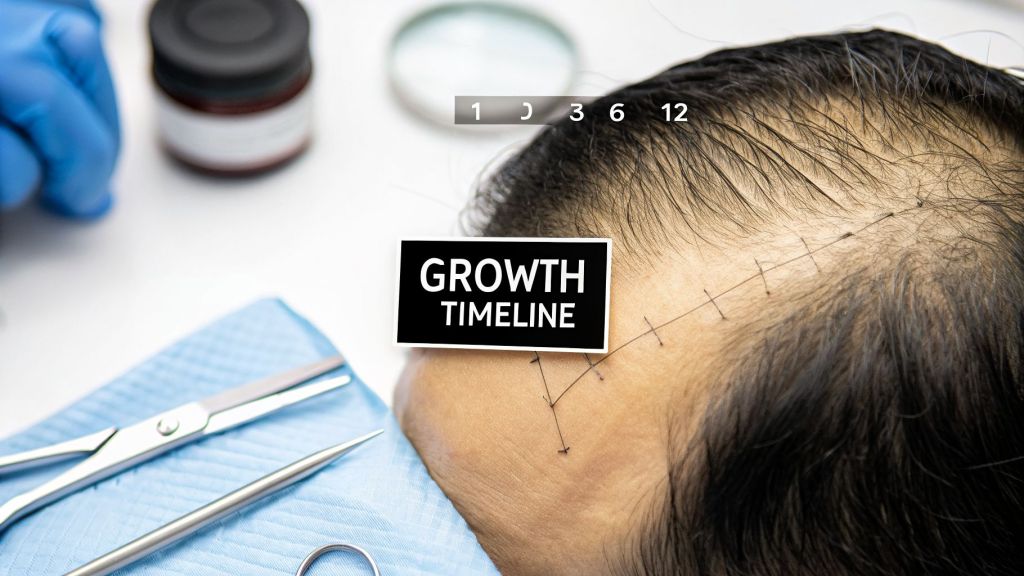
Let's cut right to the chase. You can generally expect to see the first, subtle signs of new growth in about 3 to 6 months. The more significant, noticeable results often take up to a year of consistent, daily use. This is a journey that definitely rewards patience.
Your Minoxidil Results Timeline: What to Expect
Starting minoxidil is a real commitment, and knowing what to expect can make all the difference. It’s not an overnight fix. I like to think of it like tending to a lawn—you won't see a lush, green carpet overnight, but with steady effort, you’ll see those bare patches gradually fill in.
One of the first things you might notice, oddly enough, is more shedding. It sounds totally counterintuitive, I know, but it’s a genuinely positive sign. This just means the treatment is doing its job, pushing out old, dormant hairs to make way for new, healthy ones.
Here's a closer look at what your journey will likely look like.
The Initial Phase: Shedding and Early Growth (Months 1-3)
During the first 1 to 3 months, your hair follicles are essentially being shaken awake from a long nap. This is when that initial shedding phase, sometimes called the "dread shed," can happen. Don't panic. It's a clear signal that your follicles are transitioning into a new growth cycle.
Towards the end of this period, if you run your hand over your scalp, you might feel some fine, soft, baby-like hairs. These are the very first sprouts of new growth, a sign that you're on the right track. It helps to know the 7 signs of new hair growth so you can spot these early indicators.
The Growth Phase: Visible Progress (Months 3-6)
This is where things start to get exciting. Between months 3 and 6, those initial fine hairs begin to mature. They’ll gradually become thicker, stronger, and more pigmented, blending in with the rest of your hair.
At this stage, you should begin to see and feel a real difference in density in the areas you've been treating.

The Maintenance Phase: Long-Term Results (Months 6-12+)
By the time you hit the 6-month mark, and certainly by 12 months, you’ll have a very clear picture of how well minoxidil works for you. From here on out, the goal shifts from kickstarting new growth to maintaining what you’ve gained.
Think of it this way: consistency is non-negotiable. If you stop the treatment, the progress you've made will unfortunately reverse over time as the hair follicles return to their previous, untreated state.
Research backs this timeline up. While some early responders see changes in as little as 8 weeks, the most significant improvements typically happen after the 4-month mark. In a landmark 2004 study, an impressive 84% of men using 5% minoxidil for one year rated it as effective for promoting new hair growth.
How Minoxidil Revives Dormant Hair Follicles

So, you’re applying minoxidil every day, but what's actually going on under the surface? It’s not just some magic potion; it’s a direct intervention in your hair’s natural growth rhythm. Before we get into what minoxidil does, we need to talk about what it's up against.
Your hair is in a constant cycle of growing, resting, and shedding. With male pattern baldness, this cycle gets completely thrown off. The growth phase shortens, and the follicles themselves begin to shrink—a process called miniaturization. Over time, these shrunken follicles just give up and stop producing hair.
The good news? Those follicles aren't dead. They’re just dormant, waiting for a good reason to get back to work. Minoxidil is that reason.
Waking Up Your Hair Follicles
While researchers are still piecing together the full picture, we know minoxidil's primary power comes from vasodilation.
Think of the tiny blood vessels nourishing your scalp as pipelines. In androgenetic alopecia, these pipelines get squeezed, choking off the supply of oxygen and nutrients your hair follicles need to build healthy hair.
Minoxidil works by widening these blood vessels. It’s like opening the floodgates, allowing a rush of blood, oxygen, and vital nutrients to flow directly to the hair root. This revitalized environment is exactly what a shrunken, starved follicle needs to kickstart itself back into the growth phase and, just as importantly, stay there longer.
By boosting the supply line of nutrients, minoxidil essentially gives miniaturized follicles the fuel they need to begin producing thicker, healthier hair shafts again. This is a critical step in reversing the effects of hair thinning.
This is also why consistency is so crucial. Every single application helps keep those important pipelines open and flowing.
Understanding the Anagen, Catagen, and Telogen Phases
To really get a feel for the minoxidil timeline, you have to understand the three stages of hair growth. Every single strand on your head is in one of these phases right now:
- Anagen (The Growing Phase): This is the main event, where hair is actively growing. This phase can last anywhere from two to six years. Minoxidil’s main job is to extend this critical window, giving your hair more time to grow longer and stronger.
- Catagen (The Transition Phase): A brief, two-week transition where the hair follicle shrinks and cuts itself off from the blood supply, preparing to rest.
- Telogen (The Resting Phase): The follicle sits dormant for about three months. At the end of this phase, the old hair is pushed out—or shed—as a new hair begins its anagen phase.
Minoxidil works by forcing more follicles into the anagen phase and keeping them there. It's a gradual shift, but over time, it changes the entire balance of your scalp toward active growth instead of resting and shedding. Want to know what to look for? You can learn to spot the reawakening of dormant hair follicles in our detailed guide.
Demystifying the "Dread Shed"
One of the first things many people notice when starting minoxidil is also the most alarming: you start shedding more hair. It’s easy to panic and think the treatment is backfiring, but this couldn't be further from the truth.
This initial shedding—often called the "dread shed"—is one of the best early signs that minoxidil is working.
Think of it as a complete reset for your scalp. Minoxidil gives a powerful push to all the hairs that were already in the resting (telogen) phase, causing them to fall out at around the same time. It’s making room for the new, stronger anagen hairs that are starting to grow in their place.
It's a classic "out with the old, in with the new" scenario. While finding extra hair in your comb or the shower drain is unsettling, just know it’s a temporary and necessary part of the journey to thicker hair.
Getting the Most Out of Your Minoxidil Treatment

Starting minoxidil is a fantastic first step, but just slapping it on your scalp twice a day isn't the whole story. To really see impressive results and maybe even speed things up a bit, you need to create the best possible conditions for your hair to grow. It’s all about stacking the deck in your favor.
Think of it this way: your daily habits, the specific product you choose, and your own unique biology all have a say in the final outcome. Let's walk through how to make sure every drop of minoxidil counts.
The Number One Rule: Be Unbelievably Consistent
If you take only one piece of advice from this article, let it be this: you have to be consistent. Applying it twice a day, every single day, isn't just a suggestion—it's the bedrock of your success.
Minoxidil works by keeping the blood vessels around your hair follicles dilated, which ensures a steady flow of oxygen and nutrients. Its effects are temporary, though. When you skip an application, that supply line starts to shrink, stalling the very growth cycle you're trying so hard to awaken.
Imagine you're trying to fill a bucket with a slow, dripping faucet. If you keep turning the faucet off and on, you'll never make progress. You have to leave it on, drip by drip, to eventually fill the bucket. Minoxidil is the same way; steady application is what ultimately delivers results.
Of course, missing a single dose won't completely derail your progress. But if you’re frequently forgetting, you're definitely going to slow things down. The easiest way to stay on track is to tie it to your existing daily habits, like brushing your teeth in the morning and at night.
Choosing Your Weapon: Liquid vs. Foam
When you head to the pharmacy, you’ll find two main types of minoxidil: the original liquid and the newer foam. Both use the same active ingredient to get the job done, but their formulations are different, which might make one a better choice for you.
-
Liquid Minoxidil: This is the classic formula. It contains an ingredient called propylene glycol, which is great for helping the minoxidil absorb into your scalp. The downside? For some people, it can cause itching, redness, or dandruff. The dropper applicator makes it easy to target specific thinning spots with precision.
-
Foam Minoxidil: The foam was developed specifically to be gentler. It's free of propylene glycol, so it's a great option if you have sensitive skin. It also dries much faster and is less greasy, which most people find makes styling their hair a lot easier.
A lot of people start with the liquid because it's often a bit cheaper, but they'll switch to the foam if they run into any scalp irritation. Both are proven to work, so this choice really boils down to your skin's sensitivity and personal preference. You can find more on different ways to apply it, including the practicality of a minoxidil spray for men, in our other guides.
The Right Strength for the Job: 2% or 5%?
You'll also see minoxidil sold in two main strengths, 2% and 5%. While the 2% solution can certainly help, the 5% concentration is overwhelmingly the standard recommendation for men experiencing male pattern baldness.
The reason is simple: research clearly shows that the higher strength just works better and faster. For men, the 5% topical minoxidil solution was shown to be significantly more effective at stimulating satisfying hair regrowth compared to the 2% version.
Just remember, more isn't always better. Stick to the twice-daily application. Using it more often won't make your hair grow any faster, but it will definitely increase your risk of side effects.
Other Factors That Shape Your Results
Beyond your daily routine, a few personal factors play a big role in how quickly and how well you respond to minoxidil.
-
Age and Genetics: Generally, younger guys who catch their hair loss early tend to see the fastest and most dramatic results. Your unique genetic blueprint for hair loss is also a major factor in how well your follicles respond to treatment.
-
Stage of Hair Loss: Minoxidil works best on the crown (the bald spot at the back, or vertex) and for men who are in the earlier phases of thinning. If an area has been completely slick and bald for many years, the follicles there may have permanently shut down, making it very difficult to revive them.
By understanding these elements and committing to a consistent, smart approach, you give yourself the absolute best chance of achieving the hair regrowth you're hoping for.
A Realistic Look at Minoxidil Success Rates

While personal stories are encouraging, it's the clinical data that gives us a truly realistic picture of what to expect. Looking at the numbers helps ground our expectations and separates fact from fiction when it comes to minoxidil's effectiveness.
So, what does "success" actually mean in this context? For most people, it’s not about growing back a full head of teenage hair. Success is usually measured in two ways: first, holding the line and stopping further hair loss, and second, seeing noticeable regrowth, particularly at the crown.
The good news is that for the vast majority of men who use it consistently, minoxidil works. It's a long game, but the results build steadily month after month.
What the Studies Show About Efficacy
When you dig into the research, you'll find a clear and consistent pattern. Minoxidil is a proven tool for a significant number of men who commit to it. While it's not a silver bullet for everyone—genetics and your current stage of hair loss are big factors—the odds are definitely in your favor.
One landmark study gives us a great benchmark. It followed men using 5% topical minoxidil for a full year and found that an impressive 62% saw a reduction in the size of their balding area. That tells us that with a bit of patience, well over half of users can expect real, visible improvement.
The bottom line from all this data is clear: minoxidil isn't just a hopeful shot in the dark. It is a scientifically-backed treatment that produces measurable results for most men who commit to it.
This level of success is precisely why it continues to be one of the most recommended and trusted treatments for male pattern baldness.
Measuring Hair Growth Quantitatively
Okay, so balding areas can get smaller, but what about the raw numbers? Do you actually grow more hair? Dozens of high-quality trials have focused on this exact question, and the results are consistently positive.
On average, men who use minoxidil as directed see an increase in hair count of around 10-20% over 6 to 12 months. That percentage might not sound like a huge number, but it's often enough to create a visible difference in scalp coverage and thickness.
A separate comparative study drove this point home. It put 5% minoxidil head-to-head with a placebo. After just 16 weeks, the men using minoxidil had a statistically significant jump in new hair growth compared to the group using the inactive solution. You can see what this looks like in practice by checking out these minoxidil results before and after photos.
These figures confirm what so many guys report from their own experience: minoxidil is fantastic at stopping hair loss in its tracks and helping to fill in thinning spots on the crown (the vertex). It acts as a solid defense against further thinning while actively encouraging new growth where it's often needed most.
Combining Minoxidil with Treatments Like PRP
Minoxidil is a fantastic start, but it doesn't have to be the only tool in your arsenal. For many guys serious about stopping hair loss, the most powerful approach involves hitting the problem from multiple angles. It’s less about finding one magic bullet and more about building a smart, complementary routine.
When you pair minoxidil with other proven treatments, the results are often far greater than the sum of their parts. You’re creating an environment that not only wakes up dormant follicles but also gives them everything they need to produce thick, healthy hair again.
PRP: The High-Octane Growth Factor Boost
One of the most effective partners for minoxidil is Platelet-Rich Plasma, or PRP therapy. If you think of minoxidil as the worker opening up the roads to your hair follicles, PRP is the specialized crew that arrives with a potent supply of building materials.
PRP therapy works by concentrating the natural growth factors found in your own blood. When these growth factors are injected into your scalp, they act like a powerful signal, telling your body to repair and regenerate tissue. This gives miniaturized, struggling hair follicles a massive boost.
The combination is incredibly effective for two key reasons:
- Minoxidil gets the blood flowing, widening the vessels to ensure a steady stream of oxygen and nutrients can reach the follicle.
- PRP then delivers a super-concentrated dose of growth factors right where they're needed, stimulating cell repair and pushing follicles to produce stronger, thicker hair.
This one-two punch can really amplify your results, often speeding up how quickly you see visible changes and leading to a much more significant improvement in overall hair density. The timeline for PRP hair treatment also tends to line up nicely with minoxidil, creating compounding waves of progress.
Finasteride: The DHT Blocker
Another absolute cornerstone of combination therapy is finasteride. While minoxidil is on the front lines stimulating growth, finasteride works behind the scenes to stop the very thing that causes male pattern baldness in the first place: dihydrotestosterone (DHT).
Finasteride’s job is to lower the amount of DHT in your system. Since DHT is the hormone that attacks and shrinks hair follicles over time, adding finasteride to your routine is like playing both offense and defense at the same time.
Minoxidil is your offense, pushing follicles into the growth phase and keeping them there longer. Finasteride is your defense, shielding those same follicles from the relentless hormonal damage caused by DHT. This duo is widely considered the gold standard for a reason.
Study after study has confirmed that using minoxidil and finasteride together produces dramatically better results than using either one on its own.
Microneedling: Paving the Way for Better Absorption
A third powerful ally to consider is microneedling. This involves using a small device with very fine needles to create tiny, invisible punctures in the scalp. It might sound a bit intense, but the science behind it is solid.
First, these micro-injuries kickstart your body’s natural healing process. This releases a cascade of your own native growth factors and boosts collagen, creating a healthier scalp environment for hair to grow. Second, and perhaps more importantly, these microscopic channels can drastically improve the absorption of topical minoxidil, allowing more of the active ingredient to penetrate deep down to the follicles.
Stacking these therapies gives you the best possible shot at success. It’s a proactive strategy that moves beyond just hoping for results and instead focuses on creating the ideal biological conditions for regrowth.
Minoxidil vs. Combination Therapy Effectiveness
To put it in perspective, here’s a look at how combining treatments can elevate the results you see compared to using minoxidil alone.
| Treatment | Reported Effectiveness Rate | Primary Benefit |
|---|---|---|
| Minoxidil 5% (Alone) | Approx. 60-65% see visible improvement. | Stimulates blood flow and prolongs the growth phase. |
| Minoxidil + Finasteride | Effectiveness can approach 90% for stopping hair loss. | Stimulates growth while blocking follicle-shrinking DHT. |
| Minoxidil + Microneedling | Studies show significantly higher hair count increases. | Boosts minoxidil absorption and stimulates growth factors. |
By building a comprehensive treatment plan, you’re not just fighting hair loss—you’re actively working to reverse it by giving your hair follicles the support they need from every possible angle.
Navigating Potential Side Effects Safely
Look, while minoxidil is an incredibly safe tool for most people, it's still a medication. Knowing what to expect—both good and bad—is just smart. The great news is that for the vast majority of users, any side effects are mild, temporary, and happen right where you apply the product.
Serious problems are very rare. Most of the time, what you're experiencing is just your scalp getting used to a new routine.
Common and Manageable Side Effects
If you run into an issue, it's almost always going to be a simple skin reaction. These things often clear up on their own after a week or two, but if they don't, there's usually an easy fix.
Here’s what you might notice:
- Scalp Irritation: Some initial redness, itching, or even a bit of flaking is pretty common. This is almost always a reaction to propylene glycol, an ingredient in the liquid formula that helps the minoxidil absorb but can be irritating to sensitive skin.
- Unwanted Hair Growth: Minoxidil works where you put it. If you're a little sloppy and it drips onto your forehead or the sides of your face, you might see some fine, new hairs pop up. This is easily prevented by being more careful with your application.
If your scalp is giving you trouble, the first and most effective step is switching from the liquid to the foam version. The foam is specifically designed without propylene glycol, which makes it a much gentler option for most people.
When to Contact Your Doctor
While minor scalp irritation is one thing, you need to be aware of the signs of a more serious systemic reaction. These are not common, but they are not something to ignore.
Stop using minoxidil immediately and get in touch with your doctor if you experience any of these symptoms:
- Chest pain or a heart rate that feels unusually fast
- Feeling dizzy, lightheaded, or like you might faint
- Sudden and unexplained weight gain
- Noticeable swelling in your hands or feet
These symptoms can be a sign that your body is absorbing too much of the drug. Again, it’s rare, but it's something you need to take seriously. To get a fuller picture of how the medication can affect the body, you can read more about potential oral minoxidil side effects.
Knowing When to Re-evaluate Your Treatment
Patience is the name of the game with minoxidil, but it's not a "wait forever" situation. You have to know when to call it. My rule of thumb for patients is to give it at least a full year of consistent, twice-a-day use before making a final judgment.
If you've been diligent for 12 solid months and can honestly say you see zero change—no new sprouts, no slowdown in shedding, nothing—then it’s time for a new plan. A consultation with a dermatologist or a hair loss specialist can help figure out why it didn't work for you and pivot to other treatments that might be a better fit. An honest assessment is the only way to make sure you're on the right path.
Your Minoxidil Questions, Answered
If you’re thinking about starting minoxidil, you've probably got a few questions floating around. Let's get you some straight answers based on years of experience and data.
Is It Okay to Use Minoxidil Just Once a Day?
Look, applying it once a day is certainly better than nothing. But to get the results you're really after, you need to stick to the recommended twice-daily application.
Minoxidil has a pretty short half-life in your body. Applying it in the morning and again at night keeps a steady, consistent level of stimulation on your follicles. Think of it like keeping a fire going—you have to add a log every so often to keep it from dying out. Sticking to the twice-a-day schedule ensures your follicles get that constant signal to grow.
Will Minoxidil Fix My Receding Hairline?
This is a big one. Officially, the FDA approved minoxidil for hair loss at the crown of the head (the vertex). That’s where the original studies were focused, and it’s where we know it works best.
That said, countless people use it "off-label" for their receding hairline and temples. The results there are often more modest. It might help you hold the line, slowing down further recession, and you could see some finer, vellus hairs sprout up. Just be realistic—it’s generally not as effective at rebuilding a dense, frontal hairline as it is at filling in the crown.
What Happens If I Stop Taking Minoxidil?
It's crucial to understand that minoxidil is a treatment, not a cure. It works by keeping the blood vessels supplying your follicles open and stimulated. The moment you stop, that process begins to reverse.
Within 2-3 months of stopping, you can expect any hair you've regrown to fall out. You'll likely return to the exact same state of hair loss you were in before you ever started. If you want to keep the hair you've gained, minoxidil has to be a long-term commitment.
Can I Make Minoxidil Work Faster?
Patience really is the name of the game here. However, you can definitely create the best possible environment for it to work.
- Apply to a clean, dry scalp. This helps with absorption.
- Stay consistent. This is the single most important factor. Missing applications will slow you down more than anything. Don't try to double up to "catch up"—just get back on schedule.
- Consider a booster. As we've covered, pairing minoxidil with treatments like microneedling can create micro-channels in the scalp, potentially boosting absorption and effectiveness.
Ready to learn how to get the most out of your hair restoration efforts? At PRP For HairLoss, we specialize in combining proven treatments like minoxidil with advanced therapies to create a comprehensive plan. Discover more powerful strategies at https://prpforhairloss.com.
 PRP For Hairloss
Leave a comment