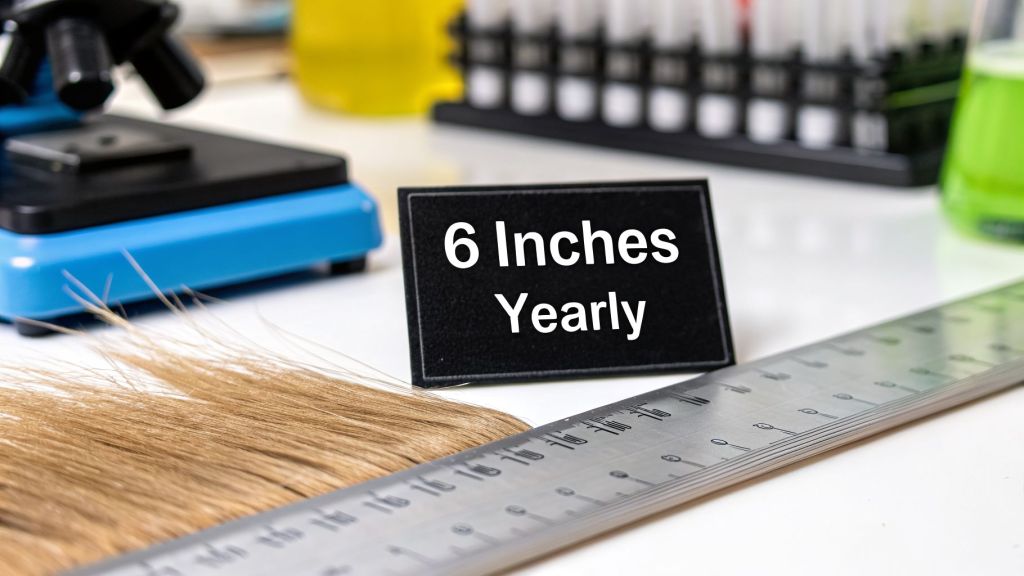
Ever found yourself staring in the mirror, wondering just how much your hair actually grows in a year? You're not the only one. The short and simple answer is about six inches.
Think of that as the gold standard, the average benchmark we can all expect when things are running normally.
The Six-Inch Rule of Hair Growth
That six-inch figure is a great starting point for understanding your hair's potential. But the real magic is in how that growth happens, bit by bit, every single day. Over the course of a year, those tiny, almost invisible gains compound into a length that’s hard to miss.
To really get a feel for it, let's break that number down into smaller chunks of time. When you see the daily and monthly figures, it becomes clear how slow, steady progress adds up to a big change. It’s definitely a marathon, not a sprint.
Daily and Monthly Growth Averages
Your hair is quietly working away, day in and day out. On any given day, each strand grows just a tiny fraction of a millimeter—so small you’d never notice it. Zoom out to a month, though, and that growth becomes much more tangible, usually hitting the half-inch mark.
This consistent rate is what makes growing your hair out possible. It's also why patience is key, especially if you're trying to recover from thinning or just want longer hair. The small, positive habits you build can have a huge impact when you give them a few months to work. If you're curious, you can learn more about spotting the subtle signs your hair is growing back.
The fascinating part isn't just the final six-inch number, but the biological consistency behind it. Your body is on a predictable schedule, and learning its rhythm is the first step to supporting healthier, stronger hair.
For men dealing with hair loss, this baseline is particularly important. Clinical studies confirm it: on average, a man's scalp hair grows about 6 inches per year. That breaks down to roughly 0.5 inches per month or about 0.35 mm per day.
However, for guys experiencing male pattern baldness, this rate often slows down in their 30s and 40s. The hormone DHT starts to shrink the hair follicles, which means each new growth cycle produces a shorter, finer hair until it eventually stops altogether.
Average Hair Growth Rates at a Glance
To make these numbers even easier to visualize, here’s a quick summary of what you can typically expect.
| Timeframe | Average Growth (Inches) | Average Growth (Millimeters) |
|---|---|---|
| Per Day | ~0.014 inches | ~0.35 mm |
| Per Month | 0.5 inches | ~12.7 mm |
| Per Year | 6.0 inches | ~152.4 mm |
This table gives you a clear, at-a-glance reference for typical hair growth.
Now that we have this six-inch foundation firmly in place, let's dig into the fascinating mechanics of why hair grows at this speed and what you can do to influence it.
Understanding Your Hair's Internal Growth Cycle
Beyond just measuring inches, what's really going on beneath the surface of your scalp is a complex biological clock. Your hair follows a fascinating, three-part schedule known as the hair growth cycle. To really get a handle on how much hair grows in a year, you first have to understand the engine that drives it all.
Think of each hair follicle not just as a pore, but as its own tiny, independent factory. This factory has a very specific production schedule it follows, cycling through periods of work, transition, and rest.
The Three Phases of Hair Growth
The whole operation is broken down into three main phases. Each one has a distinct job, and how long each phase lasts is what ultimately determines the health and length of your hair.
-
Anagen (The Growth Phase): This is where all the action happens. It's the active manufacturing stage where cells in the hair bulb are dividing rapidly to build new hair. For the hair on your head, this is by far the longest phase, lasting anywhere from 2 to 7 years. This is the key factor in how long your hair can physically grow.
-
Catagen (The Transition Phase): After a long growth spurt, the follicle needs to reset. This is a very brief transitional period, usually lasting just a couple of weeks, where the factory floor essentially shuts down for a quick retooling. Hair growth stops, and the follicle shrinks.
-
Telogen (The Resting Phase): This is the final stage. The hair has stopped growing and is just resting in the follicle for about three months before it's shed. Don't worry, this is normal! A new hair is already beginning to form underneath, ready to push the old one out and start the Anagen phase all over again.
This infographic gives you a clear look at the typical growth rates you can expect during that all-important Anagen phase.

As you can see, those tiny daily gains are what add up to the half-inch of monthly growth and the impressive six inches per year we’re aiming for.
How Male Pattern Baldness Disrupts the Cycle
Under normal circumstances, this production line runs like a well-oiled machine. But for guys experiencing male pattern baldness, this cycle is ground zero for the problem. The main culprit is a hormone called Dihydrotestosterone (DHT).
DHT can attach to the hair follicles on the scalp, throwing a serious wrench in the works. It triggers a process called miniaturization, which means the follicles literally begin to shrink.
The core issue in male pattern baldness isn't that hair stops growing entirely. It's that the Anagen (growth) phase gets progressively shorter with each new cycle.
This creates a devastating one-two punch. First, a shorter Anagen phase means the hair simply doesn't have enough time to grow long and strong. A growth period that should last for years might get cut down to just a few months or even weeks.
Second, the hair that does manage to grow comes back weaker, finer, and often lighter in color. This is why thinning is usually the first sign you notice, long before any bald spots appear. You can dive deeper into this topic in our complete guide on the hair growth cycle and its connection to hair loss.
Understanding how this cycle gets disrupted is the first real step toward finding effective ways to get your follicles back on track and running smoothly again.
The Link Between Hair Thickness and Growth Speed
If you've ever felt like your thinning hair just doesn't grow as fast as it used to, you're not imagining things. It's a biological fact: thicker, healthier hair strands genuinely grow faster than their thinner, weaker counterparts.
This isn't a small difference, either. A robust strand of hair will outpace a fine, miniaturized one significantly over the course of a year. For men trying to understand their hair loss, this is a crucial piece of the puzzle that often gets missed.

Why Thicker Hair Grows Faster
It all boils down to the health and size of the hair follicle. A big, strong follicle has a much better connection to the blood vessels in your scalp, giving it prime access to the oxygen and nutrients needed to build a solid hair shaft.
Think of it like a well-supplied construction site versus one with constant material shortages. The one with better resources is going to build a stronger, taller structure, and do it much faster.
This direct link between hair diameter and growth rate is well-documented. Research into the hair cycle shows a clear difference.
Thicker hair strands—those over 60 micrometers in diameter—grow at a rate of 11.4 mm per month. That adds up to almost 13.7 inches per year. In contrast, thinner hairs (around 20-30 micrometers) only manage about 7.6 mm per month, which is just over 9 inches annually. You can dig into some of the detailed human hair growth and follicle studies yourself.
That’s a nearly five-inch difference every single year. The takeaway is simple: as your hair thins, its ability to grow long also takes a major hit.
The Miniaturization Double Whammy
This becomes especially important for guys dealing with male pattern baldness. The process responsible, known as follicular miniaturization, delivers a frustrating one-two punch.
First, as the hormone DHT shrinks the follicle, it starts producing a thinner, weaker hair strand. This is what you see in the mirror as thinning hair and lower scalp density.
But that’s not all. Second, this new, wispier hair also grows much more slowly. So, not only is your hair becoming finer, but it's also taking way longer to reach any real length. This combination is what makes hair loss seem to accelerate so quickly as it progresses along the Norwood scale.
Grasping this connection is vital. You're not just losing hair; the hair that remains is becoming less and less productive. This insight is key to understanding why certain treatments work. By focusing on follicle health, it’s possible to reverse the trend—helping hair grow thicker and, as a result, faster and longer again. If you're looking for solutions, our guide on how to increase hair thickness is a great place to start fighting back against miniaturization.
What Really Dictates How Fast Your Hair Grows?
That standard six-inch-a-year figure is a great starting point, but it's just an average. The truth is, your personal growth rate is a mix of things you can't change and things you absolutely can. Think of it like a car—everyone might start with the same basic model, but the engine you've got under the hood, the fuel you put in the tank, and even the roads you drive on will determine how fast you really go.
Your hair is no different. Some factors are hardwired into your DNA, while others are a direct result of your daily choices. Getting a handle on the whole picture is the key to setting realistic expectations and putting your energy where it will actually make a difference.
Your Hair’s Blueprint: Genetics
Before anything else, there’s genetics. Your DNA is the master blueprint for your hair, dictating everything from its color and texture to its maximum possible length. Most importantly, it determines your sensitivity to conditions like androgenetic alopecia, better known as male pattern baldness.
If the men in your family tree have a history of thick, fast-growing hair, you’ve probably hit the genetic jackpot in that department. On the other hand, if thinning hair is a common story, you're more likely to face the same journey. This genetic inheritance is, without a doubt, the most powerful force shaping your hair's future.
Genetics don't just set the stage; they write most of the script. This includes how sensitive your hair follicles are to the hormone DHT, which is the primary trigger for male pattern baldness.
This sensitivity is exactly why two guys can be the same age, live similar lifestyles, yet have completely different hairlines. It’s not about one person doing something "wrong"—it's simply how their bodies are genetically programmed to react to normal hormonal changes over time. You can't rewrite your genes, but knowing your predisposition means you can be proactive and take action sooner.
The Influence of Age and Hormones
Age and hormones are two sides of the same coin, working together to change your hair's growth patterns throughout your life. In your younger years, your hair growth cycle is usually firing on all cylinders. The anagen (growth) phase is long and robust, producing strong, healthy hair. For most men, hair growth is at its absolute peak during the late teens and twenties.
But as we get older, hormonal shifts begin to change the game. The main player here is Dihydrotestosterone (DHT), a powerful byproduct of testosterone. For men who are genetically susceptible, DHT is the villain behind follicular miniaturization—the process where hair follicles shrink over time, producing thinner and shorter hairs with each new cycle.
This isn't an overnight collapse. It's a gradual slowdown that you might start to notice in your 30s or 40s. The anagen phase gets shorter, the telogen (resting) phase can drag on longer, and the overall productivity of your follicles just isn't what it used to be. This is the biological reason your hair might not seem to grow as fast or as thick as it did a decade ago.
Fueling the Follicles: Nutrition
While you can't fight genetics or stop the clock, you have total control over what you feed your follicles. Good nutrition is the fuel that drives hair production. Without the right building blocks, your body simply can't construct strong, healthy hair, no matter how good your genes are.
Imagine each strand of hair as a tiny tower built from proteins, vitamins, and minerals. If you're running low on these materials, your body will wisely decide to ration them. Hair growth is one of the first "non-essential" processes to get cut back so those resources can be sent to more critical bodily functions.
Here are a few of the non-negotiables for healthy hair:
- Protein (Keratin): Hair is literally made of protein. A diet lacking in it will lead to brittle, weak strands. It’s that simple.
- Iron: This mineral helps create hemoglobin, which is like the delivery truck that carries oxygen to all your cells—including the ones that power hair growth.
- Zinc: Zinc is a workhorse. It plays a key role in hair tissue growth and repair, and it helps keep the oil glands around the follicles functioning properly.
- Biotin (Vitamin B7): Famous for its role in producing keratin, biotin is a cornerstone for strong, resilient hair.
A balanced diet packed with these nutrients gives your body the raw materials it needs to reach its full hair-growing potential.
Lifestyle and Overall Health
Finally, your day-to-day habits and overall well-being have a huge say in your hair's health. Things like chronic stress, not getting enough sleep, and smoking can throw your body's delicate hormonal balance out of whack and stall its ability to grow hair.
For instance, high-stress levels flood your system with cortisol. This stress hormone can prematurely kick hair follicles out of their growth phase and into their resting phase, triggering a type of shedding called telogen effluvium. Likewise, poor sleep robs your body of its prime time for repair and regeneration—processes that are essential for healthy follicles.
By managing stress, making 7-9 hours of sleep a priority, and looking after your general health, you create the ideal internal environment for your hair to thrive. This helps you get as close as possible to your own maximum potential growth rate.
How PRP Therapy Can Support Your Natural Hair Regrowth
Knowing how hair loss works is one thing, but knowing how to fight back is another. For guys who are serious about tackling thinning hair, it helps to understand how modern treatments can work with your body, not against it.
This is exactly where a science-backed approach like Platelet-Rich Plasma (PRP) therapy comes in. It's not a miracle cure, but rather a powerful way to stimulate and support your struggling hair follicles, giving them the kick they need to get back to work.
PRP uses your body's own natural healing power to wake up dormant follicles and give them a supercharged boost. The goal is to nudge them out of that frustrating resting phase and back into a healthy, active growth cycle.
What to Expect From a PRP Treatment Journey
Patience is probably the toughest part of any hair restoration plan. Hair doesn't thin out overnight, and unfortunately, it doesn't grow back overnight either. Setting realistic expectations from the get-go is the key to staying motivated and recognizing real progress when it happens.
The PRP process follows a pretty predictable timeline that’s tied directly to your hair's natural growth cycle. It's a gradual recovery, with clear milestones you can watch for. You can learn more about the treatment specifics in our guide on what PRP therapy is.
Here’s a look at what you can realistically expect as you move through your treatment plan.
A Realistic Timeline for Hair Regrowth
Think of your PRP journey as a marathon, not a sprint. Your follicles need time to respond to the treatment and start producing the healthier, thicker hair you're looking for. Here’s a typical timeline breakdown.
-
Months 1-2: Laying the Foundation
In the first couple of months, the biggest change is often something you feel instead of see. Most guys first report a noticeable reduction in daily hair shedding. This is a fantastic early sign that the treatment is stabilizing the follicles and putting the brakes on further loss. -
Months 3-6: The First Signs of New Growth
This is when things start to get exciting. Around the three-to-six-month mark, you’ll likely start spotting fine, new hairs sprouting up. They're often called "vellus" hairs—very soft and light at first—but their appearance is a clear signal that dormant follicles are waking up. -
Months 6-12: Gaining Thickness and Density
As you stick with your treatment plan, those new, fine hairs begin to mature. They grow thicker, stronger, and darker, starting to blend in with your existing hair. This is the stage where you really begin to see a visible improvement in overall density and scalp coverage.
It's crucial to remember that PRP therapy is working to reset a biological clock. The entire goal is to shorten the resting (telogen) phase and extend the growing (anagen) phase, effectively fighting back against the miniaturization process that causes thinning.
This timeline makes perfect sense when you remember how fast hair grows naturally. At about half an inch per month, it simply takes several months for new growth to become long enough to make a real cosmetic difference. When you see it this way, PRP isn't an instant fix—it's a strategic way to get your hair’s natural production line fired up and running at full steam again.
Actionable Habits for Healthier Hair Growth

Knowing the science behind hair growth is one thing, but putting that knowledge into practice is what really moves the needle. You have the power to create an environment—both inside your body and out—that gives your hair follicles the best possible chance to thrive.
Think of it as shoring up the fundamentals. While you can't change your genetic blueprint, you absolutely control the fuel you give your body and the daily conditions your hair is exposed to. These habits are your toolkit for maximizing your hair’s natural potential.
Fuel Your Follicles From the Inside Out
What you see on your head is a direct reflection of what's happening inside your body. Supplying the right nutrients isn't just a nice-to-have; it's a non-negotiable for building strong, resilient hair strands. Starving your follicles of their building blocks is one of the quickest ways to sabotage your growth rate.
Making sure you’re getting enough protein is ground zero for healthy hair. After all, hair is made of protein. A complete guide to protein intake can help you figure out exactly what your body needs to keep the hair-building factory running smoothly.
Here are a few other key nutrients to load up on:
- Iron-Rich Foods: Think lean red meat, spinach, and lentils. Iron is crucial because it helps red blood cells deliver oxygen to your follicles, powering their growth and repair.
- Zinc Powerhouses: Oysters, beef, and pumpkin seeds are great sources. Zinc is a workhorse, playing a big role in hair tissue growth and keeping the oil glands around the follicles working properly.
- Essential Fatty Acids: You’ll find these in salmon, avocados, and walnuts. These healthy fats are vital for scalp health and contribute to that strong, shiny look we’re all after.
A hair-healthy diet isn't about being perfect; it's about being consistent. By weaving these nutrient-dense foods into your regular meals, you’re giving your hair the raw materials it needs to build itself stronger, day in and day out.
For a more detailed shopping list, take a look at our guide to the best foods for hair growth.
Master Your Stress and Prioritize Rest
Chronic stress is a well-known enemy of healthy hair. When you're constantly on edge, your body pumps out cortisol, a stress hormone that can seriously disrupt the hair growth cycle and even push more follicles into the shedding phase.
Finding simple, sustainable ways to manage stress can be a game-changer. This doesn't have to be complicated—a 10-minute walk, a few deep breaths, or just unplugging from your phone an hour before bed can make a real difference.
On that note, sleep is when your body does its most important repair work. That includes regenerating the cells critical for hair growth. Aiming for 7-9 hours of quality sleep each night gives your body the window it needs to get the job done.
Adopt a Gentle Hair Care Routine
All the good nutrition and rest in the world won't do much if you're physically damaging your hair every day. A gentle approach is essential for preventing breakage, which can often be mistaken for slow growth.
Remember, your hair is at its most fragile when it's wet. Instead of rubbing it aggressively with a towel, gently pat it dry. Use a wide-tooth comb to work through tangles, starting from the ends and moving up toward the roots. This small shift minimizes pulling and snapping, helping you hold on to the length you've worked so hard to grow.
Common Questions About Hair Growth
Even after digging into the science, you've probably still got a few questions. That's totally normal. Let's clear the air and tackle some of the most common myths and concerns guys have when they start thinking about how fast their hair actually grows.
Getting straight answers helps you focus on what really works and ignore the noise.
Does Cutting Your Hair Make It Grow Faster?
This is probably the biggest myth in the book, and the short answer is a hard no. A haircut has zero effect on the hair follicles tucked away in your scalp, which are the little engines driving your hair growth. Trimming your ends doesn't magically send a "grow faster" signal down to the roots.
So, why does everyone say it? Because regular trims do have a major benefit. By snipping off brittle split ends, you stop that damage from creeping up the hair shaft. This means less breakage, which helps you retain the length you've grown. Your hair doesn't grow faster, but it looks fuller and healthier because you're not losing length to damage.
Is It Possible to Grow More Than Six Inches a Year?
While six inches is the textbook average, it's not a universal speed limit. Some guys can definitely outpace it.
A few things can nudge your growth rate above the norm. Having naturally thicker hair strands, sticking to an excellent diet packed with hair-friendly nutrients, and simply winning the genetic lottery can all play a role.
That said, it’s important to keep your expectations grounded. Pushing your growth to seven, maybe even eight inches in a year could be in the cards if everything is perfect. But don't expect a foot of new hair in twelve months—that's just not realistic for most men.
How Can I Tell If It Is Normal Shedding or Male Pattern Baldness?
This is a big one. It's completely normal to lose between 50 to 100 hairs every day. You’ll find them on your pillow, in the shower drain, or tangled in your comb. This is just part of a healthy hair cycle, where old hairs make way for new ones.
The real giveaway with male pattern baldness is the pattern. Instead of random, all-over shedding, you’ll notice thinning in very specific zones. Keep an eye out for the classic signs: a receding hairline, a part that seems to be getting wider, or a growing bald spot on your crown. If the loss is concentrated in these areas, it’s a strong signal that it's more than just everyday shedding.
If you're noticing these patterns, it's a good time to think about what's next. At PRP For HairLoss, we focus on clear, science-backed information to help you understand treatments that work with your body’s natural growth cycle. Start learning about your hair restoration journey at https://prpforhairloss.com.
 PRP For Hairloss
Leave a comment