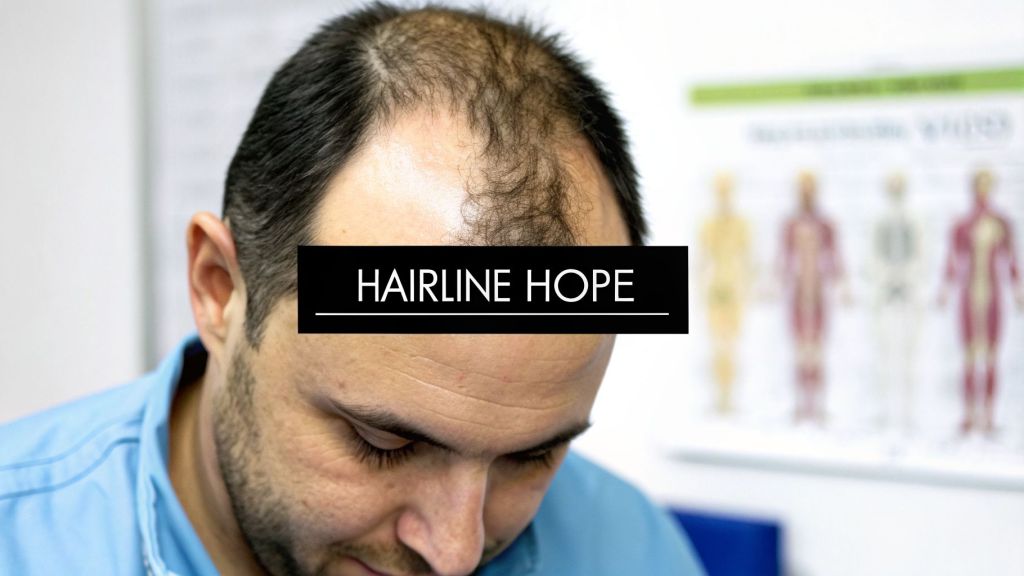
It's a moment most guys dread: you're looking in the mirror and notice your hairline isn't quite where it used to be. That first hint of thinning right at the temples can be unsettling, but I promise you, it’s an incredibly common and well-understood experience. A receding hairline at the corners is the classic starting point for male pattern baldness, and knowing what's going on is the first step to getting ahead of it.
Why Your Hairline Recedes at the Corners First

If you've spotted your hairline pulling back from your temples, you're in very good company. This isn't just a random pattern of shedding; it's a specific, predictable process that's rooted in your genetics and hormones.
The main driver is a powerful male hormone called dihydrotestosterone (DHT). Think of DHT as a key and your hair follicles as locks. For some of us, the "locks" at the hairline corners and crown are genetically programmed to be extra sensitive to this key.
When DHT binds to these sensitive follicles, it kicks off a process called miniaturization. This effectively chokes the follicle, making it shrink over time. With each new growth cycle, the hair that comes out is a little finer, a little shorter, and a little weaker, until the follicle eventually just gives up and stops producing hair altogether.
The Science Behind the 'M' Shape
So, why do the corners almost always go first? It all comes down to genetic mapping. The hair follicles located at the temples are often the most susceptible to DHT's damaging effects. This is why hair loss often begins right there, creating that distinct "M" or "V" shape that’s become the tell-tale sign of a receding hairline.
This isn’t a rare thing—it's the norm. For many men, watching the hairline creep back at the temples is the earliest hallmark of androgenetic alopecia (the clinical term for male pattern baldness). It hits a staggering one in four men by age 25 and is responsible for about 95% of all hair loss cases in men. You can dig into more data on global hair loss patterns to see just how widespread this really is.
Quick Guide to Early Receding Hairline Signs
To help you get a clear picture of what's happening, here’s a quick summary of the early signals and what they mean. Catching these signs early is your biggest advantage in slowing things down.
| Symptom or Sign | What It Signals | Primary Cause |
|---|---|---|
| Noticeable "M" Shape | The classic pattern of male hair loss is starting to form at your temples. | Genetic sensitivity to DHT |
| Increased Hair Shedding | You're finding more hair on your pillow, in the shower, or on your brush. | Follicles are weakening under hormonal influence. |
| Thinner Hair at Temples | The hair at your corners feels finer and less dense than the rest. | Early stages of follicle miniaturization. |
| Higher Forehead | Your hairline has visibly moved back, exposing more of your forehead. | Progressive, long-term follicle shrinkage. |
Realizing that your receding hairline isn't just a random part of "getting older" but a specific, biological process is a game-changer. It takes the mystery out of it and puts the power back in your hands, shifting the focus from worry to proactive management.
The Role of Genetics and Hormones in Hair Loss
To really get a handle on why your hairline is receding at the corners, we have to look past the mirror and understand what’s actually happening on a biological level. It’s easy to blame a grandpa for bad hair genes, but the real story is a fascinating team-up between your inherited DNA and your body's own hormones.
The main culprit behind male pattern baldness is a powerful hormone called dihydrotestosterone (DHT). While it comes from testosterone, its impact on hair follicles is a completely different ballgame. DHT is the primary trigger that kicks off the entire chain reaction of hair loss.
This process isn't random; it's incredibly specific. Your genetic code essentially pre-programs certain hair follicles to be sensitive to DHT. For most guys, the follicles at the temples and on the crown are the most vulnerable, which is why that’s exactly where hair loss usually starts.
DHT: The Key to Follicle Miniaturization
Think of it like a lock and key. Your genetically susceptible hair follicles are the “locks,” and DHT molecules are the “keys.” When a DHT key slides into a follicle’s receptor lock, it sends a signal that starts a destructive process called follicle miniaturization.
This doesn't happen overnight. Instead, with each new hair growth cycle, the affected follicle actually shrinks. It starts producing hair that's shorter, finer, and weaker than before. Eventually, the follicle gets so tiny it can no longer push out a visible hair, leading to the thinning and bald spots we see. You can dig deeper into how genetics drive male pattern baldness in our detailed guide.
This whole hormonal and genetic dance is extremely common. For most men, it kicks off with a receding hairline at the corners, following a predictable path that affects over 50% of men by age 50 worldwide. In fact, many guys notice their temples pulling back by age 30—a classic sign that DHT is shrinking follicles in a pattern seen in 95% of male hair loss cases.
Mapping Your Journey: The Norwood Scale
This pattern of hair loss is so predictable, in fact, that doctors have a classification system to map its progression. The Norwood Scale is the go-to tool for this.
The Norwood Scale isn't some scary crystal ball predicting your future; it’s a practical roadmap. It helps you and your doctor pinpoint exactly where you are in the process, which is critical for choosing the right treatment at the right time.
The scale lays out seven distinct stages:
- Stage 1: No significant hair loss or recession.
- Stage 2: The hairline starts to pull back slightly at the temples. This is often called a "mature" hairline and is the very first sign of receding corners.
- Stage 3: The recession at the temples becomes much more obvious, carving out a clear "M" shape. A variation, Stage 3 Vertex, also includes thinning on the crown.
- Stage 4: The hairline recedes even further, and the bald spot at the crown gets larger. A thin bridge of hair still separates the two areas.
- Stage 5: That bridge of hair separating the front and the crown thins out dramatically.
- Stage 6: The balding areas at the front and the crown finally merge into one large area.
- Stage 7: All that's left is the classic "horseshoe" pattern of hair around the sides and back of the head.
Getting familiar with this framework is empowering. It confirms that what you’re experiencing is a recognized medical condition with a clear biological cause—not some personal failing. Knowing your stage gives you context and a solid starting point for talking with a professional about what can be done. Plus, understanding how to achieve a healthy hormone balance for men can offer crucial insights into other factors influencing your hair's health.
How PRP Therapy Can Reboot Hair Follicles
When you start to see your hairline recede at the corners, it's easy to feel like you're fighting a losing battle against genetics. But there are ways to push back, and one of the most interesting is Platelet-Rich Plasma (PRP) therapy. This isn't some magic bullet, but it's a clever way to use your body's own healing systems to wake up those struggling hair follicles.
Think of PRP as a highly concentrated, organic fertilizer for your scalp. A healthy garden needs rich soil, right? Well, your hair follicles need a healthy environment with great blood flow and the right biological signals to produce strong hair. When DHT starts shrinking those follicles, it’s like the soil has been depleted—the plant weakens and eventually stops growing. PRP aims to enrich that soil, right at the source.
The whole idea is to harness the power already inside your own blood. Your blood contains tiny cells called platelets, which are packed with hundreds of powerful proteins known as growth factors. These are your body's emergency response team, rushing to an injury to kickstart tissue regeneration. PRP therapy isolates these platelets, concentrates them, and turns them into a super-serum for your scalp.
This process directly counters the slow-motion damage caused by DHT—the gradual shrinking, or "miniaturization," of the hair follicle.

As you can see, a healthy follicle gets progressively weaker and produces a thinner, wispier hair once DHT takes hold. This is exactly what treatments like PRP are designed to reverse.
What the Patient Experience Is Really Like
The procedure itself is surprisingly simple and happens right in the clinic. It’s a three-step process that usually takes less than an hour.
- The Blood Draw: It all starts with a standard blood draw from your arm, just like you’d have for a routine check-up.
- The Centrifuge Process: This is where the science happens. The vial of blood is placed in a centrifuge, a machine that spins it at an incredibly high speed. This separates the blood into layers: the red blood cells sink, and the golden, platelet-rich plasma rises to the top.
- The Injection: Your clinician then carefully draws that concentrated plasma into a syringe. After numbing your scalp to keep you comfortable, they perform a series of quick, shallow injections directly into the areas where your hairline is thinning.
This targeted approach delivers a potent dose of growth factors right where they're needed most, getting straight to work on the follicles. For a more detailed look, our guide on platelet-rich plasma therapy for hair breaks it down even further.
How Growth Factors Reawaken Dormant Follicles
So, what exactly happens after the injections? Those growth factors act like messengers, sending a flurry of signals to the cells in your scalp.
It's important to understand that PRP therapy doesn't create brand new hair follicles. What it does is rescue and rejuvenate existing ones that are either dormant or in the process of shrinking, nudging them back into their active growth phase.
Here’s a quick look at what those growth factors are telling your follicles to do:
- Activate Stem Cells: They signal the stem cells in the follicle to wake up and get back to work, which is the first step in starting a new growth cycle (the anagen phase).
- Improve Blood Flow: They encourage the formation of new blood vessels around the follicle. Better circulation means more oxygen and nutrients, which is crucial for a healthy growth environment.
- Thicken the Hair Shaft: By strengthening the follicle and keeping it in the growth phase longer, PRP helps it produce a thicker, stronger hair. This alone can make a huge difference in the appearance of fullness.
Studies have backed this up, showing that PRP can lead to a significant increase in hair count and thickness for many people. It’s especially good at tackling the kind of thinning that defines those early-stage receding corners.
Are You a Good Candidate for PRP?
While PRP shows a lot of promise, it’s not a fit for everyone. The best candidates are usually people in the earlier stages of hair loss—think a Norwood Scale 2 to 4. The logic is simple: PRP needs a living follicle to work with, even if it's currently weak or dormant.
You might be a great candidate if:
- You've only started noticing your receding hairline corners in the last few years.
- Your hair is thinning, but the area isn't completely smooth or bald.
- You like the idea of using your body's own natural materials for treatment.
- You're looking for something to use alongside other proven therapies like Minoxidil or Finasteride.
On the flip side, PRP is far less effective for someone with long-term, extensive baldness where the follicles have likely died off and scarred over.
The Treatment Protocol and Realistic Expectations
Don't expect PRP to be a one-and-done fix. A successful plan involves an initial series of treatments to build momentum, followed by regular maintenance.
Here’s what a typical schedule looks like:
- Initial Phase: 3 to 4 treatments, each spaced about 4 to 6 weeks apart. This initial push is designed to saturate the scalp with growth factors and kick the follicles into gear.
- Maintenance Phase: Follow-up treatments every 6 to 12 months. These are key for sustaining your results and continuing to support follicle health over time.
The results show up slowly and subtly. You won't leave your first appointment with a new hairline. Most people first notice a decrease in shedding within 3 to 4 months. More visible improvements in thickness and density usually start appearing around the 6-month mark, and your hair can continue to improve for up to a year.
Comparing Your Hair Loss Treatment Options
Staring down the different options for treating receding hairline corners can be a lot to take in. With a few really solid treatments out there, the challenge isn't finding a magic bullet, but figuring out which one actually fits your specific hair loss pattern, lifestyle, and what you’re hoping to achieve. Let's break down the three heavy hitters: PRP Therapy, Minoxidil, and Finasteride.
Each one tackles hair loss from a completely different angle. It helps to think of it like defending a castle. Finasteride is your scout, stopping the enemy (the hormone DHT) from ever reaching the castle walls. Minoxidil is the supply line, pushing more resources (blood and nutrients) to the soldiers inside. And PRP? That’s the elite medic team sent directly to the front lines to heal, revive, and strengthen the defenders—your hair follicles.
A Head-to-Head Comparison
To make sense of it all, let's put these treatments side-by-side. This isn't about crowning a single winner; it's about helping you find the right tool for your personal fight against hair loss.
PRP vs Minoxidil vs Finasteride Head to Head
| Feature | PRP Therapy | Minoxidil (Topical) | Finasteride (Oral) |
|---|---|---|---|
| How It Works | Uses your blood's own growth factors to directly stimulate and rejuvenate weak or dormant hair follicles at the injection site. | A vasodilator that works by increasing blood flow to the scalp, which helps prolong the hair's growth phase and revive follicles. | A systemic DHT blocker that works inside your body to reduce the levels of the hormone responsible for shrinking hair follicles. |
| Application | An in-clinic procedure that involves a blood draw, spinning it in a centrifuge, and then a series of precise scalp injections. | A topical foam or liquid that you have to apply directly to the scalp once or twice daily, every single day, without fail. | A simple prescription pill taken orally once a day. |
| Best For | People in the earlier stages of hair loss who are looking for a natural approach to boost hair density and thickness. | General thinning and slowing down hair loss. It's often a great starting point for many guys just getting into treatment. | Men with clear signs of male pattern baldness who want to shut down the hormonal root cause of their receding corners. |
| Main Drawbacks | Requires a series of sessions, has the highest upfront cost, and the results can vary significantly from person to person. | Demands lifelong, consistent daily use to keep your results. Some people also experience scalp irritation or itchiness. | Carries a risk of systemic side effects, including sexual side effects in a small percentage of men. It also requires a prescription. |
Understanding How They Work
The real difference is in the game plan. Finasteride plays defense, working on a hormonal level to prevent the damage before it even starts. By blocking the enzyme that turns testosterone into follicle-killing DHT, it effectively cuts the problem off at the source. This makes it incredibly powerful for stopping hair loss in its tracks.
Minoxidil, on the other hand, is all about stimulation. It doesn't block DHT, but it helps counteract its suffocating effects by improving the scalp's environment. By widening the blood vessels, it makes sure those struggling follicles get the oxygen and nutrients they desperately need to hang on and, hopefully, get back to growing.
The most significant distinction with PRP Therapy is its targeted, regenerative approach. It doesn't touch your hormones or act as a general stimulant. Instead, it delivers a super-concentrated dose of your body's own healing machinery directly where you need it, telling damaged follicles to wake up and get back to work.
Making the Right Choice for You
So, which path is yours? If your main goal is to stop the hormonal attack that’s causing your hairline to retreat, Finasteride is widely considered the first line of defense. If you’d rather stick to a non-prescription, topical routine and are good about daily habits, Minoxidil is a reliable choice. And if you're drawn to a more natural strategy that uses your own biology to heal and repair follicles, PRP is definitely worth looking into.
Of course, you don't always have to choose just one. Many clinicians see the best results by combining treatments. For instance, using Finasteride to block DHT while Minoxidil stimulates growth can be a potent one-two punch. Adding PRP into that mix can then provide an extra boost to follicle health and overall thickness.
To get a fuller picture, it's worth exploring the other effective hair loss treatment options for men in 2025. Ultimately, the best move is to sit down with a hair loss specialist who can properly diagnose what’s going on and help you build a game plan that truly works for you.
Lifestyle Changes to Support Your Hairline

While specific treatments are critical for stopping a receding hairline, your daily habits set the stage for their success. Think of it this way: treatments are the targeted intervention, but your lifestyle is the environment your hair follicles live in every single day.
A healthy lifestyle won't reverse male pattern baldness on its own, but it's absolutely essential for maximizing your results. By making smart choices with your diet, stress levels, and hair care routine, you're giving your hair the best possible foundation to grow stronger and thicker.
Fuel Your Follicles with a Balanced Diet
You can't build a strong house with flimsy materials, and the same goes for your hair. What you eat provides the literal building blocks for every strand. Nutrient gaps can lead to brittle, weak hair that breaks easily, making thin areas at the corners look even more sparse.
A diet rich in the right vitamins and minerals is non-negotiable. Pay special attention to these hair-health powerhouses:
- Iron: This is all about oxygen delivery. Iron helps create hemoglobin, which transports oxygen to your cells—including the ones that power your hair follicles. You'll find it in lean red meat, spinach, and lentils.
- Zinc: Zinc is a workhorse for hair tissue growth and repair. It also helps the oil glands around the follicles function properly. Oysters, beef, and pumpkin seeds are great sources.
- Biotin: Often called the "hair vitamin," this B-complex vitamin is crucial for producing keratin, the core protein your hair is made of. Load up on eggs, nuts, and salmon.
To complement a good diet, some people explore targeted nutritional support. You might find it useful to look into something like a Chlorella Food Supplement For Hair as part of a holistic wellness plan.
Manage Stress and Protect Your Hair
Severe, chronic stress can wreak havoc on your hair. It can trigger a condition called telogen effluvium, where a large number of follicles are prematurely pushed into the "shedding" phase of the hair cycle. For someone already dealing with receding corners, this sudden increase in shedding can make the thinning much more obvious.
It's a myth that everyday stress makes you bald. However, significant, long-term stress can disrupt your hair's natural growth cycle, creating a temporary but noticeable increase in shedding that can worsen thinning.
This is where simple stress management techniques become a powerful hair care tool. Things like daily walks, meditation, or even just carving out time for a hobby can lower cortisol levels and help keep your hair growth cycle running smoothly.
Gentle Hair Care and Debunking Myths
Finally, how you handle your hair can make a big difference. Aggressive styling and rough treatment cause physical breakage, which is the last thing you want when you're trying to preserve every hair.
A few simple adjustments can go a long way:
- Avoid Tight Hairstyles: Ponytails, tight buns, or braids that constantly pull on the hairline can lead to traction alopecia—hair loss caused by physical stress.
- Be Gentle When Wet: Hair is at its most fragile when it's soaked. Instead of rubbing vigorously with a towel, gently pat it dry.
- Let Go of the Hat Myth: A lot of guys worry that wearing a hat will suffocate their follicles and cause baldness. Don't sweat it. A normal-fitting hat is perfectly fine and won't impact your hairline.
When you pair these supportive habits with a targeted treatment plan, you're fighting hair loss from every possible angle. For more tips, take a look at our guide on other ways to increase hair growth naturally.
When to See a Professional About Your Hairline
There's a point where you move from just worrying in front of the mirror to actually doing something about it. If your receding hairline corners are on your mind, that first real step is talking to a professional. I can't stress enough how much of a difference early intervention makes.
Catching hair loss in its early stages gives you a real fighting chance to slow it down and hold onto the hair you have. If you wait until the thinning is obvious to everyone, you'll find your effective treatment options are much more limited. Being proactive is the only way to play it.
What to Expect from a Consultation
Think of an appointment with a dermatologist or a hair loss specialist as a fact-finding mission, not a high-pressure sales pitch. The main goal here is to get a solid, accurate diagnosis. The specialist will likely start with a simple examination of your scalp, sometimes using a magnifying scope to get a close-up look at your hair follicles.
They'll also ask about your medical background and family history of hair loss. This conversation gives them crucial clues about what’s really going on and helps confirm whether you're dealing with male pattern baldness or something else entirely.
An expert diagnosis is the bedrock of any good treatment plan. You have to know the specific type and stage of your hair loss before you can choose the right path forward, whether that ends up being PRP, finasteride, or another therapy.
Getting this professional assessment arms you with real information. It replaces the anxiety of the unknown with a clear picture of what's happening and what you can do about it. You’ll find out where you stand on the Norwood Scale and learn which treatments have the best shot at working for you.
Ultimately, this consultation is about taking back control. It's the step that changes you from someone just watching their hair loss happen to someone actively managing it. For more detailed guidance, you can learn more about when it's the right time to see a dermatologist in our dedicated article. That expert input is what helps you make the best decision for your future.
Your Questions Answered: Receding Hairlines
Even with a solid game plan, it's natural to have a few lingering questions. Let's dig into some of the most common concerns and get you the straightforward answers you need.
How Fast Will My Hairline Recede?
This is the big question, and honestly, the answer is different for everyone. The speed of your hair loss really comes down to your individual genetics—specifically, how sensitive your hair follicles are to DHT—and your age. There's no one-size-fits-all timeline.
For some guys, the corners might barely move over a decade. For others, the change can feel alarmingly fast, happening over just a few years. The one constant is that male pattern baldness is progressive. It won't stop on its own, which is why taking action early is your biggest advantage.
Does PRP Therapy Hurt?
It's a fair question, and one we hear all the time. The great news is that most patients find the procedure much more comfortable than they expect, reporting only minor discomfort, not real pain. Before starting, your clinician will apply a strong topical numbing cream or use a local anesthetic to make sure the area is completely numb.
You might feel a slight pinch or a bit of pressure as the injections are administered, but each one is over in a flash. The whole process usually takes less than an hour, and any soreness you might feel afterward typically disappears by the next day.
It’s important to have realistic expectations. While treatments can make a huge difference in hair density and wake up sleepy follicles, they aren't a magic wand for areas that have been completely bald for many years.
Can a Receding Hairline Actually Grow Back?
Setting the right goals is key. Treatments like PRP are fantastic for fortifying the fine, thinning hairs you still have and coaxing dormant follicles back into a growth phase. The result is a visibly denser, fuller look that can effectively "fill in" those thinning corners.
However, trying to grow hair on skin that's been smooth and bald for years is a whole different ball game. Once a hair follicle is gone for good and the pore has essentially scarred over, it can't produce hair anymore. This is exactly why it pays to start treatment sooner rather than later, while those follicles are still there to be saved.
At PRP For HairLoss, we believe that understanding your options is the first step toward regaining control. To learn more about how PRP therapy can help you address your receding hairline corners, visit us at https://prpforhairloss.com.
 PRP For Hairloss
Leave a comment