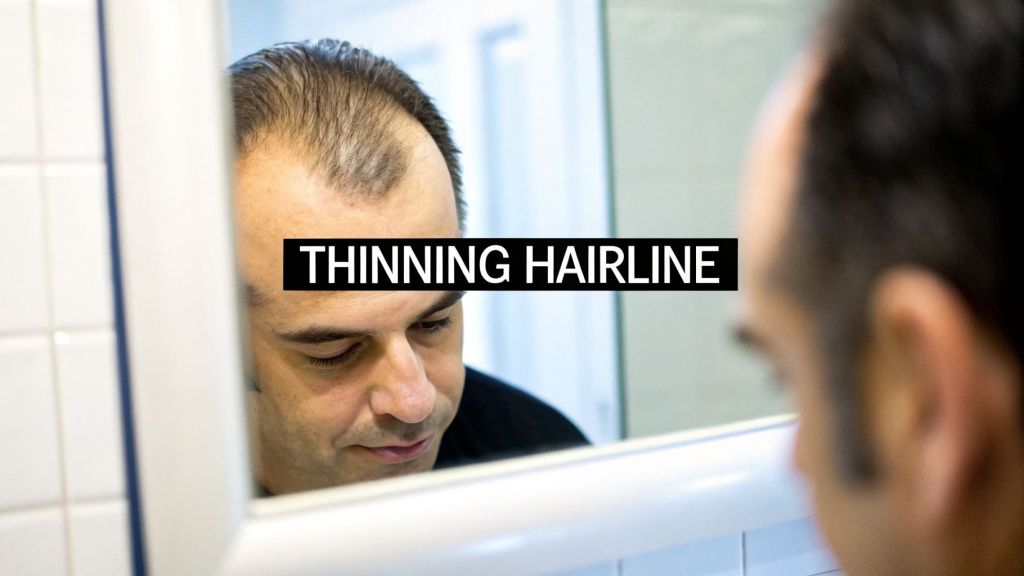
If you're staring in the mirror asking, "Why is my hair thinning at the front?" you’ve likely come face-to-face with the most common cause of hair loss in men: male pattern baldness. It’s the classic, gradual recession at the temples and hairline, driven by a combination of your genes and hormones.
That First Glance in the Mirror
It's a moment most men can relate to. You’re washing your face, combing your hair, or just catching your reflection, and something looks… off. Maybe your hairline seems to have crept back a bit, or the hair at your temples just isn't as thick as it used to be. It's a subtle change, but you see it. You aren’t imagining things, and you’re definitely not alone.

For the vast majority of men, this is the start of a journey with androgenetic alopecia, the clinical term for male pattern baldness (MPB). This is, by far, the number one culprit behind thinning at the front. The process is kicked off by a genetic sensitivity to a hormone called dihydrotestosterone, or DHT.
Over time, DHT attacks and shrinks the hair follicles at your hairline and crown, causing that trademark M-shaped recession. It’s incredibly common—by age 30, about 30% of men are dealing with noticeable hair loss. That number jumps to a staggering 50% by age 50, according to data from the International Society of Hair Restoration Surgery.
The "Dimmer Switch" Effect on Your Hair
To understand what DHT is doing, think of it less like an on/off switch and more like a dimmer switch for your hair follicles. In the areas genetically programmed for baldness, like your hairline, DHT doesn't just shut things down overnight. Instead, it slowly dials down the follicle's ability to grow healthy hair over many years.
With each new growth cycle, the hair that emerges is a little bit shorter, finer, and lighter in color. This process is called miniaturization. It’s so gradual that you might not even realize it’s happening until the collective thinning becomes obvious in the mirror. It's this slow fade that creates the illusion of a "disappearing" hairline.
Your genetics are the blueprint. They determine which follicles on your scalp are built with the sensitivity to DHT. This is why hair loss follows predictable patterns instead of happening all over your head at once.
Why Does the Front Go First?
The reason the battle against hair loss so often begins at the front is pure biology. The hair follicles along your hairline and at your temples simply have more receptors that are sensitive to DHT. They are the most vulnerable targets, so they're the first to show the signs of miniaturization.
While your genes hold the primary responsibility, other factors can absolutely step on the gas and speed up the process. These can include:
- Periods of major stress (both physical and emotional)
- Nutritional gaps or significant vitamin deficiencies
- Certain medications or underlying health conditions
Accepting that male pattern baldness is the most probable cause is the first real step forward. It allows you to shift your focus from asking "Why is this happening to me?" to "What can I do about it?" And the good news is, there are more effective, proven options available today than ever before.
Unpacking the Main Culprit: Male Pattern Baldness
If you're dealing with thinning hair at the front, the odds are overwhelmingly in favor of one diagnosis: male pattern baldness (MPB). It's not a disease or a sign that you're unhealthy. It's simply a natural, genetically programmed process that a huge number of men go through. The whole thing boils down to a specific hormone and how your hair follicles are destined to react to it.
The main antagonist in this story is a hormone called dihydrotestosterone, or DHT. It’s a powerful offshoot of testosterone. While testosterone handles a lot of key masculine traits, DHT can be bad news for certain hair follicles. Think of DHT as a key and the follicles at your hairline, temples, and crown as having specific locks. For some men, that key is a perfect fit.
When DHT locks onto these follicles, it kicks off a process called miniaturization. This is a gradual shrinking of the hair follicle itself. With each new growth cycle, the hair that emerges is a little weaker, shorter, and finer than the last. Eventually, the follicle can shrink so much that it just gives up on producing any visible hair. You can get a deeper dive into this genetic process in our detailed guide on androgenetic alopecia.
Why Does the Hairline Get Hit First?
So, why does it always seem to start at the front? There’s a solid biological reason for this. The hair follicles along your frontal hairline and temples just happen to have a much higher concentration of those DHT-sensitive receptors compared to the hair on the back and sides of your head. This high density of receptors makes them ground zero.
This genetic sensitivity is exactly why male pattern baldness follows such a predictable route—a path so well-trodden that it even has its own classification system.
The DHT-driven miniaturization process doesn't happen overnight. It's a slow, systematic weakening of the follicles over years, even decades, which is why early action is so crucial for maintaining your hairline.
Charting the Path with the Norwood Scale
To bring a little order to the chaos of hair loss, experts rely on the Norwood Scale. This is basically a visual roadmap that classifies the different stages of male pattern baldness. It’s an incredibly useful tool for helping you and your doctor figure out exactly where you are in the process and what might be coming next.
Getting familiar with the Norwood Scale can be really empowering. It removes the guesswork and gives everyone a common language to talk about treatment options.
- Stage 1: This is the starting line. A full head of hair with no noticeable recession.
- Stage 2: The first signs start to creep in. You might see a slight, often symmetrical, recession at the temples. This is where many guys first start to pay attention.
- Stage 3: This is what doctors consider "clinically significant" balding. The recession at the temples becomes much more obvious, carving out that classic 'M' or 'V' shape. You might also notice some thinning on the crown (the vertex).
- Stage 4 and beyond: From here, the hair loss becomes more extensive. The receding hairline and the bald spot on the crown expand until they eventually merge, leaving only that familiar "horseshoe" of hair around the sides and back of the head.
Pinpointing your stage helps you get real about your situation. If you're in Stage 2 or 3, you're in the sweet spot for proactive treatments that can stop further loss and maybe even regrow some of what you've lost.
You're in Good Company
Watching your hairline change can feel isolating, but the numbers tell a completely different story. Thinning at the front is an incredibly common part of being a man. For many, it's a genetic time bomb that starts ticking pretty early. By the time they hit 25, roughly one in four men (25%) is already seeing some degree of recession.
And that trend just picks up speed with age. Global data shows just how widespread this is, especially in Europe. The Czech Republic is at the top of the list, with 42.8% of adult males affected. Spain, Germany, and the UK aren't far behind. Researchers point to a mix of genetics, hormones, and maybe even lifestyle factors to explain these high rates. You can explore more on these global baldness statistics to see the full picture.
The takeaway is simple: you are far from alone in this.
Exploring Other Reasons for a Thinning Hairline
While male pattern baldness is the usual suspect, it's certainly not the only reason you might be seeing more scalp along your hairline. Your hair is like a barometer for your overall health; while genetics set the stage, your lifestyle and environment play a huge supporting role. Sometimes, figuring out "why is my hair thinning at the front" means looking beyond your family tree.
Physical Stress on the Hairline
One of the most common non-genetic causes is something called traction alopecia. This isn't about hormones or aging—it's about pure and simple physical force. Consistently wearing hairstyles that pull on your hair, like tight braids, cornrows, or even a man bun that's too severe, puts constant tension on the hair follicles.
Think of it like repeatedly tugging on a plant. At first, it holds firm, but over time, the roots weaken, and eventually, it just gives up. This constant pulling can permanently damage the follicles, causing them to stop growing hair, especially at the front hairline and temples where the strain is often greatest.

When Stress and Lifestyle Interfere
Major life stress—whether it's from an illness, a surgery, or a significant emotional event—can trigger a condition called telogen effluvium. This is your body’s way of hitting the emergency brake on non-essential functions, and hair growth is one of the first things to get paused.
This shock to the system pushes a large percentage of your hair follicles into the "resting" phase all at once. A few months later, you might notice a sudden and diffuse shedding from all over your head. While it affects your entire scalp, this widespread thinning can make a receding hairline look much more pronounced.
The good news is that telogen effluvium is usually temporary. Once the underlying stressor is resolved, your hair's growth cycle typically resets, and the shedding slows down within a few months.
The Role of Nutrition and Health
Your hair follicles are tiny but demanding factories, and they need a consistent supply of raw materials to operate. If your diet is lacking in key vitamins and minerals, hair production can slow down, resulting in weaker strands and thinning.
A few nutritional culprits to keep an eye on include:
- Iron: Absolutely essential for producing hemoglobin, which carries the oxygen your hair follicles need to grow and repair themselves.
- Zinc: A key player in hair tissue growth and repair. It also helps keep the oil glands around the follicles functioning as they should.
- Biotin (Vitamin B7): Famous for its role in hair health, biotin helps produce keratin, the very protein that makes up your hair.
Underlying medical issues can also throw a wrench in the works. Thyroid problems, for instance, can disrupt your body's delicate hormonal balance and directly interfere with the hair growth cycle. You can dive deeper into how hormone imbalances cause hair loss in our dedicated guide. For women, conditions like Polycystic Ovary Syndrome (PCOS) are also a common cause of hormonal hair thinning.
Male Pattern Baldness vs. Other Frontal Thinning Causes
It can be tough to tell what's really going on just by looking in the mirror. This table breaks down the common signs to help you differentiate between genetic hair loss and other potential causes.
| Symptom | Male Pattern Baldness (MPB) | Traction Alopecia | Stress/Nutritional Deficiency |
|---|---|---|---|
| Pattern of Loss | Distinct "M" shape, receding temples, thinning at the crown | Thinning concentrated along the hairline where hair is pulled tight | Diffuse thinning all over the scalp, not just the front |
| Speed of Onset | Gradual, often taking place over years | Can be slow or rapid, depending on the severity of the tension | Usually sudden, appearing 2-3 months after a trigger |
| Associated Symptoms | Often none, just visible hair loss | Scalp pain, itching, redness, or small bumps at the hairline | Increased shedding on pillows, in the shower drain, and when brushing |
| Reversibility | Progressive, but can be managed with treatment | Often reversible if the hairstyle is changed early enough | Typically reversible once the underlying cause is addressed |
While there are many potential culprits, it's important to remember that for most men, the flowchart above holds true: the journey of frontal thinning usually starts with a genetic trigger.
How PRP Therapy Can Reboot Your Hair Follicles
Once you understand what’s causing your thinning hairline, the conversation naturally shifts from "why is this happening?" to "what can I do about it?" For a lot of guys looking for a solid, proactive solution, Platelet-Rich Plasma (PRP) therapy is one of the most promising options out there. This isn’t about harsh chemicals or major surgery; it’s about using your body's own healing power to give your hair follicles a much-needed kickstart.

Think of PRP as a highly concentrated, natural fertilizer for your scalp. Just like fertilizer gives struggling plants the essential nutrients they need to grow strong, PRP delivers a powerful cocktail of growth factors directly to your shrinking hair follicles. These growth factors are basically your body's own repair crew.
Unlocking Your Body's Healing Power
So, what’s in this "fertilizer"? It’s made from a small sample of your own blood. Your blood contains tiny powerhouses called platelets, which you probably know for their role in clotting a cut. But that's just scratching the surface of what they can do. Platelets are loaded with hundreds of different proteins called growth factors.
When we concentrate these platelets and reintroduce them to an area—like your thinning hairline—they signal your cells to get to work. They can help wake up dormant follicles, boost blood flow to bring in more oxygen and nutrients, and encourage the growth of thicker, stronger hair. It’s a targeted approach that gets right to the root of the problem.
To get a better grip on the science, you can learn more about the science behind how PRP for hair loss works in our detailed guide. It breaks down the biological process that makes this a go-to treatment for men with frontal thinning.
The Straightforward PRP Process
Using your own blood might sound intimidating, but the process is actually pretty simple and is done right in a clinical setting. It’s a clean, three-step procedure that usually takes less than an hour from start to finish.
- The Blood Draw: It starts with a standard blood draw, just like you’d have at a regular doctor's visit. A small vial of blood is taken from your arm.
- The Centrifuge: That vial is then placed into a machine called a centrifuge. It spins the blood at an incredibly high speed, which separates it into different layers. This isolates the valuable platelet-rich plasma from the other blood cells.
- The Injection: Finally, this golden, platelet-rich liquid is carefully injected into the areas of your scalp where you need it most, like along your hairline and at the temples.
This entire method is about harnessing the power that already exists inside you. We're not introducing a foreign substance; we're just concentrating your natural healing ability and putting it exactly where it can do the most good.
The whole point is to reboot the hair growth cycle. By delivering a surge of growth factors, PRP can help push follicles out of their resting (telogen) phase and back into the active growing (anagen) phase, leading to a visible improvement in hair density and thickness over time.
For guys in the earlier stages of hair loss, PRP can be a real game-changer. The therapy isolates your platelets to a concentration that is 5 to 10 times greater than what’s normally in your blood, injecting a powerful blend of growth factors to extend the growth phase and boost circulation.
Clinical trials have shown an impressive 25-35% gain in hair density after just four sessions, making it especially effective for that initial thinning at the front. With a patient satisfaction rate around 80% in U.S. studies, it’s a trusted option for men who want real results without the downtime or high cost of a transplant.
Your PRP Journey: A Step-by-Step Guide
Deciding on a hair restoration treatment is a big deal. Part of feeling good about that decision is knowing exactly what you’re signing up for. Let's walk through the entire PRP journey, from your first chat with a specialist to the day you start seeing real growth in the mirror. This way, you can ditch the guesswork and set some solid, achievable goals for your hairline.
PRP isn't a one-and-done deal. It's a series of treatments carefully planned to build momentum inside your hair follicles. It all kicks off with a detailed consultation where an expert will take a close look at your scalp, confirm you're a good fit for the treatment, and answer all of your questions.
The Treatment Schedule Unpacked
The magic of PRP is cumulative—the results from one session build on the last. You can’t expect to undo years of hair thinning in a single afternoon. A proven, effective protocol always starts with what we call a "loading phase."
This initial push usually involves three to four PRP sessions, scheduled about a month apart. This timing is deliberate. It’s designed to give your dormant follicles a consistent, powerful dose of growth factors to wake them up and kick them back into their active growth phase. Think of it like a personal training boot camp to get your follicles back into fighting shape.
After that initial blitz, the job isn't finished. You’ll shift into a maintenance phase to lock in your results and keep future thinning at bay.
- Maintenance Sessions: These follow-up treatments are absolutely essential for long-term success. Most guys find they need a touch-up session every six to twelve months to keep their follicles nourished and the hair growth cycle humming along.
What to Expect on Treatment Day
The procedure itself is surprisingly quick and straightforward, with almost no downtime. When you arrive, a small sample of blood is drawn from your arm—just like a routine blood test. That blood is then spun in a centrifuge, which is a machine that separates and concentrates the platelet-rich plasma.
Before the injections begin, a local anesthetic is typically used to numb your scalp. Because of this, most men say they feel a bit of manageable pressure, not sharp pain. The whole thing, from the blood draw to the last injection, is usually over in less than an hour, making it easy to schedule into your day. Aftercare is simple, too—you’ll just need to skip any intense workouts and harsh hair products for a day or two.
We want the experience to be as comfortable as possible. You might have some mild tenderness or redness right after, but it almost always fades within 24 hours. You can get right back to your normal routine.
A Realistic Timeline for Results
When it comes to PRP, patience is your best friend. The results won't pop up overnight because they're directly tied to the natural speed of your hair growth cycle. The journey to a fuller hairline happens in stages.
- First 1-3 Months: The first changes you'll see are subtle. You might notice you’re shedding a lot less hair in the shower or on your pillow. That's the first big sign that the treatment is stabilizing your follicles.
- Months 3-6: This is when things start to get exciting. You may begin to see fine, new hairs (often called "vellus" hairs) sprouting. At the same time, your existing hairs should start to feel thicker and look healthier.
- Months 6-12: By this point, the results are much more obvious. Those new hairs have had time to grow and mature, leading to a visible improvement in the density and coverage of your hairline.
Understanding this timeline is crucial. For an even more detailed look at what to expect month by month, take a look at our complete PRP hair treatment timeline. Knowing what's ahead allows you to approach your PRP journey with confidence, ready to see real, lasting change.
Your Action Plan for a Stronger Hairline
Knowing why your hair is thinning at the front is a great start, but it's taking action that really counts. This is where you shift from just noticing a problem to actively solving it. It’s your chance to stop the retreat, regain control, and fight back with a clear, effective plan.

By now, you know that male pattern baldness is the most common culprit and that proactive treatments like PRP therapy offer a powerful, natural way to combat it. But a successful strategy is about more than just one treatment. You get the best results when you support your efforts with healthy habits that give your hair every advantage.
Building a Supportive Foundation
Think of these daily habits as the support crew for your main treatment. They create the ideal environment for your hair follicles not just to survive, but to thrive.
- Fuel Your Follicles: Your hair is built from the nutrients you consume. Make sure your diet is packed with protein, iron, zinc, and biotin. That means loading up on foods like eggs, spinach, lean meats, and nuts.
- Manage Your Stress: Chronic stress can throw your hair’s growth cycle out of whack and speed up hair loss. Find what works for you—whether it's regular exercise, meditation, or just taking a short walk to clear your head.
- Loosen Up: If you wear your hair in tight styles like man buns, braids, or cornrows, you're putting constant strain on your hairline. This can cause traction alopecia, which only makes genetic thinning worse. Give your follicles a break.
Here’s the single most important thing to remember: You have options. The key is to stop being a bystander and start taking decisive action. A stronger hairline begins the moment you decide to fight for it.
Your next step is the most critical one you'll take. Book a consultation with a professional to get a definitive diagnosis. This is non-negotiable. An expert can confirm what's really going on and build a plan that’s right for your specific stage of hair loss. To learn more about finding the right expert, it's worth understanding how to choose the right plastic surgeon, especially one with proven experience in hair restoration.
Taking that one step puts you back in the driver's seat. It's the beginning of your proactive journey, and as you explore your options, our guide on how to regrow a receding hairline offers even more targeted strategies.
Common Questions About Frontal Hair Loss
When you're staring down thinning hair and trying to figure out what to do next, questions are going to pop up. It’s only natural. Getting straight answers is the key to moving forward with confidence, so let's tackle some of the most common ones we hear from men considering PRP therapy.
Does PRP Treatment Hurt?
This is easily one of the first things guys ask, and it’s a fair question. Let’s be clear: we go to great lengths to make this as comfortable as possible. Before we even begin, a local anesthetic is applied to thoroughly numb your scalp. That step is a game-changer.
Most men who go through with it say they feel more of a manageable pressure than any actual pain. If there is any discomfort, it's typically mild and fades within a few hours of the session.
How Long Do The Results From PRP Actually Last?
It's crucial to think of PRP as a long-term management strategy, not a one-and-done cure. The results can be fantastic, but they need a little help to stick around. Your treatment plan will kick off with an initial series of sessions designed to wake up those sleepy hair follicles.
After that initial push, you'll need to schedule maintenance sessions to keep the momentum going. For most guys, that means coming in for a follow-up treatment every 6 to 12 months. This ongoing support is what locks in your results and keeps your hair looking its best over time.
A good way to think about it is like tending to a lawn. The initial effort gets it green and thick, but you have to keep watering and feeding it to maintain that healthy look. Your PRP maintenance sessions are the essential "fertilizer" for your hair follicles.
Have I Waited Too Long To Try PRP?
This is a big one, especially for men wondering "why is my hair thinning at the front" and fearing they've missed the boat. Here’s the deal: PRP works best on hair follicles that are weakened or dormant, but not completely dead and gone. This means it’s most effective for guys in the early-to-mid stages of hair loss.
If your follicles are still there, even if they aren't producing much, PRP can often give them the jolt they need to get back to work. The only real way to know if you're a good candidate is to have a specialist take a close look at your scalp during a professional consultation.
Can I Combine PRP With Other Hair Loss Treatments?
Not only can you, but you probably should. For many men, the most powerful results come from a multi-pronged attack on hair loss. Using PRP alongside proven treatments like topical minoxidil or oral finasteride creates a really comprehensive strategy.
This approach lets you fight hair loss from different angles at the same time. While PRP is stimulating growth factors right at the follicle, other medications can tackle the underlying hormonal causes. Combining forces like this often leads to much better, more sustainable results than relying on just one treatment alone.
Ready to take control of your hairline? At PRP For HairLoss, our goal is to give you the clear, honest information you need to make the right choice for you. Dig into our resources to see how PRP can help restore your hair and your confidence. Visit us at https://prpforhairloss.com to get started.
 PRP For Hairloss
Leave a comment