If you're looking to get DHT off your scalp, you need a two-pronged attack: one part involves blocking DHT from being produced in the first place, and the other is all about boosting your overall scalp health. The most effective way to do this is by combining targeted shampoos, clinically-proven medications like finasteride, and natural ingredients such as saw palmetto to fight the hormone’s effects right at the follicle.
What Is DHT and Why Is It Your Hair's Biggest Threat
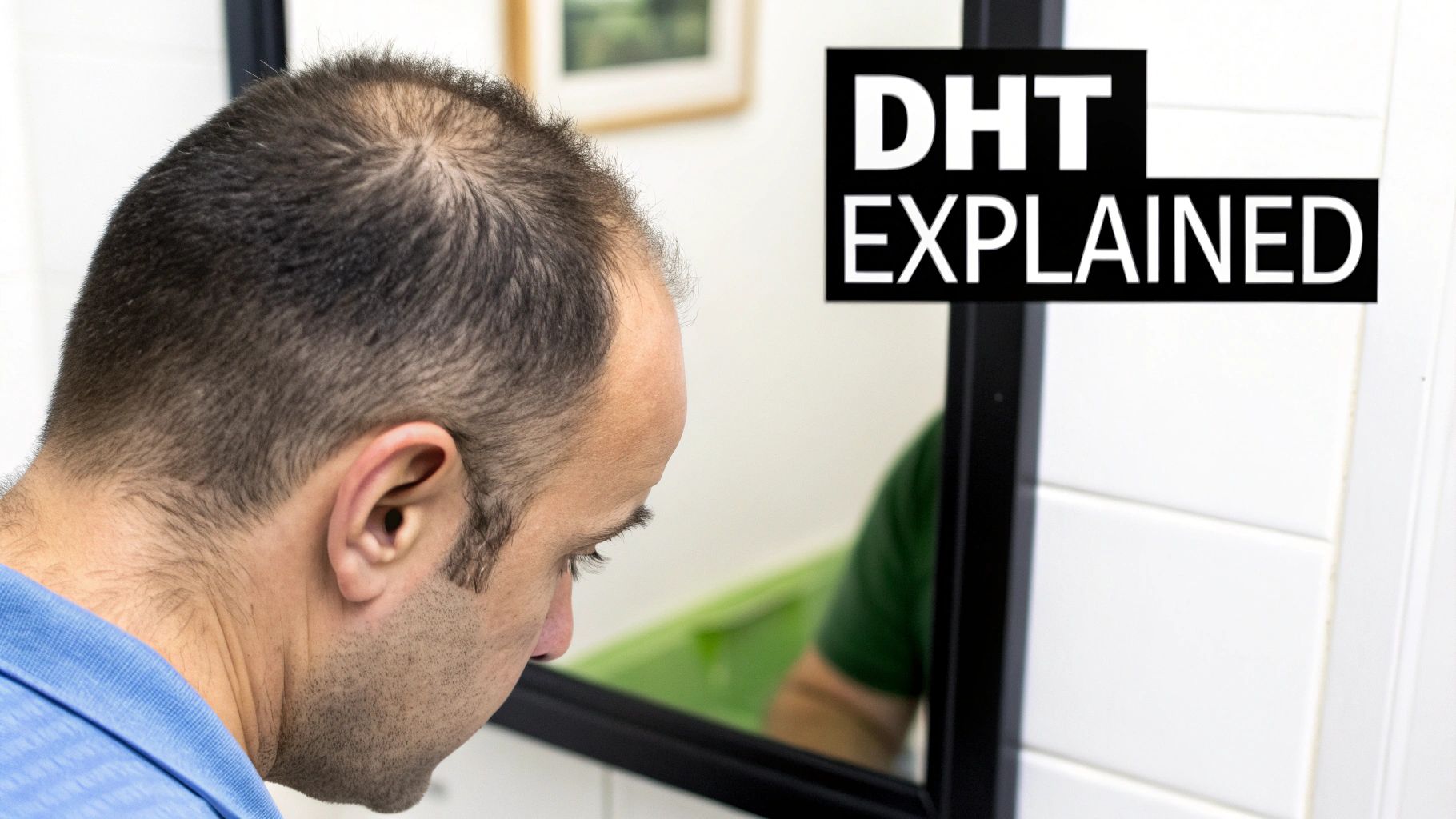
If you've noticed your hairline starting to retreat or seen that spot on your crown getting a little thinner, you've probably come across the acronym "DHT." So, what is this stuff, and why is it considered public enemy number one for your hair?
Let's cut through the scientific jargon. Dihydrotestosterone (DHT) is a potent male sex hormone, an androgen, that your body naturally creates from testosterone. An enzyme known as 5-alpha reductase is the culprit responsible for converting a small amount of your testosterone into this much stronger hormone.
During puberty, DHT is actually a good guy. It’s essential for developing male characteristics like a deeper voice, more muscle mass, and body hair. But once you're past adolescence, its role can change, and for a lot of guys, it starts causing problems for the hair on their head.
The Miniaturization Process Explained
The best way to think about it is this: DHT is like a key, and your hair follicles are tiny, sensitive locks. If your genes make those locks susceptible to DHT, the key fits perfectly and essentially sends a signal to self-destruct.
This signal kicks off a process called follicle miniaturization. The hair follicle literally begins to shrink. With each new growth cycle, the hair that emerges is thinner, shorter, and weaker than the one before. The hair's growing phase gets shorter, while the resting phase gets longer.
Eventually, the follicle becomes so small it can't produce a visible hair anymore. That's what we see as male pattern baldness. Your hair isn't just falling out—the follicles are slowly being throttled.
The crucial takeaway here is that hair loss isn't just random bad luck. It's a specific, predictable process driven by the clash between your genes and DHT. The good news? That means it's a process you can interrupt.
Genetics Are the Deciding Factor
Ever wonder why some guys go bald in their twenties while others rock a full head of hair their whole lives? The answer is written in your DNA.
Your genetic code dictates just how sensitive your scalp's hair follicles are to DHT. If you inherited a high sensitivity, even normal levels of DHT are enough to trigger major hair loss. This is exactly why male pattern baldness runs in families—you're not inheriting baldness itself, but the genetic trait that makes your follicles vulnerable to DHT. Getting this is the first real step in understanding how https://prpforhairloss.com/what-is-dht-and-hair-loss are connected.
Recognizing why DHT is the main culprit often starts with appreciating the importance of scalp health and hair growth. Once you know the 'why' behind your hair loss, you're in a much better position to take the right actions, which we’ll cover next.
Your First Line of Defense: Topical DHT Solutions
When you're ready to start fighting back against DHT, the most direct and accessible place to begin is right at the source: your scalp. Topical solutions are your ground-level infantry, designed to work on the surface to protect your hair follicles. This is all about building an effective, simple routine you can start tonight.
For most guys, the easiest entry point is a specialized, DHT-blocking shampoo. Think of this as more than just cleaning your hair; it's a daily treatment step. You’ll want to look for specific active ingredients that have shown real promise in disrupting DHT's damaging effects.
Key Ingredients to Look For
The real power of these shampoos comes from a handful of key players. While marketing labels will throw a lot of botanical names at you, a few ingredients stand out because we have some science backing up how they work.
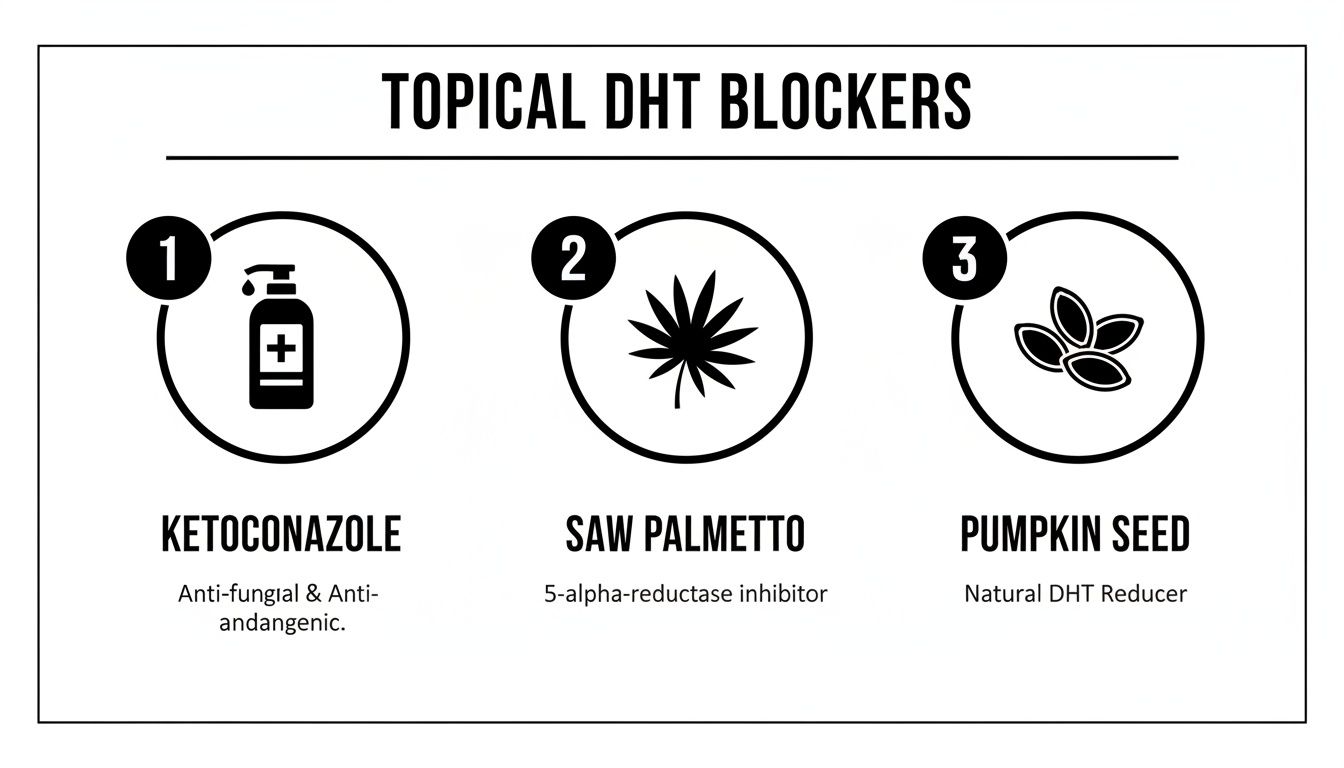
Here’s a quick rundown of the ingredients you'll see most often in topical DHT fighters:
Key Ingredients in Topical DHT Fighters
| Ingredient | Mechanism of Action | Ideal For | Common Concentration |
|---|---|---|---|
| Ketoconazole | Disrupts the DHT pathway on the scalp; also has anti-inflammatory and anti-fungal properties. | Men with thinning hair who also experience dandruff, itchiness, or inflammation. | 1% (over-the-counter) or 2% (prescription). |
| Saw Palmetto | A natural plant extract believed to inhibit the 5-alpha reductase enzyme, which converts testosterone to DHT. | Those looking for a natural, non-prescription starting point. | Varies by product, but a key ingredient in many popular formulas. |
| Pumpkin Seed Oil | Contains phytosterols, which are also thought to help block the 5-alpha reductase enzyme. | Anyone seeking another evidence-backed natural ingredient, often paired with saw palmetto. | Varies widely; often part of a blend of carrier and essential oils. |
| Caffeine | Thought to stimulate the hair follicle and may counteract some of DHT's suppressive effects. | Men who want to add a growth stimulant to their DHT-blocking routine. | Typically found in 1-2% concentrations in hair care products. |
This isn't an exhaustive list, but these are the heavy hitters you'll want on your team. Finding a product that combines a few of these is often a great strategy.
These ingredients form the core of many effective hair loss shampoos. If you want to dive deeper into the science, check out our complete guide on if DHT-blocking shampoos work.
A Quick Tip from Experience: Don't just wash and rinse. To get the most out of a DHT-blocking shampoo, you need to give the active ingredients time to actually work. Lather it in, massage your scalp for a minute, and then let it sit for at least 3-5 minutes before rinsing. Treat it like a scalp treatment, not just a quick wash.
Going Beyond Shampoos: Serums and Foams
While a good shampoo is a great start, you can take your topical defense a step further with leave-in products like serums and foams.
These are designed to stay on your scalp for hours, delivering a more concentrated and sustained dose of DHT-fighting ingredients. They often contain the same players—like saw palmetto or pumpkin seed oil—but in a more potent formulation. You’d typically apply these once or twice a day to a dry scalp, targeting the areas where thinning is most noticeable.
A Modern Approach: Topical Finasteride
For years, the most powerful prescription DHT blocker, finasteride, was only available as an oral pill. That's changing, and a newer option is gaining a lot of traction: topical finasteride.
This is a prescription-strength solution, usually mixed into a serum or foam, that you apply directly to your scalp. The entire goal is to deliver the powerful DHT-blocking effects of finasteride right where you need it—at the hair follicles—while minimizing how much gets absorbed into your bloodstream.
The key advantage here is a potentially lower risk of the systemic side effects that some men worry about with the oral medication. It acts locally to reduce scalp DHT levels significantly, making it an excellent choice for guys who want a powerful treatment but are hesitant to take a daily pill. It's a targeted, modern way to tackle the problem directly where it starts.
Taking the Fight Systemic: Oral DHT Blockers
When topical treatments just aren't cutting it, or if you're dealing with more aggressive hair loss, it's time to consider working from the inside out. Systemic DHT blockers are the big guns—medically-proven medications that lower DHT levels throughout your entire body. This gives your scalp's hair follicles a much-needed reprieve from the constant DHT assault.
Think of it like this: topical treatments are like posting guards directly at the follicle. Systemic blockers are more like disrupting the DHT supply chain at the source, preventing it from ever reaching the "battlefield" on your scalp.
While the topical ingredients we've already covered are fantastic for a direct, scalp-level defense, oral medications offer a far more comprehensive and powerful approach.
Finasteride: The Gold Standard for a Reason
For decades, Finasteride has been the go-to prescription for male pattern baldness. It was FDA-approved way back in 1997, and its reputation is built on a mountain of clinical data and real-world success stories.
So, how does it work? Finasteride inhibits the Type II 5-alpha reductase enzyme. This is the specific enzyme that does most of the heavy lifting in converting testosterone to DHT within your hair follicles. By putting the brakes on this enzyme, you dramatically lower the amount of follicle-killing DHT circulating in your scalp.
The results are pretty staggering. A landmark 1999 study found that a standard 1 mg daily dose of Finasteride slashed scalp DHT levels by 69.4% and DHT in the blood by 72.2%. In massive, five-year trials, an incredible 90% of men using it either kept the hair they had or actually saw regrowth. Compare that to the placebo groups, where hair loss simply continued its march. You can dig into the original findings on its effectiveness yourself.
A Note on Expectations: Finasteride is a powerhouse, but it's important to know its strengths. It works wonders on the vertex (the crown or bald spot), with studies showing regrowth in up to 65% of men. It's generally less effective for fully restoring a receding hairline, which is a notoriously difficult area to treat for everyone.
Dutasteride: The More Powerful Option
If Finasteride is the king, Dutasteride is the emperor. While Finasteride only targets the Type II 5-alpha reductase enzyme, Dutasteride is a dual-action inhibitor, blocking both the Type I and Type II versions.
This double-pronged attack makes it a much stronger weapon. Dutasteride can crush serum DHT levels by more than 90%, a significant jump from Finasteride's ~70% reduction. This makes it a compelling choice for guys who didn't get the results they hoped for with Finasteride or who are facing very rapid and aggressive hair loss.
One thing to keep in mind: Dutasteride is technically only FDA-approved for treating an enlarged prostate. Using it for hair loss is considered an "off-label" prescription, though it's a very common one backed by a growing body of clinical evidence. If you're weighing your options, our guide on Dutasteride vs. Finasteride for hair loss breaks down the differences in detail.
An Honest Conversation About Side Effects
You can't talk about these medications without addressing the potential side effects. Because they work by altering your hormones, there is a risk of side effects, which are primarily sexual.
This can include things like:
- Decreased libido (sex drive)
- Erectile dysfunction (ED)
- A reduction in ejaculate volume
It's crucial to look at this with a level head. The internet can be an echo chamber for worst-case scenarios, but the clinical data tells a different story. The actual incidence of sexual side effects is quite low, affecting somewhere between 1.8% to 2.4% of men. And for the vast majority who do experience them, the issues are temporary and go away if they stop the medication.
Ultimately, starting a systemic DHT blocker is a personal decision that you should always make with your doctor. They can help you weigh the proven benefits for your hair against the small but real risk of side effects, so you can make a choice that feels right for you.
How PRP Therapy Helps Revive Damaged Hair Follicles
So far, we’ve covered how to play defense—using things like specialized shampoos and medications to block DHT and prevent more damage to your hair. But what about the follicles that are already weakened or have gone dormant? This is where we shift from defense to offense, actively working to repair and wake up that sleeping hair.
This is where Platelet-Rich Plasma (PRP) therapy comes in. It’s a clever, non-hormonal approach that uses your body's own healing power to give struggling hair follicles a much-needed push. It's a fantastic option for guys who are hesitant to start systemic medications, have hit a plateau with other treatments, or just want to add a powerful growth stimulus to their existing routine.
The Science of PRP, Made Simple
The idea behind PRP is actually pretty straightforward. It’s all about concentrating the natural healing power floating around in your blood and delivering it right where you need it most—your scalp.
The process is simple and happens right in the clinic:
- A quick blood draw: It starts just like a routine blood test, with a small sample of blood taken from your arm.
- Spinning for "liquid gold": That blood is then placed in a centrifuge, a machine that spins at incredibly high speeds to separate the blood components. This isolates the platelets, creating a super-concentrated serum we call platelet-rich plasma.
- Targeted injections: Finally, this potent PRP serum, which is packed with growth factors, is carefully injected into the areas of your scalp where the thinning is happening.
The real magic is in those platelets. They are your body's first responders when there's an injury, and they're loaded with powerful proteins and growth factors that signal cells to get to work repairing and regenerating tissue. When injected into the scalp, they create a rich, fertile environment that can help push dormant follicles back into an active growth phase. If you want a deeper dive, you can learn more about how PRP works to stimulate hair follicles.
Think of it this way: DHT blockers stop the enemy from attacking your hair follicles. PRP therapy is like sending in a specialized team of medics and engineers to rebuild the fortifications and get the factory running again.
Why PRP is a Great Partner to DHT Blockers
Combining treatments is almost always the key to getting the best results, and PRP works in perfect harmony with DHT blockers. While medications like finasteride stop the hormonal assault, PRP gets to work directly repairing the damage that’s already been done. This one-two punch is especially effective for men who feel like their progress has stalled.
I see it all the time. A guy might be on a powerful medication like Dutasteride, which is the heavy hitter in the DHT-blocking world. It inhibits both types of 5-alpha reductase enzymes for a brutal 90-94% knockout of scalp DHT—that’s well beyond finasteride's 70-73%.
While this is amazing for stopping hair loss in its tracks, it doesn't always kickstart new growth from follicles that have been dormant for a while. This is exactly where PRP shines. By flooding those follicles with essential growth factors, it directly counters the damage without adding any more hormonal variables into the mix. It's not uncommon for clinics to see 25-30% increases in density after just 3-4 monthly sessions, with regular maintenance treatments keeping those gains locked in.
What to Realistically Expect from PRP
PRP is a process, not a one-and-done miracle. To see real results, you absolutely have to be consistent.
Here’s what a typical journey with PRP looks like:
- The Initial Phase: Most treatment plans kick off with a series of 3 to 4 sessions, spaced about a month apart. This "loading phase" is designed to saturate the scalp with growth factors and get a strong response from your follicles.
- The Maintenance Phase: After that initial series, you’ll typically shift to maintenance sessions every 6 to 12 months. This is crucial for preserving your results and continuing to support healthy hair growth long-term.
- When You'll See Results: You won't see a full head of hair overnight. It often takes until the second or third session to notice the first small changes, like less shedding or some new, fine "peach fuzz" hairs. More significant improvements in thickness and density usually become apparent 4 to 6 months after you start.
While PRP is a highly localized and powerful tool, it’s part of a much larger field of regenerative medicine. For a broader perspective on how the body's healing mechanisms can be harnessed, you might find it interesting to read about Exploring the Benefits of Hyperbaric Oxygen Therapy, which works on a more systemic level.
Putting It All Together: Your Complete Hair Defense Strategy
Successfully fighting hair loss is rarely about finding a single magic bullet. It’s about building a smart, sustainable plan that protects your hair from every angle. This is where we bring it all together—the topicals, the medications, and the lifestyle habits—into a cohesive strategy that gives you the best possible shot at keeping and regrowing your hair.
The real secret weapon here is combination therapy. Think of it like a coordinated attack. You have different forces, each with a specific job, all working in concert to achieve one mission. Just using a special shampoo is like sending in one soldier and hoping for the best; a multi-pronged approach is always going to be more powerful.
The Power of a Multi-Pronged Attack
A truly effective strategy doesn't just block DHT. It also creates the perfect environment for your hair to actually grow and thrive. This means your primary treatments need a solid support system, and that support system is built from your daily habits.
Let's walk through what a powerful, real-world strategy looks like in practice:
- Morning Routine: You start the day using a DHT-blocking shampoo with ketoconazole. The key is to massage it in and let it sit on your scalp for at least five minutes to really do its job.
- Daily Medication: With breakfast, you take your daily dose of oral finasteride. This works from the inside out, systemically lowering your body’s overall DHT production.
- Quarterly Boost: Every three months, you head to a clinic for a PRP session. This injects a powerful dose of growth factors directly where they're needed most, helping to repair follicles damaged by DHT.
This is what a comprehensive plan looks like. The shampoo provides localized defense on the scalp, the finasteride cuts off the DHT supply at the source, and PRP acts like a repair crew, rebuilding what was damaged. It’s a smart, informed strategy that covers all your bases.
Your Lifestyle Is the Foundation
You can use the most powerful treatments on the planet, but they can be seriously undermined by a poor lifestyle. Your daily habits are the foundation of your entire hair defense strategy. They create the right internal conditions for your treatments to work effectively.
To give your hair the best support, you need to zero in on these key areas:
- Nutrition: A diet rich in the right nutrients is non-negotiable. Zinc is crucial for regulating hormones, and biotin is essential for producing keratin, the very protein that makes up your hair. Load up on foods like eggs, nuts, spinach, and lean meats.
- Stress Management: Chronic stress floods your body with cortisol. This hormone can throw your hair growth cycle out of whack and make androgenetic alopecia worse. Find what works for you to de-stress—exercise, meditation, even a hobby—because your scalp will thank you.
- Proper Scalp Care: A clean, healthy scalp is like fertile soil for a garden. If it's clogged or inflamed, nothing will grow well. Avoid harsh chemical treatments and excessive heat styling that can damage follicles. You can learn more about how a combined approach helps you how to lower dht levels on our site.
The most important thing I can tell you is this: a consistent, patient approach is the only thing that works. You won't see results in a few weeks. You're playing the long game here, and it takes months to see real, lasting change.
Taking Back Control
Ultimately, building this kind of strategy is about empowerment. It’s about moving past that feeling of helplessness that so often comes with hair loss and taking proactive, informed control of the situation.
When you understand the tools you have and how they work together, you can create a personalized plan that actually fits your life and your goals. This is about more than just getting DHT off your scalp; it’s about building a sustainable defense that protects your hair for years to come. You have the knowledge—now it's time to put it into action.
Common Questions About Fighting DHT
Even with a solid game plan, it's natural to have a few lingering questions as you start trying to reclaim your hair. This is new territory for a lot of guys, and there's a ton of conflicting information out there. Let's cut through the confusion and tackle some of the most common questions head-on.
Getting these details straight can make a huge difference in your confidence and commitment to the process. Think of this as the final briefing before you go all-in on your hair defense strategy.
Can I Get Rid of DHT on My Scalp Naturally?
This is probably the number one question I hear, and the honest answer is a bit of a "yes and no." You can absolutely take steps to naturally reduce the impact of DHT, but you can't completely eliminate the molecule itself with natural methods alone.
Ingredients like saw palmetto, pumpkin seed oil, and the catechins in green tea are thought to work by inhibiting the 5-alpha reductase enzyme—the very culprit that converts testosterone into hair-destroying DHT. Using products with these ingredients is a fantastic first step and a great supporting part of a bigger plan.
But it’s important to have realistic expectations. These natural options are like your support crew; they help create a better environment for your hair to grow. When it comes to significant, medically-proven results, treatments like Finasteride are simply in a different league in terms of their power.
How Long Until I See Results from a DHT Blocker?
Patience is probably the most underrated part of any hair restoration plan. Hair growth is a marathon, not a sprint. Your follicles operate on their own slow, steady timeline, so setting the right expectations from day one is crucial to staying the course.
Here’s a general timeline to keep in mind:
- Topical Treatments (Shampoos, Serums): With consistent daily use, you might start to notice a reduction in shedding within 2 to 4 months. This is often the very first positive sign that things are moving in the right direction.
- Oral Medications (Finasteride): It typically takes a minimum of 3 to 6 months just to stabilize hair loss. Visible regrowth, if it's going to happen, often becomes apparent after a full year of continuous use.
- PRP Therapy: Many guys start seeing improved hair texture and thickness after their second or third monthly session, with more noticeable results kicking in around the 4 to 6-month mark.
The single most important factor here is consistency. Stopping any of these treatments will, unfortunately, cause a reversal of your progress. DHT will creep back in, and the miniaturization process will pick up right where it left off.
Are the Side Effects of Finasteride Permanent?
This is an incredibly valid concern that every man should consider before starting a systemic DHT blocker. The internet is full of scary stories, so let's look at what the clinical data actually shows.
For the overwhelming majority of men, any side effects that occur from oral DHT blockers are temporary and resolve if the medication is stopped. The percentage of men who experience sexual side effects is quite low, hovering around 2-4% in most large-scale studies.
The idea of "Post-Finasteride Syndrome," where symptoms reportedly persist after stopping the drug, is a topic of ongoing medical discussion. It's reported by a very small minority of users, and its mechanisms aren't yet fully understood. This is exactly why having an open, honest conversation with your doctor about your complete health history is an absolute must before you ever start.
Can I Combine PRP Therapy with a Medication Like Finasteride?
Absolutely. In fact, for many men, this combination represents the most effective game plan possible. Combining these treatments creates a powerful one-two punch that tackles hair loss from two different, complementary angles.
Think of it as playing both offense and defense for your hair.
- The Defense (Finasteride): This works systemically to lower DHT levels throughout your body, protecting your follicles from further harm. It’s stopping the root cause of the damage.
- The Offense (PRP): This works locally, right on the scalp, by delivering a potent dose of your body's own growth factors to stimulate repair, awaken dormant follicles, and encourage new growth.
This synergistic approach addresses both the underlying cause of the problem and the damage it has already done. Many of the top hair restoration clinics recommend this combination therapy as the gold standard for achieving the best possible results when figuring out how to remove dht from the scalp for good.
At PRP For HairLoss, we believe that the right information is the most powerful tool in your fight against hair loss. Our goal is to provide clear, evidence-based guidance to help you make the best decisions for your hair. Explore our resources to learn more about how PRP can be a cornerstone of your hair restoration journey.
 PRP For Hairloss
Leave a comment