Let's get straight to it: you're wondering if using minoxidil for frontal baldness is actually worth the time and effort. The short answer is yes, it can definitely help, but it's not a magic potion that will restore the hairline you had in high school.
Think of minoxidil as a key player on your hair loss defense team. Its biggest strength is slowing down or even stopping further recession. For some guys, it can also wake up some of those sleepy follicles and coax out a bit of regrowth.
The Honest Truth About Minoxidil and Your Hairline

When you’re staring down a receding hairline, the most important thing is to set realistic expectations from day one. Minoxidil is FDA-approved, and decades of science back up its ability to stimulate hair growth. But let's be real—it built its reputation on the impressive results it gets on the crown (the vertex area at the back of your head).
The frontal scalp, where your hairline is, is just a different battlefield. The hair follicles there are notoriously more sensitive to DHT, the hormone that's the main culprit behind male pattern baldness.
Why the Hairline Is a Tougher Battle
So, how does minoxidil actually work? Picture it as a booster shot for your struggling hair follicles. It revs up blood flow, delivering more oxygen and nutrients to the hair roots, which encourages them to hang out in their growth phase longer.
However, it can't bring back follicles that have already packed up and left. Since the hairline is often the first place to thin, those follicles might be too far along in the miniaturization process for minoxidil to have a dramatic effect. This is why the results you see upfront are often less dramatic than what you might see on the crown.
The real win when using minoxidil on your hairline is stabilization. If you can stop the recession in its tracks, you're winning the fight. Any regrowth you get on top of that is a huge bonus.
To give you a clearer idea of what you’re in for, let’s break it down in a quick, easy-to-read format.
Minoxidil for Your Hairline at a Glance
| Aspect | What You Can Realistically Expect | The Bottom Line for Men |
|---|---|---|
| Slowing Recession | High likelihood of success. This is minoxidil's strong suit for the hairline. | This should be your main goal. Stopping further loss is a major victory. |
| Regrowth | Possible, but often modest. Think finer, "vellus" hairs or slight thickening. | Don't bank on a brand new hairline. Any new growth is a fantastic bonus. |
| Timeline | You'll need 3-6 months of consistent use to see if it's working for you. | Patience is an absolute must. Quitting too early is a common mistake. |
| Commitment | Lifelong. If you stop using it, any gains will vanish within a few months. | You have to be in it for the long haul. It becomes a daily habit. |
This table helps frame the experience. It's about playing the long game.
The science backs this up, too. One study, for example, found that the average increase in hair density on the frontal scalp was just 3.1 hairs per cm². This shows that while minoxidil is definitely doing something, the gains are often subtle. Understanding this helps explain why so many guys report that the treatment maintained their hairline rather than fully restoring it.
Remember, minoxidil is just one piece of the puzzle. It's always a good idea to learn about how to improve overall hair health to support your efforts. If you're concerned about this specific area, you might also find our guide on the causes of thinning hair in front for men helpful.
How Minoxidil Actually Revives Hair Follicles
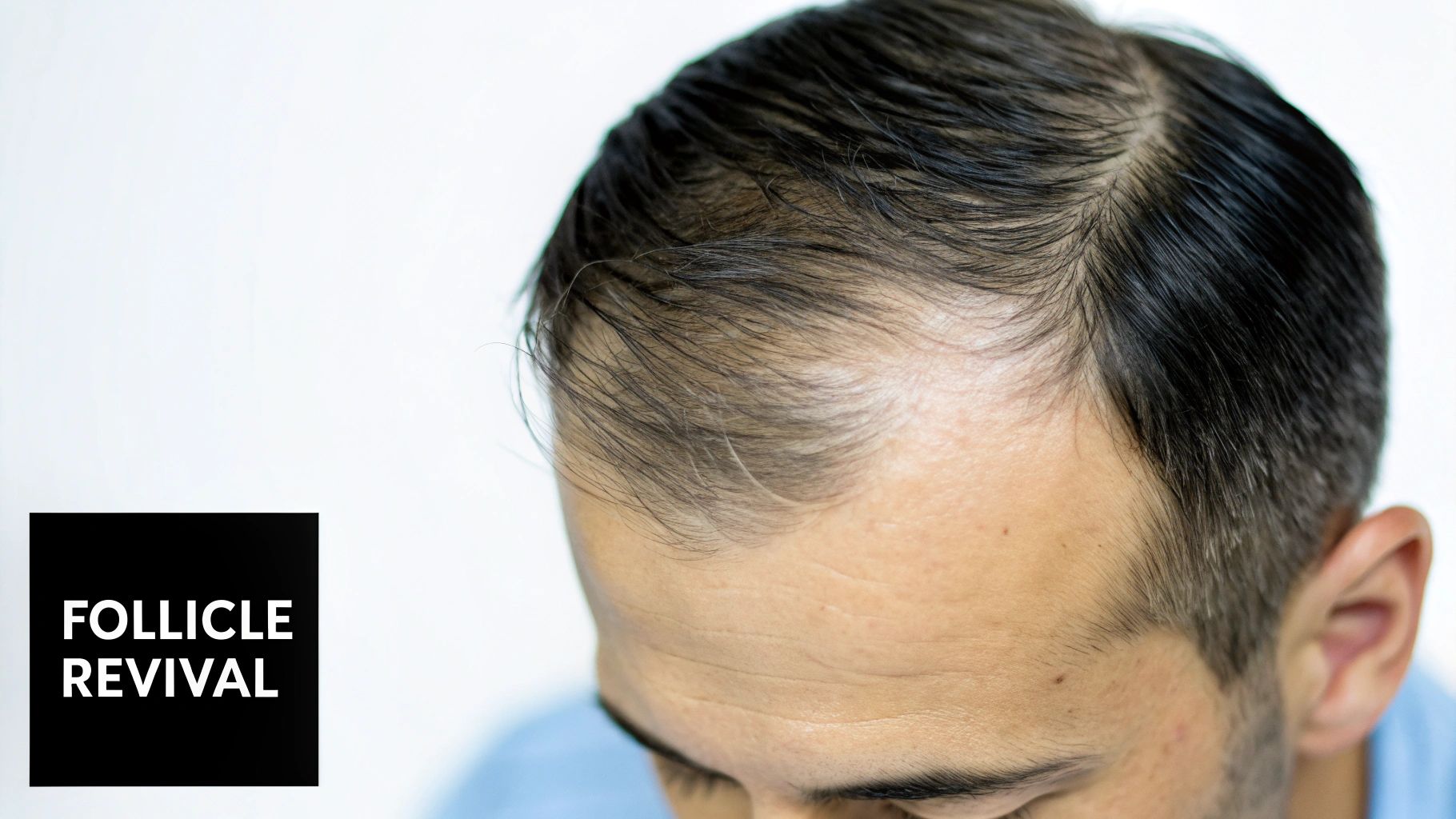
So, what’s really going on at a microscopic level when you put minoxidil on your scalp? Let's skip the dense science for a minute and think about it in a more straightforward way to really get its role in tackling frontal baldness.
Imagine each of your hair follicles is a tiny, hair-producing factory. The hormone DHT, the main villain in male pattern baldness, acts like a saboteur, slowly squeezing the supply lines that feed these factories. Without a steady flow of resources, the factories start to shrink and, eventually, just shut down completely.
This is where minoxidil steps in. It's basically the cavalry, riding in to reopen those crucial supply lines and get production humming again.
Boosting Blood Flow and Nutrients
At its core, minoxidil is a vasodilator. Its main job is to widen the blood vessels around your hair follicles. This simple action has a huge impact, as it allows a fresh surge of oxygen, blood, and vital nutrients to flood into those struggling little factories.
This renewed supply accomplishes a few critical things:
- It awakens dormant follicles: That fresh delivery of nutrients can nudge weakened, tired follicles back into their production cycle.
- It prolongs the growth phase: Minoxidil encourages follicles to stay in their active growth (anagen) phase longer, which often leads to thicker, healthier hairs over time.
- It supports the hair you still have: Better blood flow helps keep your existing hair strong and firmly anchored in the scalp.
Getting a handle on this mechanism is key to setting realistic expectations for your hairline. Minoxidil is much better at reviving struggling factories than it is at building brand-new ones on completely bald skin. For a closer look at this revival process, you can learn more about how to reverse miniaturized hair follicles and bring them back from the brink.
This is exactly why its biggest strength lies in stabilizing a receding hairline and thickening up the hair that’s already there.
The core function of minoxidil isn't to stop DHT production; it's to create a healthier, more nutrient-rich environment that helps hair follicles withstand DHT's negative effects. It works by supporting the follicle directly.
Now, this process isn't a magic trick—it takes time. Re-establishing those supply lines and getting the factories back up and running is a gradual effort, which is why consistency is the absolute golden rule. Skipping applications is like telling the supply trucks to turn around for the day, stalling all the progress you've made. This journey requires patience and a real commitment to the daily routine.
Choosing the Right Minoxidil Strength for Your Hairline
When you're ready to start using minoxidil for frontal baldness, the options on the pharmacy shelf can be a little confusing. You'll mainly see two choices: 5% and 10% concentrations. Picking the right one from the start is key to getting results without unnecessary side effects.
Why 5% is the Standard Starting Point
For most guys just starting their journey, the 5% minoxidil solution is the gold standard. It's not just a random number; this is the strength that's FDA-approved and has decades of solid proof behind its effectiveness for male pattern hair loss.
Think of it as the most reliable and well-tested tool in the box. It offers a great balance between waking up dormant hair follicles and being gentle enough for you to use every single day.
The Lure of "Extra Strength"
It's natural to think, "Why not just jump to the 10%? More has to be better, right?" It’s a fair question. While some studies do hint that a higher concentration can boost hair count a bit more, that extra kick often comes with a price.
A stronger formula means a higher risk of the common side effects. We're talking about more noticeable scalp irritation, annoying dryness, and even unwanted hair popping up on your forehead or face. For a lot of men, these issues are enough to make them ditch the routine altogether.
The smartest play is to start with the proven 5% solution. It's the most reliable and tolerable starting point for rebuilding a thinning hairline without causing a lot of irritation.
This strategy lets your scalp get used to the treatment and helps you see how your body responds. And when it comes to how you apply it, it's worth exploring the differences between Rogaine foam vs liquid to find what works best for your lifestyle.
Balancing Power with Practicality
The real game here is finding the sweet spot between effectiveness and your own comfort. A comparative study did find that a 10% minoxidil solution led to a bigger jump in frontal hair count compared to the 5% version.
However, that same study pointed out that fewer patients stuck with the higher strength because of increased side effects like itching and irritation. You can read the full research findings on this topic if you want to dive into the data.
At the end of the day, the best treatment is the one you actually use consistently. If you’ve been on the 5% strength for a full year and feel like your progress has hit a wall, that's the time to talk to your doctor. You can then make an informed decision together about whether the potential for slightly better results with a 10% formula is worth the trade-off.
A Practical Guide to Applying Minoxidil Correctly
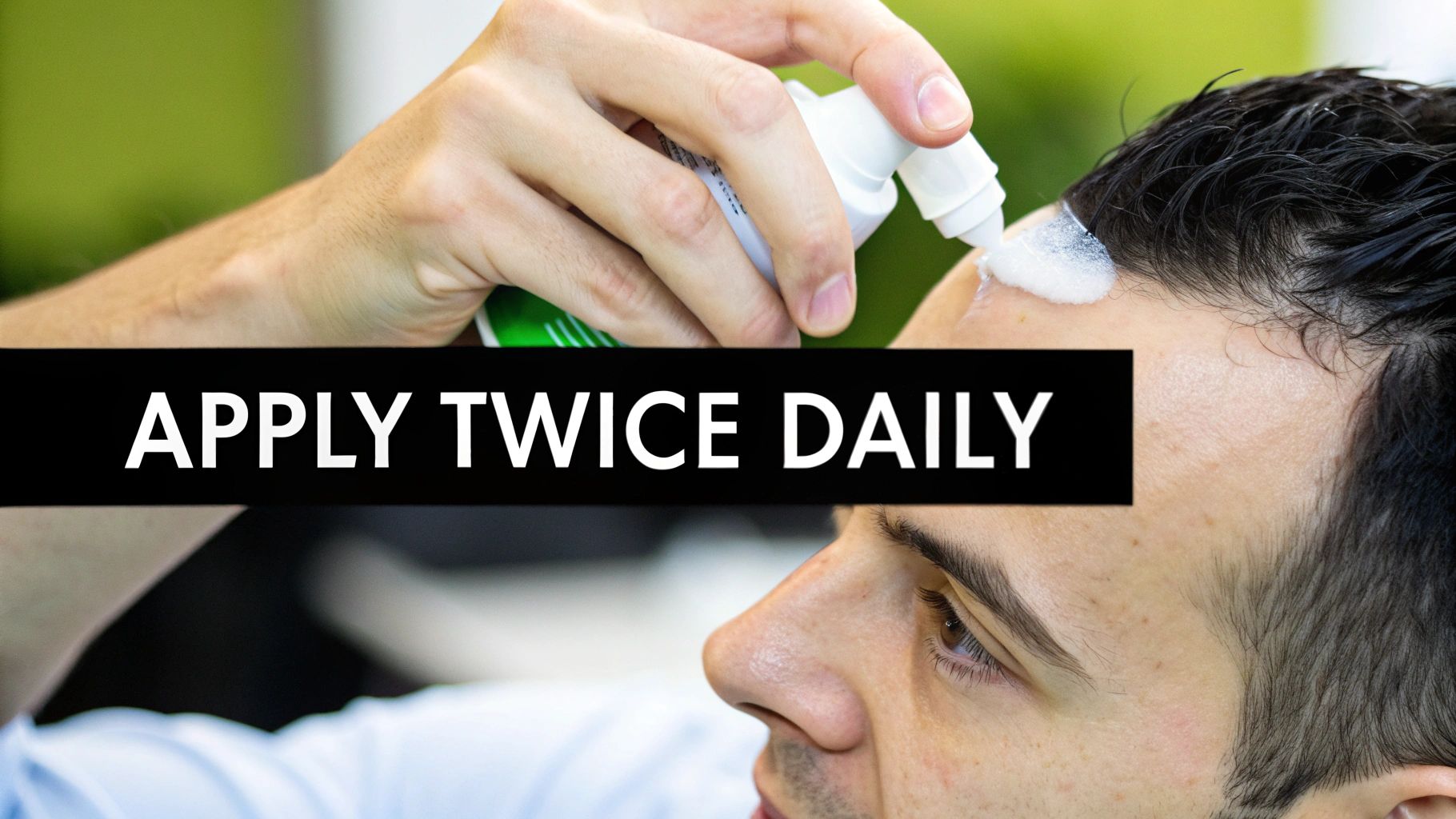
Getting results with minoxidil for frontal baldness isn’t just about having the bottle on your counter—it's about using it the right way, day in and day out. The best way to think about it is to treat it like brushing your teeth; it needs to be a non-negotiable part of your daily routine.
The absolute number one rule here is consistency. Skipping applications is like taking two steps forward and one step back. You’re basically giving hair loss a chance to catch up and undo all your hard work. If you want to see any meaningful change, you have to stick with it.
The Core Application Routine
The game plan is simple but needs to be followed precisely. You'll apply minoxidil twice a day to a scalp that is completely dry. Putting it on damp hair or a wet scalp is a classic mistake that just dilutes the product, preventing it from absorbing properly and wasting your effort.
Whether you're using the foam or the liquid, the standard dose is 1ml per application. The key is to get it directly onto the scalp along your thinning hairline, not just smeared over your hair. Use your fingertips to gently massage it into the skin, making sure it reaches the follicles where it needs to work.
A word of caution: don't fall into the "more is better" trap. Doubling up on the dose won't speed up hair growth. All it really does is increase your chances of dealing with side effects like scalp irritation or unwanted hair on your face. Stick to the recommended amount.
And don't forget this crucial final step: wash your hands thoroughly with soap and warm water right after you're done. This simple move prevents you from accidentally spreading the solution to your face or pillow, which is how many guys end up with hair growing where they don't want it.
Building an Effortless Habit
The last piece of the puzzle is making this process second nature. You want to get to a point where you do it automatically, without even thinking about it. Here’s a simple way to build that habit:
- Morning Routine: Apply minoxidil after you shower and your hair is fully dry. Let it absorb for a few minutes before you start styling. This gives it a head start before you add any other products.
- Evening Routine: Apply your second dose at least 30 minutes to an hour before you hit the pillow. This gives it enough time to dry completely, ensuring it stays on your scalp and not on your pillowcase.
By piggybacking the application onto habits you already have, you turn a chore into a quick, two-minute task. It’s also worth noting that as you get into a rhythm, you can look into different application methods; for example, many men find that a minoxidil spray for male pattern baldness can make the process even smoother. Ultimately, a routine you can actually stick to is your most powerful tool in this fight.
What to Realistically Expect and When to Expect It
Patience. If there’s one thing you absolutely need when starting minoxidil for frontal baldness, that’s it. This is a marathon, not a sprint, and knowing the typical timeline will keep you from giving up right before you might see results.
So, let's break down what your first year really looks like.
Months 1 to 2: The "Dread Shed"
The first couple of months can be a little unsettling. You might actually notice more hair shedding than usual, a phase known as the "dread shed." It feels completely backward, I know, but it’s often a good sign.
Think of it this way: minoxidil is waking up your dormant hair follicles. To make room for new, stronger hair, it has to push out the old, weak hairs that were already on their way out anyway. Seeing a few extra strands in the shower drain means the treatment is starting to work.
Months 3 to 6: The First Signs of Life
Once the initial shedding phase chills out, things get quiet for a bit. Then, around the three-month mark, you might start to see it—very fine, soft, almost colorless hairs sprouting along your hairline. This is the "peach fuzz" stage.
These are your new hairs taking root. It’s not going to be a dramatic transformation overnight, but it’s the foundation for what’s to come. This is the point where your daily consistency really starts to pay off. To get a better idea of what this early stage can look like, check out some real-world minoxidil before and after results.
Months 6 to 12: Maturation and Holding the Line
This is the timeframe where the real progress happens. Those tiny vellus hairs can start to mature, growing thicker, darker, and longer until they begin to blend in with the rest of your hair.
For the frontal hairline, the biggest win for most guys is stabilization—your recession has stopped. Simply holding the line is a huge victory. Any visible regrowth on top of that is a fantastic bonus and a clear sign that you're responding well to the treatment.
The bottom line from study after study is this: expect to wait about six months for noticeable results. This is a long game, and stopping the treatment means you'll lose any ground you've gained.
This timeline isn't just guesswork; it's backed by solid research. Clinical trials on 5% minoxidil foam consistently show significant improvements by week 24. In one major study, nearly 50% of men saw moderate regrowth, with user satisfaction rates climbing to 70% after several months of dedicated use. If you're interested in the specifics, you can learn more about these clinical findings.
Boosting Your Results with PRP Therapy
Think of minoxidil as your daily defensive line against a receding hairline. It's consistent, reliable work. But what if you could bring in a specialized offensive team to really push back? That’s where Platelet-Rich Plasma (PRP) therapy comes into the picture.
When you pair these two, you're not just fighting hair loss from one angle; you're creating a powerful, comprehensive game plan. It’s like tending to a garden. Minoxidil is the daily watering that keeps the soil receptive and encourages growth. PRP is the professional-grade, nutrient-rich fertilizer you add every few months to truly revitalize the roots and get robust results.
How PRP Supercharges Your Hair Follicles
So, what exactly is PRP? In a nutshell, it’s a treatment that uses the concentrated healing power found right in your own blood. A small blood sample is taken and spun in a centrifuge to isolate the platelets, which are packed with potent growth factors.
These growth factors are then injected directly into your scalp, right where you need them most. This delivers a powerful signal to weak or sleeping hair follicles, basically waking them up and kicking them into high gear.
While minoxidil works from the outside-in by improving blood flow, PRP works from the inside-out, providing a direct biological boost. Some guys even explore options like learning about the microneedling with PRP benefits to further stimulate the scalp and enhance their overall strategy.
Minoxidil vs PRP: A Head-to-Head Look
Trying to figure out where each treatment fits into your hair restoration plan can be tricky. This table lays it all out, side-by-side, to help you see the distinct roles they play.
| Feature | Minoxidil (The Daily Defender) | PRP Therapy (The Strategic Booster) |
|---|---|---|
| How It Works | A topical vasodilator that improves blood flow to the follicles. | An injectable treatment using your own blood's growth factors. |
| Frequency | Requires application twice daily, every single day. | Involves a series of sessions, typically spaced 4-6 weeks apart. |
| Primary Goal | To slow down hair loss and maintain the existing hairline. | To actively stimulate dormant follicles for new growth and thickness. |
| Effort Level | A low-effort, daily habit you build into your routine. | A clinical procedure performed by a medical professional. |
Ultimately, you can see they aren't competitors; they're teammates. Minoxidil holds the line day-to-day, while PRP provides periodic, high-impact reinforcement to reclaim lost ground.
It's also important to have realistic expectations for your daily treatment. This timeline shows you what the journey with minoxidil typically looks like.
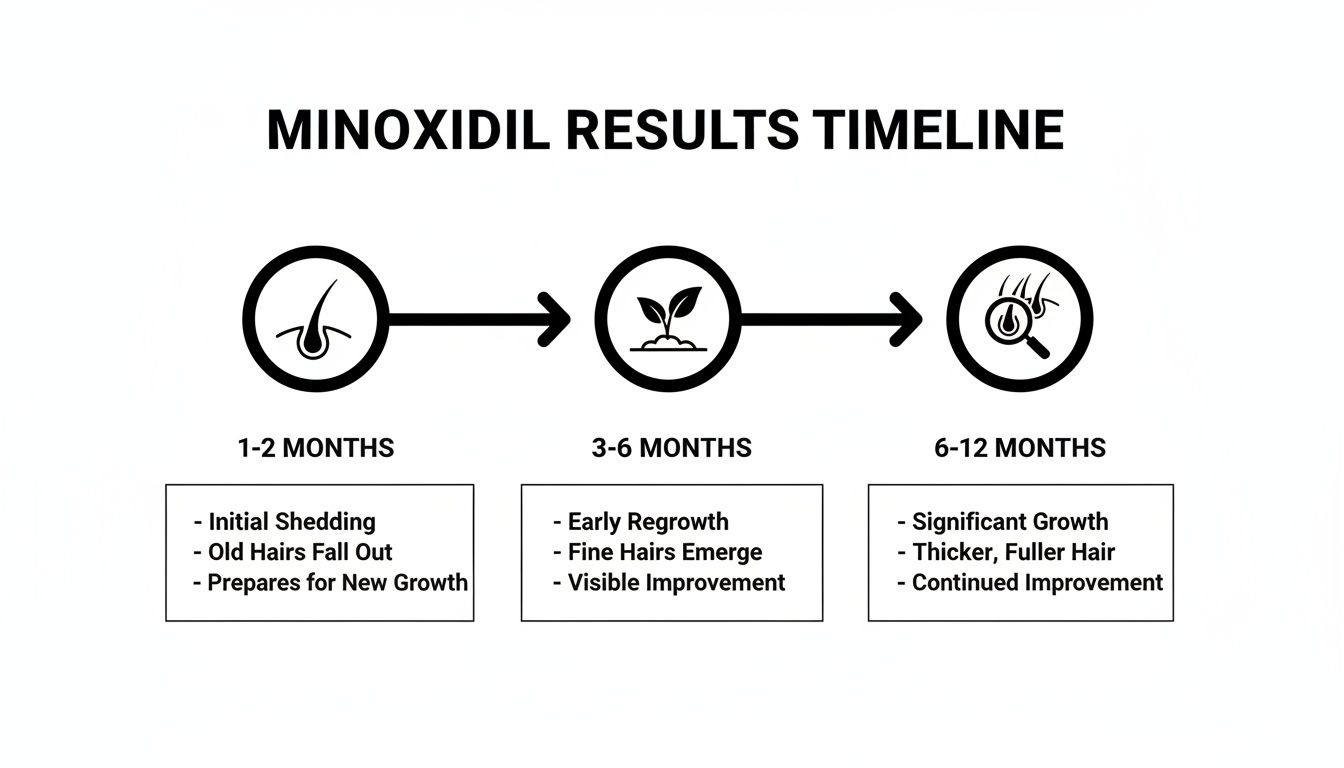
The biggest takeaway here is patience. Progress is a slow burn, not a sprint, and the most satisfying changes often don't show up until you're past the six-month mark.
Common Questions About Using Minoxidil for Your Hairline
Starting any new treatment for your hairline brings up a lot of questions. That’s totally normal. Getting straight answers is the best way to know what you're getting into and set realistic goals. Let's tackle some of the most common things men ask before starting minoxidil.
What Happens If I Stop Using Minoxidil?
Think of minoxidil less like a cure and more like a subscription service for your hair follicles. It only works as long as you're using it.
If you stop applying it every day, you can expect any hair you've maintained or regrown to start falling out within 3 to 4 months. After that, your original hair loss pattern will pick up right where it left off. This is one treatment where consistency is everything—the benefits are completely dependent on you sticking with it.
Can I Use a Dermaroller with Minoxidil on My Hairline?
Yes, and a lot of guys are getting great results with this combination. The technique is called microneedling, and using a dermaroller can help minoxidil absorb better into the scalp, potentially giving it an extra edge against a stubborn receding hairline.
But you have to be smart about the timing. Never apply minoxidil right after using a dermaroller. Doing so can cause too much of the drug to absorb into your bloodstream, which isn't safe. The best approach is to wait several hours, or even better, use the dermaroller and minoxidil on alternate days. A dermatologist can help you map out a safe and effective schedule.
Is It True Minoxidil Makes Hair Worse Before It Gets Better?
This is a big one, and yes, for some guys, it's a real thing. You might notice an initial shedding phase, which usually kicks in somewhere between the first 2 to 8 weeks of starting treatment. Seeing more hair in the drain can be alarming, but it's actually a good sign.
What’s happening is that the minoxidil is pushing out old, weak hairs that were about to fall out anyway. This makes way for new, healthier hairs to grow in their place. This shedding period is temporary and should calm down as you continue with consistent daily use.
Ready to build a smart strategy to fight your hair loss? At PRP For HairLoss, we offer expert insights to help you navigate all your options. Discover more about effective treatments by visiting our official website.
 PRP For Hairloss
Leave a comment