Let's be honest, watching your hair thin out is a frustrating experience. You’ve probably gone down the usual roads—the foams, the pills—with results that were, well, less than stellar. This guide is here to talk about exosome therapy for hair loss, not as some miracle cure, but as a genuine scientific development that’s turning heads for good reason.
Your Guide to Exosome Therapy for Hair Loss
If you're tired of seeing more hair in the shower drain than on your head, you've come to the right place. Male pattern baldness is incredibly common, but that doesn't make it any less demoralizing. The constant hunt for a real solution can feel like a maze of empty promises and products that just don't deliver.
But what if you could take a different route? Imagine sending a specialized crew of "messengers" directly to your scalp. Their mission: to deliver a precise set of instructions to your sleeping hair follicles, telling them it's time to wake up and get back to work. That’s the core idea behind exosome therapy.
A New Chapter in Hair Restoration
This isn't just another cream you rub on or a pill you take. Exosome therapy works on a cellular level, marking a major leap forward in regenerative medicine. It gets to the very root of the problem by reviving the follicles that have weakened or gone dormant. It's less like mowing the grass and more like enriching the soil so everything grows thicker and healthier.
Throughout this guide, we'll break down exactly what this means for you. My aim is to provide a clear, no-nonsense roadmap to understanding this powerful option for hair restoration.
By using the body's own communication system, exosome therapy proactively fights hair thinning. It encourages follicles to jump back into their growth phase, ultimately producing stronger, healthier hair.
What You Will Learn
We’ll walk through everything you need to know in plain English, giving you the full picture so you can make a solid decision. Here’s a quick rundown of what we'll cover:
- The Science Explained: We'll pull back the curtain on what exosomes are and how these microscopic powerhouses actually work.
- The Treatment Process: You'll get a step-by-step look at what to expect during a typical session, from start to finish.
- Real Expectations: We'll compare exosome therapy to familiar treatments like PRP so you can see where it fits in.
- Your Candidacy: We’ll help you figure out if you're a good candidate for this procedure.
My goal is simple: to give you the information you need to decide if exosome therapy is the right next step in your hair restoration journey.
What Are Exosomes and How Do They Trigger Hair Growth?
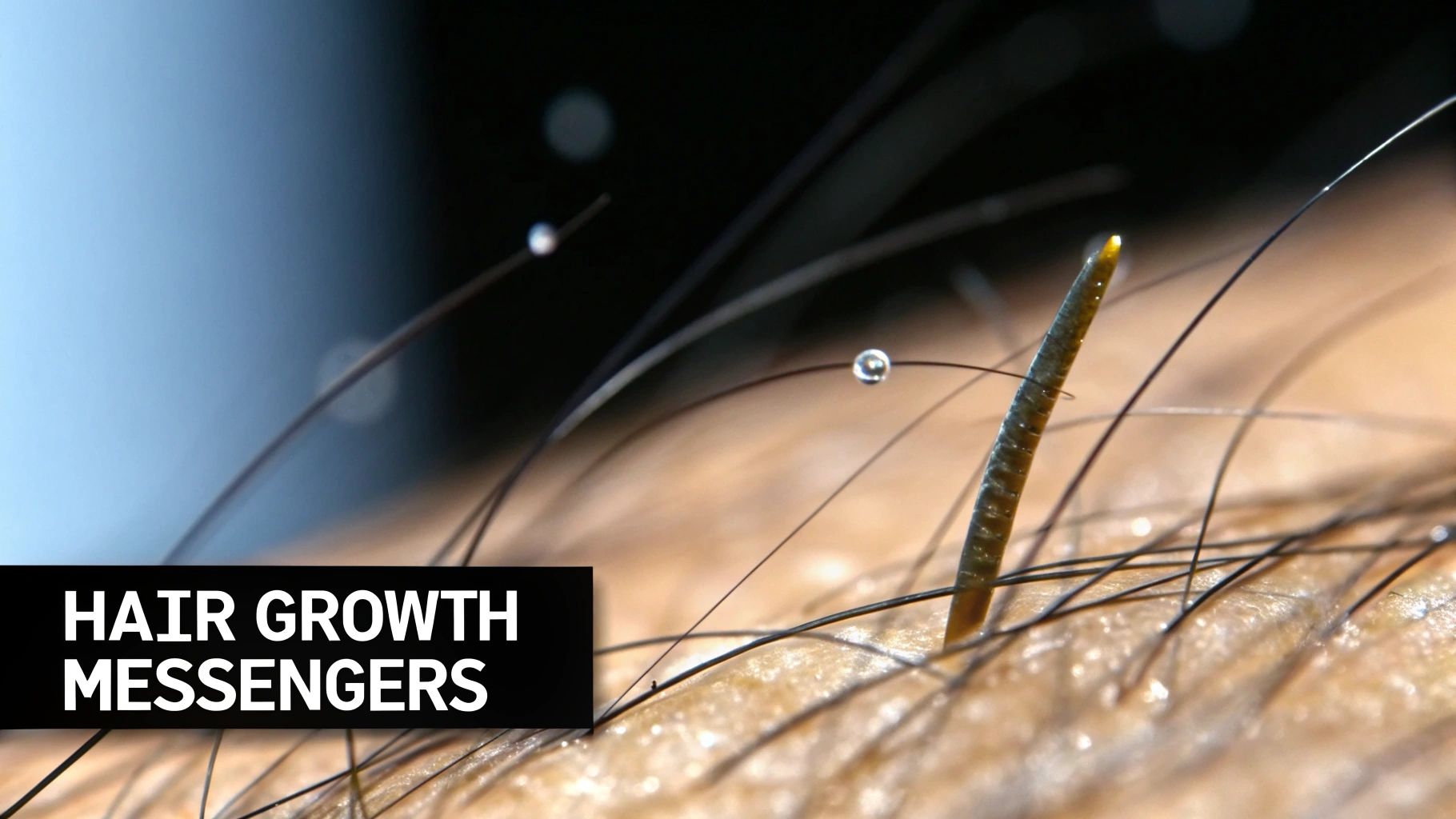
To really get what exosome therapy for hair loss is all about, let’s start with a simple analogy. Imagine your body is a massive, complex city. For anything to happen—from repairing a road to constructing a new building—the command center has to send out messengers with specific blueprints.
Exosomes are those messengers.
These are microscopic sacs released by almost every cell in your body, and they function like a highly advanced postal service. They carry crucial cargo—proteins, lipids, and bits of genetic code like mRNA—from one cell to another. This cargo contains instructions telling the receiving cell what to do: repair itself, calm down inflammation, or, in our case, get back to work growing hair.
For a guy struggling with thinning hair, this cell-to-cell communication is the whole ballgame. The exosomes used in hair therapy are typically sourced from mesenchymal stem cells (MSCs), which are known for their powerful regenerative abilities. Think of these exosomes as pre-packaged repair kits, full of the growth factors and signals your follicles are starving for.
Giving Your Hair Follicles a Boost
When it comes to male pattern baldness, the main villain is a hormone called dihydrotestosterone, or DHT. DHT attacks your hair follicles, causing them to shrink and weaken over time in a process called "miniaturization." Eventually, they just give up and stop producing hair. This is where the targeted messages inside exosomes make a real difference.
When these exosomes are introduced to your scalp, they get to work delivering instructions that counteract what DHT is doing. They essentially tell those dormant, tired follicles to wake up and jump back into the anagen (growth) phase of the hair cycle.
In short, exosomes act like a specialized support crew for your hair. They deliver a concentrated burst of regenerative signals that kickstart follicles into producing thicker, stronger, and healthier hair, which in turn improves your overall hair density.
This is all happening at a cellular level. The proteins and genetic material inside the exosomes directly stimulate the dermal papilla cells, which are like the power plant for each hair follicle. By restoring clear communication between cells, the treatment helps foster a much better environment for new growth. You can explore similar regenerative concepts in our guide to stem cell hair therapy.
Is It Safe and Does It Actually Work?
If you're looking into treatments for male pattern baldness, you need to know if it's backed by solid evidence. A 2025 review in the journal Dermatologic Surgery looked at nine different clinical studies covering 125 patients treated with exosome injections. One of the biggest takeaways was how safe the procedure is—side effects were incredibly rare, and no major issues were reported. Read the full analysis of the clinical studies on PubMed.
Patients saw genuine improvement because the treatment gets to the root of the problem. The growth factors packed inside the exosomes target dormant dermal papilla cells and improve blood flow, basically waking up your hair's "factories" and giving them the resources they need to thrive.
This is what makes exosome therapy so compelling. It’s not about introducing a foreign substance; it’s about using powerful, natural signals to help your own body do its job better and restore the hair you've lost.
What to Expect During Your Exosome Treatment Session
Knowing what’s coming can make any new experience feel more manageable. An exosome therapy session for hair loss is straightforward and much less intimidating than you might think. It’s not a complex surgery, but a precise, in-office procedure designed to get those regenerative messengers right where they need to go—your scalp.
Let’s walk through the entire process, from your first visit to walking out of the clinic, so there are no surprises.
It all starts with a detailed one-on-one consultation. This is your chance to talk through your hair loss history, what you're hoping to achieve, and any questions you have. The clinician will examine your scalp and the pattern of thinning to figure out if you're a good candidate for the treatment.
Your Step-By-Step Treatment Walkthrough
Once you and your clinician decide to move forward, the actual treatment day is surprisingly simple. Unlike other regenerative treatments, the exosomes are purified in a lab and ready to go, which means there's no need for a blood draw on your end.
Here’s a look at what you can generally expect during the session:
-
Scalp Preparation: First things first, the area needs to be prepped. Your scalp will be thoroughly cleaned, and a potent topical numbing cream is usually applied to keep you comfortable. This cream typically needs about 30-45 minutes to fully kick in.
-
Exosome Administration: After your scalp is numb, the clinician will begin administering the exosome serum. This is done with a series of tiny, targeted injections using very fine needles, delivered directly into the areas where your hair is thinning. The goal is to spread the exosomes evenly across the scalp to wake up as many dormant follicles as possible.
-
Enhancing Absorption: Many clinics will pair the injections with other techniques to get the most out of the treatment. For instance, microneedling might be used right after the injections. This creates tiny micro-channels in the skin that help the scalp absorb any remaining exosome serum and also boosts blood flow to the area.
The entire application process is pretty quick, often taking less than an hour from start to finish. If you're familiar with other non-surgical hair treatments, the experience is quite similar. You can get a feel for it by reading our guide on the PRP procedure for hair.
The core idea is simple: deliver a high concentration of growth signals directly to the hair follicles. By placing the exosomes at the root of the problem, the treatment gives your scalp the best possible chance to respond and restart the growth cycle.
The Science in Action
Clinicians are always refining these protocols to maximize results. The research pipeline is buzzing with studies designed to pinpoint the most effective dosages and application methods.
For example, some trials are currently testing different exosome concentrations, from 5 billion to 50 billion particles, combined with microneedling to measure improvements in hair count and thickness over 12 months. Other studies are looking at different injection schedules, like administering exosomes every 14 days for two months, to see how it impacts hair density. You can discover more insights about these ongoing clinical trials at ClinicalTrials.gov.
Ultimately, the session is designed to be efficient, comfortable, and highly targeted. After the procedure, you're typically free to go about your day. The post-treatment instructions are minimal—usually just to avoid washing your hair or hitting the gym hard for the first 24 hours. This straightforward approach is a big part of what makes it an appealing option for men looking for a powerful solution without significant downtime.
How Exosome Therapy Compares to PRP
If you’ve spent any time looking into hair loss treatments, you’ve definitely heard of Platelet-Rich Plasma, or PRP. It's been the go-to regenerative option for years, and for good reason. So, you might be wondering: if PRP is the tried-and-true method, where does exosome therapy for hair loss fit in?
Think of it like this: PRP is a reliable workhorse, using your body's own resources to get the job done. Exosome therapy is the newer, high-performance model. It’s been specifically engineered to deliver more power and a more targeted function right where you need it most.
The Source of Power
The biggest difference comes down to what's actually being injected into your scalp.
With PRP, the process is all about you. Your blood is drawn, spun down in a centrifuge to separate the platelets, and that concentrated plasma is injected back into your scalp. The growth factors are whatever your body happens to produce that day.
Exosome therapy, on the other hand, is a cell-free treatment. It uses a precisely formulated serum created in a lab from mesenchymal stem cells, which is absolutely packed with billions of powerful exosomes. This means you get a consistent, high-potency dose of regenerative signals every single time, with no blood draw required.
While both treatments aim to wake up sleepy hair follicles, exosomes deliver a much stronger and more targeted payload of growth factors. PRP's effectiveness depends on the variable concentration of growth factors found in your own blood at that moment.
Head-to-Head Clinical Results
So, how do they stack up in the real world? Recent research is starting to paint a pretty clear picture. A 2024 systematic review analyzed data from multiple studies and found that exosomes triggered a huge jump in hair density. The study tracked hair counts climbing from a baseline of 96.5 hairs per cm² to an impressive 163.5 hairs per cm² just six weeks after treatment.
When put side-by-side, exosomes far outpaced PRP's gain of +35 hairs/cm², thickened hair shafts by over 13 microns, and earned a patient satisfaction score of 8.5 out of 10. This data strongly suggests exosomes have a more powerful effect on follicle stimulation and overall hair health.
Of course, exosomes and PRP aren't the only players in the game. It's worth knowing how they compare to other advanced options like polynucleotide treatments, which also work by promoting cellular rejuvenation.
This infographic breaks down the simple, three-step process you can expect during an exosome therapy session.
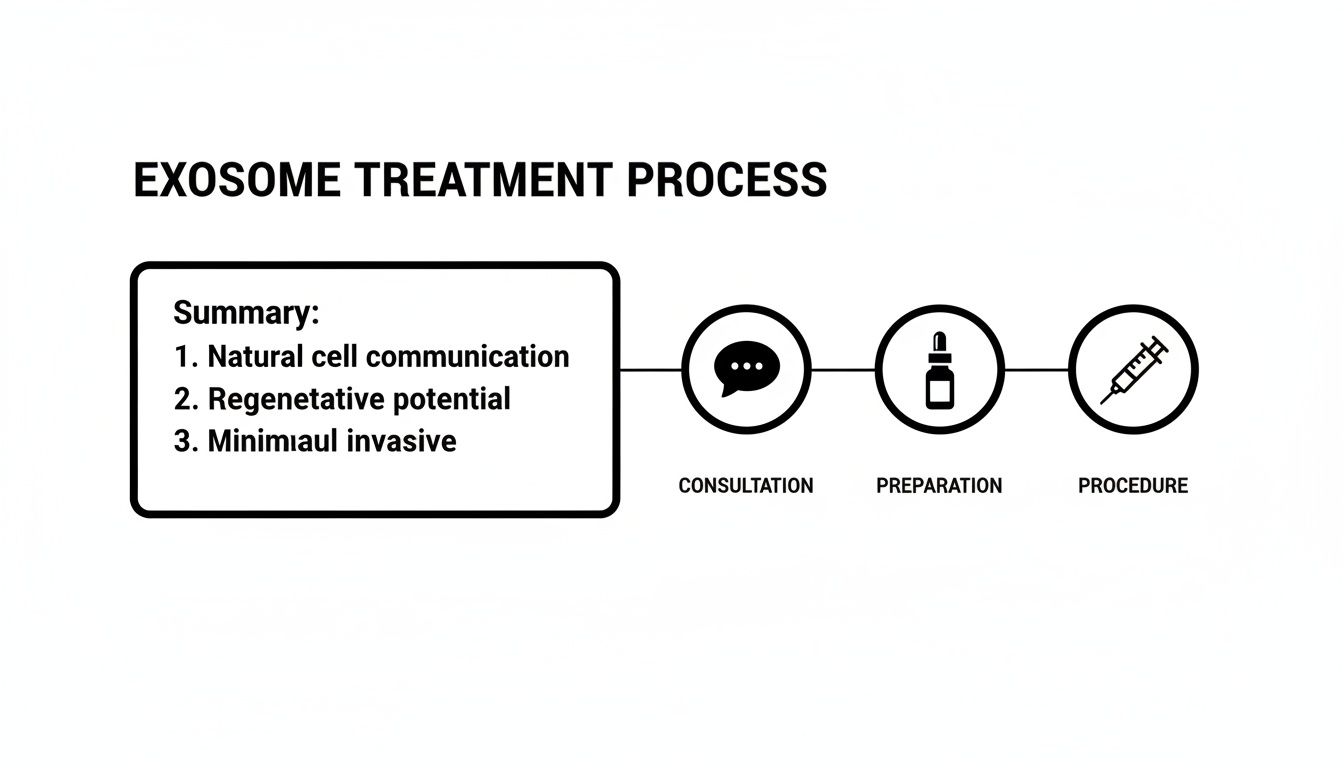
As you can see, the whole process is incredibly straightforward—from the initial chat with your clinician to the quick application, all without the need for a blood draw.
To make the comparison even clearer, here's a simple table breaking down the key differences between the two treatments.
Exosome Therapy vs PRP At a Glance
| Feature | Exosome Therapy | Platelet-Rich Plasma (PRP) |
|---|---|---|
| Source | Lab-derived from mesenchymal stem cells | Patient's own blood |
| Active Components | Billions of exosomes with growth factors & mRNA | Platelets and growth factors from your plasma |
| Consistency | Standardized, high-potency dose | Varies based on individual health and platelet count |
| Blood Draw | None required | Yes, a blood draw is the first step |
| Typical Protocol | Often a single treatment session | Series of 3-4 initial sessions, plus maintenance |
| Potency | Very high concentration of signaling molecules | Moderate, limited by your body's own supply |
| Convenience | Faster "off-the-shelf" procedure | Longer procedure due to blood processing time |
| Upfront Cost | Higher per session | Lower per session |
This table gives you a quick snapshot, but the best choice really depends on your specific situation and what you're looking for in a treatment.
Comparing Convenience and Cost
Beyond the science, practical things like convenience and cost matter. This is another area where the two treatments have some key differences.
-
Convenience: Exosome therapy has a clear edge here. Because the product is ready to go, there’s no blood draw. This saves time and makes the entire experience much more comfortable, especially if you’re not a fan of needles.
-
Number of Sessions: A typical PRP protocol involves a series of initial treatments—often 3 to 4 sessions spaced a month apart—followed by maintenance treatments every 6 to 12 months. In contrast, exosome therapy is usually done as a single session, with results that can last a year or even longer before you might need a touch-up.
-
Cost: The price tag reflects the technology and treatment schedule. A single exosome session costs more upfront than a single PRP session. But when you add up the cost of the multiple sessions needed for a full PRP course, the long-term investment can start to look much more similar.
Ultimately, the choice comes down to your priorities. Are you looking for the most advanced, potent option and value the convenience of a single treatment? Or do you prefer a more established method that uses your body’s own natural resources? Understanding these differences is the first step. For a more detailed look at PRP, you can explore this guide explaining what is PRP therapy.
What to Expect: Results Timeline and Safety

If you're considering a new approach to hair loss, two big questions probably come to mind: "When will I actually see a difference?" and "Is this safe?" Getting straight answers about the timeline and safety of exosome therapy for hair loss is crucial for setting the right expectations and feeling confident about your decision.
This isn't a quick fix like a new haircut; it's a biological process. Exosome therapy is all about nudging your natural hair growth cycles back into action, and that takes time. So, patience is part of the process, as the results build up gradually over several months.
The Typical Results Timeline
Most guys start to see the first signs of progress within a couple of months. The journey usually happens in phases, starting with subtle improvements under the surface before the more visible growth kicks in.
The very first sign that things are working is often a reduction in hair shedding. Within 2 to 3 months, many men notice less hair in the shower drain or on their brush. This is a great indicator that the exosomes are fortifying existing follicles and helping them hold onto hair more effectively.
After that, the focus shifts to quality. You'll likely notice your existing hair feels a bit thicker and looks healthier. It's a clear signal that your follicles are getting the support they need to produce stronger, more robust strands of hair.
The most exciting results—where you can see a real improvement in hair density and coverage—usually show up between 4 to 6 months. This is the sweet spot where dormant follicles have had enough time to wake up, re-enter the growth phase, and start producing new hair.
Keep in mind, these are just general timelines. Your individual results can be influenced by factors like the extent of your hair loss, your age, and your overall health. For a point of comparison, check out the PRP hair treatment timeline, which operates on a similar, biologically-driven schedule.
Unpacking the Safety of Exosome Therapy
It's completely natural to want to know that any treatment you're considering is safe. The good news is that exosome therapy has a very strong safety profile, mainly because it's a cell-free treatment. You're not getting whole cells, just their powerful signaling vesicles, which are purified and meticulously screened in a lab to minimize risk.
The most common side effects are mild, temporary, and directly related to the injections, not the exosomes themselves.
- Minor Discomfort: You might feel some tenderness, slight swelling, or see a bit of redness where the injections were made.
- Temporary Sensitivity: It's normal for your scalp to feel a little sensitive for a day or two afterward.
- Minimal Bruising: In some cases, a small bruise can form at an injection site.
These effects almost always clear up on their own within 24 to 48 hours. There’s essentially no downtime, and you can jump right back into your daily routine. Your clinician might just suggest holding off on a strenuous workout or harsh hair products for a day.
A Note on the Regulatory Landscape
It’s also important to understand the current regulatory status of this treatment. Because exosome therapy is a relatively new frontier in regenerative medicine, it has not yet been formally approved by the FDA specifically for hair loss. This doesn't mean it's unsafe, but it does highlight that results can vary and there isn't one universal standard that all clinics must follow.
This is precisely why choosing a reputable, experienced provider is non-negotiable. A top-tier clinician will only use high-quality, ethically sourced exosomes and will be completely transparent about the treatment's status and what you can realistically achieve. Your choice of clinic is the single most important factor in ensuring a safe procedure and a positive outcome.
Are You a Good Candidate for Exosome Therapy?
Deciding on any new treatment is a big deal, and it's smart to figure out if exosome therapy for hair loss is actually the right move for you. This isn’t a magic bullet for everyone; its success really comes down to the current condition of your hair follicles. The key is catching things before it's too late.
The ideal candidate is usually a man in the early to middle stages of androgenetic alopecia (what we all know as male pattern baldness). At this point, your hair follicles have probably weakened and shrunk—a process called miniaturization—but the most important thing is that they're still alive. Think of them as being dormant, not dead. Exosome therapy needs something to work with, and its whole job is to deliver those regenerative signals to follicles that are just waiting to be woken up.
But, if an area of your scalp has been completely smooth and bald for years, the follicles there have likely shut down for good. In that scenario, exosome therapy won’t do much, because there’s simply nothing left to revive.
Who Sees the Best Results?
So, how do you know if you're a strong candidate? A few key signs can point you in the right direction and help you have a better chat with a specialist.
You're likely a good fit if you:
- Have noticeable thinning but not total baldness. You've seen your hair density drop, but there’s still hair covering the thinning spots.
- Are in the early stages of hair loss. Tackling male pattern baldness early on (think Norwood stages 2-4) gives exosomes the best possible chance to strengthen the follicles you still have.
- Are in good overall health. Your body's response to regenerative treatments is always better when you're healthy.
- Have realistic expectations. You get that the goal is a real improvement in hair thickness and health, not a brand-new head of hair overnight.
The whole point of exosome therapy is to reactivate and strengthen struggling hair follicles. If your follicles are still there—even if they're just producing fine, wispy hairs—you are in a perfect position to benefit from this treatment.
For any guy looking into hair loss solutions, it's also a good idea to understand what's driving it. For example, understanding male hormone levels with a simple blood test can give you and your doctor a clearer picture of whether this therapy is the best approach for you.
When to Consider Other Options
On the flip side, there are times when another route might make more sense. You're probably not the best candidate for exosomes if you have widespread, long-term baldness where the follicles are no longer viable. For these more advanced cases, a hair transplant could be a much more effective way to get back that coverage.
Figuring all this out begins with a professional consultation. A specialist can get a close look at your scalp, often using specific tools to check on follicle health. To get a better idea of what they're looking for, you can learn more about how a hair density test is done. Knowing where you truly stand is the first step toward choosing a treatment that will actually deliver the results you want.
Your Questions About Exosome Hair Therapy, Answered
Alright, you've learned a lot about what exosome therapy is and how it works. But now it's time for the practical stuff—the questions every guy has before deciding if this is the right move. Let's get straight to the point and tackle the most common concerns.
Think of this as the final briefing before you talk to a specialist.
How Much Does Exosome Therapy for Hair Loss Typically Cost?
Let's talk about the investment. The price tag for exosome hair therapy isn't one-size-fits-all; it generally lands somewhere between $3,000 and $8,000 for a single session. Why the wide range? It really comes down to where you live, the reputation of the clinic, and, most importantly, the quality and concentration of the exosome product they're using.
Keep in mind, this might not be a one-time expense. While a single session can produce incredible results, your doctor might suggest a follow-up or a yearly touch-up to maintain that progress and keep your hair follicles firing on all cylinders.
How Long Do the Results of Exosome Hair Therapy Last?
This is the million-dollar question, isn't it? The results from exosome therapy are impressive and stick around for a good while, but they aren't permanent. We have to remember that male pattern baldness is a progressive condition.
Most men see the benefits—less shedding, thicker strands, and better overall density—for 12 to 24 months. After that, a single maintenance treatment is usually all you need to keep those follicles awake and protect your investment. The best way to look at it is as a powerful management strategy for your hair, not a one-and-done cure.
Think of it like this: the initial treatment is a major reset for your hair follicles, and a maintenance session is the annual tune-up that keeps the engine running smoothly.
Is the Exosome Treatment Painful and What Is the Downtime?
We get it—no one likes pain. The procedure itself involves a series of tiny injections across the scalp, so you’ll feel some minor pricks. But don't worry, any good clinic will apply a potent topical numbing cream about 30-45 minutes before they start, which makes the whole thing very tolerable.
And the best part? There’s virtually no downtime. You can walk out of the clinic and get right back to your day. The only real post-treatment rule is to skip the gym, pools, and harsh hair products for the first 24 hours. This just gives your scalp a little time to calm down.
What Should I Ask My Doctor Before Getting This Treatment?
Going into a consultation armed with the right questions is the key to getting great results. You're not just a patient; you're hiring a specialist for an important job.
Here are a few non-negotiable questions to ask any provider you're considering:
- Where do your exosomes come from? Ask about the source (like MSCs) and the concentration of the product.
- Can I see your results? Request before-and-after photos of their actual patients treated for hair loss.
- What's your track record? Ask about their specific experience treating male pattern baldness with exosomes.
- What's the total cost? Get a clear breakdown, including any potential follow-up treatments.
Asking these direct questions will help you find a skilled provider and feel completely confident in your decision.
At PRP For HairLoss, we believe clear, honest information is the most important tool you have. We're committed to giving men the resources they need to understand every option on their hair restoration journey. To continue your research, visit our homepage at https://prpforhairloss.com.
 PRP For Hairloss
Leave a comment