Find yourself staring in the mirror, wondering what’s going on up top? Before you can tackle hair loss, you have to get a handle on where it all starts: your body’s natural hair growth cycle.
It’s a constant, repeating rhythm where individual hairs grow, rest, and eventually fall out, making way for new ones. The good news? Not all your hairs are on the same schedule, which is a very good thing.
Your Quick Guide to the Hair Growth Cycle

I like to think of the scalp as a garden. You've got somewhere between 100,000 to 150,000 follicles, each one like a tiny seedbed responsible for growing a single hair. And just like any plant, that hair goes through a predictable lifecycle—it sprouts, it grows, it matures, and then it’s gone.
That whole process is what we call the hair growth cycle. It's not one long, continuous growth spurt. It's actually a series of four distinct phases, and every single hair on your head is in one of them right now. This is a huge advantage, as it means you don't lose all your hair at once. While some follicles are shedding old hairs, thousands of others are busy growing new ones.
Why Understanding the Cycle Matters
Getting a handle on this is the first real step in making sense of hair loss. When you start to notice thinning, it's usually because something has thrown this delicate, natural rhythm out of whack. The cycle can get stuck, with some phases shortening and others lasting way too long, which ultimately leads to weaker, finer hair and less coverage.
Here's the key takeaway: Shedding is a normal, essential part of the hair growth cycle. In fact, losing up to 100 hairs per day is completely standard. The problem starts when that cycle gets disrupted and the hair growing back isn't as healthy as the one it replaced.
This is the foundational knowledge you need before we dig into how something like male pattern baldness hijacks the system. Once they understand the basics, a lot of guys want to know what they can do to support this natural process. For those looking into lifestyle changes, ArtNaturals has a great guide on how to grow hair faster naturally.
It's also really helpful to know what healthy regrowth looks and feels like before you start any treatment. We put together a resource on the early signs hair is growing to help you monitor your progress.
With that, let’s break down each phase of the cycle.
The Four Phases of Hair Growth at a Glance
To make this easier to visualize, here's a quick cheat sheet summarizing what's happening on your scalp at any given moment.
| Phase Name | What Happens | Typical Duration |
|---|---|---|
| Anagen | The "growth" phase; hair is actively growing. | 2–7 years |
| Catagen | The "transition" phase; growth stops, follicle shrinks. | 2–3 weeks |
| Telogen | The "resting" phase; old hair sits in the follicle. | Around 3 months |
| Exogen | The "shedding" phase; old hair falls out. | 2–5 months |
This table gives you the big picture, but the real story is in the details of each phase—and how they can be manipulated by genetics and treatments.
The Anagen Phase: Your Hair's Growth Engine
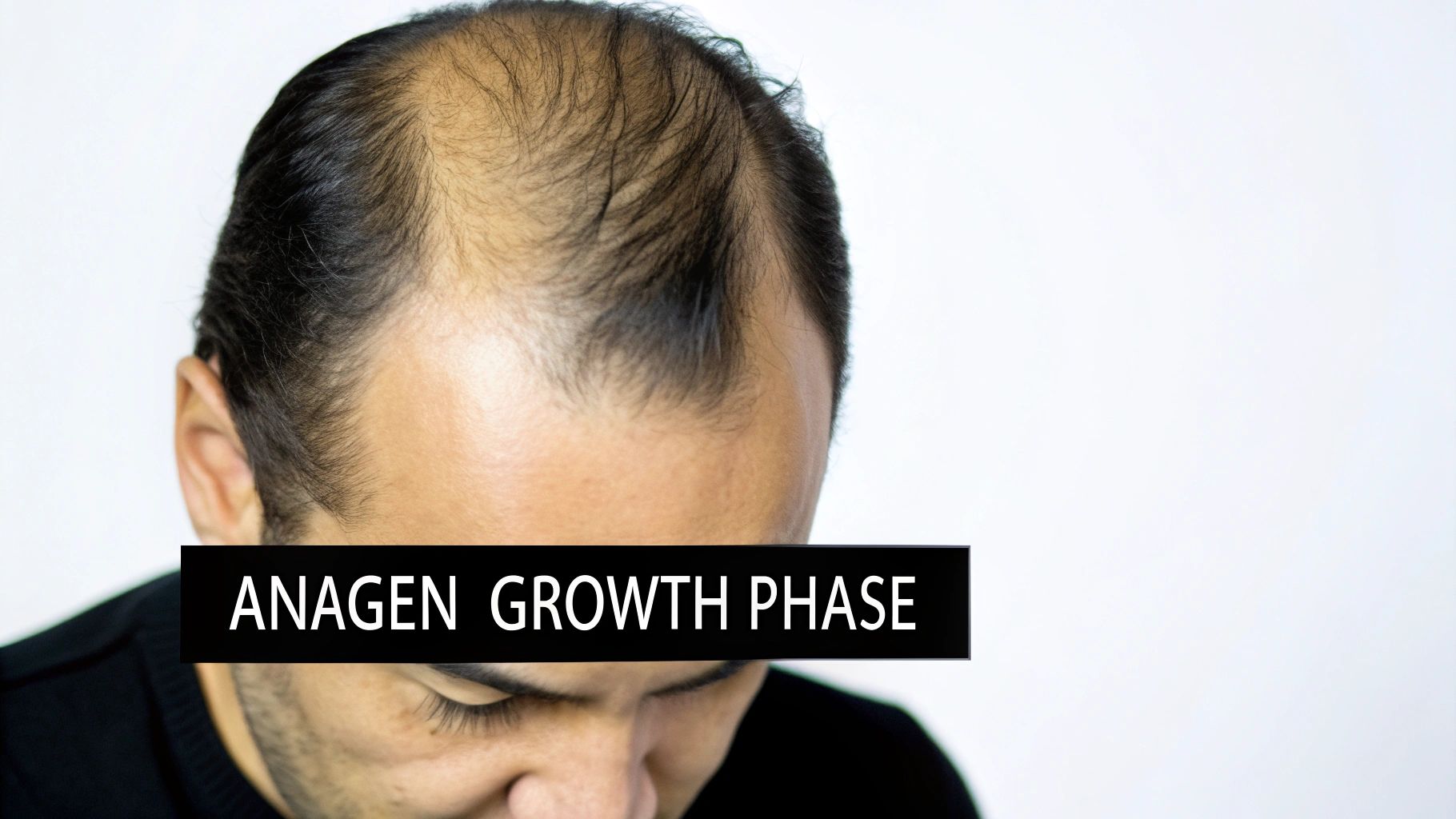
If you're dealing with thinning hair, the anagen phase is the one you really need to understand. Think of it as the powerhouse of your entire hair growth cycle. This is the active, productive stage where your hair follicles are working around the clock, building new hair fiber and pushing it longer day by day.
Unlike the other, much shorter phases, a healthy anagen phase can last for years. In fact, its duration is the single most important factor determining how long your hair can actually grow. A long, robust anagen phase means longer, healthier hair. It’s as simple as that.
How the Follicle Factory Works
To get what’s happening, picture each hair follicle as a tiny, high-tech factory. Deep down at the base of this factory is the dermal papilla, which is hooked up to a network of tiny blood vessels. This connection is the follicle's lifeline, delivering a constant stream of oxygen and nutrients.
During the anagen phase, cells in the hair bulb divide like crazy to form the hair shaft itself. This process burns a ton of energy, which is why proper nutrition and good blood flow are so critical. The follicle keeps churning out new hair cells, stacking them on top of one another and pushing the strand up and out through the scalp.
At any given time, about 85-90% of your scalp hairs are in this active growth stage, chugging along at a rate of roughly 1 cm per month. For scalp hair, this phase can last anywhere from 2 to 7 years.
The Anagen Phase and Male Pattern Baldness
This brings us to the main event for men experiencing hair loss: the battle for the anagen phase. Male pattern baldness, or androgenetic alopecia, is a direct assault on this crucial growth period. The primary culprit is a hormone called dihydrotestosterone, or DHT.
In men with a genetic sensitivity to it, DHT latches onto receptors in the hair follicles. This sends a disruptive signal that throws the whole growth cycle out of whack.
The most destructive effect of DHT is that it progressively shortens the anagen phase. With each new cycle, the growth period gets shorter, while the resting period (telogen phase) gets longer.
This process, known as miniaturization, is the real reason behind thinning hair and receding hairlines. The hair that eventually grows back is weaker, finer, and less pigmented than the one it replaced. Over time, the anagen phase becomes so short that the new hair barely breaks the surface of the scalp—if it grows at all. This is precisely why understanding and protecting the anagen phase is so critical. For a deeper dive into this vital stage, you can explore our complete guide on the anagen phase of hair growth.
Why a Longer Anagen Phase Matters
Simply put, a longer anagen phase equals a healthier, fuller head of hair. It means your follicles are spending more time actively producing strong hair and less time resting or shedding.
Here’s why it’s so important:
- More Hair Length: The longer this phase lasts, the longer your hair can grow before it sheds. It's the reason scalp hair can get so much longer than your eyebrows, which have a very short anagen phase.
- Greater Hair Density: When more of your follicles are in the anagen phase at once, your scalp just looks fuller. A shortened cycle means more follicles are dormant at any given time, which leads to that see-through, thinning look.
- Stronger, Thicker Hair: A well-nourished follicle in a long anagen phase produces a thicker, more resilient hair strand that doesn't break as easily.
Ultimately, the fight against male pattern baldness is a fight to preserve and extend the anagen phase. Every effective treatment, from medications to therapies like PRP, is aimed at keeping this hair-producing engine running strong for as long as possible.
Winding Down: The Catagen and Telogen Phases
After the long, productive marathon of the anagen phase, your hair follicles need to catch their breath. This is where the next two stages come in, acting as a cool-down period before the whole cycle kicks off again. They might not be as dramatic as the growth phase, but these stages are absolutely essential for a healthy rhythm.
First up is catagen. Think of this as a brief, transitional shutdown. The follicle, which was a bustling factory just moments ago, starts winding down operations.
This entire stage is remarkably quick, lasting only about two to three weeks. During this time, the hair follicle shrinks and detaches from the dermal papilla—its blood supply and nutrient source. Growth grinds to a halt as the follicle prepares to rest. At any given moment, only about 3% of your scalp hairs are in this state.
Telogen: The Resting Period
Following catagen's quick transition, the hair enters the telogen phase. This is the official "resting" stage of the hair growth cycle. The hair strand isn't growing anymore, but it's not quite ready to fall out either.
Imagine a tree in winter. It's not actively sprouting new leaves, but it’s not dead—it's just dormant, conserving energy for spring. A hair in the telogen phase is a lot like that. It just sits quietly in the follicle for about three months, waiting for its turn to be shed.
On a healthy scalp, about 10-15% of hairs are in the telogen phase at any given time. This is a perfectly normal and necessary part of the cycle, ensuring a constant rotation of hair without any noticeable thinning.
These are the hairs you find on your brush, in the shower drain, or on your pillow. Seeing them isn't a sign of a problem; it's proof the cycle is working correctly. That old, resting hair is simply making way for a new anagen hair that’s already starting to grow beneath it.
What Happens When Shedding Increases?
The actual shedding part, sometimes called the exogen phase, is when the new anagen hair physically pushes the old telogen hair out of the follicle. It’s the final step that completes the loop, allowing a fresh, healthy strand to take its place.
Sometimes, though, a major shock to your system—like intense stress, an illness, or a big nutritional gap—can shove a huge number of hairs into the telogen phase all at once. This leads to a condition known as Telogen Effluvium, where you'll notice a sudden, dramatic increase in shedding a few months after the trigger event. It’s different from genetic male pattern baldness, and knowing which is which is crucial for a proper diagnosis. You can dive deeper into our comparison of Telogen Effluvium vs. male pattern baldness.
For men with androgenetic alopecia, the problem isn't a sudden shock but a slow, gradual shift. The telogen phase starts to last longer while the anagen (growth) phase gets shorter. This slowly tilts the balance toward more resting hairs and fewer growing ones. Over time, this disruption is what creates the appearance of thinning, as the natural rhythm of your hair cycle is thrown off balance.
How Male Pattern Baldness Hijacks the Hair Cycle
So far, we’ve looked at the hair growth cycle as a predictable, well-oiled machine. But what happens when someone throws a wrench in the gears? For millions of men, that wrench is male pattern baldness, and it doesn't just make hair fall out—it systematically corrupts the entire cycle from the inside.
This isn’t about a sudden increase in shedding. Male pattern baldness, known clinically as androgenetic alopecia, is more like a slow-motion hostile takeover of your hair follicles. The root of the problem is a genetic sensitivity to a potent hormone called dihydrotestosterone (DHT). While DHT is a normal part of being a man, the follicles on the scalp, crown, and temples of genetically predisposed men react badly to it.
The Miniaturization Process Explained
When DHT latches onto receptors in these sensitive follicles, it kicks off a destructive process called miniaturization. This is the core mechanism behind male pattern baldness, and it’s a direct assault on the hair growth cycle. Specifically, DHT declares war on the all-important anagen (growth) phase.
With every new cycle, DHT signaling forces the anagen phase to get shorter and shorter. At the same time, it often makes the telogen (resting) phase last longer. The result is a disastrous shift in your hair's natural rhythm. Your follicles start spending less time actively growing hair and more time just sitting idle.
Think of it like a rechargeable battery that starts losing its ability to hold a full charge. Each time you plug it in, its maximum capacity gets a little weaker. That’s exactly what DHT does to your hair follicles—every new growth cycle leaves them weaker and less able to produce a healthy, robust hair.
This gradual weakening means the hair that does manage to grow back is just a shadow of its former self. It comes in shorter, finer, and with less pigment. Over time, a strong, healthy terminal hair gets replaced by a soft, wispy vellus hair, the kind you might call "peach fuzz." If the process isn't stopped, the follicle might eventually give up and shut down for good.
This is where the cycle gets thrown completely out of whack.
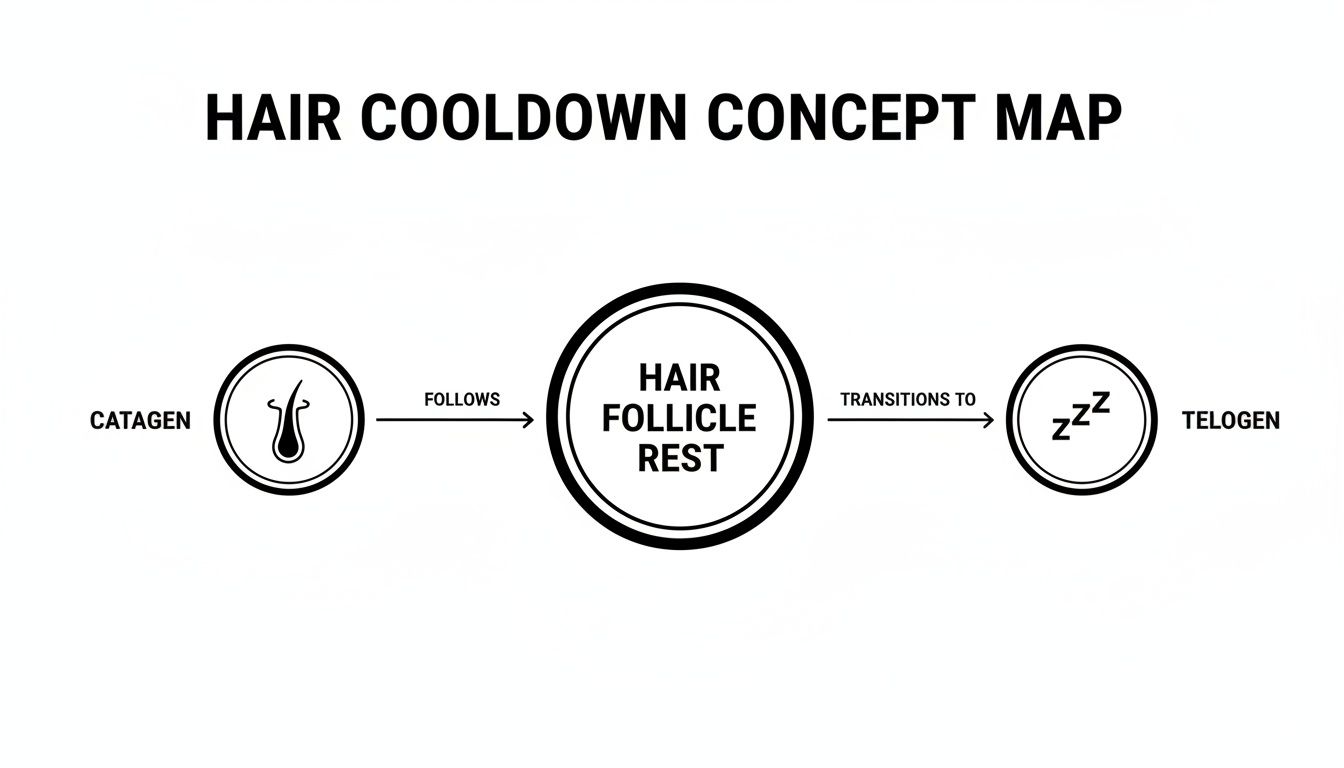
As DHT cuts the growth phase short, the follicle spends way too much time transitioning (catagen) and resting (telogen), fast-tracking its journey toward dormancy.
The Visible Signs of a Hijacked Cycle
You won't feel this complex biological process happening, but you’ll definitely see its effects in the mirror. Because miniaturization is so gradual, male pattern baldness shows up as slow, progressive thinning rather than a sudden loss of hair.
Here are the classic signs that your hair growth cycle is being disrupted:
- A Receding Hairline: The follicles at the temples are usually the first to go, leading to that telltale "M" shape.
- Thinning at the Crown: The vertex, or the back of your head, is another hotspot where miniaturization often starts, creating a noticeable bald spot.
- Reduced Density: Your hair might start looking "see-through," especially in bright light. This happens as more follicles produce weaker hairs or just stay in that prolonged resting state.
- A Widening Part: For guys with longer hair, one of the first clues can be a part line that looks wider than it used to.
Every one of these signs is a direct result of the anagen phase being cut short, cycle after cycle. The real problem with what is androgenetic alopecia isn't that hairs are simply falling out—it's that the hairs growing back are fundamentally weaker.
Why Time Is a Critical Factor
Because miniaturization is a progressive decline, the sooner you address it, the better your chances are of slowing or even reversing the damage. It’s far more difficult to reactivate a follicle that's been dormant for years than it is to help one that’s only recently started producing weaker hairs.
Ultimately, the fight against male pattern baldness is a fight to protect the anagen phase. Effective treatments work by either blocking DHT's effects or by giving the follicle the biological reinforcement it needs to push back against miniaturization. By intervening, you can help extend that crucial growth phase, giving follicles a chance to produce thicker, stronger hair again and restoring a healthier balance to your hair's life cycle.
Using PRP to Reboot Your Hair Growth Cycle
Watching male pattern baldness hijack your natural hair growth cycle can be frustrating. It’s a slow, methodical takeover. But here's the good news: understanding the problem is the first step toward a real solution—one that actually works with your body to reclaim control. This is exactly where Platelet-Rich Plasma (PRP) therapy enters the picture.
PRP isn’t a synthetic drug or a harsh chemical. It’s a regenerative treatment that taps into the concentrated healing power already inside your own blood. The process itself is surprisingly simple. We draw a small amount of your blood, place it in a centrifuge, and spin it down to isolate a golden liquid packed with platelets.
This is the PRP, and it’s loaded with powerful proteins called growth factors. Think of these growth factors as a special ops team sent in to repair and rebuild. They are your body's own first responders for regeneration.
A Wake-Up Call for Your Follicles
When we inject this concentrated PRP into the areas of your scalp where hair is thinning, we're delivering a potent dose of those growth factors right to the root of the problem. It’s a biological wake-up call for your dormant or struggling hair follicles.
For follicles that have been weakened by DHT and are stuck in a short, unproductive growth phase, this infusion gives them the backup they desperately need. The goal is to break the cycle of miniaturization and nudge those follicles back into a longer, healthier anagen (growth) phase.
By nourishing the scalp and kickstarting cellular activity, PRP therapy essentially tells your follicles, "It's time to get back to work." It doesn't create new follicles from scratch, but it reinforces the ones you still have, helping them regain their strength.
This targeted support helps push back against the damaging effects of DHT. It gives your hair a real fighting chance to grow back thicker, stronger, and healthier over time. You can get a deeper look into the science behind this by exploring our guide on how does PRP for hair loss work.
How PRP Influences the Hair Cycle
PRP therapy works by directly influencing the cells that control the hair growth cycle. Introducing this concentration of growth factors to the scalp can trigger several key changes:
- Extending the Anagen Phase: This is the primary goal. The growth factors stimulate the cells in the hair bulb, encouraging them to stay in the active growth stage longer. The result is longer, more substantial hair strands.
- Boosting Blood Flow: PRP can promote the formation of new blood vessels around the hair follicles, a process called angiogenesis. Better circulation means more oxygen and more nutrients—the essential fuel for producing healthy hair.
- Calming Inflammation: Androgenetic alopecia often involves low-grade inflammation around the follicles. The natural healing properties in PRP help calm this irritation, creating a much better environment for hair to grow.
Essentially, PRP therapy helps restore balance. It provides your body with the biological tools it needs to shift the cycle away from a prolonged resting phase and back toward a productive, robust growth phase.
Beyond PRP Emerging Therapies
Regenerative medicine is always moving forward. Beyond the established PRP methods, researchers are exploring other cutting-edge therapies that use advanced peptide blends. For instance, some new approaches focus on combinations like the Glow Peptide, which includes compounds known for their potential to support cellular repair and growth.
Ultimately, the strategy is the same, whether it's through the proven science of PRP or emerging peptide research. The goal is to reboot the hair growth cycle by delivering targeted, biological support directly where it's needed most. This approach helps you work in harmony with your body’s own systems to promote stronger, healthier hair.
Your Hair Growth Cycle Questions, Answered
It's easy to get lost in the science of hair growth, especially when you're trying to figure out what's going on with your own hair. We've covered a lot, but you probably still have some specific questions. This is where we tackle the common things men ask about their hair and its natural lifecycle.
Let's clear things up so you have a solid understanding and can move forward with confidence.
Can I Make My Anagen Phase Longer Naturally?
Genetics largely dictates the maximum length of your anagen (growth) phase, but your lifestyle habits can absolutely help you reach that full potential. Think of it like giving your body the best raw materials to build with. A solid diet packed with protein, vitamins (especially Biotin), and minerals like iron and zinc is non-negotiable for creating strong hair.
Stress management is another big one. High cortisol levels can prematurely shove hair follicles out of the growth phase and into the shedding phase. Things like scalp massages can help with blood flow, but they're more supportive than transformative. For male pattern baldness, where hormones are actively shortening the anagen phase, lifestyle tweaks alone usually aren't enough. They're best used to support a targeted treatment plan that gets to the root of the problem.
How Do I Know If My Hair Shedding Is Normal?
Losing 50 to 100 hairs a day is completely normal. Most of the time, you won't even notice it—you'll just find a few strands in your brush or the shower drain. This is just part of a healthy cycle where old hairs make way for new ones.
The time to pay attention is when that shedding ramps up, or when the hair that grows back seems thinner and wispier. For men, the classic signs of a cycle gone wrong include:
- A receding hairline: That "M" shape starting to creep back at your temples.
- Thinning at the crown: The classic bald spot appearing at the back of your head.
- A widening part: More scalp showing through your hair than there used to be.
If you can pull your hands through your hair and consistently come away with a small clump instead of just a strand or two, that’s a clear signal something is off. It’s the perfect time to start looking into what's really going on.
How Does the Hair Growth Cycle Change with Age?
Getting older affects the hair cycle, even for men who aren't experiencing male pattern baldness. It's a natural part of the aging process. The anagen phase tends to get a bit shorter, which means your hair might not grow as long as it did when you were younger.
On top of that, some follicles just decide to retire over time and stop producing hair altogether, leading to a general, subtle decrease in density. The hair that does grow can also become finer and lose its pigment, turning grey. These age-related shifts are different from the aggressive follicle-shrinking caused by DHT, but they can certainly add to the problem, making genetic hair loss look more pronounced. Knowing the difference helps you understand what's just aging and what's a treatable condition.
Understanding the "why" behind your hair loss is the first real step toward taking back control. At PRP For HairLoss, we know that educated patients get the best results. Take a look through our resources to see how treatments like PRP can help bring your hair growth cycle back into balance for healthier, fuller-looking hair.
Ready to learn more? Visit us at https://prpforhairloss.com to continue your journey.
 PRP For Hairloss
Leave a comment