When people ask me, "Is PRP for hair loss FDA-approved?" the answer isn't a simple yes or no. It's a bit more complicated than that.
The short answer is that the specific procedure of using platelet-rich plasma (PRP) for hair restoration is not FDA-approved. However, the medical devices used to prepare your PRP often are FDA-cleared, and understanding that difference is absolutely crucial.
Unpacking PRP's Relationship with the FDA
If you're looking into Platelet-Rich Plasma (PRP) to combat hair loss, one of the first things you'll bump into is its regulatory status. It can feel like alphabet soup with all the different terms, but once you break it down, the FDA's role in PRP is pretty straightforward.
Think of it like this: the FDA's main job is to ensure medical products are safe and effective. When it comes to PRP, they aren't regulating the actual medical procedure—the part where a skilled practitioner injects your own processed plasma back into your scalp. Instead, their oversight focuses squarely on the equipment used to create the PRP.
The All-Important Difference: FDA Clearance vs. Approval
This is probably the single most important concept to get your head around. "FDA-cleared" and "FDA-approved" sound almost the same, but in the world of medical regulations, they are miles apart.
FDA Approval: This is the gold standard, a grueling and lengthy process reserved for high-risk medical devices and new drugs. To earn "approval," a product has to go through extensive clinical trials to prove it's both safe and effective for one very specific purpose. Think of a new heart medication—that definitely needs formal approval.
FDA Clearance: This is a much more common pathway, known as the 510(k) pathway, for low-to-moderate risk medical devices. A device gets "cleared" when its manufacturer can demonstrate it is "substantially equivalent" to a device that’s already legally on the market. It’s essentially the FDA saying, "This new machine is safe and works just like this other machine we already know about."
This is where PRP fits in. Most of the centrifuges and special kits used to separate platelets from your blood have been FDA-cleared. The FDA has given the equipment a thumbs-up for being safe and doing its basic job.
Here's the takeaway: While the machine gets a green light, the FDA hasn't formally evaluated or approved the act of using that machine's output to treat hair loss. This is what's known as "off-label" use.
Using a drug or device "off-label" is incredibly common and perfectly legal in medicine. It simply means a doctor is using their professional judgment to apply a safe, cleared tool for a purpose other than what it was originally cleared for.
This table breaks down the key regulatory terms and how they apply to PRP therapy, giving you a quick, digestible summary of the core concepts.
FDA Regulation at a Glance
| Regulatory Status | What It Means for You | How It Applies to PRP |
|---|---|---|
| FDA-Approved | The product has passed rigorous clinical trials for a specific use, proving both safety and effectiveness. | The procedure of using PRP for hair loss is NOT FDA-approved. |
| FDA-Cleared | A medical device has been shown to be "substantially equivalent" to an existing, legally marketed device. It focuses on device safety and function, not its use in a specific procedure. | The centrifuges and kits used to prepare PRP are typically FDA-cleared as safe medical devices. |
| Off-Label Use | A medical professional uses an approved or cleared drug/device for a purpose not explicitly stated on its FDA label. This is a common and legal practice. | Since the PRP procedure isn't approved but the devices are cleared, using PRP for hair loss falls into the category of off-label use. |
This regulatory status puts PRP in a unique position: it's a legally permissible treatment that relies on cleared technology, but it doesn't have the formal "approved" stamp for hair loss specifically.
For anyone weighing their options, it’s always a good idea to compare this with other officially FDA-approved hair loss treatments to make a fully informed decision.
How the FDA Regulates Medical Treatments
To really get why PRP for hair loss has such a unique regulatory status, we need to pull back the curtain on how the Food and Drug Administration (FDA) actually works. The agency's core mission is to protect public health by ensuring that medical treatments, devices, and drugs are both safe for patients and effective for their intended use.
But this isn't just a simple "approved" or "not approved" stamp. The FDA uses several different pathways for overseeing everything from a new heart medication to the centrifuge spinning in your doctor's office. Think of it like different security levels at an airport—the level of scrutiny depends entirely on the potential risk.
The Main Regulatory Pathways Explained
Most medical products travel down one of a few key routes in the FDA system. Each path involves a different level of review, which is dictated by how new the technology is and the risk it might pose to you. Getting a handle on these pathways is the key to understanding why PRP for hair loss exists in a bit of a gray area.
Here are the most common statuses you’ll hear about:
FDA Approval: This is the big one. It's the most rigorous review process, reserved for high-risk products like brand-new drugs or life-sustaining medical implants. A product must go through extensive clinical trials to prove it's both safe and effective for a very specific purpose. Think of it like having a book verified, word by word, before it can ever hit the shelves.
FDA Clearance (510(k) Pathway): This is a much more common path for medical devices that pose a low-to-moderate risk. Instead of proving effectiveness from scratch, a manufacturer just needs to show their device is "substantially equivalent" to one that’s already legally on the market. It’s less about reinventing the wheel and more about proving your new toaster works just as safely as the ones already in stores.
The crucial takeaway is this: Approval is about validating a product for a specific use, while Clearance is mostly about confirming the device itself is safe and functions as expected. This distinction is at the heart of the "is PRP FDA approved" question.
Because PRP therapy uses a patient's own blood—what's called an autologous product—it doesn't fit neatly into the typical drug or device box. To get the full picture of this complex world, it's worth reading a comprehensive guide on the FDA approval process for medical devices. This context helps explain why the equipment used for your treatment has a different regulatory journey than the procedure itself.
And if you're just starting out, getting a solid foundation on the treatment is a great first step. You can learn more about how platelet-rich plasma therapy for hair is explained here.
Understanding Device Clearance vs. Procedure Approval
This is where things get a bit confusing for most people, but it’s the most important piece of the puzzle. Grasping the difference between the FDA giving a thumbs-up to a device versus endorsing a specific medical procedure is key.
The FDA gives a 'clearance' to many of the medical tools used to prepare PRP. We're talking about the centrifuges that spin your blood and the special kits used to separate the platelets. This clearance simply means the agency agrees the equipment is safe and works as intended because it's "substantially equivalent" to other devices already legally on the market.
But here’s the critical part: that clearance does not mean the FDA has 'approved' the act of injecting PRP to treat hair loss. The FDA has not formally signed off on PRP as a hair loss treatment.
The Chef and The Knife Analogy
Let me break it down with an analogy. Think of a high-end, professional chef's knife. The FDA might clear that knife for sale, confirming it’s made from food-safe steel, is properly sharp, and does a great job of chopping vegetables. They're clearing the tool.
However, the FDA doesn't approve every single recipe a chef might create using that knife. The chef might use it to carve a Thanksgiving turkey, julienne carrots for a salad, or even craft an intricate ice sculpture.
- The Device (The Knife): The centrifuge used for PRP is like the chef's knife. It's an FDA-cleared tool.
- The Procedure (The Recipe): The specific act of injecting PRP for hair loss is like the chef's unique recipe. It’s an "off-label" use of that cleared tool.
This is a perfectly legal and extremely common practice across all fields of medicine. A trained doctor uses their clinical judgment and experience to apply a safe, cleared device for a purpose that wasn't part of its original FDA submission.
This flowchart gives you a great visual of how the FDA handles different medical products.
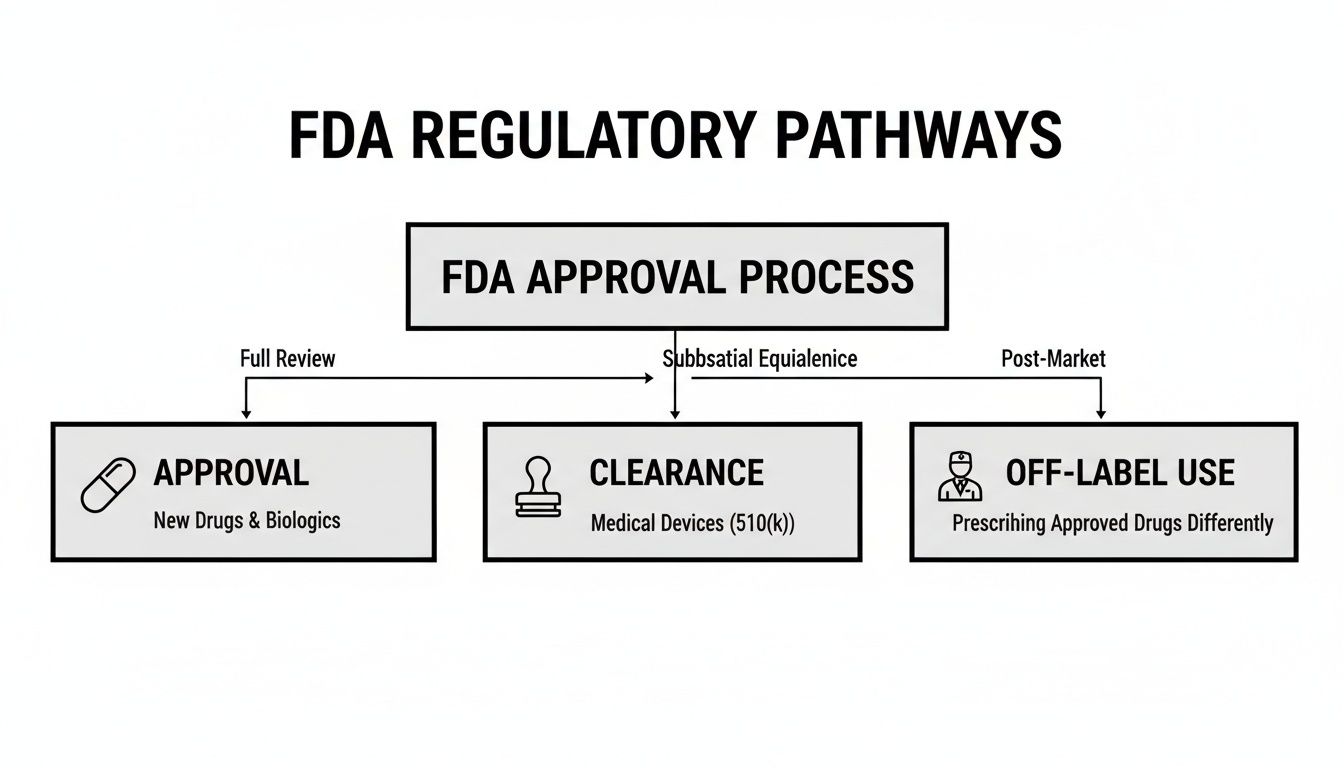
As you can see, drugs typically go through a demanding 'Approval' process. Many medical devices, on the other hand, just need 'Clearance,' which then allows skilled physicians to use them for 'Off-Label' applications based on their expertise.
Why This Distinction Matters to You
Understanding this difference completely changes the conversation you can have with a potential provider. You can move past the simple "is PRP FDA approved?" and start asking much smarter, more specific questions.
Here's the bottom line: A clinic that advertises "FDA-Cleared PRP" is telling the truth about their equipment. But if they claim their PRP hair loss treatment itself is "FDA-Approved," that's a major red flag and a sign you should be cautious.
This knowledge equips you to properly vet clinics. You need to know that the platelet-rich plasma preparation is being done with high-quality, legitimate equipment, because the device directly affects the quality of the PRP injected into your scalp. The goal is to confirm the tools are top-notch, even while understanding the procedure itself is an off-label application.
What Clinical Evidence Reveals About PRP for Hair Loss
Now that we’ve untangled the regulatory side of things, let’s get to the question that really matters: does PRP actually work for hair loss? While the FDA hasn't stamped its approval on the procedure itself, a growing mountain of scientific research and real-world clinical experience suggests it can be quite effective for the right person.
The evidence points to PRP helping slow down thinning, boost the thickness of existing hair, and even wake up dormant follicles to spur new growth. It's not a miracle cure, but dozens of studies have documented real, measurable improvements in both hair count and the diameter of the hair shaft. This is precisely why it’s become such a go-to treatment for androgenetic alopecia, often called male pattern baldness.
Of course, results aren't guaranteed. The success of PRP treatment really hinges on a few key factors.
Factors Influencing PRP Success
Not all PRP treatments are created equal, and the final outcome can swing wildly depending on how the procedure is performed. The quality of the PRP itself is probably the single most important piece of the puzzle. You need a high concentration of platelets to get a powerful release of growth factors—the very things that stimulate your hair follicles.
Three variables can truly make or break a treatment session:
- Platelet Concentration: The final PRP solution has to be potent. If the system used to prepare it is low-quality, you simply won't get the therapeutic dose of platelets needed to make a difference.
- Provider Protocol: The technique of the person doing the injections is huge. Their skill in managing the depth, spacing, and volume of each injection determines whether those growth factors actually get to where they need to go.
- Patient Selection: PRP works best for people in the earlier stages of hair loss. At that point, the follicles are often just dormant, not gone for good, which gives the treatment something to work with.
A critical factor in getting results is the platelet concentration. Recent analyses show that formulations with platelet counts exceeding 1 million per microliter are necessary to achieve positive outcomes.
Understanding the Clinical Data
So, what do the numbers actually tell us? The clinical evidence for PRP is pretty encouraging. Meta-analyses, which combine the results of multiple studies, show that well-chosen patients can see a meaningful improvement in 50-70% of cases. On top of that, it's exceptionally safe—serious complications happen in less than 0.1% of procedures.
This reinforces the idea that while it’s not a magic bullet, a solid majority of men who try PRP do see visible benefits. As you think about your own options, it's crucial to understand what success really looks like. For a much deeper dive into the data, check out our complete guide on how effective PRP is for hair loss to help set realistic expectations.
What to Ask Your Provider Before Starting PRP Treatment
Now that you have a solid grasp of how the FDA looks at PRP, you're in the perfect position to evaluate providers. Remember, finding a clinic and a practitioner you trust is just as crucial as the treatment itself. Think of this as your personal checklist to use during consultations, ensuring you’re signing up for a high-quality, safe, and effective therapy.
Walking into that first appointment armed with the right questions transforms you from a passive patient into an active partner in your own healthcare. It signals that you've done your research and are serious about achieving real results. The idea isn't to put the doctor on the spot, but to start an honest dialogue about their specific technology and methods.

First, Ask About Their Equipment
The quality of the PRP that gets injected into your scalp is directly tied to the system used to prepare it. Not all centrifuges and kits are created equal, and using the right tools is absolutely essential for a good outcome.
Start with these foundational questions about their hardware:
- Is the PRP system you use FDA-cleared? This should be your very first question. A clear "yes" means they're using a professional medical device that has passed the FDA's scrutiny for safety and performance. If the provider gets evasive or tries to say the procedure is "FDA approved," that's a major red flag.
- What platelet concentration can your system produce? This question cuts right to the chase of whether the treatment will work. For PRP to be effective, you need a high concentration of platelets. A quality system should deliver a concentration that's at least 3 to 5 times higher than what’s normally in your blood. Anything lower simply might not have enough growth factors to make a difference.
- Do you use a single-use, closed-system kit for each patient? This is all about safety. A closed system is designed to prevent contamination by keeping your blood contained within a sterile environment from the moment it's drawn to the moment it's injected.
Then, Ask About Their Treatment Process
Beyond the machinery, the provider's hands-on protocol and deep expertise are what truly shape your results. The clinic's philosophy on patient care and communication also says a lot. In fact, how a practice presents itself, such as whether they use a patient-centric digital marketing strategy, can give you clues about their commitment to transparency and patient education.
Getting into the nitty-gritty of their protocol helps you gauge a clinic's experience level and dedication to clinical best practices. It's how you can tell a real specialist from a place that just added PRP to their menu of services.
Don't be shy about asking for specifics on their approach:
- Could you walk me through every step of the treatment process, from blood draw to injection?
- How do you ensure patients are comfortable and manage any pain during the injections?
- What does your recommended treatment schedule look like, and what kind of follow-up can I expect?
What to Expect from PRP Cost and Market Trends
Beyond the clinical evidence and FDA regulations, there are a couple of practical things every patient wants to know: what’s it going to cost, and is this treatment here to stay? Let’s be honest, any hair restoration journey is a real investment, both emotionally and financially, so it's good to know what to expect.
First off, let's talk about insurance. Because PRP for hair loss is considered a cosmetic procedure, it's almost never covered. That means you should plan on paying for the full course of treatment out-of-pocket.
Understanding the Investment
So, what's the price tag? A single PRP session can range anywhere from $500 to $2,500. The final price depends heavily on your geographic location, the clinic's reputation, and the specific technology they use.
Remember, a standard treatment plan almost always involves a series of sessions, particularly in the first year. This is why the total cost can add up. The price reflects not just the doctor's time and skill, but also the sophisticated, FDA-cleared equipment required to do the job right. Many clinics understand this is a significant expense and offer package deals or financing plans to make it more manageable.
For a deeper dive into what goes into the pricing, you can see our full breakdown of PRP cost for hair treatments.
A Growing Market Signals Confidence
While the personal cost is one piece of the puzzle, the booming PRP market tells a bigger story about its acceptance. This isn’t some fringe treatment; it’s rapidly becoming a cornerstone of regenerative medicine.
In fact, the global PRP market is expected to surge from $591.8 million in 2026 to over $1.38 billion by 2034. You can discover more insights about these market projections on Fortune Business Insights. This isn't just a number—it’s a powerful vote of confidence from both doctors and patients.
This impressive market growth reflects increasing confidence within the medical community. It shows that despite not having a specific FDA approval for hair loss, the clinical results are compelling enough to drive widespread use and investment.
This trend shows that PRP is an established and evolving field, which should give you another layer of assurance as you weigh your options.
Got Questions? Here’s a Quick Q&A on PRP and the FDA
Even with all this information, it's natural to have a few lingering questions. Let's tackle some of the most common ones head-on so you can feel completely confident about your next steps.
Is It Illegal for a Doctor to Offer PRP for Hair Loss?
Not at all. This is a perfectly legal and common practice.
Here's why: Licensed doctors have the professional discretion to use medical devices for purposes other than their original, cleared intention. This is known as "off-label" use, and it's a standard part of medicine that allows for innovation. Using FDA-cleared PRP systems for hair loss is a prime example of this.
Are There Any FDA-Approved Treatments for Hair Loss?
Yes, but they're medications, not procedures like PRP.
The FDA has officially approved two drugs for androgenetic alopecia (pattern baldness): topical minoxidil (you might know it as Rogaine) and the oral medication finasteride (Propecia). PRP is in a different category because it's a procedure that uses your own biological material with a medical device, which is why its regulatory path is different.
The bottom line is this: The "off-label" status of PRP for hair loss isn't a red flag. It's a normal, legal part of how medicine evolves, letting skilled doctors apply safe, established technology to help patients with new problems.
How Do I Know If a PRP Treatment Is Safe?
Your safety really boils down to two things: the equipment being used and the person performing the procedure.
First, always ask if the clinic uses a sterile, single-use, FDA-cleared PRP kit. This is non-negotiable, as it eliminates the risk of cross-contamination. Second, and just as important, make sure a licensed medical professional with deep experience in PRP is doing the treatment. Their expertise is your best defense against complications and your best bet for a good result.
At PRP For HairLoss, we believe that clear, accurate information is the first step in any successful hair restoration journey. We provide the resources you need to understand your options and make confident decisions about treatments like PRP. Explore our guides to learn more at https://prpforhairloss.com.
 PRP For Hairloss
Leave a comment