It usually starts small. Maybe you notice a few too many hairs in the sink, or a spot in the mirror that looks a little thinner than it used to. The hunt for a solution can be frustrating, leading you down a path of half-truths and products that just don't deliver.
But there's another way. Regenerative medicine for hair loss taps into your body's own remarkable ability to heal, aiming to reawaken dormant hair follicles and naturally boost your hair's density.
Your Introduction to Regenerative Hair Restoration
This guide is here to cut through the confusion and give you a clear, honest roadmap. We’re not talking about temporary cover-ups or surface-level treatments. Instead, we're going straight to the source, exploring therapies designed to restore hair on a biological level. It’s all about giving your body the raw materials it needs to get back to work.
We'll break down the science in a way that actually makes sense, steering clear of dense medical jargon and focusing on the practical info you actually need. Our goal is to offer a realistic, informed perspective for guys who are ready for real answers.
What Is This Approach?
At its core, regenerative medicine is all about repair and renewal. Picture your scalp as a garden. If the soil becomes depleted, new plants are going to struggle to grow. You wouldn't solve that problem by painting the dirt green—you'd add nutrients and get the soil healthy again. That’s exactly what these treatments do for your hair follicles.
By concentrating your body's natural healing agents—things like growth factors and cellular signals—and delivering them right where they're needed, these therapies create the perfect environment for your follicles to start working properly again.
The key difference is that this approach works with your body, not against it. It's a fundamental shift from many of the traditional hair loss treatments you've probably already heard about.
A Focus on Real Solutions
This guide will walk you through the most proven and promising options available today. You'll learn how each one works, what to expect in terms of cost, and what kind of results are actually achievable. We'll be covering:
- Platelet-Rich Plasma (PRP): This therapy uses the powerful growth factors found in your own blood to give your hair follicles a much-needed kickstart.
- Stem Cell Therapy: A more advanced technique that introduces fresh cellular building blocks to help repair and revitalize follicles that have weakened over time. Our guide on stem cell hair therapy dives deeper into this specific option.
- Exosome Therapy: This method uses tiny messengers derived from stem cells that carry precise instructions to your scalp, signaling the follicles to get back to work.
The clinical evidence for these treatments is getting stronger all the time. For instance, studies on PRP have shown it can increase the average number of hair follicles in a treated area from 71 to 93 units. For men in the earlier stages of hair loss, reported success rates often land between 70-80%. Many guys see a real difference in thickness and density after just a few sessions. You can find more data on PRP's effectiveness on healthline.com.
How Regenerative Medicine Fights Hair Loss
Let's get straight to the point. Think of your scalp like a garden. When the soil gets tired and lacks nutrients, the plants—in this case, your hair—start to thin out and look weak. You wouldn't just paint the grass green and call it a day, right? You'd get in there with fertilizer and new seeds to fix the problem at the source.
Regenerative medicine for hair loss follows that same logic. It’s not about covering up the issue. It's about using your body’s own powerful, natural signals to recharge the scalp's environment and wake up those sleepy or struggling hair follicles.
Tapping into Your Body's Healing Power
The whole idea is beautifully simple: your body has an incredible, built-in capacity to heal itself. Sometimes, though, that system just needs a concentrated push in the right direction. With male pattern baldness, hair follicles shrink and eventually give up because they become sensitive to the hormone DHT.
Regenerative therapies step in to interrupt that cycle. They deliver a highly concentrated dose of growth factors, proteins, and other crucial signals directly where they're needed—the scalp. These components are like an alarm clock for your follicles, telling them it's time to get back to work and start growing again.
This is a complete shift from just trying to prevent more hair from falling out. We're talking about fundamentally improving the health of your follicles to create a solid foundation for new, sustainable growth.
The goal of regenerative medicine isn't to introduce something foreign to your system. It's to amplify your body’s inherent ability to repair itself, creating a healthier environment where your hair can thrive naturally.
Because these treatments use materials sourced directly from your own body, they are incredibly well-tolerated. This dramatically lowers the risk of negative reactions or side effects.
The Science of Awakening Hair Follicles
So, what’s really going on at the microscopic level? These treatments trigger a chain reaction of positive biological events in your scalp.
Imagine a construction crew showing up to a rundown building. They don't just patch the holes; they rebuild. Here's how it works:
- Improve Blood Supply: The growth factors encourage the formation of tiny new blood vessels around your hair follicles. This process, called angiogenesis, is a game-changer. More blood flow means more oxygen and nutrients getting to the hair roots, which is exactly what they need to thrive.
- Reduce Inflammation: A lot of hair loss involves chronic, low-level inflammation that silently strangles follicles. The healing agents in these therapies help calm that inflammation down, protecting your follicles from further damage.
- Signal Follicles to Grow: This is the main event. These treatments send direct biochemical messages to follicles that are stuck in the resting phase (telogen), pushing them back into the active growth phase (anagen).
This multi-pronged attack is what makes regenerative medicine for hair loss such a potent option. It’s not just about slowing down thinning—it’s about actively reversing it by coaxing follicles to produce thicker, healthier hair.
For a deeper dive into how these growth factors spark follicle activity, you can learn more about how PRP works right here on our site. Ultimately, it’s all about rebuilding a healthier scalp from the inside out, one follicle at a time.
Exploring the Top Regenerative Hair Treatments
With the science covered, let's dive into the actual tools in the regenerative medicine toolkit for hair loss. While each therapy has its own unique way of revitalizing your scalp, they all work from the same playbook: using your body's own powerful, natural building blocks to wake up your hair follicles.
Think of it like this: if your car's engine is sputtering, you could have a fuel problem, a spark plug issue, or an electrical fault. Each one needs a different fix. The same logic applies here—these treatments offer distinct ways to tackle follicle miniaturization and get them growing again.
The visual below helps map out how these therapies send signals to your scalp to kickstart follicle activity.
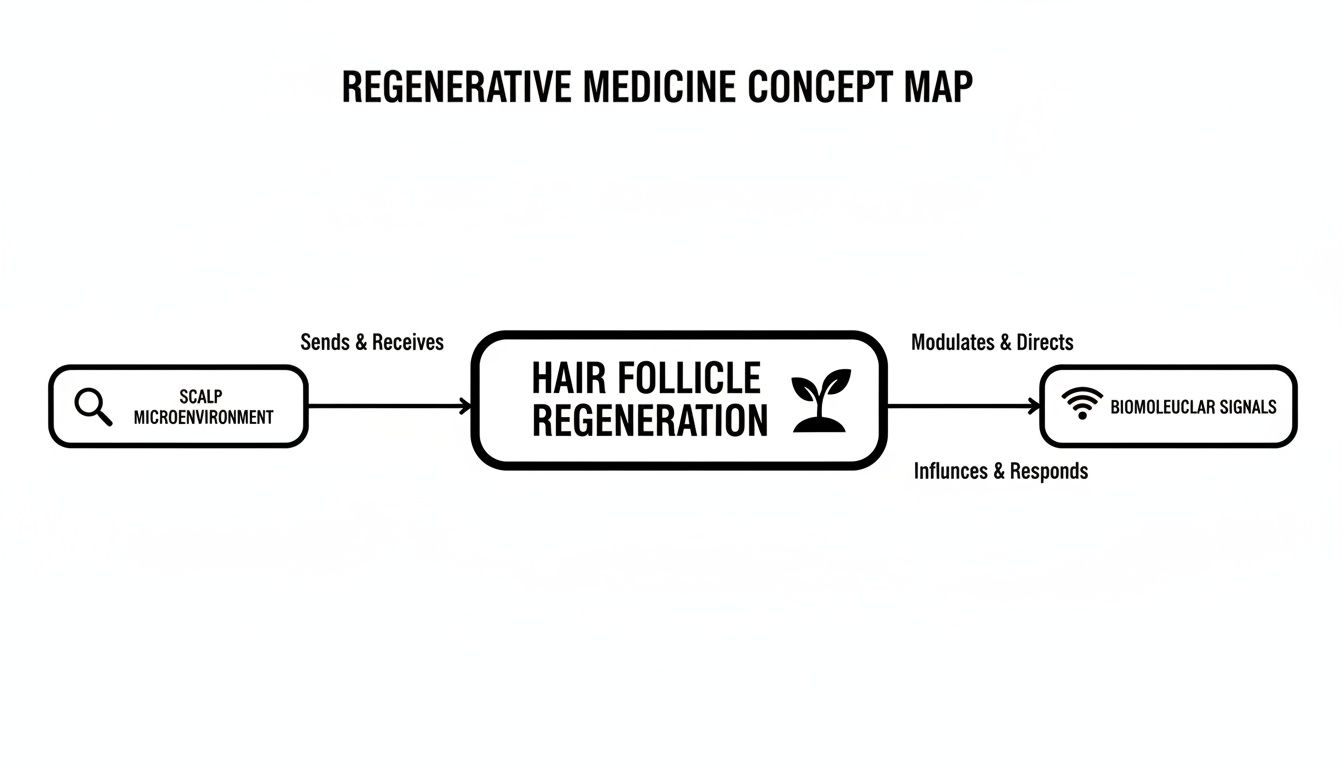
It all comes down to communication—sending the right messages to your follicles to get them back on the job.
Platelet-Rich Plasma (PRP): Your Body's Own Healing Team
Platelet-Rich Plasma, or PRP, is easily one of the most well-known and trusted regenerative treatments out there. The concept is refreshingly simple: we concentrate the powerful healing components already inside your own blood and use them to stimulate hair growth.
Imagine you have a highly skilled repair crew on standby, ready to fix any damage in your body. That's what your platelets do. When you get a cut, they rush to the site, release a flood of growth factors, and kick off the healing process. PRP therapy just gathers a huge concentration of these "repair workers" and puts them exactly where you need them most—your scalp.
The process itself is straightforward. A small amount of your blood is drawn, just like a routine lab test, and spun in a centrifuge. This separates the platelets and plasma from other blood cells, creating a golden, platelet-rich solution that’s loaded with growth factors. This "liquid gold" is then carefully injected into the areas of your scalp where hair is thinning. Those growth factors get to work immediately, waking up dormant follicles and beefing up the ones you still have.
And the research backs it up. Clinical studies show that PRP isn't just wishful thinking. In one review, patient ratings showed 64% experienced improved hair density, and clinician evaluations confirmed improvement in 46% of cases. When it came to new hair growth, 57% of patients reported an improvement.
Even better, 48% of patients said they were experiencing less hair loss. Another study found something remarkable: 93% of men with male pattern baldness reported that their hair loss had stopped just two months after starting PRP treatments. You can read the full research about these PRP findings.
Stem Cell Therapy: The Master Construction Workers
Stem cell therapy takes things a step further. If PRP is the repair crew that patches things up, think of stem cells as the master construction workers who arrive with the original blueprints to rebuild from the ground up.
Stem cells are the body's raw materials. They're "undifferentiated," which is a fancy way of saying they haven't decided what they want to be yet—they can become any type of specialized cell the body needs. For hair loss, we harness that potential to repair and regenerate weakened hair follicles, often using stem cells sourced from your own fat tissue.
Once these cells are introduced to the scalp, they get to work creating a healthier environment for hair growth and can even help form new follicular structures.
Stem cell therapy aims to repopulate the scalp with healthy, versatile cells that can help rebuild the foundational structures needed for robust hair growth, offering a powerful approach for more significant rejuvenation.
This is a powerful option because it attacks the problem at its very core, bringing fresh resources to an area that’s become depleted over time. It's a more intensive approach than PRP, and if you're weighing your options, our guide on alternatives to a hair transplant can be a really helpful resource.
Exosome Therapy: Delivering Precise Instruction Manuals
Exosome therapy is one of the most exciting new players in the regenerative space. If stem cells are the construction workers, then exosomes are the instruction manuals they carry, telling all the other cells in the area exactly what to do.
Here’s the thing: exosomes aren't actually cells. They are microscopic messengers released by stem cells. These tiny packages are filled with proteins, growth factors, and genetic information that they can deliver to other cells. When applied to the scalp, they provide precise signals that tell your existing cells to start behaving in a healthier, more youthful way.
Essentially, they tell dormant hair follicles to wake up, calm down the inflammation that’s hurting them, and get back to functioning properly.
- How It Works: Exosomes deliver growth signals directly to follicle cells.
- Key Advantage: They don't require harvesting cells from your body, as they are derived from ethically sourced stem cells in a lab.
- The Goal: To trigger regeneration without introducing new cells—just the instructions for repair.
This method gives you the regenerative punch of stem cells without the need for a procedure to collect them. Think of it as sending a critical software update to your scalp’s cellular machinery.
To make it easier to see how these therapies stack up, here’s a quick comparison.
Comparing Regenerative Hair Loss Therapies
| Therapy Type | How It Works | Best For | Treatment Source |
|---|---|---|---|
| PRP Therapy | Uses concentrated platelets from your own blood to release growth factors and stimulate follicles. | Men with early to moderate hair thinning who want to thicken existing hair. | Your own blood |
| Stem Cell Therapy | Introduces undifferentiated cells to the scalp to repair damaged follicles and promote regeneration. | Men with more significant hair loss seeking to rebuild follicular health. | Your own fat tissue (autologous) |
| Exosome Therapy | Uses microscopic messengers from stem cells to deliver targeted instructions for cellular repair. | Men looking for a non-invasive, cutting-edge option to signal regeneration. | Lab-cultured (ethically sourced) |
Each of these therapies offers a unique path toward healthier hair, and the best one for you really depends on your specific situation and goals.
Low-Level Laser Therapy and Other Adjuncts
Beyond these primary treatments, other therapies can support and boost the regenerative process. Low-Level Laser Therapy (LLLT), often found in caps or combs you can use at home, uses specific wavelengths of light to gently energize the cells in your follicles.
This energy boost can increase blood flow and encourage follicles to shift into the growth phase. It works great on its own for mild thinning or as a fantastic complementary treatment alongside PRP or exosomes to maintain your results. You can also explore the benefits of red light therapy, which is gaining a lot of traction for its ability to stimulate growth.
These supportive therapies are key to creating a complete plan, making sure your scalp has everything it needs to grow and sustain healthy hair for the long haul.
The PRP Journey: What to Expect Step by Step
Embarking on any new treatment can feel a bit intimidating, but the path for Platelet-Rich Plasma (PRP) therapy is surprisingly direct. Knowing what’s coming demystifies the whole thing, making it feel less like a clinical procedure and more like a proactive step toward getting your hair back. Let's walk through the entire experience, from the first conversation to seeing the final results, so you know exactly what you’re signing up for.
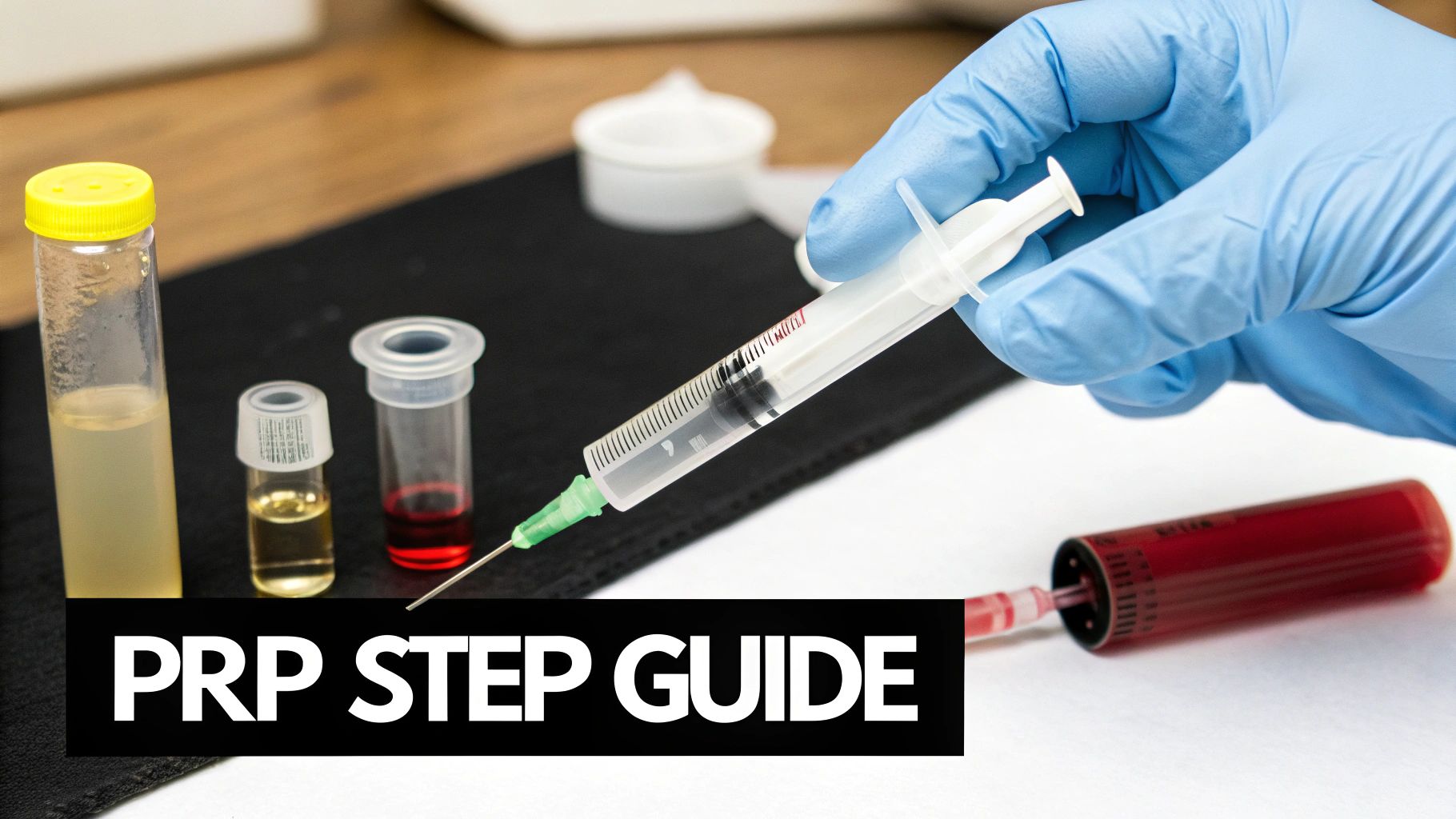
The whole process is designed to be efficient and fit right into a busy schedule. From start to finish, a typical PRP session usually takes about an hour to complete. Unlike more invasive surgeries, PRP has become a go-to for guys looking for an effective, early-stage solution. If you want a deeper dive, you can learn about the PRP procedure for hair on our site.
The Initial Consultation and Blood Draw
Your journey starts with a simple consultation. This is your chance to sit down with a specialist who will examine your scalp, go over your hair loss history, and make sure PRP is the right move for you. It's the perfect time to get all your questions answered and set some clear, realistic goals.
Once you’re ready to proceed, the first real step is a quick blood draw—no different than the one you'd get at a routine physical. A small amount of blood is taken from your arm. This sample is the raw material that holds all the powerful growth factors needed to wake up your hair follicles.
Creating the "Liquid Gold"
This next part is where the science kicks in, but the concept is beautifully simple. The vial of your blood is placed into a machine called a centrifuge.
Think of a centrifuge as a high-speed spinner. It whirls the blood around so fast that it separates into layers based on density. The heavier red blood cells sink to the bottom, while the lighter, golden-colored plasma—which is packed with platelets—rises to the top.
This concentrated, platelet-rich plasma is the "liquid gold" we're after. It's a powerful serum loaded with the biological signals that tell dormant hair follicles it's time to get back to work.
The Injection Process and Managing Comfort
With the PRP ready to go, the final step is delivering it directly to the parts of your scalp that need it most. Using a very fine needle, the specialist will perform a series of small injections across the thinning areas.
Of course, this is the part most guys are curious about. While it’s not completely sensation-free, clinics are very good at managing comfort. Common methods include:
- Topical Numbing Cream: Applied to your scalp beforehand to dull the feeling.
- Cooling Devices: A little blast of cold air can numb the skin just before each injection.
- Vibrating Tools: These are clever devices that distract the nerve endings to minimize any pinching sensation.
Most men describe it as a quick, mild pressure that is very tolerable. The injection part of the process is over quickly, usually taking just 15-20 minutes.
After Your Session and the Timeline for Results
Once the injections are done, you’re free to head out and get on with your day. There’s practically no downtime. You might have some mild redness, a little bit of swelling, or some tenderness on your scalp, but that usually fades within a few hours to a day.
Now for the big question: when will you see results? Hair growth is a slow, cyclical process, so patience is absolutely key. Most treatment plans recommend an initial series of 3 to 4 sessions, spaced every 2 to 3 weeks over a 3-month period. This schedule helps build momentum and consistently stimulate the follicles.
Here’s a realistic timeline of what to expect:
- First 2-3 Months: The earliest signs are often subtle. You might notice you’re shedding less hair in the shower or on your brush.
- 3-6 Months: This is typically when visible changes start to appear. Your hair might feel thicker, and you could see new, fine hairs sprouting in the treated spots.
- 6-12 Months: You'll likely see continued improvement in density and coverage as the new hair matures and thickens up.
After you complete the initial series, most specialists will recommend a maintenance session every 6 to 12 months to protect your investment and keep the results going strong.
Are You a Good Candidate for These Treatments?
So, who are these treatments actually for? While the science is exciting, regenerative medicine isn't a magic bullet for every guy experiencing hair loss. The key is understanding where you are on your hair loss journey and setting realistic expectations from the get-go.
The ideal candidate is typically someone in the early to moderate stages of male pattern baldness. This is the sweet spot. Why? Because at this stage, the hair follicles are usually still alive—they're just shrinking, getting lazy, and producing weaker, thinner hairs.
Think of it like reviving a struggling plant. If the root is still alive, you can give it the right nutrients to bring it back to life. But if the root is long gone, no amount of fertilizer will help. These treatments are designed to "wake up" and fortify those struggling follicles, not to grow new ones from a completely barren scalp.
Who Sees the Best Results?
Success really hinges on what’s currently happening on your scalp. You’re likely a prime candidate for regenerative therapies if you check these boxes:
- You've Noticed Recent Thinning: Your hair has been thinning over the past few years, but you still have a good amount of hair, even if it's finer than it used to be.
- You Can See "Miniaturized" Hairs: If you look closely at your thinning areas, you can see tiny, vellus-like hairs. This is a fantastic sign! It means the follicles are still active and just waiting for a boost.
- You're in Good General Health: Your body’s healing and regenerative capacity is a huge piece of the puzzle. Being in good overall health gives these treatments a much better chance of success.
Your lifestyle and general wellness also play a big part. For instance, knowing how to improve metabolic health can support your body's ability to respond well to any kind of regenerative procedure.
When These Treatments Might Not Be the Best Fit
Just as important is knowing when these treatments might not deliver the results you're hoping for. It's best to be realistic. Regenerative medicine is likely less effective in these situations:
- Advanced, Long-Term Baldness: If an area of your scalp has been shiny and smooth for many years, the follicles there have probably shut down for good.
- Certain Underlying Health Issues: Some blood disorders, active scalp infections, or autoimmune conditions can interfere with the body's healing response, making these treatments less suitable.
The bottom line is this: these therapies work by supercharging your body's own natural repair systems. For that to happen, there has to be something to work with—living, even if they're weak, hair follicles.
Ultimately, the only way to know for sure is to get an expert opinion. A proper consultation is the most critical first step. A specialist can get a magnified look at your scalp, evaluate the state of your follicles, and give you an honest assessment of what you can realistically expect.
Breaking Down the Costs, Risks, and How to Move Forward
Alright, let's get down to the practical stuff—the real-world details every guy wants to know before taking the plunge. When you're looking into regenerative medicine for hair loss, you have to think about the financial investment, the potential downsides, and how to make a choice that feels right for you.
It helps to think of these treatments not as a simple cost, but as an investment in your confidence and how you feel. The price tag can swing quite a bit depending on where you live, the clinic's reputation, and which therapy you land on. As a ballpark, a single PRP session can run anywhere from $500 to over $1,500.
Keep in mind, you're almost never buying just one. The initial protocol is usually a package of three or four sessions to really kickstart the growth, followed by maintenance treatments every so often to keep your results going strong. To get a better handle on the numbers, you can explore a detailed breakdown of PRP costs for hair.
Weighing the Potential Risks
Here’s one of the best things about PRP: its safety record is fantastic. Because the entire treatment comes from a small sample of your own blood, the chance of an allergic reaction or your body rejecting it is practically zero. You're just concentrating your body's natural healing power and putting it right where you need it.
Of course, no procedure is completely risk-free, but the side effects here are usually minor and don't last long. The most common things men report are:
- Temporary Soreness: Your scalp might feel a little tender where the injections were done, but this typically fades in a day or two.
- Minor Swelling or Redness: A bit of inflammation around the treated area is perfectly normal and goes away quickly.
- Minimal Bleeding: You might see a pinprick of blood at an injection site, but it's uncommon.
These issues almost always resolve on their own without you having to do anything. It's a world away from the recovery time and more serious risks that can come with surgical procedures.
How to Find a Qualified Provider
This is the most critical part of the whole process. Your results and your safety are directly tied to the skill of the person performing the treatment. You'll want to find a board-certified dermatologist, plastic surgeon, or a doctor who truly specializes in hair restoration.
When you walk into that consultation, remember you're not just a patient—you're the one doing the hiring. This is your opportunity to vet their expertise and see if they're the right person to help you reach your goals.
Go in with a list of questions. A good conversation will tell you everything you need to know about their experience and whether their approach is right for you.
Key Questions to Ask Your Provider:
- How many of these specific procedures have you actually performed for hair loss?
- Can I see a portfolio of before-and-after photos from your own patients, not stock images?
- What kind of system do you use to process the PRP? (Not all are created equal.)
- For someone with my pattern of hair loss, what's your recommended treatment and maintenance plan?
- What are the realistic results I can expect, and in what timeframe?
A provider who is both honest and skilled will give you straight answers, set clear expectations, and make you feel informed, not pressured. By understanding the investment, knowing the minimal risks, and carefully choosing your expert, you can move forward with total confidence.
Your Top Questions, Answered
It's completely normal to still have questions floating around after digging into the details. Let's tackle some of the most common things guys ask when they're thinking about regenerative treatments for hair loss.
Does PRP for Hair Loss Hurt?
For most guys, the procedure is surprisingly tolerable. You’ll feel the injections, of course, but clinics do a great job of managing any discomfort. They'll typically apply a strong numbing cream to your scalp beforehand, which really takes the edge off.
Afterward, you might feel a bit of soreness or tenderness where you had the injections, but it's usually mild and gone within a day or two. When you compare it to a full-on surgical hair transplant, it’s a walk in the park.
How Long Will My Results Last?
The results are impressive and long-lasting, but they aren't a one-and-done permanent fix. That's because male pattern baldness doesn't just stop; it's an ongoing process.
After your initial round of treatments (usually three or four sessions), your doctor will map out a simple maintenance plan.
Think of it like a personal trainer for your hair follicles. You can't just get in shape and then stop working out. To keep seeing results, you have to keep showing up. For most men, this means coming in for a booster session every 6 to 12 months.
Consistency is what keeps the hair thick and the follicles active over the long haul.
Can I Use PRP with Other Hair Loss Treatments?
Absolutely. In fact, combining treatments is often the smartest way to get the best possible results. Regenerative medicine plays incredibly well with proven medications like Minoxidil (Rogaine) and Finasteride (Propecia).
Think of it as a one-two punch against hair loss:
- Medications: Go after the hormonal and chemical triggers that cause thinning in the first place.
- PRP Therapy: Directly fuels the follicles with the growth factors they need to thrive.
This combined approach can create a much bigger improvement in hair density than either one could alone. Just be sure to tell your provider about everything you're currently using so they can build a safe and effective plan that works for you.
At PRP For HairLoss, our goal is to give you clear, straightforward information so you can feel confident about your next steps. To learn more about how regenerative medicine can help you, visit us at https://prpforhairloss.com.
 PRP For Hairloss
Leave a comment