Catching that first glimpse of thinning hair in the mirror when you're 25 can feel like a lonely wake-up call. But the reality is, you're in very good company. This is an incredibly common story, one driven mostly by the genetic hand you were dealt. The key isn't to panic; it's to realize that now is the perfect time to get ahead of it. Modern treatments work best when you catch things early.
Why Am I Balding At 25 And What Can I Do?

Spotting your first gray hair is one thing. Noticing your hairline is creeping back or the hair on your crown is looking a little less dense? That feels entirely different. It's a jarring moment that can make you question everything from your health to how old you look. The first thought for most guys is, "This can't be happening already."
But it can, and it does. The truth is, balding at 25 is far from a rare thing. The official term is androgenetic alopecia, and for a huge number of men, it's just a normal part of the aging process. It doesn't mean you're unhealthy or getting old before your time. It simply means a genetic switch has been flipped, making your hair follicles sensitive to a particular hormone.
You're Far From Alone in This
It’s easy to look around and feel like you’re the only one in your friend group going through this, but the statistics tell a different story. By some estimates, around 25% of men with male pattern baldness start seeing noticeable thinning before they even hit 21. By 25, that number is even higher.
The most important thing to grasp is this: balding at 25 isn't some kind of personal failure. It's a genetic reality for millions of men. Once you accept that, you can shift your focus from worrying to finding solutions that actually work.
Here’s a quick breakdown of what’s at play when you see early hair loss.
Quick Guide To Understanding Hair Loss At 25
| Factor | What It Means For You At 25 |
|---|---|
| Genetics | This is the main driver. If hair loss runs in your family (on either side!), your follicles are likely predisposed to shrink over time. |
| Hormones (DHT) | A testosterone byproduct called DHT is the direct cause of follicle miniaturization. Your genes determine how sensitive your follicles are to it. |
| Age | At 25, your body has had years to be exposed to DHT, and the genetic effects are just now becoming visible. |
| Lifestyle | While not the primary cause, high stress, poor diet, and lack of sleep can accelerate the process your genes already started. |
Understanding these factors is the first step toward taking meaningful action.
The Power Of Taking Early Action
Right now, time is your single greatest advantage. The sooner you intervene, the more hair you can save and the more effective treatments will be. Think of it like a coastline; it’s much easier to build a seawall to prevent erosion than it is to reclaim land that’s already been washed away.
By acting now, you can:
- Slow the process way down. Proven treatments can hit the brakes on further thinning.
- Keep the hair you have. The number one goal is to preserve your current hair, keeping it healthy and strong.
- Potentially see some regrowth. Some treatments are great at waking up dormant follicles, which can thicken up thinning areas.
Instead of seeing this as a crisis, reframe it as a chance to take control. The first step is learning what's really going on under the surface. If you want to dig into the details, this guide explains why you might be losing hair. In the sections ahead, we’ll get into the science and the best options available to you.
The Real Science Behind Early Hair Loss
If you're wondering why you might be balding at 25, you don't need a Ph.D. in biology to get it. The whole thing really boils down to an interaction between the genes you inherited and one particular hormone. It's a common myth that it’s about having "too much testosterone" or being unhealthy—the truth is it’s all about a specific, inherited sensitivity.
I like to use a garden analogy. Think of your scalp as the plot of land and your hair follicles as the soil where your hair grows. For most guys, this soil is rich and fertile. But for those with a genetic predisposition to hair loss, that soil has a built-in vulnerability.
This weak spot gets exploited by a hormone called dihydrotestosterone, or DHT. DHT is just a natural byproduct of testosterone; every man has it. The problem starts when your hair follicles—the soil in our garden—are genetically programmed to be overly sensitive to its presence.
The DHT Effect: How It Shrinks Your Hair
When DHT latches onto these sensitive follicles, it essentially acts like a slow-acting poison. It doesn't just kill the follicle overnight. Instead, it gradually strangles it in a process we call miniaturization.
With each new growth cycle, the hair that comes out is a little thinner, a little weaker, and less pigmented than the one before. Eventually, the follicle shrinks so much that it can no longer produce a visible hair at all. That’s what creates the thinning patches and bald spots you're starting to see.
This process is why hair loss often follows such predictable patterns, like a receding M-shaped hairline or a thinning spot on the crown. It’s because the follicles in those specific zones are the ones that inherited the sensitivity, while the hair on the sides and back of your head is usually genetically resistant to DHT. This is why they're often used for hair transplants!
You can learn more about what causes androgenetic alopecia in our detailed guide.
Here's the key takeaway: You're not balding because of something you did. You're balding because your follicles were genetically wired to overreact to a hormone that is a normal part of being a man.
How Lifestyle Can Hit the Fast-Forward Button
While your genes load the gun, certain lifestyle factors can absolutely pull the trigger sooner. Think of it as pouring gasoline on a fire that was already smoldering. If you're seeing significant hair loss at 25, it's definitely worth taking a hard look at these accelerators.
Here are the big three:
- Chronic Stress: Sky-high levels of the stress hormone cortisol can throw your hair's growth cycle out of whack. It can prematurely push more of your hair into the shedding phase, making the damage from DHT look even worse.
- Poor Nutrition: Your hair is built from the nutrients you eat. If you're running low on essentials like iron, zinc, biotin, and protein, your hair strands will be weaker and your follicles more vulnerable to attack.
- Smoking: It's no secret that smoking is terrible for circulation. The toxins in cigarettes constrict blood vessels, which means less oxygen-rich blood can get to your scalp. This effectively starves your follicles of the fuel they need to grow healthy hair.
Let's be clear: cleaning up your lifestyle won't stop male pattern baldness by itself. But it does create a much healthier environment for your hair to defend itself. By managing your stress, diet, and habits, you're giving any medical treatments you try a much better foundation to work from.
Spotting The Early Signs Of Hair Loss
It's a familiar cycle: you catch a glimpse in the mirror and start questioning everything. Is that a new cowlick, or is my hair actually getting thinner? Has my hairline always been this high? This kind of self-doubt is completely normal, but moving past it is the first real step toward taking control if you're worried about balding at 25.
The reality is, male pattern baldness doesn't just show up one morning. It's a slow burn—a gradual process that often begins years before anyone else would notice. Learning to spot these subtle changes early gives you a huge advantage in keeping the hair you have.
The Classic Telltale Signs
For most guys, hair loss follows a predictable path laid out by genetics and hormones. The American Hair Loss Association confirms that male pattern baldness is behind more than 95% of all hair loss in men. And you are definitely not alone—data shows that roughly 16-20% of men aged 18-29 are already dealing with moderate to extensive thinning. You can see how these numbers break down by reading the full breakdown on MyFreeBird.com.
So, what should you actually be looking for? There are two classic patterns that show up time and time again:
- A Receding Hairline: This is the big one for many guys. It usually starts at the temples, slowly carving out a more defined "M" or "V" shape over months or years.
- Thinning at the Crown: The vertex—that spot at the back of your head—is another prime target for hair loss. You might first notice it under harsh bathroom lighting or when you see a picture of the back of your head.
Beyond those two hotspots, you might also notice an overall drop in hair density across the top of your scalp. Maybe your part seems wider, or you can just see more scalp than you used to. We dive deeper into how these patterns start in our guide on the first signs of baldness.
Understanding The Norwood Scale
To get a more objective look at what's happening, hair loss specialists use a tool called the Norwood Scale. Think of it as a roadmap for male pattern baldness. It lays out seven distinct stages, starting from a full head of hair (Stage 1) and progressing to significant loss across the scalp (Stage 7).
The Norwood Scale isn't a timeline; it's a visual guide. Knowing where you are on the scale helps you track changes over time and have a much clearer conversation with a doctor or specialist.
If you're noticing changes and are balding at 25, you're most likely in one of the earlier stages. These include:
- Stage 2: You'll see a slight recession at the temples. It's often subtle but a definite change from a juvenile hairline.
- Stage 3: The "M" shape at the hairline becomes much more obvious. This is generally considered the first point of clinically significant balding.
- Stage 3 Vertex: This is a combination of a receding hairline and the first noticeable thinning on the crown.
Pinpointing your stage gives you a solid benchmark. Instead of just having a vague feeling that you're losing hair, you can say, “I was a Norwood 2 six months ago, and now I'm definitely a Norwood 3.” That kind of specific information is incredibly useful for you and your doctor.
Your Toolkit Of Proven Hair Loss Treatments
Alright, now that you understand the science and how to spot the early signs, it's time to get proactive. This is where you move from worrying to taking action. The good news? If you’re balding at 25, you're living in an era with a powerful lineup of science-backed treatments that actually work. We're not talking about miracle tonics or snake oil here; we're focusing on the heavy hitters that deliver real results.
Think of these treatments like tools in a workshop. Some are for prevention, others are for rebuilding, and often, the best approach is to use them together. Getting a handle on what each one does is the key to building a smart strategy that works for you.
To get started, it’s helpful to map out what to do when you first spot changes in your hair.
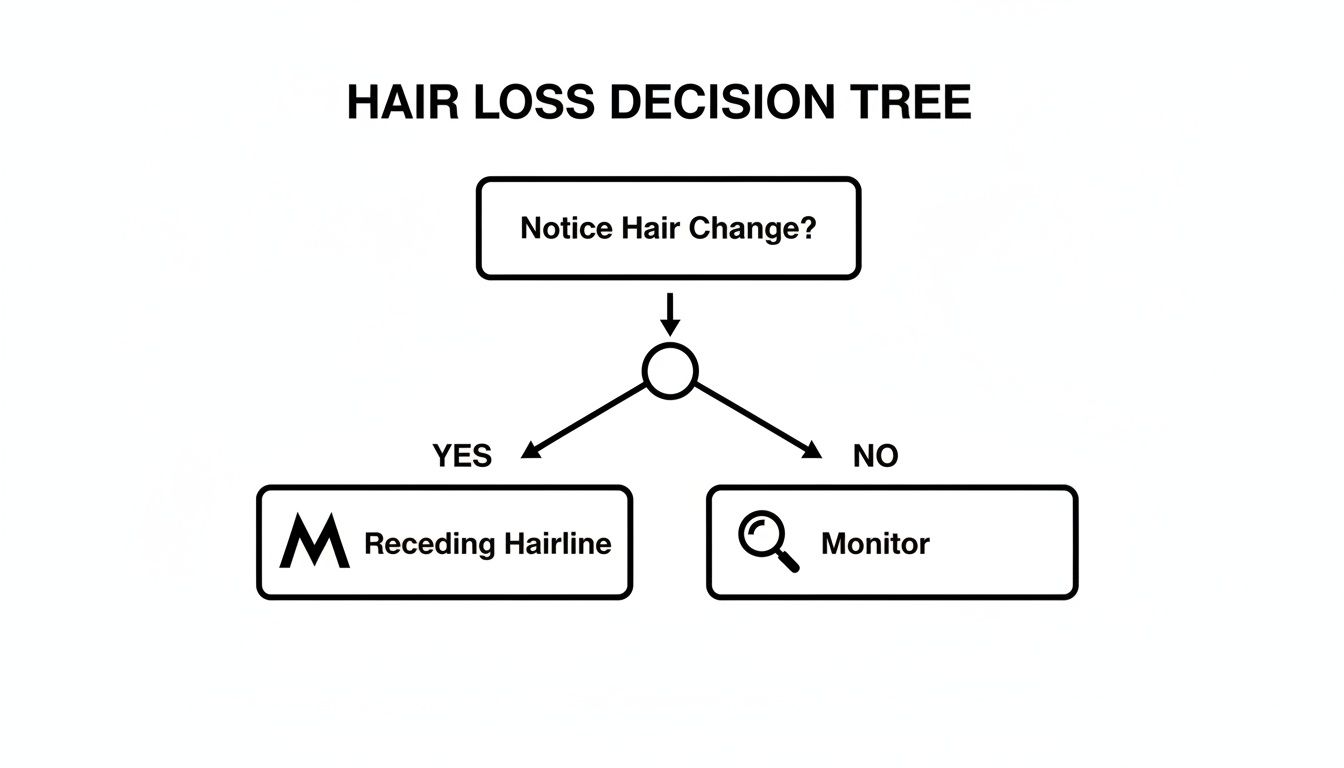
This simple chart highlights the most important step: acknowledging the change and deciding to do something about it, instead of just watching and waiting.
H3: Finasteride: The DHT Blocker
First up is Finasteride, a daily pill that gets to the hormonal root of male pattern baldness. Remember DHT, that pesky hormone that shrinks hair follicles? Finasteride's job is to block the enzyme (5-alpha reductase) that turns testosterone into DHT.
Think of it this way: your body has a factory that churns out DHT. Finasteride essentially walks in and shuts down a huge part of the production line. By dramatically cutting down the DHT levels in your scalp, it takes the pressure off your hair follicles, giving them a fighting chance to recover and stop thinning.
- How It Works: Slashes scalp DHT levels by up to 70%.
- Best For: Hitting the brakes on hair loss progression and holding onto the hair you still have. It’s a rockstar for the crown area but helps the hairline, too.
- Timeline: This is a long game. You’ll need to wait 3-6 months to see shedding slow down. Real improvements in thickness and density usually start to show up around the one-year mark.
Of course, it's crucial to chat with your doctor about potential side effects. They're not common, but they can happen, so an open conversation is a must before you start.
H3: Minoxidil: The Growth Promoter
Next in the lineup is Minoxidil, a topical solution or foam you apply right onto your scalp. Unlike Finasteride, Minoxidil doesn’t mess with your hormones at all. It’s a vasodilator, which is just a fancy way of saying it widens your blood vessels.
Imagine it's improving the delivery routes to your follicles. By boosting blood flow, Minoxidil makes sure your follicles get a steady supply of oxygen and nutrients. This can wake up dormant follicles and help your existing hairs grow back thicker and healthier.
Minoxidil doesn't block DHT, but it helps fight its effects by creating a much better environment for growth. This is exactly why it’s often paired with Finasteride for a powerful one-two punch.
Here’s the rundown:
- How It Works: Increases blood flow and nutrient delivery to the hair follicles.
- Best For: Encouraging regrowth where hair is thinning, especially on the crown. It won’t bring hair back on a totally bald spot, but it's fantastic for boosting density.
- Timeline: Like Finasteride, expect to wait about 4-6 months for visible results. You might even see some shedding at first—don't panic! It’s actually a sign it's working.
With Minoxidil, consistency is everything. You have to apply it twice a day, every single day, or the results will disappear.
H3: PRP Therapy: Your Body’s Own Healing Power
Platelet-Rich Plasma (PRP) therapy is a more hands-on approach that harnesses your body's own healing ability to kickstart struggling hair follicles. It’s a three-step process: a small amount of your blood is drawn, spun in a centrifuge to concentrate the platelets, and then this "liquid gold" is injected back into your scalp.
Platelets are your body's natural first responders. They're loaded with growth factors that repair damaged tissue and tell cells to get growing. PRP therapy isolates these powerful healers and puts them right where you need them most: your hair follicles. For a deeper dive, check out our guide on the best hair loss treatments for men, which breaks down these options in detail.
When you're looking at your options, you might also come across advanced combination therapies like PRP Microneedling. This technique can boost the effectiveness of the treatment by creating tiny channels in the scalp that help the growth factors penetrate deeper.
- How It Works: Uses the concentrated growth factors from your own blood to stimulate follicle repair and new growth.
- Best For: Guys in the earlier stages of hair loss who have noticeable thinning but aren't completely bald. It’s amazing for improving overall hair density and thickness.
- Timeline: It usually starts with 3-4 treatments scheduled about a month apart. After that, you'll need maintenance sessions every 6-12 months. You'll often start seeing a difference after the second or third session.
Since PRP uses your own biological material, the risk of an allergic reaction is practically zero. This makes it a really safe and effective option for many guys balding at 25.
Comparing Popular Hair Loss Treatments
To help you see how these options stack up, here’s a quick comparison table. It gives you a bird's-eye view of how the top treatments work, who they're best for, and what kind of timeline you can expect.
| Treatment | How It Works | Best For | Results Timeline |
|---|---|---|---|
| Finasteride | An oral pill that blocks the DHT hormone, preventing follicle miniaturization. | Men looking to stop the progression of hair loss and maintain current hair. | 3-6 months to slow shedding, 12+ months for regrowth. |
| Minoxidil | A topical solution that increases blood flow and nutrient supply to follicles. | Regrowing hair in thinning areas, especially the crown. | 4-6 months to see initial regrowth, ongoing use needed. |
| PRP Therapy | Injections of concentrated platelets from your own blood to stimulate growth. | Men in early stages of hair loss seeking to improve density and thickness. | 2-3 months (after 2nd session), with maintenance needed. |
| Hair Transplant | Surgically moving DHT-resistant follicles to balding areas. | Men with significant, stabilized hair loss for a permanent solution. | 6-12 months for final, permanent results. |
Remember, the "best" treatment is highly individual. It often comes down to your specific pattern of hair loss, your goals, and your lifestyle. Many find that a combination approach delivers the most comprehensive and satisfying results.
How PRP Therapy Rejuvenates Hair Follicles

When we talk about modern tools for fighting hair loss, Platelet-Rich Plasma (PRP) therapy is one of the most interesting because it uses your body's own healing machinery to do the job. If you're balding at 25, it's a compelling option that works with your biology, not against it.
Instead of introducing outside chemicals, PRP simply takes what you already have, concentrates it, and puts it back to work revitalizing your struggling hair follicles. Think of it as creating a custom super-fertilizer for your scalp.
The Three-Step Process From Start to Finish
The entire PRP procedure is surprisingly straightforward and usually wrapped up in about an hour. It’s an in-office visit that boils down to three key stages, all designed to get powerful growth factors right where you need them most.
Here’s a quick walkthrough of what the experience is like.
- The Blood Draw: It all starts with a standard blood draw from your arm, no different than what you’d get during a routine check-up. We're only talking about a small amount.
- The Centrifuge: This is where the magic happens. That vial of blood goes into a machine called a centrifuge, which spins it at high speed. This process neatly separates your blood into layers: red blood cells, platelet-poor plasma, and the star of the show—the platelet-rich plasma.
- The Injection: The resulting PRP, a concentration of platelets floating in plasma, is then carefully drawn into a syringe. A specialist injects this "liquid gold" directly into the areas of your scalp where the thinning is most obvious.
The whole process is designed for comfort, and most clinics offer numbing options to make the injections as painless as possible.
Why Is PRP a Compelling Option?
What makes PRP so attractive, especially for younger guys, is how safe and natural it is. Since we're using your own biological material, the risk of an allergic reaction or strange side effects is practically zero. You're just redirecting your body's own healing power.
The platelets in the PRP are absolutely packed with growth factors. When they're injected into the scalp, these proteins send a wake-up call to dormant or shrinking hair follicles.
Essentially, PRP tells your scalp it's time to get back to work. These growth factors kickstart tissue repair, encourage the formation of new blood vessels to deliver more nutrients, and can even extend the active growing phase of the hair cycle.
This biological boost helps fight back against the miniaturizing effects of DHT, leading to thicker hair shafts and better overall density. If you want to dive deeper into the science, you can explore more about how PRP works to stimulate hair growth in our detailed guide.
Who Is the Ideal Candidate for PRP?
Now, PRP isn't a miracle cure for everyone, but it can be a game-changer for the right person. The best candidates are usually those in the early to moderate stages of hair loss—which is exactly the boat many guys are in when they start balding at 25.
PRP is likely a great fit if:
- You have noticeable thinning but still have decent hair coverage. PRP is fantastic for strengthening existing follicles, not for regrowing a full head of hair on a completely bald scalp.
- Your hair loss is fairly recent. The sooner you take action, the more follicles there are to save and rejuvenate.
- You're looking for a natural approach. If you're hesitant to commit to daily medications, PRP offers a non-synthetic alternative with less frequent treatments.
A typical treatment plan kicks off with a series of three or four sessions, spaced about a month apart, to really get things going. After that initial phase, most people find that a maintenance treatment once or twice a year is enough to keep up the results. While everyone’s journey is different, many guys report seeing less shedding first, followed by a noticeable improvement in thickness and density within just a few months.
Building Your Personal Action Plan
Alright, you've got the science and the treatment options down. That's a huge first step. But all that information is just noise until you put it to work. Think of this section as your roadmap—the part where knowledge turns into action. If the thought of balding at 25 has you feeling stuck, these clear, manageable steps will help you take back control.
The whole journey kicks off with one non-negotiable step: getting a proper diagnosis. Guessing in the mirror can only get you so far. Nothing beats the trained eye of a dermatologist or a dedicated hair loss specialist. They'll be able to confirm if it’s actually male pattern baldness, rule out any other sneaky causes, and give you a straight answer on where you currently stand.
Your First Doctor's Visit
Walking into that first appointment prepared will make a world of difference. Instead of just saying, "I think I'm losing my hair," you'll be able to steer the conversation and get the specific answers you need.
Be ready to talk about your goals and what's worrying you most. The more open you are, the better the specialist can tailor a plan that actually fits your life and what you hope to achieve.
The most important part of this whole thing is finding a path you can actually stick with. Consistency is the name of the game when it comes to getting results, so your action plan has to be something you can realistically maintain long-term.
It's also completely normal for early balding to take an emotional toll. For a lot of guys, it can be a major source of stress. Learning some effective strategies to cope with anxiety can be a game-changer for your mindset and an important part of your overall plan.
Key Questions to Ask Your Specialist
To make sure you walk out of that consultation feeling confident and clear-headed, you need to go in armed with the right questions. This is how you cover all your bases and truly understand the road ahead.
Here are a few essentials to have on your list:
- What’s the main reason I’m losing my hair? (This nails down the diagnosis.)
- What stage of hair loss am I at right now? (This gives you a baseline to measure against.)
- For my specific situation, what treatment or combo of treatments would you recommend? (This is your personalized starting point.)
- Realistically, what kind of results can I expect, and over what timeframe? (This is crucial for managing expectations.)
- Are there any potential side effects I should know about? (This helps you make a fully informed choice.)
Taking this proactive stance puts you firmly in the driver's seat. You stop being someone who just worries about their hair and become someone who is actively doing something about it.
Your Questions About Balding at 25, Answered
It's completely normal to have a million questions running through your mind when you first notice your hair thinning. Let's tackle some of the most common ones head-on to give you the clarity you need.
If I'm Balding at 25, Will I Be Completely Bald by 30?
Not at all. That's a common fear, but the reality is usually much less dramatic. Male pattern baldness is different for everyone; for most guys, it’s a slow burn that plays out over decades, not a five-year sprint to total baldness.
The key is taking action now. Starting a proven treatment plan in your 20s is the single most powerful thing you can do. Getting ahead of the problem gives you a fantastic shot at slowing it way down, stopping it in its tracks, or even regaining some lost ground.
Can I Reverse This With Just a Better Diet and More Exercise?
A healthy lifestyle is fantastic for your hair—no doubt about it. Eating well, managing stress, and getting regular exercise create the perfect environment for healthy hair growth.
But here's the honest truth: diet and exercise alone can't override your genetics. Think of it like this: a healthy lifestyle is like preparing fertile soil for a garden. It helps everything grow stronger, but it won't change the fundamental genetic blueprint that's causing male pattern baldness. It simply sets the stage for medical treatments to be as effective as possible.
The bottom line: Lifestyle improvements are the supporting cast, not the main star. They work hand-in-hand with medical treatments but can't replace them for genetic hair loss.
Are These Treatments a Lifelong Commitment?
When it comes to male pattern baldness, the answer is generally yes. Treatments like finasteride and minoxidil are essentially holding back the tide. They work by constantly fighting the hormonal (DHT) and circulatory factors that cause your follicles to shrink. If you stop, that protection goes away, and the hair you kept or regrew will likely start to shed again.
PRP therapy works in a similar way. You’ll typically start with a few sessions to kickstart growth and then come back for maintenance treatments every six to twelve months to keep those results going strong.
At PRP For HairLoss, we know that knowledge is power. Understanding what's happening and what you can do about it is the first real step toward taking back control. If you're ready to dive deeper, we have more guides and treatment information to help you on your journey.

 PRP For Hairloss
Leave a comment