The core difference really boils down to this: a hair system is a non-surgical, immediate fix, while a hair transplant is a surgical, permanent procedure. Your decision rests on whether you're looking for a quick, reversible transformation or a long-term, low-maintenance result with your own growing hair.
The Crossroads of Hair Loss: A Modern Man's Choice

Dealing with hair loss can feel like you've hit a fork in the road. One path offers an instant change, a full head of hair practically overnight. The other path promises a gradual but permanent restoration. Think of this guide as your map for navigating the very personal decision between a hair system and a hair transplant. We're going to cut through the jargon and get straight to what matters—getting your confidence back in a way that truly fits your life.
First, let's get one thing straight: modern hair systems are a world away from the toupees of the past. These are sophisticated, non-surgical pieces made from real human hair, meticulously attached to an ultra-thin, breathable base. The look is undetectable from day one. On the flip side, a hair transplant is a medical procedure. It involves moving your own healthy hair follicles from a dense donor area (usually the back of your head) to the thinning spots, where they'll take root and grow naturally for good.
Key Factors to Consider
Before we dive deep, it helps to see the main differences at a glance. Both options have their place, and the right one for you depends entirely on your goals, your lifestyle, and how much hair you've lost. The extent of hair loss is often measured on the Norwood scale, and you can get a rough idea of where you stand by looking at the stages of the Norwood Scale for hair loss.
As guys explore these solutions, other questions often pop up. For instance, many in the fitness community ask, "Does creatine cause hair loss?". Getting a handle on all the contributing factors is a smart first step.
| Factor | Hair System | Hair Transplant |
|---|---|---|
| Result Speed | Instant results after fitting | Gradual results over 12-18 months |
| Permanence | Temporary (requires replacement) | Permanent (uses your own hair) |
| Procedure Type | Non-surgical application | Minimally invasive surgery |
| Maintenance | Regular cleaning and re-bonding | Standard hair care after initial healing |
| Candidacy | Suitable for any level of hair loss | Requires sufficient donor hair |
The Reality of Living with a Modern Hair System

So, what’s it actually like to wear a modern hair system every day? Forget any outdated images of obvious, ill-fitting toupees. The systems available today are on a completely different level. We're talking about ultra-thin polymer or lace bases that mesh seamlessly with the scalp, meticulously threaded with real human hair. When done right, they are incredibly difficult to spot.
For most guys, the initial feeling is pure relief and a massive shot of confidence. Imagine walking into a salon with visible thinning and leaving a short time later with a full, perfectly styled head of hair. That immediate result is a huge draw, especially for those who need a quick fix or just aren't good candidates for surgery.
The Daily Routine and Lifestyle Impact
Life with a hair system does require some tweaks to your daily habits. Although it looks and feels like your own hair, you have to follow a specific care routine to keep it looking great and securely attached.
Styling is usually pretty easy. Most standard hair products are fine, but you learn quickly to be gentle around the base so you don't mess with the adhesive. And yes, you can absolutely shower, hit the gym, and even swim with a properly bonded system. The adhesives used today are powerful, designed to hold up against water and sweat, so you don't have to put your life on hold.
That said, there is a learning curve. You’ll find yourself thinking more about how you sleep to reduce friction and how you wash and dry your hair. It's a classic trade-off: you get incredible hair density right away, but it's attached to a new set of daily considerations.
The key thing to understand is that a modern hair system allows you to lead a completely normal, active life. But that freedom is built on the foundation of a consistent maintenance schedule. If you neglect the upkeep, the system simply won't stay secure or look its best.
Maintenance: The Ongoing Commitment
The biggest lifestyle change is, without a doubt, the maintenance. This is not a one-and-done solution. The commitment really falls into a few distinct categories.
- Weekly Cleaning: You’ll likely need to do some light at-home maintenance, which usually involves cleaning and reapplying adhesive along the hairline to keep the edge sharp and the hold strong.
- Full Re-Bonding: Every 2-4 weeks, the entire system has to come off. This is a process. You have to gently detach it, clean every bit of adhesive residue from both your scalp and the system's base, and then apply a fresh bond.
- Professional Refits: While many guys get good at doing this themselves, a lot of them prefer to see a professional every 4-6 weeks. A pro can ensure a flawless reapplication and give you a haircut to perfectly blend the system with your own growing hair.
This routine is really at the heart of the "hair system vs hair transplant" debate. A transplant, once it’s healed and grown in, is just your own hair. A system, however, demands your regular attention. When you're first trying to figure out what to do, managing bald spots can feel like a full-time job, and a system offers an instant cover-up. If you're looking at different approaches, you can learn more about how to hide bald spots effectively while you weigh your long-term options.
At the end of the day, living with a hair system is a balancing act. You get the incredible aesthetic reward of a full head of hair on demand, but it comes with the practical reality of upkeep. It requires your time, effort, and an ongoing financial investment to keep it looking natural. The right choice really comes down to whether you prioritize immediate results and are ready for what is essentially a lifelong subscription.
A Look Inside the Hair Transplant Journey
Deciding on a hair transplant means you're playing the long game for a permanent, surgical fix. It's a world away from the instant results of a hair system. A transplant is a genuine medical procedure, and it's a journey that takes patience as it unfolds over several months.
It all starts with a detailed consultation. A specialist will take a close look at your hair loss, check the quality and density of your donor hair (usually from the back and sides of your head), and see if you're a good fit. This is also when you'll discuss the two main techniques on the table.
FUE vs. FUT: The Two Roads to Restoration
When you hear people talk about hair transplants, they're almost always referring to one of two methods: Follicular Unit Excision (FUE) or Follicular Unit Transplantation (FUT). Both are designed to do the same thing—move healthy, DHT-resistant hair follicles to thinning spots—but how they get those follicles out is completely different.
-
Follicular Unit Excision (FUE): This is the more modern approach. The surgeon carefully extracts individual follicular units (tiny bundles of 1-4 hairs) one by one directly from the scalp using a micro-punch tool. Since there's no linear cut, you're left with tiny, dot-like scars that are practically invisible, even if you buzz your hair. This makes FUE the go-to for guys who like to keep their hair short. If you want to get into the nitty-gritty, you can learn more about what Follicular Unit Extraction is and how it all works.
-
Follicular Unit Transplantation (FUT): Often called the "strip method," FUT involves removing a small, thin strip of scalp from the donor area. Highly skilled technicians then work under microscopes to dissect that strip into individual follicular units for transplantation. The trade-off is a fine linear scar, but it’s easily hidden by hair that’s kept at least a half-inch long. A big plus for FUT is that a surgeon can often harvest a higher number of grafts in a single session, which is a huge advantage for men needing more extensive coverage.
Choosing between FUE and FUT is about more than just the scar. It really comes down to how many grafts you need, your preferred hairstyle, and what your surgeon thinks is best for you. The final result—how the transplanted hair looks—will be identical no matter which harvesting method is used.
The Timeline: From Procedure Day to a Full Head of Hair
Managing your expectations is crucial, and that starts with understanding the timeline. The path from the operating chair to seeing your final results is a marathon, not a sprint, with very distinct phases.
The procedure itself will take up most of a day. You'll be awake the whole time, but the area will be completely numb thanks to local anesthesia. Recovery is pretty fast, with most of the initial redness and swelling gone within about a week.
Then comes a phase that catches many guys by surprise: "shock loss." Around 2-4 weeks after the procedure, the newly transplanted hairs will fall out. Don't panic—this is a totally normal and expected part of the process. The follicles are just entering a dormant phase before rebooting for a new growth cycle.
You’ll start seeing the first real signs of life around the 3-4 month mark, as the first new, fine hairs begin to push through. From that point on, the growth gets stronger and more noticeable. The biggest visual jump usually happens between 6 and 9 months when the hair really starts to thicken up and add length.
The permanence of a transplant is its biggest advantage. Data shows that around 90% of transplanted follicles take hold and grow permanently within 6 to 12 months, blending in seamlessly with your natural hair. That's a life-changing outcome for men who want a real, wash-and-go solution.
Your final, mature results will be on full display by the 12 to 18-month mark. By then, your new hair has grown in, thickened up, and can be cut, styled, and treated just like the rest of your hair. To help with healing and give the results an extra boost, some surgeons also recommend treatments like Platelet-Rich Plasma (PRP) therapy in the months following the surgery.
A Head-to-Head Comparison of Your Two Options
Deciding between a hair system and a hair transplant really boils down to a classic trade-off: do you want an instant fix or a permanent solution? To help you figure out what makes sense for you, let's break down the real-world differences between these two paths.
We'll move beyond the sales pitches and dig into what each option means for your day-to-day life, your appearance, and ultimately, your confidence.
The Critical Factor: Speed of Results
The biggest and most immediate difference is how quickly you see a change. It's night and day.
A hair system offers a truly instant transformation. You can walk into a specialized salon with thinning hair and, in just a few hours, walk out with a full, perfectly styled head of hair. For anyone needing a fast confidence boost or looking sharp for a specific event, the appeal is undeniable.
On the other hand, a hair transplant is a biological process, and it requires patience. A lot of it. After the procedure, you're in for a long waiting game. First comes the "shock loss" phase, where the newly transplanted hairs fall out—which can feel discouraging, but it's a normal part of the process. Real, new growth doesn't typically start until the three or four-month mark. The final, mature results won't be fully visible for a good 12 to 18 months.
This timeline shows you exactly what that journey looks like.
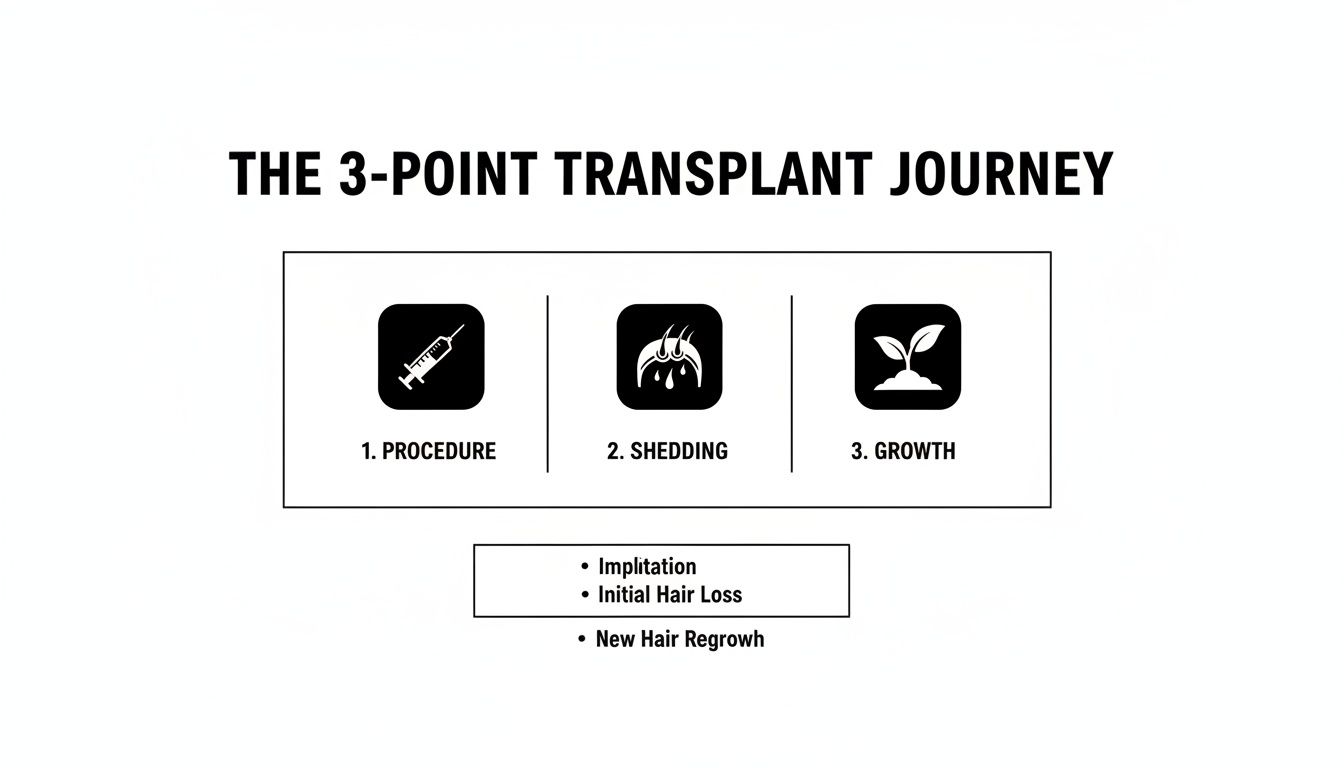
As you can see, it’s a marathon, not a sprint. The journey involves the actual procedure, a shedding period, and then a slow-and-steady regrowth phase.
Permanence and Natural Appearance
This is where the two options truly part ways. A hair transplant offers a permanent, living solution because it uses your own hair follicles, just moved to a new location. Once those follicles take root and start growing, that hair is yours for life. It will grow, need cutting, and even turn gray right along with the rest of your hair. It becomes a seamless part of you.
A high-quality hair system, especially one made from real human hair, can look incredibly realistic. But it’s fundamentally a temporary accessory. The unit itself wears out and will need to be replaced every 6 to 24 months. It won't adapt as you age; you’ll have to get new systems over the years to match any changes in your natural hair color or texture.
The core trade-off is this: a hair system gives you a flawless but static look that demands ongoing upkeep, while a transplant delivers a dynamic, growing result that truly becomes your own.
When it comes to lasting results, modern hair transplants are incredibly reliable, with 90-95% graft survival rates. This means that once you’re past that initial growth period, the hair is there to stay.
Ideal Candidacy and Lifestyle Fit
Who you are and how you live play a massive role in which option is better for you. Hair systems are remarkably versatile and are one of the best alternatives to a hair transplant for specific situations.
-
Hair System Candidates: This is a fantastic option for men with very extensive hair loss who may not have enough healthy donor hair for a transplant. It’s also great for anyone who wants to "test drive" a full head of hair without a surgical commitment or for those who need a solution they can reverse if they change their mind.
-
Hair Transplant Candidates: The best candidate has stabilized hair loss and a good, dense supply of donor hair on the back and sides of their head. This is someone looking for a one-and-done, low-maintenance solution who is willing to be patient to see the final outcome.
Hair System vs Hair Transplant At a Glance
Sometimes, seeing the key differences side-by-side makes the decision clearer. Here's a straightforward breakdown to help you compare the two at a glance.
| Factor | Hair System | Hair Transplant |
|---|---|---|
| Result Speed | Instant | 12-18 months |
| Permanence | Temporary (requires replacement) | Permanent |
| Naturalness | Looks natural but is static | Grows and ages with you |
| Maintenance | High (regular salon visits) | Low (just like your own hair) |
| Procedure | Non-surgical application | Minimally invasive surgery |
| Best For | Extensive hair loss, immediate results | Stable loss, long-term goals |
Ultimately, both are valid choices. The "better" option depends entirely on your personal goals, budget, lifestyle, and how quickly you want to see a change in the mirror.
The True Cost Breakdown: Investment Versus Subscription

When we get to the money conversation, the hair system vs. hair transplant debate seems simple at first glance. One option looks way cheaper, and the other can feel like a major financial hurdle. But that’s just looking at the price tag on day one.
The real story unfolds over years, and it's a classic tale of a one-time investment versus a lifelong subscription. A hair transplant is a significant, planned expense for a permanent result. In contrast, a hair system's lower entry cost is just the first payment in a continuous cycle of spending. Let’s actually crunch the numbers and see what each path costs over time.
The Hair System: A Continuous Subscription
Think of a hair system like a subscription service for your hair. You pay an initial fee to get it installed, but then you're on the hook for regular monthly and annual costs just to keep it looking good. As long as you want to wear it, the financial commitment never really ends.
The first hit to your wallet is the system itself. A good, custom-made unit using real human hair can run you anywhere from $1,000 to $3,000. But that’s just to get in the door. The real costs are hidden in the upkeep and replacements.
- Professional Maintenance: Plan on visiting a specialist every 4-6 weeks for a professional re-bonding and haircut. Each visit can cost between $200 and $500, easily adding up to thousands per year.
- Maintenance Products: You'll also need a steady supply of specialized adhesives, solvents, and shampoos for at-home care, which adds another few hundred dollars to your annual bill.
- Full Replacements: Hair systems don't last forever. They wear out. Depending on the base material and how well you care for it, you’ll need a brand new unit every 6 to 24 months. That means re-buying your initial investment over and over again.
When you add it all up, those recurring expenses over a decade can easily climb past $20,000 to $50,000. What started as an affordable choice can quickly become a serious long-term financial drain.
The Hair Transplant: A One-Time Investment
A hair transplant, on the other hand, is much more like a permanent home improvement. The upfront cost is substantial, there's no denying that. But once it's paid for, the ongoing financial burden is minimal.
The price of a transplant is mostly driven by the number of grafts you need to achieve the density you want. Typically, costs average between $4,000 and $15,000 for a single procedure. That’s a wide range, but it covers most men with moderate hair loss who need 1,500 to 4,000 grafts. You can get a much clearer idea by checking out our guide that explores how much hair restoration costs based on various factors.
After the procedure and healing period, the new hair is yours—permanently. There are no special products to buy, no mandatory salon visits for re-bonding, and definitely no replacement units to budget for. Your only ongoing cost is getting a regular haircut, just like you always have.
The crucial financial difference in the hair system vs. hair transplant debate is that a transplant's cost has an endpoint. A hair system’s costs do not.
The long-term math almost always favors the transplant. With a hair system, you're looking at $2,000 to $5,000 annually just for maintenance and replacements. In just a few years, those costs can easily surpass the one-time price of a transplant.
Ultimately, a transplant frames your hair restoration as a permanent asset. A system, however, positions it as a recurring liability. The choice really comes down to whether you’d rather pay once for a lasting solution or manage smaller, but endless, payments for a temporary one.
So, How Do You Choose What's Right for You?
Alright, you've seen the side-by-side comparison. Now comes the hard part: figuring out which path makes sense for your life. It's easy to get lost in the details, but the choice between a hair system and a hair transplant really boils down to a few key personal factors. This isn't just about hair; it's about your lifestyle, your patience, and what you want to see in the mirror a year from now.
To cut through the noise, let's get practical. Ask yourself these straightforward questions.
Your Decision Checklist
Be honest with yourself here. There's no "better" option overall, only the one that aligns with your reality.
-
How fast do I need to see a change? If you have a wedding in two months or you're just done with waiting, a hair system is your answer. It delivers a full head of hair instantly. A transplant, on the other hand, is a long game—you're looking at 12-18 months before you see the final, grown-in result.
-
Am I okay with a regular maintenance routine? A hair system is a commitment, almost like a subscription service for your hair. You'll have cleaning schedules, re-bonding appointments, and eventual replacements. If that sounds like a chore you'd rather avoid, the one-and-done nature of a transplant will feel like a breath of fresh air.
-
Is my hair loss still progressing? Transplants work best when your hair loss has stabilized. If you're still thinning aggressively, you might find yourself needing another procedure down the line to fill in new gaps. A hair system can be a great solution in the meantime, or even long-term.
-
Do I have enough donor hair to work with? This is the make-or-break question for surgery. If your hair loss is very advanced (think Norwood stage 6-7), there might not be enough healthy follicles on the back and sides of your head to achieve the density you want. A hair system, however, works regardless of how much hair you've lost.
The right choice often comes down to a single question: Are you solving for today or for the rest of your life? A hair system provides a perfect, immediate look, while a transplant offers a permanent, growing part of you.
Real-World Scenarios: Who Gets What?
Let's ground this in reality. The best move in the hair system vs hair transplant debate is completely situational.
A hair system is a fantastic choice for a man who wants to see what he looks like with a full head of hair without making a permanent surgical commitment. It's also the only real option for guys with extensive hair loss who just don't qualify for a transplant anymore. Think of it as the ultimate tool for guaranteed density on demand.
On the flip side, a hair transplant is the definitive solution for someone who wants a permanent, low-maintenance head of their own hair. If your hair loss has settled down, you have good donor hair, and you have the patience for the journey, a transplant gives you back something incredible: your own hair that you can wash, style, and run your fingers through without a second thought.
At the end of the day, only you can make this call. Our job is to give you the unvarnished facts so you can move forward with confidence, ready to get back not just your hair, but a part of yourself.
Your Top Questions Answered
Even with all the facts laid out, you probably still have a few practical questions bouncing around in your head. Let's tackle some of the most common ones I hear from men trying to make this exact decision.
Can You Actually Swim and Work Out with a Hair System?
Absolutely. This is a huge misconception. Today’s high-end hair systems are built for an active life, bonded with incredibly strong, waterproof adhesives. As long as you're keeping up with maintenance and the bond is solid, you can hit the gym, swim laps, or get caught in the rain without a second thought.
Just How Natural Does a Hair Transplant Look Up Close?
A modern hair transplant, done by a skilled surgeon, is practically invisible to the naked eye. The artistry is in the details—they place each individual graft to match the angle, direction, and density of your natural hair growth. Since it’s your own hair, it grows, changes, and even goes gray just like the rest of your hair, blending in perfectly.
Think of it this way: a top-tier hair system looks flawless, but a great hair transplant is flawless because it’s your own real, living hair.
What if I'm Using a Hair System Now but Want a Transplant Later?
Making the switch is not only possible, but it's also a path many guys take. You can wear a hair system for years and then decide you’re ready for something permanent. As long as you’re a good candidate with enough donor hair, you can simply stop using the system and schedule a transplant. It’s a great way to have an immediate solution while you plan for a permanent one down the road.
At PRP For HairLoss, our mission is to give you clear, straightforward information for your hair restoration journey. Whether you're just starting to explore options or are ready for a definitive solution, we want to equip you with the right knowledge. You can find more in-depth resources on all your options at https://prpforhairloss.com.
 PRP For Hairloss
Leave a comment