Finding a growing collection of hair in your sink or tangled in your brush is always a little jarring. It immediately sparks that one big question: is this permanent?
Let's get straight to it. While some types of shedding are just a temporary phase, for the vast majority of guys, the kind of gradual thinning you're likely noticing is a progressive and often permanent condition. But here's the good news: it's also highly manageable once you know what you're up against.
The Big Question: Is Your Hair Loss Here to Stay?
Worrying about hair loss is a common experience for guys. It’s not just about what you see in the mirror; it’s about figuring out what’s actually happening on your scalp and what the future holds. You’ve come to the right place for clear, no-nonsense answers.
Think of this guide as your roadmap. We're going to break down the key differences between temporary shedding and the more common, permanent thinning that most men encounter. Our goal is to give you the confidence to understand the signs your body is sending you.
Understanding the Prevalence of Male Hair Loss
First off, you should know that you are far from alone in this. The reality is that androgenetic alopecia—much better known as male pattern baldness—is the culprit behind about 95% of all hair loss in men. It's the most common cause by a long shot, and it is typically permanent.
The numbers really put it into perspective. By the time they hit 35, roughly two-thirds of American men will have some degree of noticeable hair loss. That figure jumps to about 85% of men having significantly thinner hair by age 50. For a deeper look at these stats, the American Hair Loss Association is a great resource.
This leads us to the real issue at the root of it all: the hair follicle. When we talk about "permanent" loss, what we usually mean is that the hair follicle has either been irreversibly damaged or has shrunk so much that it can no longer produce a healthy, visible hair.
The crucial difference comes down to the health of the hair follicle. Temporary shedding happens when healthy follicles drop their hairs too soon. Permanent loss, on the other hand, almost always involves the slow, steady shrinking—or miniaturization—of the follicles themselves.
Grasping this distinction is the absolute first step toward forming a smart plan. It all starts with figuring out if your follicles are just sleeping on the job (dormant) or if they've shut down for good. For a more detailed explanation on this, check out our guide on whether dead follicles can be revived. Knowing the true state of your follicles is essential for setting realistic goals and choosing a strategy that will actually work for you.
Decoding the Clues Your Scalp Is Giving You
Think of yourself as a detective. The case? Your own hair loss. Your scalp and the hair on your pillow are leaving a trail of evidence, and if you know how to read the clues, you can figure out if you're dealing with something temporary or a more permanent change.
The first step is simply to observe. Paying close attention to the specific patterns of your thinning can tell you a huge part of the story and help you build a clearer picture of what's going on.
The "Where" – Location Is Everything
The location of your hair loss is one of the biggest giveaways. Permanent male pattern baldness, for example, almost always follows a predictable script. Take a good look in the mirror—do any of these classic signs seem familiar?
- The M-Shaped Hairline: Is your hairline pulling back at the temples? This retreat often creates a distinct “M” shape and is a dead ringer for male pattern baldness.
- The Thinning Crown: Maybe you’ve noticed a thinning spot or a small bald patch developing right at the top of your head, also known as the vertex. This is another classic starting point for permanent loss.
- Overall Thinning on Top: Sometimes, the loss isn't just in one spot. You might notice a general, widespread thinning across the top of your scalp that makes your hair feel less dense than it used to.
In contrast, temporary shedding usually looks quite different. It tends to show up as diffuse hair fall from all over your head, without a specific pattern like a receding hairline. Certain scalp conditions that cause hair loss can also create unique patterns, which is why location is such a vital piece of the puzzle.
The "When" – It’s All About Timing
The timeline of your hair loss provides another critical piece of evidence. Did it seem to happen overnight, or has this been a slow, creeping change over the last few years?
Permanent hair loss, particularly androgenetic alopecia, is a marathon, not a sprint. It develops very gradually over years, sometimes even decades. You might only really notice the difference when you compare a recent photo to one from five or ten years ago.
On the other hand, a sudden and dramatic increase in shedding often points to a temporary condition like telogen effluvium. This type of loss is almost always kicked off by a specific event—a major illness, surgery, or even just a period of intense stress.
This decision tree helps visualize how the timeline can point you toward different potential causes.
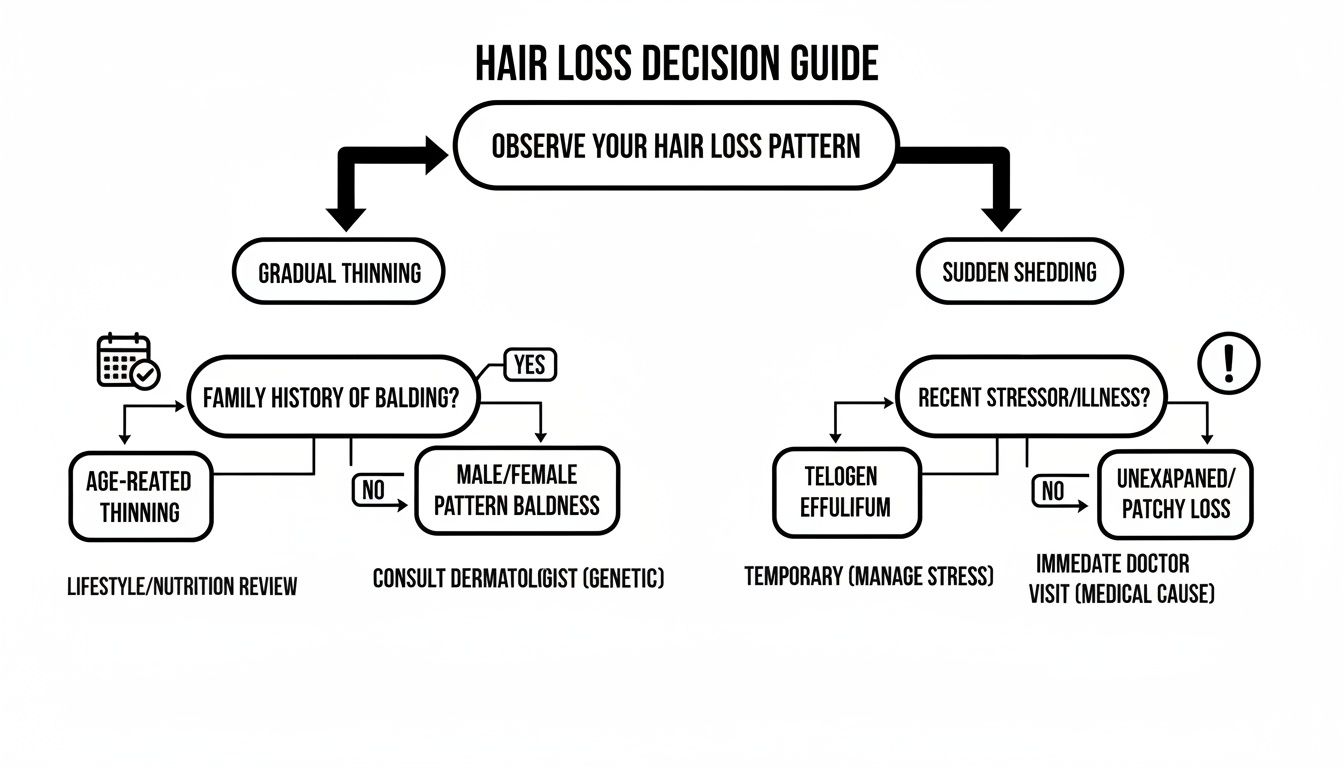
As the chart shows, a slow, progressive thinning is a strong indicator of a permanent genetic pattern. Abrupt, heavy shedding, however, is much more likely to be a temporary, trigger-based reaction.
The "What" – Look at the Hair Itself
Beyond where and when, the "what" refers to the physical changes in your hair strands. This is where we see one of the clearest signs of permanent hair loss: miniaturization.
Miniaturization is the process where hair follicles, under the influence of the hormone DHT, literally start to shrink. As they get smaller, they produce hairs that are progressively finer, shorter, and weaker with each growth cycle.
Think of a healthy hair follicle as a big, robust oak tree. Miniaturization is like that tree slowly shrinking over time, eventually becoming a tiny bonsai that can only produce a fragile, wispy twig.
This is exactly why male pattern baldness is often described as "thinning" long before it becomes outright "balding." The hair is still there, but it’s lost its former thickness and color, making the scalp underneath much more visible.
This table breaks down the key differences to look for when you're examining your hair loss.
Key Signs of Permanent vs Temporary Hair Loss
| Sign to Check | What It Looks Like in Permanent Loss | What It Looks Like in Temporary Loss |
|---|---|---|
| Pattern of Loss | Follows a specific pattern (receding hairline, thinning crown). | Diffuse shedding all over the scalp, no clear pattern. |
| Speed of Onset | Very gradual, developing over several years or even decades. | Sudden and noticeable, often starting abruptly. |
| Hair Quality | Hairs become finer, shorter, and lighter in color (miniaturization). | Hair that falls out is typically normal, full-length hair. |
| Family History | Often a strong genetic link (father, grandfather, uncles). | Not typically linked to genetics. |
| Associated Event | No specific trigger; it’s a progressive condition. | Usually follows a trigger 2-3 months later (stress, illness, etc.). |
Taking a moment to analyze these signs can give you a much better handle on what you're up against. Remember, a large U.S. survey noted that 53% of men aged 40–49 experienced moderate to severe male pattern baldness, highlighting just how common this slow, steady progression is.
Understanding What Causes Hair Loss in Men
Once you start noticing the signs of thinning, the big question is why it's happening. The root cause is the single most important clue to figuring out whether the hair loss is here to stay.
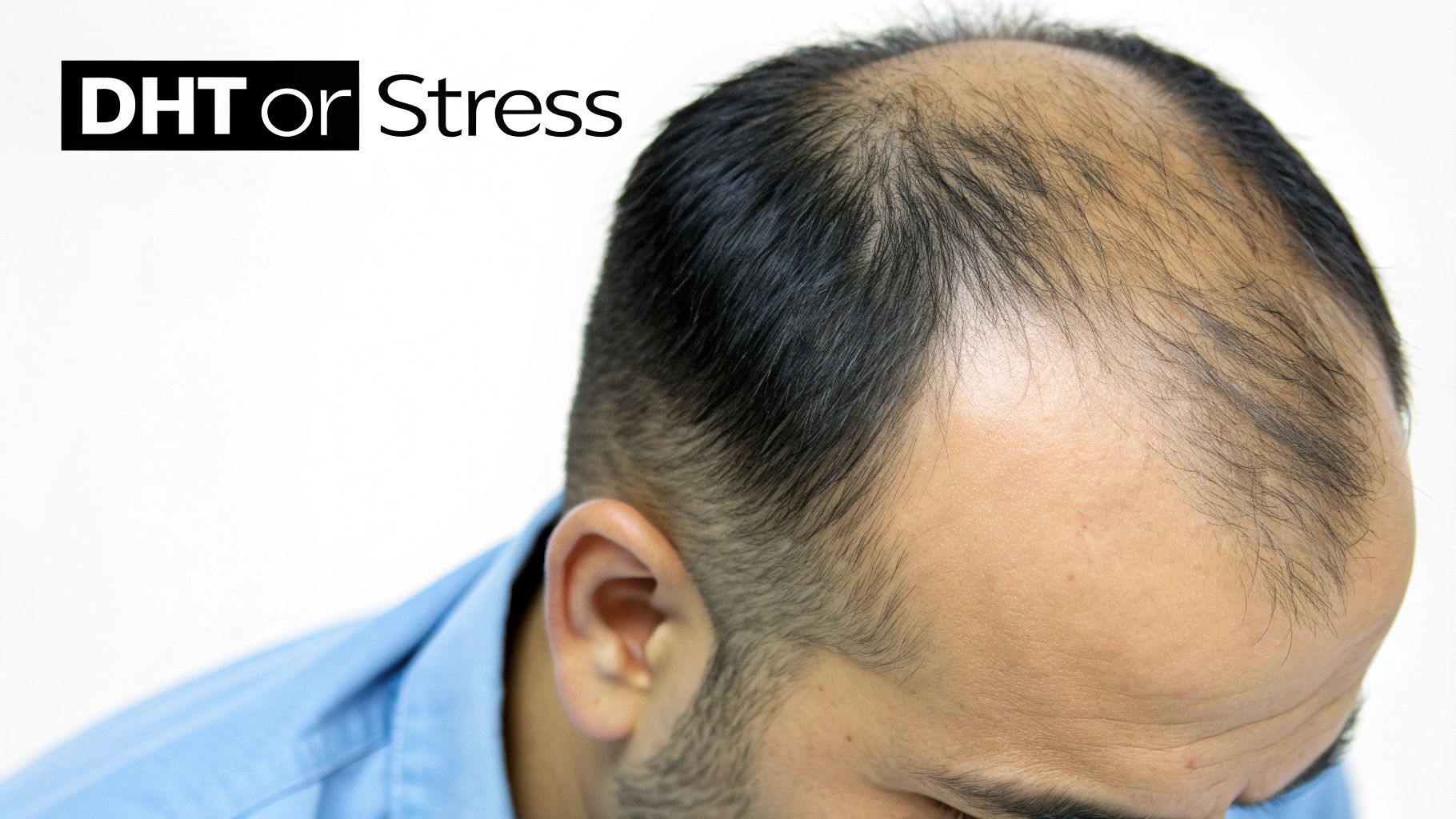
For the vast majority of men, the answer is a one-two punch of genetics and hormones. This is the classic, permanent condition we all know as male pattern baldness, or as doctors call it, androgenetic alopecia.
The Main Culprit: Dihydrotestosterone (DHT)
Think of your hair follicles as tiny, hair-producing factories. If you have the genes for hair loss, these factories have a critical vulnerability to a hormone called dihydrotestosterone (DHT).
DHT, a byproduct of testosterone, latches onto receptors in your hair follicles. For susceptible follicles, this sends a signal that kicks off that miniaturization process we talked about earlier.
Imagine DHT as a dimmer switch on your hair follicles. Over many years, with each new hair cycle, DHT just keeps turning that switch down a little more. The follicles shrink, their growth phases get shorter, and the hair they produce becomes weaker and finer, until they eventually just switch off.
This is a slow, methodical process, which is why male pattern baldness unfolds over years, not overnight. Your hair doesn't just fall out; it’s gradually replaced by weaker versions of itself until it’s essentially gone. To get a really deep dive on the science, you can learn more about what causes male pattern baldness and see how it all works.
Temporary Shedding: The Body’s Stress Reaction
Now, in complete contrast to the slow march of DHT, temporary hair loss often feels like a sudden ambush. The most common type is called telogen effluvium, and it’s a totally different ballgame.
Instead of shrinking the follicle, a major shock to your system—think a serious illness, surgery, extreme stress, or a big nutritional gap—can jolt a huge number of your hair follicles into the resting (telogen) phase all at once.
This means a couple of months after the event, you suddenly see a lot of shedding all over your head. It's alarming, for sure. But the good news is the follicle itself isn't damaged. Once your body recovers from the stressor, the follicles usually reset and get back to their normal growth cycle within a few months.
Common Triggers for Temporary vs. Permanent Loss
Knowing what’s behind your hair loss is everything, because the game plan for each is completely different. Our comprehensive guide on hair loss causes breaks these distinctions down even further.
Here’s a quick cheat sheet on the common triggers for each type:
Permanent Hair Loss (Androgenetic Alopecia) is driven by:
- Genetics: You inherit your follicles' sensitivity to DHT. It's in your DNA.
- Hormones: The presence of DHT acting on those vulnerable follicles.
- Age: The process simply becomes more noticeable as the years go by.
Temporary Hair Loss (Telogen Effluvium) can be triggered by:
- Severe Stress: Physical trauma like surgery or a high fever, or intense emotional stress.
- Dietary Deficiencies: Not getting enough key nutrients like iron, zinc, or protein can throw your hair cycle out of whack.
- Medical Conditions: Things like thyroid disorders can directly interfere with hair growth.
- Certain Medications: Some prescription drugs have hair shedding listed as a known side effect.
Recognizing these key differences is your first real step toward a solution. If your hair loss story involves a slow, predictable pattern that runs in the family, you're almost certainly dealing with something permanent. But if it was sudden, widespread, and followed a major life event, there's a very good chance it's temporary.
When It's Time to See a Professional for a Clear Diagnosis
Trying to figure out your hair loss on your own is a lot like listening to a weird noise in your car's engine. You might guess it's the fan belt or something with the exhaust, but you won't really know what's wrong until a mechanic gets under the hood. For a real answer on how to know if hair loss is permanent, you need to let a professional take a look.
Making that appointment can feel like a big step, but it’s the most important thing you can do. A dermatologist or trichologist (a specialist who lives and breathes hair and scalp health) has the training and tools to get past the guesswork and give you a definitive diagnosis.
Getting that clarity takes the anxiety out of the equation. It puts you on a real path toward a plan that actually works. If you're unsure who to call, our guide on what doctor you see for hair loss can point you in the right direction.
The Diagnostic Toolkit: What to Expect at Your Appointment
The good news? The diagnostic process is almost always simple and non-invasive. Your specialist isn’t going to do anything complicated or scary. They’re just gathering clues to figure out exactly what’s happening on your scalp.
Here’s a look at the common, straightforward methods they use:
- A Detailed History: First, they’ll just talk to you. Expect questions about when the loss started, your family history, lifestyle, diet, and any recent major life stressors. This conversation gives them the context they need for everything else.
- The Hair Pull Test: This sounds way more dramatic than it is. The doctor simply tugs gently on a small patch of about 50-60 hairs to see how many come loose. If more than a few come out, it often points to active shedding, a hallmark of conditions like telogen effluvium.
- Visual Scalp Examination: Often, just a close look at your scalp is revealing. A trained eye can spot subtle signs of inflammation, redness, scaling, or scarring that can immediately rule certain conditions in or out.
For many guys, especially those with classic male pattern baldness, this initial evaluation is enough for a specialist to make a confident diagnosis.
Think of your consultation as a fact-finding mission. The goal is to collect all the data—from your family history to the health of your follicles—to build a complete case file on your hair loss. This file becomes the blueprint for your action plan.
If the picture isn't crystal clear, your doctor might suggest a few more steps to confirm what they suspect or to rule out less common causes.
Getting a Closer Look
Sometimes, to really understand the problem, you need to see what’s going on at the follicular level. This is where modern diagnostic tools come in, giving a level of detail you could never get just by looking in the mirror.
Trichoscopy is one of the most powerful tools a hair loss specialist has. It's basically a high-powered, handheld digital microscope that gives them a super-magnified view of your hair shafts and scalp. It’s like putting your follicles under the microscope—literally.
With trichoscopy, a doctor can spot critical signs that are invisible to the naked eye:
- Follicle Miniaturization: They can see a mix of thick and thin hairs right next to each other, which is the textbook sign of androgenetic alopecia.
- Empty Follicles: The scope makes it easy to spot follicles that have stopped producing hair altogether.
- Scalp Inflammation: Even subtle inflammation around the follicles, which can accelerate hair loss, becomes clearly visible.
In some situations, if your doctor suspects an underlying medical issue, they might also recommend blood tests. This is a simple way to check for things like thyroid problems, hormone imbalances, or nutritional deficiencies (like low iron or zinc) that could be contributing to your hair loss. An accurate diagnosis isn't just about confirming what you have; it's also about confidently ruling out what you don't.
Creating Your Action Plan for Managing Hair Loss
Getting a diagnosis of permanent hair loss isn't a dead end—it's a starting line. This is the moment you shift from worrying about the problem to actively managing it. The term "permanent" might sound final, but it really just describes the ongoing nature of the condition, not a lack of effective solutions.
Building a solid plan is all about taking back control. With the right strategy, you can significantly slow down the thinning process, hold on to the hair you have, and in many cases, even see some regrowth. It all begins with a straightforward conversation with your doctor about what success looks like for you.

FDA-Approved Treatments: The Cornerstones of Hair Retention
When it comes to fighting male pattern baldness, two medications stand out as the most proven, widely used options. These have gone through rigorous testing to get the green light from the FDA, making them the foundation of most treatment plans.
First, there's Minoxidil, which you probably know by its brand name, Rogaine®. It’s a topical treatment, either a foam or a liquid, that you apply directly to your scalp. Think of it as a support system for your hair follicles; it helps boost blood flow, bringing more oxygen and vital nutrients right to the hair roots.
The second is Finasteride (brand name Propecia®), an oral pill you take once a day. This one works from the inside out. It gets to the very source of the problem by blocking the enzyme that converts testosterone into DHT, the hormone directly responsible for shrinking hair follicles.
By lowering DHT levels in your scalp, Finasteride essentially hits the brakes on the miniaturization process. For a lot of men, this not only stops further loss but gives those weakened follicles a chance to recover and start producing healthier, thicker hair again.
It's crucial to set realistic expectations here. These treatments deliver the best results when you start early, and their main job is to stop the progression. Regrowth is a fantastic bonus, but just maintaining what you have is a huge win. And remember, consistency is everything. You have to stick with them to keep the benefits.
Innovative Therapies: Platelet-Rich Plasma (PRP)
Beyond the go-to medications, some guys explore other therapies to give their routine an extra edge. One of the most talked-about options right now is Platelet-Rich Plasma (PRP) therapy, which uses your body's own healing abilities to encourage hair growth.
The process itself is surprisingly straightforward:
- Step 1: A small amount of your blood is drawn, just like a routine blood test.
- Step 2: That blood is spun in a centrifuge, a machine that separates it into different layers.
- Step 3: This spinning isolates the platelet-rich plasma, a golden liquid packed with natural growth factors.
- Step 4: This concentrated "liquid gold" is then carefully injected back into the areas of your scalp where thinning is a concern.
The science behind it is pretty cool. Those growth factors in the plasma act like a wake-up call for dormant or struggling hair follicles, nudging them back into their active growth phase while also improving blood supply to the scalp.
PRP is typically best for those in the earlier stages of hair loss who still have a decent number of viable, albeit miniaturized, follicles. It’s often used in combination with Minoxidil and Finasteride to create a multi-pronged attack on hair loss. Of course, the first step is always talking to a specialist to see if you're a good candidate. There is a lot to learn about every FDA-approved hair loss treatment available.
Setting Realistic Goals and Taking the Next Step
At the end of the day, managing permanent hair loss is a long-term commitment, not a one-and-done fix. The goal is to find a sustainable routine that fits your lifestyle and helps you maintain your hair with confidence. Success isn't about getting back the hairline you had at 18; for most guys, it's about stopping the clock and preserving what they've got.
Your action plan is all about being proactive, not reactive. It starts with getting a professional diagnosis and moves toward building a personalized treatment strategy. The sooner you get started, the better your odds of getting the results you want.
Taking that first practical step is easy. You can schedule your appointment with a hair loss professional today to get a clear diagnosis and start building a plan that’s tailored specifically for you. It's a simple action that can mark the beginning of your journey toward taking control of your hair loss.
Frequently Asked Questions
When you start looking into hair loss, you're bound to have a lot of questions. Getting clear, straightforward answers is a huge part of feeling in control. We've gathered some of the most common questions we hear from guys to give you the clarity you need as you figure out your next steps.
If My Dad Is Bald, Will I Be Too?
This is the big one, and the honest answer is… it’s complicated. While genetics are absolutely the main driver behind male pattern baldness, it’s not as simple as just looking at your dad.
The genes responsible for your hair's future can come from both sides of your family. So, a bald father definitely raises the odds, but it's not a guarantee. You've got to look at the bigger picture—check out the hair on your grandfathers (both mom's and dad's side) and your uncles to get a better sense of your genetic hand.
Think of it like being dealt a hand of cards. Your dad passed down some of his, but your mom’s side of the family threw some in, too. Your final hand is a mix of all of it.
Can Severe Stress Cause Permanent Hair Loss?
This question comes up a lot because we all know stress can make hair fall out. Typically, hair loss from a major stressful event—a condition called telogen effluvium—is temporary. Once the stress is gone and your body recalibrates, the hair usually grows back within a few months.
But there’s a crucial distinction here. While a single stressful event won't cause permanent baldness, chronic, long-term stress is like throwing gasoline on a fire. If you’re already genetically wired for permanent hair loss, constant stress can absolutely speed things up and make it more noticeable, sooner.
So, no, stress doesn't cause permanent baldness on its own. But it can definitely accelerate the process if the programming is already there. That makes managing stress a key part of any solid hair retention strategy.
Is It Too Late to Start Treatment?
A lot of men wait until their hair loss is pretty noticeable before they think about doing something, and then worry they've missed the boat. The good news? It’s almost never "too late" to start managing hair loss.
The key is to set realistic expectations. If an area on your scalp is completely smooth and has been that way for years, it’s highly unlikely you’ll regrow a full head of hair there with treatments alone. Those follicles have likely shut down for good.
However, treatment can still be incredibly effective for two critical goals:
- Slowing or stopping more hair loss: This is a huge win. Just holding onto the hair you have is the primary goal for many guys.
- Thickening up existing hair: Treatments can often revive those weakening, thinning hairs, making them healthier and creating a much fuller look.
The focus just shifts from total regrowth to proactive maintenance. For most guys, stopping the progression and keeping what they’ve got is a massive confidence booster and a successful outcome.
Will Wearing Hats Make My Hair Loss Worse?
This is a stubborn myth that just won't die. The simple truth is that wearing a hat, no matter how often, does not cause male pattern baldness. Permanent hair loss is an internal game of genetics and hormones.
Your hat isn't cutting off blood flow or suffocating your follicles. The only, very rare exception is if a hat is so painfully tight that it's physically yanking your hair out (a condition called traction alopecia). For 99.9% of hat-wearers, this is not a concern. Go ahead and wear your favorite cap without worry.
Does Diet Really Affect Permanent Hair Loss?
Your diet plays a supporting role, not a leading one. A bad diet won't cause male pattern baldness—that's a genetic script. However, a diet that’s missing key vitamins and minerals can definitely make existing hair loss worse or even trigger other types of temporary shedding on top of it.
Think of your hair follicles as tiny factories. They need the right raw materials (like iron, zinc, biotin, and protein) to run properly. If your body is deficient, it can't support healthy hair growth. A balanced diet is fundamental for your overall health, and that absolutely includes your hair. It ensures your follicles have the fuel they need to fight the good fight.
Navigating hair loss starts with good information. The team at PRP For HairLoss is dedicated to providing clear, factual content to help you understand what's happening and what you can do about it. From understanding the causes to exploring treatments like PRP, we're here to support you. To learn more, visit us at https://prpforhairloss.com.

 PRP For Hairloss
Leave a comment