So, let's get straight to it: Does collagen help hair growth? The short answer is yes, it absolutely plays a powerful supporting role. But it’s not a magic bullet for male pattern baldness.
The best way to think about collagen is as the foundational material your body needs to build healthier, stronger hair. It’s less of a direct cure and more of a vital ingredient in the recipe for better hair.
Collagen and Hair Growth: The Bottom Line
When you see endless rows of collagen supplements, it's easy to get lost in all the marketing promises. For guys concerned about thinning hair, it's crucial to understand what this stuff actually does. So, what's the real story?
Collagen is the most abundant protein in our bodies. It’s pretty much the "glue" holding everything together—skin, bones, and, critically, the structures that anchor your hair follicles.
Your hair itself is mostly made of a different protein called keratin. To build that keratin, your body needs a very specific mix of amino acids. As it turns out, many of those essential amino acids are found in high concentrations within collagen. The idea behind taking a collagen supplement is to give your body a surplus of these building blocks, especially proline, which is a key player in hair construction.
Why It Matters for Your Hair
This is why collagen is getting so much buzz. It's not about regrowing hair on a completely bald scalp. It's about optimizing the health and quality of the hair you already have.
Here’s what that looks like in practical terms:
- Reinforcing Hair Structure: By supplying those key amino acids, collagen helps fortify the hair shaft itself, which can lead to strands that feel thicker and are less prone to breaking.
- Improving the Scalp Environment: Healthy hair can only grow from a healthy scalp. Collagen helps maintain your skin’s elasticity and hydration, creating a much better foundation for your follicles to do their job.
- Protecting Follicles from Damage: Some early studies suggest collagen might act as an antioxidant, which could help defend your hair follicles against the everyday damage caused by free radicals.
For a quick overview, here's a summary of what you can realistically expect.
Collagen for Hair Growth At a Glance
| Key Aspect | Summary of Evidence |
|---|---|
| Direct Hair Regrowth | No direct evidence that it reverses male pattern baldness. |
| Hair Quality & Thickness | Strong supporting role; provides amino acids for building stronger, thicker-looking hair. |
| Scalp Health | Contributes to skin hydration and elasticity, creating a better environment for follicles. |
| Mechanism of Action | Provides amino acid building blocks (like proline) for keratin production. |
| Best Use Case | A foundational supplement to improve the quality of existing hair, not a standalone cure. |
Ultimately, this all points to one conclusion.
The most realistic expectation is that collagen can improve the thickness and health of existing hair. It’s a foundational piece of a larger puzzle, not a standalone solution for androgenic alopecia.
Viewing collagen as a key nutritional support is the smartest way to approach it. It delivers the best results when used alongside other proven hair health strategies and is just one of many ways to increase hair growth naturally.
Understanding Your Hair's Natural Growth Cycle
To really wrap your head around how collagen might help your hair, you first need to understand how hair actually grows. It’s not a constant process. Instead, every single hair follicle on your head cycles through a simple, repeating rhythm of growing and resting.
You can think of each follicle as having its own little 'on' and 'off' switch.
When the switch is on, your hair is in the anagen phase—this is the active growth period. When the switch flips off, the hair enters the telogen phase, which is a resting state before the strand eventually sheds.
For guys dealing with thinning hair, the problem often boils down to this cycle getting thrown out of whack. The anagen (growing) phase shortens, so hair doesn't get the chance to grow long and strong. At the same time, the telogen (resting) phase lengthens, which means more follicles are dormant and more hair is shedding.
Where Collagen Fits Into The Cycle
So, where does collagen come in? The thinking is that collagen provides the essential amino acids—the building blocks—that your body uses to produce keratin, the very protein your hair is made of.
By supplying these raw materials, collagen essentially gives your follicles the fuel they need to keep that 'on' switch flipped for longer. A well-fed follicle is a healthier follicle, better equipped to maintain a robust anagen phase. Over time, this can lead to hair that feels and looks thicker.
You can dive deeper into the nuts and bolts of the complete hair growth cycle to see exactly how each stage contributes to the hair on your head.
The goal isn't necessarily to regrow hair on a bald spot, but to strengthen the growth cycle of the hair you already have. By supporting a longer anagen phase, collagen helps create a better environment for that hair to thrive.
Understanding the cycle is step one. But to truly support your hair, you also have to consider external factors. Things like proper cleansing and conditioning are fundamental. You can check out some effective haircare routines for managing hair loss to round out your approach. Once you grasp the basics of hair biology, you’re in a much better position to decide how supplements and treatments can fit into your game plan.
What the Human Trials Actually Show
While the biological theories are interesting, what really matters are the results from studies on real people. Does any of this potential actually show up outside of a petri dish? When we look at the human trials, the picture becomes a lot clearer—and it's a mix of promising signs and important reality checks.
It’s crucial to know that most of this research isn't trying to reverse male pattern baldness. Instead, the studies have focused on measuring improvements in the quality and thickness of the hair people already have.
Examining the Clinical Evidence
Several randomized, placebo-controlled trials have found noticeable, statistically significant improvements in hair after participants took oral collagen peptide supplements. But it’s important to keep a level head here. These studies often involve small groups of people and are frequently tied to a specific branded product, which can make it hard to say the findings apply to all collagen supplements.
A great example comes from a study on a specific Bioactive Collagen Peptide called VERISOL®. In this trial, 44 healthy women aged 39 to 75 took 2.5 grams of these collagen peptides every day for 16 weeks. The results were pretty compelling: the collagen group saw a statistically significant increase in hair thickness compared to the group that got a placebo.
To connect what they saw in people to what was happening on a biological level, the researchers also ran lab tests. They discovered a 31% increase in the proliferation of human hair follicle cells after just four hours of exposure to the same peptide formula.
This suggests a direct link between taking the supplement and revving up cellular activity right at the follicle. You can read the full research about these hair thickness findings to dive deeper into the data. It’s a promising result, but it's also a reminder that collagen is just one piece of a much larger puzzle.
What This Means for You
These findings suggest that for some people, the right type of collagen supplement can deliver real, measurable benefits. The main takeaway is that collagen seems to support the hair you currently have, potentially making it stronger, thicker, and more resilient.
It doesn’t work in a vacuum, though. The amino acids from collagen need to work alongside other key nutrients. To really maximize any potential benefits, you want to make sure your body has everything it needs. You can explore our complete guide on the most effective vitamins for hair growth to see how all these nutrients fit together.
So, the bottom line from human trials is one of cautious optimism. While collagen is definitely not a cure for hair loss, the evidence strongly suggests it can be a valuable nutritional tool for improving the overall quality and density of your hair.
So, How Does This Stuff Actually Work?
Alright, let's get into the nitty-gritty. Clinical results are one thing, but to really understand what's going on, we need to pop the hood and look at the biological engine. The lab research—the stuff done with cell cultures and animal models—is what starts to connect the dots between a daily supplement and what’s happening deep inside your scalp.
The most fascinating part isn't just that collagen provides raw materials. The evidence points to certain collagen peptides acting like tiny messengers, delivering instructions directly to your hair follicle cells, telling them to get to work. It’s less about passive nutrition and more about actively flipping a switch.
Fueling the Follicle Engine
One of the most promising theories centers on how collagen might influence the hair growth cycle itself, especially the anagen phase—that's the active growth period. For guys dealing with hair thinning, a shorter anagen phase is a huge part of the problem. If collagen can help extend it, that’s a game-changer.
This isn't just a guess. In a mouse study, researchers saw some pretty compelling results with fish collagen peptides. By day 21, the mice getting the highest dose had hair regrowth scores on par with those treated with finasteride, a gold-standard hair loss drug. Not only that, but their follicles were anchored deeper in the skin, and they had a much healthier ratio of growing hairs to resting hairs (anagen-to-telogen).
Diving deeper into the lab work, scientists applied specific collagen peptides directly to human hair follicle cells. The result? A roughly 31% increase in cell proliferation. These peptides also cranked up mitochondrial activity, basically supercharging the cells' tiny power plants.
This points to a clear mechanism: these peptides don't just hang around. They actively nudge follicles to stay in their growth phase longer and operate with more horsepower. If you want to see the raw data for yourself, you can dig into the follicle metabolism findings from the study.
More Than Just Bricks and Mortar
When you look at all this, you start to see that collagen is far more than just a generic protein source. It seems to deliver a very specific toolkit of amino acids that perform several critical jobs for your hair.
- Building Keratin: Collagen is loaded with proline, an absolutely essential amino acid for producing keratin—the protein that makes up over 90% of every hair on your head.
- Fighting Off Damage: Some studies suggest that collagen peptides can act as antioxidants, helping shield the delicate hair follicle from the cellular stress caused by free radicals.
- Sending the Right Signals: As we've seen, specific peptides can directly signal follicle cells to grow and divide, promoting a more vigorous and sustained hair cycle.
Of course, these aren't just any old amino acids. Each one has a specific role to play. For a closer look at how each one contributes, check out our guide on the most important amino acids for hair growth. This growing body of preclinical evidence is exactly why collagen is being taken so seriously as a legitimate tool for improving hair health.
Let's get real for a moment. While the science we've covered is promising, we need to temper that excitement with a dose of reality. It's easy to get swept up in the marketing hype, but it's far more important to understand what collagen can't do.
The biggest hurdle is simple biology. When you take a collagen supplement, it doesn’t travel directly to your hair follicles. Your digestive system immediately breaks it down into its fundamental building blocks: individual amino acids.
Think of it like taking apart a complex Lego model. You're left with a pile of basic bricks. Your body then uses those bricks wherever they’re needed most – for healing a wound, repairing muscle tissue, or supporting vital organs. There is absolutely no guarantee that those specific amino acids will be earmarked for your scalp.
What the Experts Say
This is exactly why you won't see most major health organizations giving collagen a universal stamp of approval for hair growth. The evidence just isn't strong enough yet, and results can be all over the map depending on the person, the product, and the dosage.
The Cleveland Clinic, for example, puts it bluntly, stating that the research is "far from conclusive." They highlight that many studies are small and often funded by the companies selling the supplements. As they explain, the path from your stomach to your scalp is anything but direct. This is why most doctors won't recommend collagen as a primary treatment for hair loss without more robust, independent evidence. You can discover more insights about the clinical perspective from their article.
Here's the bottom line: Collagen is a supportive player for overall hair quality, not a direct cure for baldness. It supplies the raw materials, but it doesn’t get to decide how or where your body uses them.
So, managing expectations is key. The most glaring gap in the current research is the lack of large, independent clinical trials focused specifically on men with male pattern baldness. Until that kind of data exists, any claim that collagen can reverse baldness should be taken with a huge grain of salt. The answer to "does collagen help hair growth" isn't a simple yes or no, especially when we're talking about significant hair loss.
How to Choose and Use a Collagen Supplement
So, you're ready to give collagen a shot for your hair. The first challenge is navigating the supplement aisle. Powders, pills, even creams—it’s a lot to take in. The real secret isn't the format, but what your body can actually absorb and put to work.
When it comes to oral supplements, the term you need to look for is hydrolyzed collagen, which you'll often see called collagen peptides. The hydrolysis process basically pre-digests the large collagen molecules, breaking them down into tiny, manageable pieces. It’s like chopping up vegetables before you cook them; your body can absorb these smaller peptides far more easily than it could whole collagen.
Finding a Quality Supplement
Once you've settled on hydrolyzed collagen, you have to play detective. The supplement industry isn't known for its strict regulation, so it's on you to vet the products.
Here’s a quick checklist to use when you're looking at a label:
- Third-Party Testing: Keep an eye out for seals from groups like NSF International or USP. This is your proof that an independent lab has verified the product for purity and that it contains what it claims.
- Clear Sourcing: Good brands are open about where their collagen comes from. You should be able to easily find out if it's from grass-fed cows, wild-caught fish, or another source.
- No Unnecessary Additives: The best collagen supplements have a short ingredient list. You don't want a bunch of fillers, sugar, or artificial junk getting in the way.
The decision tree below can help you figure out where collagen fits into your game plan—whether it should be a lead player or a supporting actor.
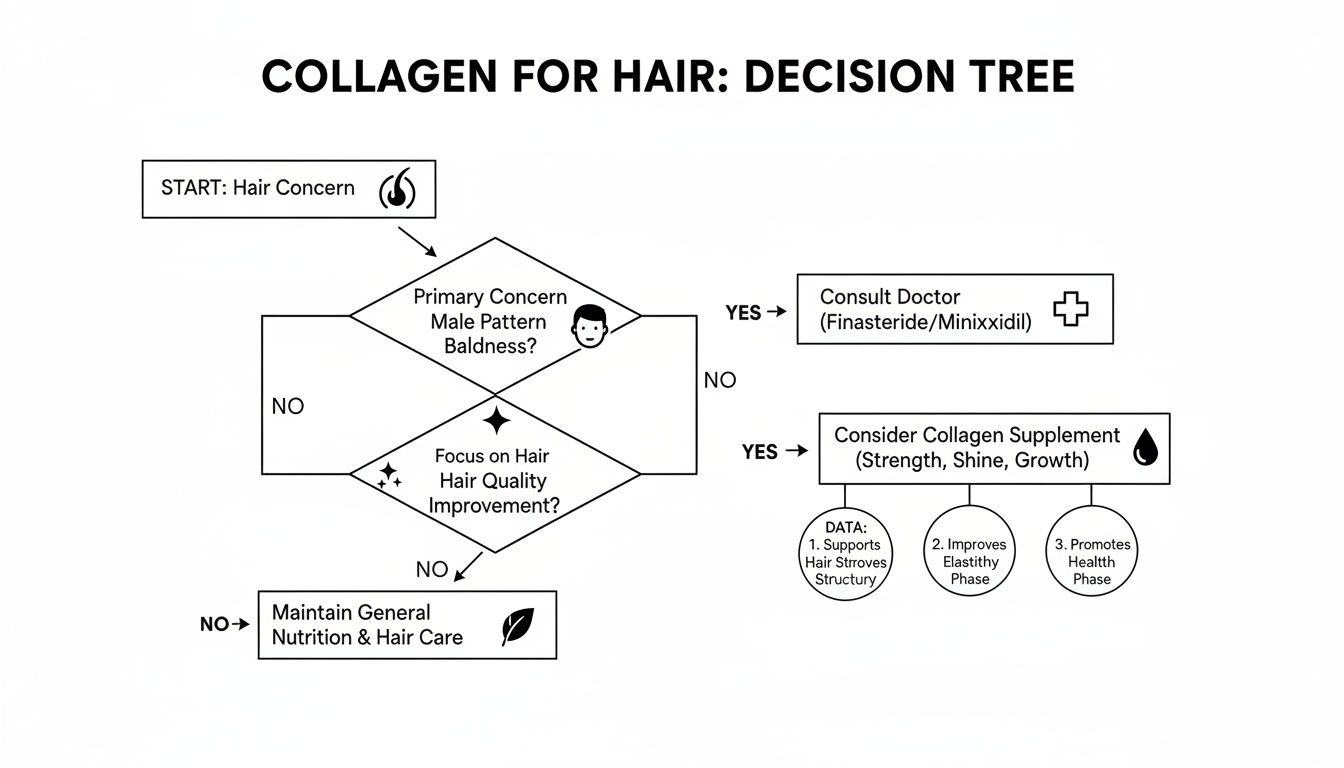
As you can see, collagen is fantastic for improving the quality and feel of the hair you already have. It's not, however, a front-line treatment for more advanced male pattern baldness.
Effective Dosage and Safety
So, what's the magic number? Most of the studies that have shown real benefits for hair and skin used daily doses between 2.5 to 10 grams. There's no need to go crazy. Starting on the lower end, around 2.5 grams a day, is a perfectly smart way to begin.
What truly matters is consistency. Taking a smaller dose every single day is much more effective than taking a huge amount every once in a while.
The great news is that collagen is incredibly safe. Side effects are very rare and usually minor, like a bit of bloating or a feeling of fullness.
Think of collagen as a nutritional foundation. It's not a miracle cure, but it gives your body the raw materials it needs to build strong hair. It's just one tool in the toolkit, but a valuable one.
When you're comparing brands, it's worth digging into the specifics of their formulas. For instance, you can find deep dives into specific products like these Herbal Life collagen product benefits. And if you're looking to build a more comprehensive nutritional plan, check out our guide to the best hair vitamins for men.
Your Top Questions About Collagen for Hair, Answered
Let's cut through the noise and tackle the most common questions guys ask when they're thinking about using collagen for their hair. I'll give you straight, evidence-based answers based on what we've covered so far.
How Long Until I Actually See a Difference?
Patience is the name of the game with any new supplement. Based on the clinical trials we have, you'll likely need to wait 12 to 16 weeks of taking it every single day before you might notice any changes in your hair's thickness or overall quality.
Remember, hair growth happens at a snail's pace. Your body needs time to absorb those amino acids from the collagen and get them to where they're needed—inside the hair follicle. This isn't an overnight fix.
Can Collagen Get Rid of My Male Pattern Baldness?
Let me be direct: right now, there is zero scientific evidence that collagen supplements can reverse or cure male pattern baldness. That condition is a complex mix of your genes and how sensitive your follicles are to the hormone DHT.
Collagen's job is to support, not to cure. It can potentially help strengthen the hair you still have, making it appear thicker and healthier. But it’s not a proven way to wake up dormant follicles and regrow hair on a bald spot.
What's the Best Type of Collagen to Buy for Hair?
When you're looking at the supplement aisle, the one you want is hydrolyzed collagen, which you'll also see labeled as collagen peptides. This is the form that’s been most studied for hair and skin benefits.
The "hydrolyzed" part is key. It means the large collagen proteins have been broken down into tiny, easy-to-absorb pieces that your body can actually put to work. Whether it comes from cows (bovine), fish (marine), or chickens doesn't matter as much as making sure it's in this peptide form. Always check the label for those exact words.
At PRP For HairLoss, our goal is to give you clear, science-backed information so you can make smart choices for your hair. You can find more expert advice and explore treatment options over at our main website.
 PRP For Hairloss
Leave a comment