Trying to make sense of PRP for hair loss reviews online can feel like a full-time job. You'll find a dizzying mix of miracle stories and disappointed reports, making it tough to figure out what's real and what's just noise.
So, what's the general takeaway? PRP can be a fantastic option for tackling male pattern baldness, but it's super important to understand it's not a one-size-fits-all cure. For a lot of guys, it does a great job of slowing down hair fall and adding some much-needed thickness. For a smaller group, it can even trigger some impressive new growth.
Sorting Fact from Fiction in PRP Reviews
As you dive into personal accounts of Platelet-Rich Plasma (PRP) therapy, you'll see the full spectrum of outcomes. Some guys swear it was the best money they ever spent on their hair. Others feel it was a total letdown, with only minor changes to show for their investment. This wide range of results is the single most important thing to grasp.
Here's the thing: the success of PRP therapy isn't just a roll of the dice. The results really hinge on a few critical factors that can make or break the experience.
- Your Stage of Hair Loss: PRP delivers its best results for men in the earlier phases of hair loss, when follicles are dormant or weak, not gone for good.
- Provider Skill and Equipment: A huge part of the outcome depends on the clinic's technique, the quality of their centrifuge, and the final platelet concentration they can achieve.
- Your Unique Biology: At the end of the day, how your body responds to the injected growth factors is entirely individual.
- Treatment Consistency: Sticking to the initial schedule of 3-4 sessions and showing up for maintenance treatments is non-negotiable for lasting results.
What Real Patients Are Saying
After looking at hundreds of reviews, a few clear patterns emerge. On the positive side, men often love that PRP uses their body's own healing power—no foreign chemicals or drugs involved. The first sign it's working is usually a noticeable drop in shedding, followed by a gradual increase in hair shaft thickness over the next few months. You can get a deeper look into the specific ways PRP can help by exploring the benefits of PRP for hair right here on our site.
On the flip side, most of the disappointment comes down to mismatched expectations. Some guys go in hoping to regrow a full head of hair that was lost years ago, which just isn't what PRP is designed to do. The treatment is more about stabilizing loss and strengthening what you have. Cost is another frequent complaint, especially when the results don't feel dramatic enough to justify the price tag.
To give you a clearer picture, here’s a quick summary of what you'll find in patient reviews:
A Quick Look at PRP Patient Reviews
| Common Themes in Positive Reviews | Common Themes in Negative/Neutral Reviews |
|---|---|
| Noticeably Less Shedding: Often the first positive sign men report. | Unrealistic Expectations: Hoped for more dramatic new growth than is typical. |
| Thicker, Healthier Hair: Existing hairs feel stronger and fuller. | High Cost vs. Perceived Results: Felt the investment didn't match the outcome. |
| Natural, Non-Surgical Approach: Appreciated using their own biology to fight loss. | Slow or Subtle Changes: The gradual nature of results was underwhelming. |
| Increased Confidence: Feeling better about their hair's appearance. | Pain or Discomfort: The injections were more uncomfortable than anticipated. |
This table helps illustrate the divide. Success often comes down to having the right expectations from the very beginning.
It's also worth noting that what a patient sees and what a clinician measures can differ. One 12-month study found that while 64% of patients felt their hair density had improved, trained clinicians actually observed new hair growth in 68% of the cases. This highlights how professional assessment can catch progress that might not be obvious in the mirror day-to-day. Read the full research about these findings.
Ultimately, my goal here is to give you the tools to read PRP for hair loss reviews with a critical eye. When you understand the variables at play, you can make a much more informed decision about whether it’s the right move for you.
How PRP Therapy Actually Works for Your Hair
So, how does this treatment actually kickstart hair growth? You'll see the science mentioned in plenty of prp for hair loss reviews, but let's cut through the jargon. At its core, PRP is about sending in your body's own elite repair crew to wake up those sleepy, weakening hair follicles on your scalp. The whole process is surprisingly straightforward and banks on the healing power already floating around in your bloodstream.
It all starts with a simple blood draw, no different than the one you'd get at a routine physical. No fasting, no special prep needed. That small vial of your blood is the raw material for the entire treatment.
Next comes the high-tech part. Your blood is placed into a specialized machine called a centrifuge. Think of it as a highly advanced spinner that separates your blood into distinct layers by spinning it at incredibly high speeds.
From Your Blood to Liquid Gold
This spinning process neatly isolates the red blood cells from the plasma, and most importantly, it concentrates the platelets into a golden-colored serum. This is the platelet-rich plasma (PRP), and it's loaded with the good stuff.
Platelets are your body’s first responders—they rush to an injury to stop bleeding and start the repair process. They're packed with powerful proteins called growth factors, which are essentially biological signals that tell your cells to heal and regenerate. By concentrating them, we’re creating a potent, natural serum designed to give your hair follicles a serious wake-up call.
This is what makes PRP so appealing and safe. The treatment is completely autologous, which is just a fancy way of saying it’s "from you, for you." Since the injections only contain components from your own body, the risk of an allergic reaction or rejection is practically zero. You'll see this safety profile mentioned time and again in positive reviews.
The whole idea behind PRP is to deliver a super-concentrated dose of your own natural growth factors directly to the hair follicle—far more than your body could ever send on its own. We're not adding anything foreign; we're just amplifying your body's own healing power right where it's needed most.
The final step is getting that liquid gold where it needs to go. The prepared PRP is meticulously injected into the areas of your scalp where the thinning is happening. This delivers that elite repair crew right to the doorstep of your struggling hair follicles. Once there, the growth factors get to work, signaling the follicles to improve blood flow and shift back into an active growth phase. Over time, this can lead to thicker hair shafts and less shedding.
If you want to dive deeper into the biology, you can get a more detailed walkthrough of how PRP works to stimulate hair growth.
Visualizing the PRP Process
The flowchart below gives you a bird's-eye view of the entire three-step journey—from the initial blood draw to the final scalp injections—and illustrates how it all comes together.
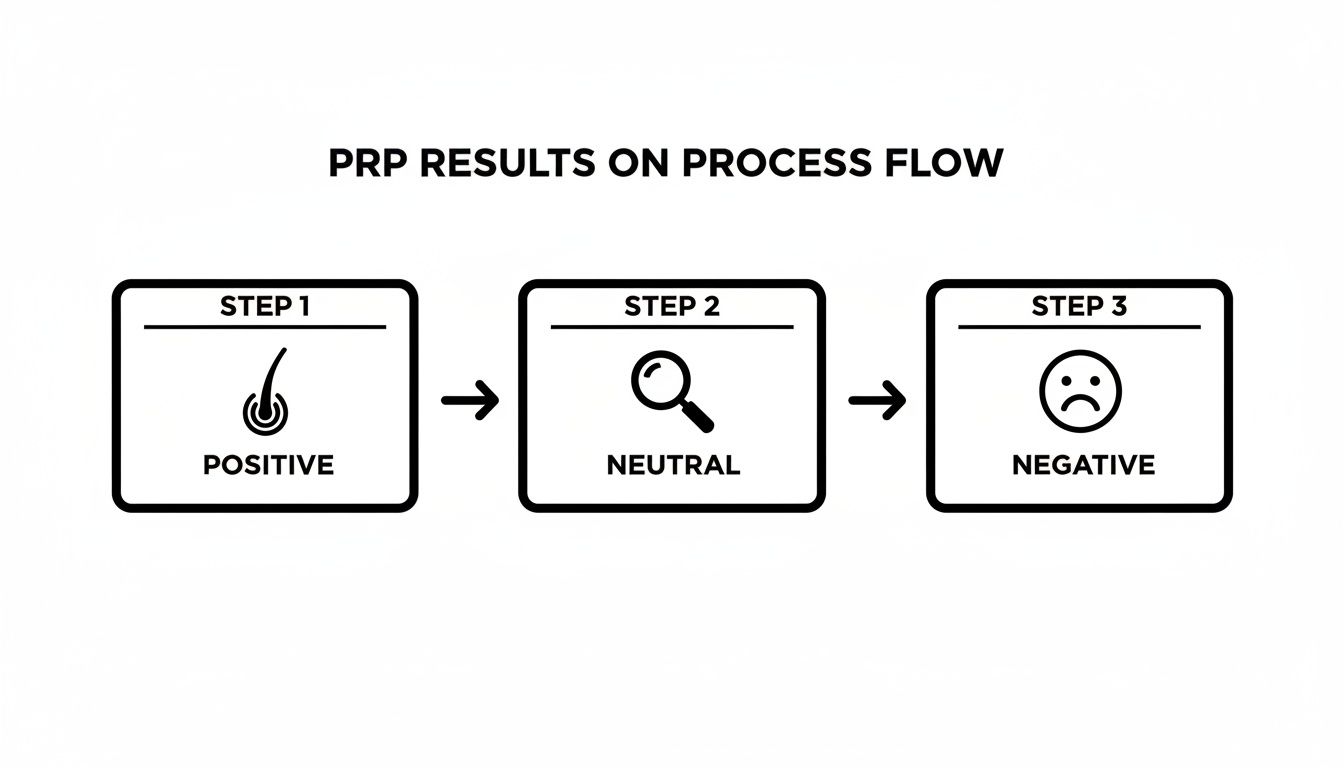
As you can see, it’s a closed-loop system. We take something from your body, concentrate its healing properties, and put it right back where it can do the most good. From sitting in the chair to what happens at a cellular level, you now have the full picture.
What Clinical Studies Reveal About PRP
If you're digging into prp for hair loss reviews, you’ll quickly find that clinical studies are where the real story is told. They move beyond slick marketing photos to give us hard numbers on whether this stuff actually works.
Researchers don't just eyeball results; they measure specific, objective changes. We're talking about tangible metrics that prove hair follicles are waking up and getting stronger.
- Hair Count per cm²: This tells us exactly how many new hairs are actively growing in a small patch of scalp.
- Shaft Diameter: Are the individual hair strands getting thicker and more robust? This metric confirms it.
- Anagen to Telogen Ratio: This is a fancy way of saying we're seeing more hairs in the "growth" phase versus the "resting" phase.
Measuring Real Results
So, what do the numbers say? A deep dive into six randomized trials with 92 patients showed that PRP clearly increased both hair thickness and density. Another massive meta-analysis, covering 776 women across 42 different studies, found PRP consistently outperformed placebo or control treatments in boosting hair density. You can get into the nitty-gritty of these findings in this detailed summary.
| Metric | PRP Group | Control Group |
|---|---|---|
| Hair Count Increase | +18 hairs/cm² | +5 hairs/cm² |
| Shaft Diameter Gain | +10 μm | +2 μm |
But it’s not just about the numbers. The human element matters, too. One year-long study found that 64% of patients felt they saw new hair growth. What’s really interesting is that 68% of clinicians observing them agreed. It's always a good sign when what patients feel and what doctors measure line up.
Key Insight: The evidence for PRP isn't one-sided. Its impact is backed by both hard data from clinical instruments and the real-world satisfaction of patients and their doctors.
Limitations in Current Research
Now for a reality check. While the results are promising, the research world has a bit of an "apples and oranges" problem. There’s no single, standardized way to do PRP.
Clinics use different centrifuges, spin them at different speeds, and inject at different depths. Some use a single-spin method, while others use a double-spin to get a higher platelet concentration. Treatment schedules are all over the map, too—some are monthly, others are every two months. All this variability makes it tough to compare results from one study to the next.
And one thing you’ll rarely see discussed in a scientific paper is the cost, which is a huge factor for most of us. In the real world, clinics charge anywhere from $500 to $2,000 for a single session. That price tag heavily influences whether someone can stick with the recommended treatment plan.
Interpreting the Evidence
This patchwork of protocols is exactly why you'll see such mixed prp for hair loss reviews online. But knowing this actually puts you in the driver's seat. It gives you the power to walk into a clinic and ask the right questions.
When you're vetting a provider, here’s what you should be asking:
- What platelet concentration do you aim for? (Look for an answer around 4x the baseline or higher).
- What kind of centrifuge do you use? Is it a single or double-spin process?
- What is your recommended treatment schedule, and how do you customize it for someone at my stage of hair loss?
To get a better handle on this, check out our guide on how effective PRP treatments are in real-world settings.
By understanding what metrics and variables truly matter, you can cut through the marketing fluff. The science generally agrees that PRP is a safe and effective way to slow hair loss and improve thickness, but it also makes it clear that the how is just as important as the what.
Practical Takeaways
Armed with this info, you can now read prp for hair loss reviews like a pro. Instead of getting swayed by vague promises, you can look for concrete proof.
- Did the review or study mention an increase of at least 10 hairs/cm²?
- Did they report a gain in hair shaft diameter of more than 5 µm?
- Was the treatment schedule consistent, with sessions spaced about 4 to 6 weeks apart?
- Does the review balance hard data with genuine patient satisfaction?
When you combine the clinical evidence with real-world patient stories, you get a much clearer picture of what PRP can realistically do for you. This approach transforms the process from a shot in the dark to an informed, evidence-based decision.
The Real Story: What Patients Say Beyond Before and After Photos

Before-and-after photos can be powerful, but they only tell you part of the story. To really understand what it's like to get PRP for hair loss, you have to dig into the reviews and hear from the guys who have actually been through it. The day-to-day details are where you find the truth of the experience.
One of the biggest takeaways from patient feedback is just how convenient the whole process is. PRP sessions are surprisingly fast—most are done in under an hour. Best of all, there's no real downtime. Guys walk out of the clinic and head right back to work or their normal routine, which is a huge advantage for anyone with a busy life.
The Treatment Itself: What Does It Feel Like?
Okay, let's get to the big question: what about the needles? It’s completely normal to be worried about the discomfort, but the consensus from most patient reviews is that it’s manageable and over quickly.
Clinics have gotten good at this. They’ll typically use a strong topical numbing cream or a cooling device to take the edge off. While you’ll definitely feel a series of quick pricks across your scalp, most guys say it was much less intense than they had imagined. Afterwards, you might feel a bit of mild soreness or tightness, but that usually disappears within a day or two.
The Emotional and Psychological Journey
There’s a lot more to the PRP experience than just the physical side. For many men, the simple act of doing something proactive about their hair loss brings a massive sense of relief and control. You're no longer just passively watching your hair thin; you're actively using your body's own healing factors to fight back.
This feeling of empowerment comes up again and again in reviews. The process feels less like a vanity procedure and more like a genuine health treatment, which really connects with guys looking for a natural-feeling solution. In the end, it’s not just about regrowing hair—it’s about regaining confidence.
The mental boost is more than just a feeling. A study at the Cleveland Clinic measured patient satisfaction with a standardized questionnaire. Before starting treatment, patients had an average score of 48.6/100 (where a lower score means higher satisfaction). After just three months of PRP, those scores dropped significantly, showing that patients felt much better about their hair and were less worried about their appearance.
Managing Expectations: This Is a Slow Burn, Not a Quick Fix
Patience is probably the most important part of the PRP process. Unlike getting a haircut, the results don’t show up overnight. You have to be prepared for the "slow burn" of gradual progress. Here’s how the journey usually plays out:
- The Shedding Phase: This can be alarming, but don't panic. Some men notice a bit more shedding right after their first session. It's often a good sign, meaning weaker hairs are being pushed out to make room for stronger new growth.
- Subtle Thickening: The first real sign that things are working is often a change in texture. Your existing hair starts to feel more robust and healthier.
- Visible Density: After a few months and several sessions, you'll start to notice better scalp coverage. This is the stage you see captured in our PRP for hair loss before and after gallery.
Understanding this timeline is crucial for having a positive experience. It's helpful to see how other industries build trust by using authentic client reviews to set realistic expectations.
The Financial Commitment
Finally, let's talk about the cost. PRP is an investment in your hair's future, not a one-and-done cure. It’s a long-term strategy for managing hair loss.
A typical treatment plan looks something like this:
- An Initial Series: Most clinics recommend starting with 3 to 4 treatments, spaced about a month apart, to get the process going.
- Maintenance Sessions: To keep your results going strong, you’ll likely need follow-up treatments once or twice a year.
Knowing about this ongoing commitment from the very beginning is key. It lets you budget properly and think of PRP as a continuous part of your hair health plan, not just a single expense. When you look at the physical, emotional, and financial realities together, you get the complete picture of the PRP journey.
Choosing the Right PRP Provider for Your Treatment

Let's be clear: the clinic you choose is just as critical as the treatment itself. The glowing prp for hair loss reviews you read online don't just happen; they're the direct result of a skilled provider using the right technology. Finding that perfect match requires a little homework on costs, safety, and what to ask during your consultation.
First, let's talk money. PRP therapy is definitely an investment in yourself, and the price tag can swing pretty wildly. A single session usually lands somewhere between $500 and $2,000. Since you'll typically need an initial series of three or four sessions, the total upfront cost can be anywhere from $1,500 to $8,000.
What's behind that big range? Several things. Clinics in major metropolitan areas with high rent will naturally charge more. A world-renowned doctor with a long track record of success will also command a higher price. Even the specific equipment, like the centrifuge used to process your blood, can affect the final bill.
Prioritizing Safety and Finding a Qualified Expert
On the safety front, PRP has a fantastic reputation. Because the injections use a concentrate made from your own blood, the risk of an allergic reaction or your body rejecting the treatment is practically zero. It's a huge selling point you'll see mentioned again and again in patient reviews.
That said, you should expect some minor, temporary side effects. A bit of soreness, mild swelling, or some redness at the injection sites is completely normal for a day or two afterward. Think of it as a sign your body is getting to work.
Ultimately, your most important job is finding a provider you can trust. A good clinic is transparent, knowledgeable, and happy to answer every last one of your questions. When you walk into a consultation, don't just think of yourself as a patient—you're interviewing them for a very important job. To get started, you can check out directories of the best hair loss doctors who specialize in this field.
Think of your consultation as a fact-finding mission. You're there to become an informed consumer. Never hesitate to ask detailed, even technical, questions. A truly experienced provider will welcome your curiosity and give you straight, easy-to-understand answers.
Your Provider Checklist: Key Questions to Ask
To make sure you're vetting clinics like a pro, here are the essential questions to ask. The quality of their answers will tell you everything about their expertise, their process, and the kind of results you can realistically hope for.
- What's your method for preparing the PRP? You want to know if they use a single or double-spin centrifuge. A double-spin process is generally considered superior because it often yields a much higher concentration of platelets, which is where the magic happens.
- What platelet concentration do you target? The sweet spot is a concentration that's 4 to 5 times richer than what's found in your normal blood. A great clinic won't just know their target number; they'll be able to explain why it's effective.
- Can I see before-and-after photos of your patients? Be specific here. You don't want to see stock photos from the company that made their machine. You want to see real-world results from people they've actually treated.
- Who performs the injections? Make sure a qualified medical professional—like a doctor, nurse practitioner, or physician assistant—is the one administering the treatment.
As you look for clinics, you'll notice how they market themselves online. Many use strategies like local SEO for medical practices to showcase their expertise and patient success stories. With these questions in your back pocket, you’ll be fully equipped to cut through the marketing and choose a true professional for your hair restoration journey.
The Final Verdict Is PRP Worth The Investment
After reviewing the science, patient stories, and clinical trials, you might wonder: is PRP for hair loss really worth it? It’s not a cure-all that restores a full head of hair overnight. Instead, think of PRP as a targeted medical boost that slows thinning and can spark new growth when used at the right time.
Investing in this treatment makes sense if you fall into a specific category. PRP shines for men with early-stage androgenic alopecia—when hair follicles have shrunk but haven’t completely faded. Picture these follicles as weary soldiers; PRP sends in the reinforcements, but it can’t raise troops out of thin air.
Who Is The Ideal Candidate For PRP
- Early-Stage Hair Loss: Noticeable thinning that began within the last few years rather than decades.
- Active But Weakened Follicles: Hair feels finer and less dense, yet follicles still hold potential.
- Realistic Goals: You’re aiming to stabilize and thicken existing hair, not achieve regrowth on a bare scalp.
- Long-Term Commitment: Prepared for an initial series of sessions, followed by yearly or biannual touch-ups.
These men tend to see the most dramatic and satisfying improvements—making each treatment feel like money well spent.
The core takeaway is this: PRP revitalizes dormant follicles, but it cannot create new ones. If a hair follicle has been completely inactive for many years, the chances of bringing it back are extremely low. Success hinges on intervening while there’s still something to work with.
When PRP May Not Be The Right Choice
On the flip side, men with long-standing bald patches often find PRP less useful. Once follicles lie dormant for years or have scar tissue, there’s little for growth factors to act on. Similarly, certain autoimmune hair disorders may blunt PRP’s effect.
In the end, choosing PRP is about informed decision-making. By digging into the data, balancing expectations against the mixed experiences you’ve read, and vetting skilled providers, you’ll know whether PRP fits your battle plan against hair loss.
Your Top Questions About PRP Hair Treatment, Answered
Once you get past the science, the practical questions are what really matter. What's this actually going to be like? Let's break down the most common things guys ask before starting PRP.
How Long Does It Take to See PRP Results?
This is the big one, and the honest answer is: it takes patience. PRP isn't an overnight fix; it works by waking up your body's natural hair growth cycle. The first signs are subtle. You'll likely notice less shedding and a bit more texture around the three-to-four-month mark.
Real, visible changes in density and scalp coverage usually show up closer to six months, after you've finished the initial series of sessions. The key is consistency—you have to give your follicles time to respond and get back to work.
Does PRP for Hair Loss Hurt?
It's natural to worry about needles, but most men say the procedure is much easier than they expected. Your provider will apply a strong numbing cream to your scalp beforehand, which takes the edge off significantly.
You'll feel a series of quick, sharp pricks, but it's typically mild and over fast. Afterward, your scalp might feel a little sore or tight for a day or so—think of it like a mild sunburn. There's no real downtime, and the discomfort fades quickly.
PRP is a treatment that manages the ongoing condition of androgenic alopecia; it does not cure it. Therefore, to maintain your results, you'll need to think of it as part of a long-term hair health strategy.
Will I Need PRP Treatments Forever?
Think of PRP as ongoing maintenance, not a one-and-done cure. The initial set of treatments gets the ball rolling, but the genetic factors causing your hair loss are still there. To protect your investment and keep your hair, you'll need a long-term plan.
For most guys, this means coming back for a maintenance session once or twice a year. These follow-up treatments are essential for keeping your follicles stimulated and preventing your hair from slipping back to where it was before you started.
At PRP For HairLoss, we believe that making an informed decision is the first step toward regaining your confidence. Our resources are designed to give you the clear, honest information you need to understand your options. To continue your research, visit us at https://prpforhairloss.com.
 PRP For Hairloss
Leave a comment