Let’s get straight to the point: does chlorine cause the kind of hair loss that leads to permanent thinning or a receding hairline? The short answer is a clear no. Spending time in a well-maintained swimming pool isn’t going to destroy your hair follicles or kickstart genetic balding.
That said, if you feel like your hair is thinning after you’ve been swimming a lot, you're not just seeing things. Chlorine is fantastic at its job—killing bacteria—but it's also incredibly effective at stripping the natural, protective oils from your hair. This leaves your hair dry, brittle, and highly susceptible to breaking. When those damaged strands snap off, it can certainly look and feel like hair loss, even though it's technically a different problem altogether.
Understanding Chlorine Hair Damage Versus True Hair Loss
Think of a healthy strand of hair like a new, flexible rope—it's strong and can handle a fair bit of stress. Now, imagine soaking that rope in a harsh chemical every day. It wouldn't take long for it to become stiff, frayed, and weak enough to snap with the slightest tug. That's essentially what repeated chlorine exposure does to your hair.
While this kind of damage is frustrating, it’s really important to draw a line between it and clinical hair loss, which is a problem that starts deep down in the scalp.
The Science Behind the Myth
So, how can we be so sure chlorine isn't the culprit for balding? The conclusion is backed by some pretty solid research. A key study published in the Journal of Dermatology offered a clear verdict after comparing 67 professional swimmers to 54 people who almost never swam.
Even with constant exposure to chlorinated water, the swimmers showed no statistically significant increase in actual hair loss compared to the non-swimmers. What the study did find, however, was that nearly all the swimmers had visible signs of hair damage—things like dryness, discoloration, and a rough, straw-like texture.
This distinction is everything.
Chlorine is a well-known cause of cosmetic hair damage, leaving strands dry, brittle, and prone to breaking. But it is not a direct cause of follicle-driven, permanent hair loss.
Breaking It Down
To make it even clearer, let's look at what's really going on when you see more hair in your brush or the shower drain after a day at the pool.
- It’s Breakage, Not Shedding: Those "lost" hairs are almost certainly strands that have snapped off somewhere along the shaft because they've become weak and brittle from chemical exposure.
- The Follicles Are Fine: True hair loss happens when the hair follicle itself—the tiny organ in your scalp that grows hair—either shrinks or gets stuck in a resting phase. This causes the entire hair to fall out from the root. Chlorine simply doesn't trigger this biological process.
To help you tell the two apart, here's a quick comparison.
Chlorine Damage vs True Hair Loss At a Glance
| Symptom / Cause | Chlorine-Induced Hair Breakage | Clinical Hair Loss (e.g., Male Pattern Baldness) |
|---|---|---|
| Primary Effect | Weakens the hair shaft, making it brittle and dry. | Weakens or damages the hair follicle at the root. |
| Where It Happens | Along the hair strand (mid-shaft breakage). | At the scalp (hair falls out from the root). |
| Visible Signs | Split ends, frizz, straw-like texture, "flyaways." | A widening part, receding hairline, or thinning at the crown. |
| Is It Reversible? | Yes, with proper hair care and reduced exposure. | Often requires medical intervention (e.g., Minoxidil, PRP) to slow or reverse. |
| Root Cause | External chemical damage from pool water. | Internal factors like genetics, hormones, or medical conditions. |
Understanding this difference is the first step toward finding the right solution. If you’re seeing a widening part, thinning at the crown, or a noticeably receding hairline, it’s a good idea to explore the real causes of male pattern baldness to figure out if something else is going on. At the end of the day, dealing with breakage from the pool requires a better hair care routine, not a clinical hair loss treatment.
How Chlorine Actually Affects Your Hair and Scalp
So, what’s really going on at a microscopic level when you jump in the pool? To get the full picture, you first have to understand your body’s own natural defense system. Your scalp produces a waxy, oily substance called sebum, which coats every strand of your hair. Think of it as your own built-in, waterproof conditioner—it’s what keeps your hair flexible, moisturized, and protected from the elements.
But when you go for a swim, that powerful disinfectant in the water—chlorine—goes to work. Its main purpose is to neutralize germs and contaminants, and unfortunately, it doesn't distinguish between bacteria and the natural oils on your hair. The chemical reaction strips away that protective layer of sebum, leaving your hair totally exposed to what comes next.
The Chemical Assault on Your Hair Strands
With your hair’s natural defenses gone, chlorine begins its direct attack on the hair's structure itself. Hair is made up almost entirely of a tough protein called keratin. Chlorine is a potent oxidizing agent, and it immediately starts to break down these keratin proteins, essentially chipping away at the building blocks of each strand. If you’re curious about how this works, you can dig into the science behind how bleach kills germs, which relies on similar chemical principles.
This is exactly why your hair feels so rough, brittle, and straw-like after a swim. The internal structure that gives your hair its strength and smoothness has been chemically weakened. That weakening is the real culprit behind the breakage that so many people mistake for genuine hair loss.
The infographic below really helps clarify the difference between the hair damage chlorine causes and actual, follicle-driven hair loss.
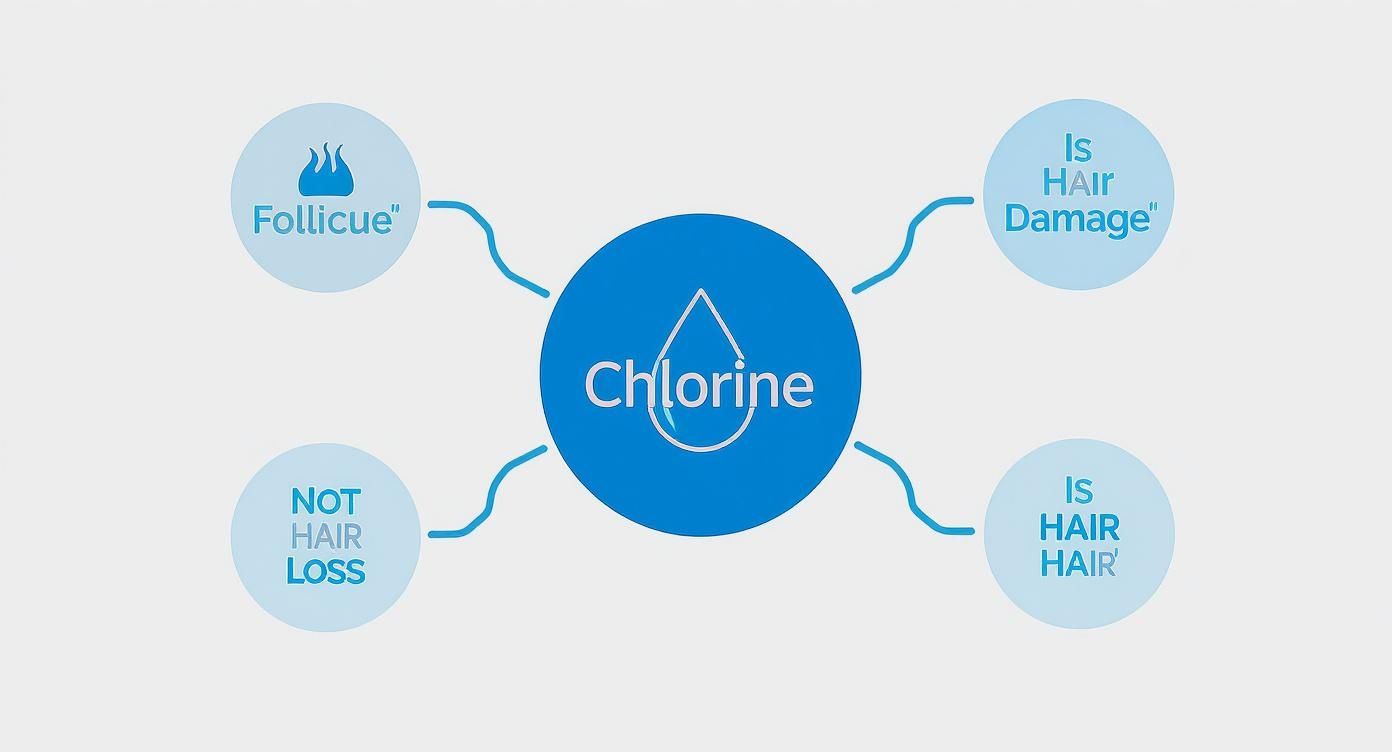
As you can see, chlorine’s attack is on the external hair shaft. It leads to damage and breakage, but it doesn't reach the follicle to trigger permanent loss.
Your Scalp Is a Target Too
The chemical onslaught doesn't just stop with your hair; your scalp is right in the line of fire, too. A healthy scalp needs a specific pH balance to support strong hair growth and keep irritation at bay.
Chlorine throws that delicate balance completely out of whack, often causing a whole host of uncomfortable symptoms:
- Dryness and Flaking: Just like it strips oil from your hair, chlorine saps moisture from your scalp. The result is often dryness and flaking that looks and feels a lot like dandruff.
- Itchiness and Irritation: For many, the chemical exposure triggers what’s called irritant dermatitis, leaving the scalp feeling uncomfortably itchy, tight, and inflamed.
- Follicle Clogging: Over time, a mix of chemical residue and dead skin cells can potentially clog hair follicles, which is never a good environment for healthy growth.
Chlorine creates a hostile environment on the scalp. By stripping natural oils and disrupting the pH balance, it can lead to irritation and dryness that compromises the overall health of your hair's foundation.
This scalp irritation is an important piece of the puzzle. While it won't cause something like male pattern baldness, an inflamed and unhealthy scalp is certainly not helping your hair. If you already deal with skin issues, it’s a good idea to look into other common scalp conditions that cause hair loss to see if chlorine is just making a pre-existing problem worse.
For most people, though, these effects are temporary and cosmetic. The damage is focused on the hair shaft, not the root.
The Truth About Swimmer's Hair and Discoloration
Anyone who's spent a summer by the pool has heard the warning: too much swimming will turn your hair green. It sounds a bit like an old wives' tale, but "swimmer's hair" is a real, visible consequence of chlorine exposure. Interestingly, though, chlorine isn't the direct culprit for that infamous green tint.
The real story begins with the damage we’ve already covered. Chlorine is incredibly effective at stripping away your hair's natural, protective oils. This leaves the hair shaft exposed, brittle, and—most importantly—highly porous.
Think of a healthy hair strand as a tightly sealed roof shingle, repelling water. After a dip in the pool, it’s more like a dry sponge, ready to absorb everything in its path.
Blame the Copper, Not the Chlorine
So, where does the green color come from? It's not the chlorine itself, but the oxidized metals floating in the pool water that are to blame.
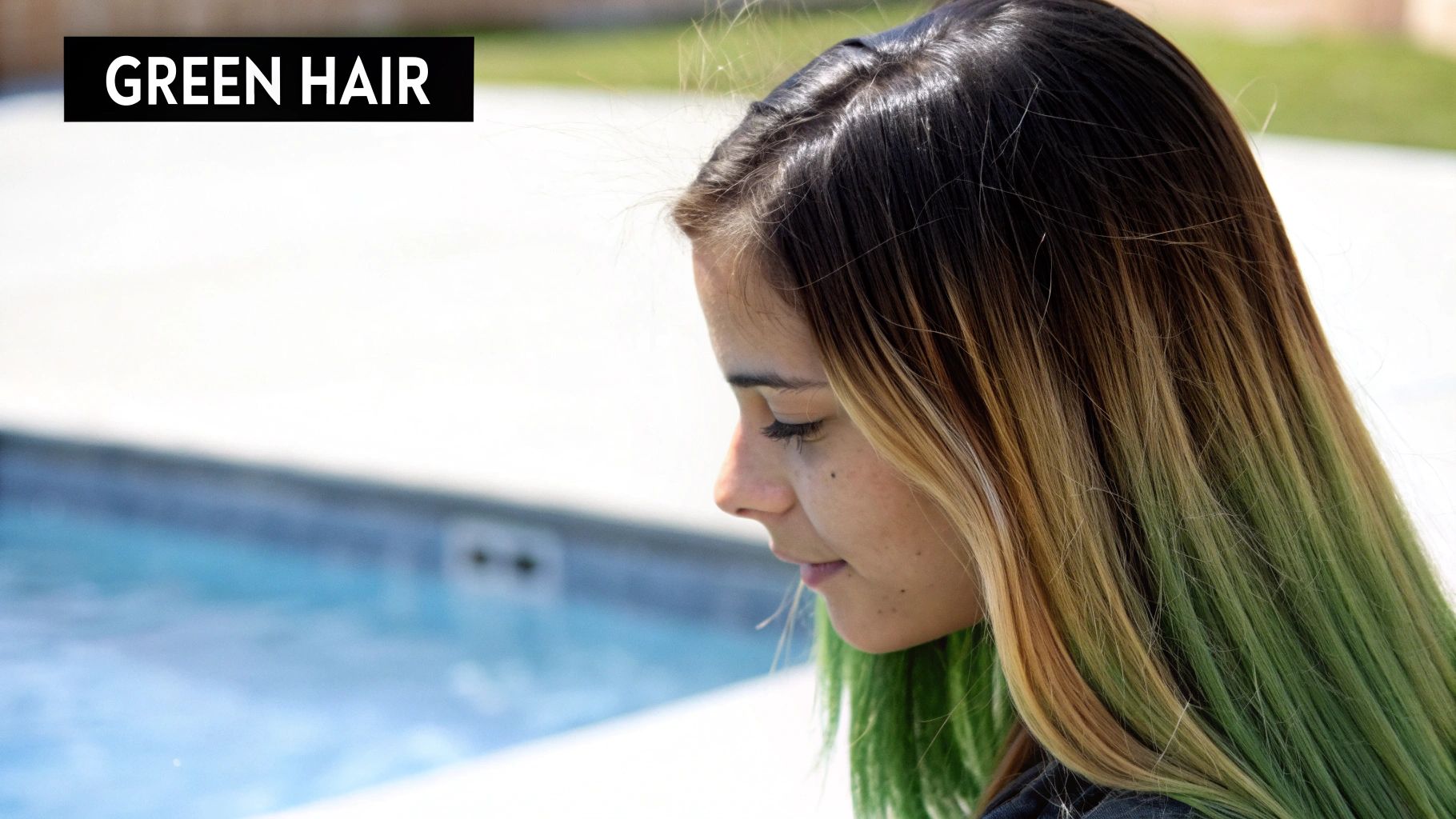
Most pool water contains trace amounts of hard metals, especially copper. This can get into the water from copper-based algaecides used for cleaning or even from the building's copper plumbing.
When chlorine oxidizes these copper particles, it readies them to latch onto proteins. Your newly porous hair soaks up this copper-infused water, and the metal particles bind directly to the keratin proteins in your hair. It’s this chemical reaction that leaves behind that unwanted greenish hue.
Don't just take my word for it. A study back in 2000 looking at professional swimmers found that a whopping 61% of them had visible hair discoloration, compared to a flat 0% of non-swimmers. This really drives home how significant the effect is for frequent swimmers. And as this deep dive on hims.com explains, while the question of does chlorine cause hair loss is largely a myth, its effect on your hair's appearance is undeniable.
So, while chlorine certainly sets the stage by roughing up your hair's defenses, it's the copper that takes the spotlight and turns your hair green.
How Chlorine Wrecks Color-Treated Hair
If you spend good money on coloring your hair, the swimming pool is public enemy number one. Color-treated hair is already more porous than natural hair to begin with. The chemical process of dyeing or bleaching has to lift the hair's outer cuticle to work, which inherently weakens its structure.
Adding chlorine to the equation is like pouring fuel on a fire. It dramatically accelerates the damage, making your already-porous hair even more absorbent and leading to a few specific, frustrating problems:
- Faster Fading: Chlorine's oxidizing power breaks down artificial color molecules, making that expensive salon visit fade into memory far too quickly.
- Brassy Tones: For blondes and anyone with highlights, chlorine is notorious for stripping away the cool-toned glosses that keep yellowing at bay. This reveals the underlying warm pigments, leaving you with that dreaded brassy or orange look.
- Uneven Color: Chlorine damage doesn't happen uniformly. It attacks the most damaged areas first, which can cause your color to become patchy and inconsistent over time.
For anyone with dyed hair, chlorine is a double threat. It makes your hair more susceptible to absorbing those green-tinting metals and actively strips away the very color you paid to put in.
Ultimately, knowing how chlorine damage, porosity, and discoloration are linked is your first line of defense. If you can protect your hair from becoming that porous sponge in the first place, you stand a much better chance of keeping its color—whether natural or from a bottle—looking exactly how you want it to.
Can Extreme Chlorine Exposure Increase Shedding?
For anyone who enjoys a few swims a week, the idea of chlorine making your hair fall out from the root is pretty far-fetched. As we've covered, chlorine’s real talent is for external damage—it’s a master of causing breakage, dryness, and messing with your hair color.
But what about people who practically live in the water? Think competitive swimmers, lifeguards, or water polo players. This brings up a critical question: is there a tipping point? Can extreme, prolonged exposure graduate from causing simple breakage to triggering actual hair shedding?
While direct human studies on this are lacking, some animal research hints that constant chemical stress might be a different beast entirely. It’s important to remember that you can't just slap animal study results onto people, but they do offer fascinating clues about how a biological system might react under intense, sustained pressure. This makes you wonder if relentless chemical exposure could, just maybe, disrupt the hair's natural growth cycle in someone who's already susceptible.
So, let's keep a balanced perspective: a normal swimming schedule is perfectly safe for your hair follicles. The conversation only really starts to change when that exposure becomes a daily, long-term reality.
The Tipping Point of Chemical Stress
Think of your scalp like a garden. A little rain (or a normal swim) is no big deal. But a constant, daily flood of chemically treated water could eventually take a toll on the soil, making it tough for plants to thrive. In much the same way, while chlorine isn't going to kill your hair follicles, the perpetual state of dryness and irritation it can inflict on your scalp could create a pretty poor environment for healthy hair growth over the long run.
This is where the line between breakage and true shedding gets a little blurry. If your scalp is constantly inflamed and stripped of its natural protective oils, it's plausible that this chronic stress could interfere with the hair growth cycle. This disruption could theoretically lead to a temporary increase in shedding—a condition known as telogen effluvium. It’s a completely different mechanism than genetic hair loss, and you can get a better handle on telogen effluvium vs. male pattern baldness to see how they differ.
What Animal Studies Suggest
While we're short on human evidence, one animal study, in particular, gives us a compelling look at what extreme exposure might do. A 2015 study had rats swim in a chlorinated pool every day for 12 weeks. Researchers watched as the rats' fur became progressively dry and dull over the course of the experiment.
During the final month of the study, the rats experienced significant and observable hair loss. This is one of the few controlled studies showing a direct correlation between prolonged chlorine exposure and actual shedding in a mammalian model.
This is a big deal because it suggests a dose-dependent relationship. A little chlorine causes cosmetic issues, but a lot of it, over a long period, might just trigger a deeper biological response. Of course, as one resource exploring these findings explains, you have to be careful when translating this to humans due to major differences in biology and exposure levels. Still, you can read the full research details here to see how scientists tackled the question.
For elite swimmers, this really drives home the importance of a serious hair and scalp care routine. The goal is to counteract that chemical assault before it can create the kind of chronic scalp stress that might tip the scales toward increased shedding. So, while the question of does chlorine cause hair loss remains a debunked myth for the average person, this research keeps the door open for those at the most extreme end of the exposure spectrum.
Your Pre- and Post-Swim Hair Protection Plan
Knowing how chlorine can weaken your hair is one thing, but having a solid game plan to stop it is what really matters. You don't have to give up the pool to keep your hair healthy; you just need a smart and consistent routine. This is your practical guide to enjoying every swim without sacrificing your hair's strength and shine.
Think of it as building a fortress around each hair strand. The best defense is a two-part strategy: create a protective barrier before you dive in, and then cleanse and repair your hair the moment you get out. Neglecting either step leaves you wide open to the drying and damaging effects of chlorine.
Step 1: Fortify Your Hair Before You Swim
The single most effective thing you can do starts before your toes even touch the water. Your hair acts like a sponge; if it's dry, it will immediately soak up the first liquid it meets—in this case, chlorinated pool water. The goal is to let it soak up something good first.
Here’s how to create that crucial pre-swim barrier:
- Rinse with Clean Water: Head to the poolside shower and completely saturate your hair with clean, non-chlorinated tap water. When your hair is already full of fresh water, there's simply less room for it to absorb the damaging pool water.
- Apply a Protective Layer: With your hair still damp, work a leave-in conditioner or a natural oil (like coconut or argan oil) from roots to ends. This adds a second layer of defense, coating the hair shaft to block chlorine from penetrating the cuticle.
- Wear a Swim Cap: For the ultimate protection, a swim cap is your best friend. It physically keeps the vast majority of chlorinated water away from your hair, drastically reducing exposure and potential damage.
A simple pre-rinse is the easiest and most effective step you can take. It primes your hair to resist chlorine absorption, turning a defensive action into a proactive one.
Step 2: Cleanse and Neutralize Immediately After
The moments right after your swim are just as critical. Chlorine doesn't stop damaging your hair once you're out of the pool; it lingers on the strands and scalp until it's properly washed away. Acting quickly is key.
Your post-swim mission is to remove every trace of chlorine and then immediately start replenishing lost moisture and nutrients. Don't wait until you get home—hit the showers as soon as you're done swimming.
Follow these post-swim recovery steps:
- Rinse Thoroughly: The first step is always another rinse with clean water to get the bulk of the chlorine off your hair.
- Use a Swimmer's Shampoo: Invest in a shampoo specifically formulated for swimmers or a good clarifying shampoo. These products are designed to break down and remove the stubborn chemical bonds that chlorine and copper form with your hair.
- Restore with Conditioner: After clarifying, your hair will be squeaky clean but also stripped of its natural oils. Follow up immediately with a rich, moisturizing conditioner to restore hydration and smooth the hair cuticle back down.
To make this routine foolproof, here's a simple checklist you can follow every time you head to the pool.
Your Swim-Proof Hair Care Checklist
| Action Step | Why It's Important | Recommended Products/Methods |
|---|---|---|
| Pre-Swim Rinse | Saturates hair with clean water, reducing chlorine absorption. | Poolside shower |
| Apply Barrier | Coats the hair shaft to block chlorine from penetrating. | Leave-in conditioner, coconut oil, or argan oil |
| Wear a Swim Cap | Provides a physical barrier against direct water contact. | Silicone or latex swim cap |
| Post-Swim Rinse | Immediately washes away surface-level chlorine and chemicals. | Poolside shower |
| Clarifying Wash | Removes stubborn chlorine and mineral buildup from the hair. | Swimmer-specific or clarifying shampoo |
| Deep Condition | Rehydrates and restores moisture stripped away by chlorine. | Rich, moisturizing conditioner or hair mask |
Sticking to this checklist can dramatically reduce the wear and tear on your hair, keeping it healthy swim after swim.
Step 3: Rehydrate and Strengthen for the Long Term
If you're a frequent swimmer, just washing and conditioning might not be enough to fully counteract the cumulative damage. You need to actively work on rebuilding your hair's internal strength and moisture levels on a regular basis.
Think of this as your weekly maintenance. Adding a deep conditioning or protein treatment into your schedule can make a world of difference. Deep conditioners focus on infusing your hair with intense moisture, while protein treatments help patch up the weakened spots in the hair's structure caused by chemical damage. Consistently working to strengthen hair follicles and strands from the inside out builds true resilience.
Beyond what you put on your hair, what you put in your body also counts. You might consider exploring how various supplements beneficial for swimmers can support your body's needs. A combination of smart external care and solid internal health creates the strongest possible defense against damage.
When You Should See a Doctor About Hair Loss
While it’s a relief to know your swimming habit probably isn't making you go bald, it's just as important to recognize when something more serious is happening. Chlorine-related breakage is a frustrating hair care problem, but it’s not a medical one.
So, how do you know when it’s time to stop blaming the pool and book an appointment with a professional? The trick is learning to spot the classic signs of clinical hair loss, which look very different from simple breakage. These are clues that an underlying condition, like androgenetic alopecia (male pattern baldness), might be the real culprit.
Distinguishing Breakage from True Hair Loss
First, let's get a handle on what chlorine damage actually looks and feels like. It’s all about the hair shaft. You'll notice your hair feels dry, brittle, or even straw-like to the touch. You’ll probably see more split ends and those annoying short, broken flyaways, especially after you brush. The key thing here is that the damage is happening along the strand, not at the root.
Clinical hair loss, on the other hand, starts at the scalp. It's less about the texture of individual hairs and more about the overall number of them.
Here are the tell-tale signs that you're dealing with more than just swimmer's hair:
- A Widening Part: When you part your hair, does the line of scalp seem wider than it used to? This is a classic early indicator of thinning.
- Thinning at the Crown: Many guys first notice a growing bald spot on the top-back of their head, an area called the vertex.
- A Receding Hairline: Is your hairline creeping backward, especially at the temples? If it's starting to form an "M" shape, that's a hallmark of male pattern baldness.
- Losing Hair in Patches: Sudden, round patches of complete hair loss (alopecia areata) point to an autoimmune issue, not chemical damage from a pool.
- Excessive Shedding: Everyone loses hair—up to 50-100 strands a day is normal. But if you’re consistently finding clumps on your pillow or in the shower drain, and you can see the tiny white root bulb at the end, that's a sign to pay attention.
Think of it this way: Chlorine damage is like a tree's branches snapping in a storm—the tree itself is still healthy. Clinical hair loss is like the tree's roots weakening, causing it to fall out of the ground entirely.
Taking the Right Next Step
If your symptoms look more like scalp-level thinning than brittle ends, that's your cue. It's time to talk to a dermatologist or a hair loss specialist. They're the only ones who can give you an accurate diagnosis and explain what’s really going on.
For many men, figuring out when to see a dermatologist for hair loss is the single most important step toward finding a real solution.
A specialist can walk you through treatment options that are actually designed for your specific condition. This could be anything from topical treatments like minoxidil to more advanced therapies like PRP. Don't let the question of does chlorine cause hair loss distract you from the real signs your body might be sending. Being proactive is the best way to get ahead of permanent thinning and make sure you're solving the right problem.
Frequently Asked Questions About Chlorine and Hair
To wrap things up, let's go over a few common questions that pop up all the time when swimmers start thinking about their hair health.
Are Saltwater or Ozone Pools Better for Hair?
It's a common misconception that saltwater pools are chlorine-free. They actually use a nifty device called a salt-chlorine generator to produce chlorine on-site. The concentration is usually lower, which is why it often feels less harsh on your skin and hair, but the potential for dryness and damage is still there.
Ozone pools, on the other hand, are a fantastic alternative. They use ozone gas to do most of the heavy lifting for sanitization, which dramatically cuts down on the amount of chlorine needed. If you have the choice, an ozone or UV-sanitized pool is definitely the kindest option for your hair.
What if I Already Have a Sensitive Scalp or Eczema?
If your scalp is already prone to sensitivity or you deal with conditions like eczema, chlorine can be a real troublemaker. It strips away the scalp's natural protective barrier of oils, which can easily lead to irritation, itchiness, and flare-ups.
For you, the pre- and post-swim routine isn't just a suggestion—it's essential.
Creating a protective layer with a leave-in conditioner before you get in the water, and rinsing thoroughly the second you get out, is the single best way to prevent chlorine from aggravating a sensitive scalp.
How Can I Stop My Blonde Hair From Turning Green?
That dreaded green tint isn't actually from the chlorine itself. It's caused by oxidized copper in the pool water grabbing onto and staining the hair shaft. Since blonde and color-treated hair is more porous, it's especially vulnerable.
Your best bet is a good defense:
- Pre-soak your hair: Always drench your hair with clean tap water before you jump in. Hair is like a sponge; if it's already full of clean water, it can't absorb as much of the copper-filled pool water.
- Create a barrier: A leave-in conditioner or hair oil smooths the cuticle and makes it harder for copper to latch on.
- Wash it out ASAP: Don't let the pool water dry in your hair. Use a good clarifying or "swimmer's" shampoo right after your swim to wash away any copper deposits before they have a chance to set.
By making these simple steps a habit, you can keep your hair healthy and vibrant, and finally put that old myth that does chlorine cause hair loss to rest.
Protecting your hair from chlorine damage is one piece of the puzzle. But if what you're seeing is genuine thinning right at the scalp, it's time to look at the real culprit. PRP For HairLoss offers straightforward, expert-backed information on male pattern baldness and proven treatments like PRP therapy. You can find out more by visiting https://prpforhairloss.com.

 PRP For Hairloss
Leave a comment