If you've started looking into solutions for hair loss, the name finasteride has almost certainly come up. It's one of the most effective treatments out there, but it's natural to have questions—especially about potential side effects.
While sexual side effects like decreased libido or erectile dysfunction are the most discussed, it's important to know they are statistically quite rare. For the overwhelming majority of men, finasteride is a safe and effective tool in the fight against male pattern baldness.
How Finasteride Fights Hair Loss in Men
To really get what finasteride does, you first have to understand the main villain in the story of male pattern hair loss: a hormone called dihydrotestosterone, or DHT.
Think of your hair follicles as healthy plants. DHT is like a persistent weed that wraps around their roots, slowly choking the life out of them. This process, called miniaturization, causes the follicles to shrink over time until they can no longer grow visible hair.
The Role of Finasteride
This is where finasteride steps in. It acts like a targeted weedkiller for DHT. Specifically, it blocks an enzyme called 5-alpha reductase, which is the catalyst that converts testosterone into the follicle-harming DHT.
By dramatically lowering DHT levels in your scalp, finasteride essentially removes that "weed." This gives your hair follicles a chance to breathe, recover, and in many cases, regrow thicker, healthier hair. It's this direct mechanism that makes it so effective. But because it works on a hormonal level, a frank discussion about the side effects is crucial.
Our goal here is to make sure you feel completely informed—not just about the potential wins for your hair, but also about what to keep an eye on for your overall health. Seeing the full picture is the only way to make a decision that feels right for you.
Despite the internet chatter, large-scale studies consistently show that the risk of side effects is low. One landmark study from 2017 that looked at 3,177 men found that only a tiny fraction—just 0.7%—reported significant side effects. This data helps ground the conversation and puts the potential finasteride side effects men might experience into a much clearer, real-world perspective.
Now that you have a solid grasp of how it works, we can dive deeper. Next, we'll break down the specific types of side effects you should know about. For a broader look, you can also explore our guide on whether finasteride can truly stop hair loss.
Before we get into the details, here is a quick overview of the categories of side effects we'll be covering.
Quick Look at Potential Finasteride Side Effects
This table provides a high-level summary of the side effect categories we'll explore in this guide.
| Side Effect Category | Common Examples | General Prevalence |
|---|---|---|
| Sexual | Decreased libido, erectile dysfunction, ejaculatory issues | Low (<4%) |
| Physical | Gynaecomastia (breast tissue growth), skin rashes | Very Low (<1%) |
| Psychological | Mood changes, depression, anxiety | Very Low (<1%) |
This summary is just the starting point. Let's now explore each of these categories in much greater detail.
Navigating the Sexual Side Effects of Finasteride
When guys start looking into finasteride for hair loss, the conversation almost always lands on one topic: sexual side effects. It’s a personal subject, and it's totally understandable to want the real story, backed by data, not just forum chatter. The goal here is to cut through the noise and give you a clear-eyed view of what the clinical trials actually say.
The three big concerns you’ll hear about are erectile dysfunction (ED), a drop in libido (sex drive), and changes in ejaculation. These aren't random; they're tied directly to how the drug works. By lowering DHT, finasteride tweaks the hormonal environment that governs male sexual function.
A Look at Erectile Dysfunction and Libido
Let's be clear about what we're talking about. Erectile dysfunction means having a tough time getting or keeping an erection firm enough for sex. A change in libido is just a simpler way of saying you're less interested in sex than you used to be. While these sound scary, we need to ground ourselves in the actual numbers from the research.
The reality is, the vast majority of men on finasteride never experience these issues. For the small handful who do, the effects are often mild and sometimes even fade away on their own as their body gets used to the medication. It's not a black-and-white situation.
The main takeaway from years of research is simple: while sexual side effects are possible, they aren't probable. And for the small percentage of men who are affected, the issues are typically reversible once they stop the treatment.
This infographic really helps put the risk into perspective.
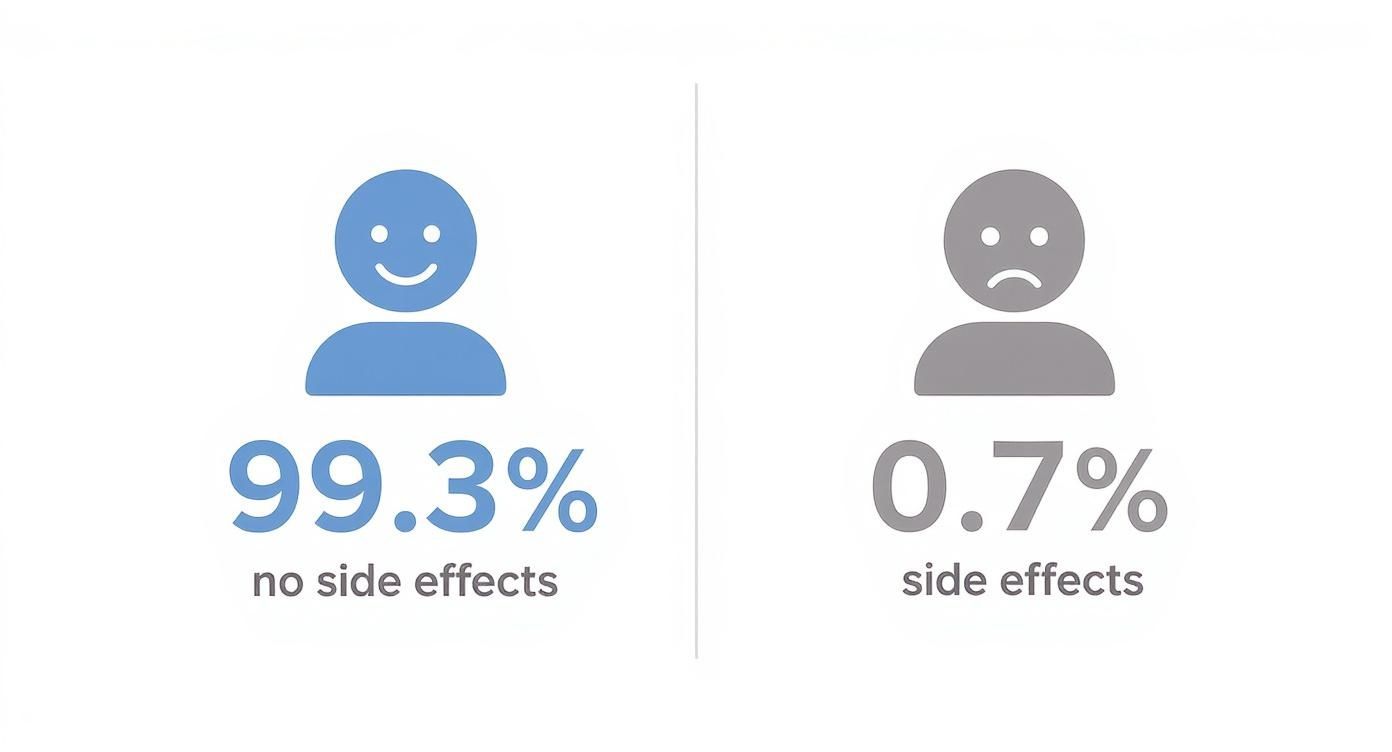
As you can see, over 99% of men use finasteride without any noticeable side effects. That context is crucial.
Understanding Changes in Ejaculation
The third potential side effect has to do with ejaculation. This can show up as a decrease in the amount of semen or, less often, difficulty reaching orgasm. Just like the other sexual side effects, this is linked to the hormonal shifts from reduced DHT.
While the numbers vary a bit between studies, they all point to the same conclusion: these effects are uncommon. For a bit of hard data, a major 2012 review looked at multiple trials with over 17,000 men. It found that men on a higher dose of finasteride for an enlarged prostate (BPH) reported:
- Erectile dysfunction: 4.9% to 15.8%
- Loss of libido: 3.1% to 5.4%
- Ejaculation problems: 2.1% to 7.7%
It’s important to remember those numbers are for a much higher dose than what's used for hair loss, but it gives a solid frame of reference.
Are the Sexual Side Effects Reversible?
This is the big question on everyone's mind: if I get these side effects, am I stuck with them forever? The overwhelming evidence says no. In the vast majority of cases, any sexual side effects that do appear will fade and disappear completely after you stop taking the medication.
Usually, things get back to normal within a few weeks to a couple of months as your body's hormone levels reset. This built-in "off-ramp" is a huge reassurance for anyone hesitant to start. You can try it, see how your body responds, and stop if you experience anything you're not comfortable with.
It's also worth remembering that sexual health is complex. It's not just about one hormone. Lifestyle, stress, and even your choice of clothing can play a part. In fact, some research has even explored the impact of underwear and scrotal temperature on fertility. Seeing the whole picture helps you make a truly informed decision.
Beyond Sexual Side Effects: Other Physical and Mental Changes to Watch For
While concerns about sexual health often take center stage, a full picture of finasteride's potential side effects includes a wider range of physical and even mental effects. Because the drug works by shifting your body's hormonal balance, it can sometimes trigger changes you might not expect.
The goal here isn't to scare you away from a highly effective treatment. It's to give you the complete story so you can be an active, informed partner in your own healthcare. Knowing what to look for means you can catch potential issues early and have a productive conversation with your doctor.

Physical Changes Beyond the Bedroom
A small fraction of men on finasteride notice some physical changes that are important to be aware of. Hormonal adjustments can show up in different ways, and simply listening to your body is the best first step.
The most well-known of these is gynecomastia, which is a technical term for tenderness or enlargement of male breast tissue. It happens because finasteride can subtly alter the ratio of testosterone to estrogen in the body. While it’s certainly not common—affecting less than 1% of men in clinical trials—it’s something that should be brought to your doctor’s attention right away if you notice it.
Other rare physical reactions can include:
- Testicular Pain: Some guys report a dull, persistent ache.
- Skin Rashes: Like any medication, an allergic reaction is possible and can manifest as a rash.
- Swelling: In very rare instances, some have noted swelling in their hands or feet.
Again, these are far from typical. The key takeaway is to report any new or unusual physical symptoms to your doctor after you start the medication. Don't just brush it off.
The Connection to Mood and Mental Clarity
More recently, the conversation has expanded to include the potential psychological impacts of finasteride. We know hormones and mood are deeply intertwined, so it stands to reason that adjusting DHT levels might affect how some men feel mentally.
A number of men have reported experiencing a low mood or depression, new or worsened anxiety, or a general feeling of mental sluggishness, often called "brain fog." This can manifest as trouble concentrating or just not feeling as sharp as usual.
It’s important to state that the link between finasteride and these mood-related symptoms is still being studied. While a direct cause-and-effect relationship hasn't been definitively established for most users, these reports are real experiences and deserve to be part of an honest discussion about the drug.
Your mental health is every bit as important as your physical health. If you start treatment and notice a consistent dip in your mood, a spike in anxiety, or that you just don't feel like yourself mentally, please don't ignore it. These are legitimate concerns to bring up with your doctor so you can figure out the best course of action together.
For men who are particularly worried about how the medication circulates through the body, exploring different delivery methods is a smart move. You can learn more about how application types might change the risk profile in our detailed guide on topical finasteride side effects. Ultimately, gathering all the information helps you make a confident choice that feels right for you.
What Happens When You Stop Taking Finasteride
So, you're experiencing side effects and wondering, "Will they go away if I stop?" It's one of the most common and critical questions men ask. For the vast majority, the answer is a clear and reassuring yes.
Think of finasteride as a roadblock for DHT production. When you stop taking your daily pill, you're essentially removing that roadblock. Your body's 5-alpha reductase enzyme gets back to its usual business, and DHT levels climb back to where they were before you started treatment.
This hormonal rebound is what allows your body to get back to its baseline. Most guys find that any unwanted effects—be they sexual, physical, or mood-related—start to fade within weeks and are often completely gone within a few months. This reversibility is a big reason why many feel comfortable giving finasteride a try in the first place.
The Typical Reversal Timeline
Everyone's body is different, but there’s a general pattern to how things recalibrate after you stop taking finasteride. It's more of a gradual fade-out than flipping a switch.
Here’s a rough idea of what you can expect:
- First Few Weeks: Your hormone levels start their journey back to your personal normal. You might begin to notice that any side effects are becoming less pronounced.
- One to Three Months: This seems to be the sweet spot for many men. It’s the timeframe where sexual function, mood, and other symptoms typically return fully to pre-finasteride levels.
- Beyond Three Months: By this stage, almost all temporary side effects should be a thing of the past. Your body's hormonal environment has pretty much stabilized.
Of course, there's a flip side to this. As your DHT returns, so will the hair loss you were trying to stop. It's a trade-off you have to be prepared for. We go into more detail on this in our article about whether hair loss is reversible.
Understanding Post-Finasteride Syndrome
No honest conversation about finasteride is complete without touching on a condition known as Post-Finasteride Syndrome (PFS). This is when men report that side effects—especially sexual, neurological, and physical ones—stick around for months or even years after they've stopped the medication.
PFS is a very real, but also very complex and controversial, topic in the medical world. Patient groups have done a lot to raise awareness, but a clear scientific agreement on what causes it, how common it is, and how it works is still in progress.
The medical community absolutely acknowledges the reports from men dealing with these persistent symptoms. The challenge has been proving a direct cause-and-effect relationship that applies to everyone, and research is ongoing to figure out why a small minority of users seem to have this lasting reaction.
It's a tough subject because the symptoms people report are genuinely distressing. The whole discussion around PFS really drives home how important it is to make an informed decision with your doctor and keep that line of communication open the entire time you're on the treatment.
What the Data Says About Persistent Side Effects
While PFS is a serious concern for a small number of men, it's helpful to zoom out and look at the broader data to get a sense of the actual risk. The good news is that most large-scale studies show persistent side effects are rare. But rare doesn't mean zero.
A significant 2017 review looking at nearly 12,000 men taking finasteride for hair loss found that 1.4% developed persistent erectile dysfunction that lasted for at least 90 days after stopping. Here's an interesting twist: when researchers narrowed their focus to a younger group (ages 16 to 42), that figure dropped to 0.8%. This suggests that age might play a role in who is more vulnerable.
This kind of data shows that while the overwhelming majority of men will see side effects resolve, a small but real percentage might face longer-term issues. And that's exactly why having a thorough chat with a doctor before you even start is not just a good idea—it's essential.
How To Keep Tabs On Your Body And Mind While Taking Finasteride
The best way to handle any potential side effects from finasteride is to get ahead of them. This isn't about worrying; it's about paying attention. By creating a simple system to track how you're feeling, you put yourself in control, making it much easier to spot any changes early and work with your doctor to manage them.
One of the most effective things you can do is start a simple weekly journal. This doesn't need to be some "Dear Diary" epic. Just a few notes in your phone or a small notebook will work perfectly. The idea is to establish a baseline—how you feel before you start—and then log any shifts you notice once the treatment begins.
Creating Your Personal Check-In System
Keeping a regular log helps you and your doctor see the bigger picture. Instead of telling your doctor, "I just feel a bit off," you can provide specific, useful feedback that helps pinpoint what's really going on.
Your weekly check-in can be as simple as rating these areas from 1 to 10 or jotting down a few quick notes:
- Libido and Sexual Function: Any changes in desire, performance, or overall satisfaction?
- Mood and Mental State: Feeling more anxious or down than your usual self? Is it harder to concentrate?
- Physical Changes: Notice any new tenderness, aches, or anything else that feels different?
This small habit transforms vague worries about finasteride side effects men might face into real, actionable data you can discuss with a medical professional.
Open and honest communication with your doctor is everything. Think of them as your co-pilot on this journey—they can't help you navigate if they don't know what's happening in the cockpit.
To make this even easier, here’s a practical checklist you can use as a guide for your weekly check-ins and conversations with your doctor.
Your Finasteride Monitoring Checklist
| Area to Monitor | Key Changes to Note | When to Talk to Your Doctor |
|---|---|---|
| Sexual Health | Lowered libido, difficulty with erections, changes in ejaculation. | If these changes are causing you distress or don't improve after a few weeks. |
| Mental & Emotional | Increased anxiety, persistent low mood, brain fog, unusual irritability. | If you feel "not like yourself" for more than a week or two, or if your mood significantly drops. |
| Physical Well-being | Breast tenderness or enlargement (gynecomastia), testicular pain. | Immediately. These symptoms warrant a prompt call to your doctor's office. |
| General Vitality | Persistent fatigue, lack of motivation, feeling physically drained. | If it's affecting your daily life, work, or relationships. |
This table isn't meant to be a scary list of what will happen, but a simple tool to empower you. It gives you a clear framework for what to look for and when to take action.
When To Make The Call
Some symptoms absolutely require a quick call to your doctor—don't just wait for your next appointment. If you experience any breast tenderness or growth, persistent pain in your testicles, a noticeable dip in your mood, or any sexual side effects that truly bother you, it's time to reach out.
Your doctor has a few options. They might advise you to keep monitoring, as some initial side effects can fade on their own. Another common strategy is adjusting the dose or frequency. Sometimes a slightly lower dose is enough to maintain the hair benefits while dialing back the unwanted effects.
They might also bring up topical finasteride. Since it's applied directly to the scalp, less of the drug gets into your system, which can significantly lower the risk of side effects for some men. Regular blood work may also be part of the plan. If that sounds intimidating, check out this straightforward guide on how to read blood test results. And if you have family planning on your mind, resources like Understanding Male Fertility: A Guide to Infertility Tests for Men can be incredibly helpful. Taking these steps ensures you're informed and confident as you move forward.
Weighing Your Options and Exploring Alternatives
So, after digging into all the potential side effects, you're probably asking yourself the million-dollar question: Is finasteride right for me? This is a completely personal decision, and it really comes down to a balancing act. You have to weigh how much your hair loss bothers you against your personal comfort level with the risks we've discussed.
There's no one-size-fits-all answer here. A great first step is to have an honest chat with yourself about your health history and how you generally feel about risk. Do you get anxious about new medications? Do you have any underlying health issues that might be a factor? Getting clear on these points will set you up for a much more productive conversation with your doctor.
The good news? Oral finasteride isn't the only game in town. If you decide the potential side effects just aren't a gamble you’re willing to take, the world of hair loss treatment has plenty of other effective options.
Beyond the Daily Pill
If taking a pill that affects your whole body makes you a bit nervous, you're in luck. There are some excellent treatments that go to work directly on the scalp, which drastically limits how much of the drug gets into your system.
Here are a few of the most popular and effective alternatives:
-
Topical Finasteride: For many guys, this is a real game-changer. It’s usually a spray or gel that you apply right to your scalp, delivering finasteride’s DHT-blocking muscle exactly where it’s needed. Since it's absorbed locally, far less of it enters your bloodstream, which can significantly lower the risk of those systemic side effects. You'll often see it combined with minoxidil for a powerful one-two punch against hair loss.
-
Minoxidil (Rogaine): This is the OG of FDA-approved hair growth treatments. Minoxidil works very differently than finasteride—instead of blocking DHT, it’s a vasodilator, which means it helps widen blood vessels. The thinking is that this boosts blood flow to your hair follicles, jolting them back into an active growth phase. It’s available over the counter as a foam or liquid.
-
Microneedling: This involves using a special device covered in tiny needles to create microscopic punctures in the scalp. Don't worry, it's a controlled process! This tiny bit of "damage" kicks your body's natural healing process into high gear, boosting blood flow and releasing growth factors that can help revive dormant follicles. A lot of guys use it to enhance the results of topical treatments like minoxidil.
If there's one thing to take away from all this, it's that you have choices. You don't have to just accept hair loss if you're not comfortable with the risk profile of a specific treatment. There’s a path forward for just about everyone.
By looking into these different avenues, you can build a hair loss plan that truly fits your goals and your life. For some, an even stronger DHT blocker might be the right call, and it’s worth taking a moment to compare finasteride vs. dutasteride for hair loss to see how they stack up. Arming yourself with this knowledge is the best way to partner with your doctor and create a strategy that puts you back in control.
Finasteride FAQs: Your Top Questions Answered
Even after covering the essentials, you probably still have a few questions rolling around in your head. That's completely normal. Let's dig into some of the most common ones to clear things up.
Can Finasteride Affect My Fertility?
This is a big one, especially if you're planning on starting a family anytime soon. The short answer is that for a small number of men, finasteride can temporarily affect things like semen volume and sperm count.
The good news? These changes are almost always reversible. Once you stop taking the medication, your parameters should bounce back to baseline. If fatherhood is in your future, it's definitely something to discuss with your doctor before you even fill the first prescription.
What Should I Do If I Experience Side Effects?
If you start noticing any of the potential finasteride side effects men can experience, your very first move should be to contact your doctor. Resist the urge to stop the medication cold turkey or adjust the dose yourself.
Think of your doctor as your co-pilot. They're the only one who can properly assess what's going on and guide you on the best next step, whether that's waiting it out, changing the plan, or stopping treatment altogether.
Going rogue rarely ends well, so always keep your healthcare professional in the loop.
Do Side Effects Tend To Get Worse Over Time?
It’s a valid concern, but interestingly, the opposite is often true. For many guys, any mild side effects that pop up at the beginning actually fade away as their body gets used to the medication over the first few months.
Of course, that's not everyone's experience. If you find a side effect is sticking around or getting worse, that's your signal to call your doctor. Honest, ongoing communication is what makes treatment work. It ensures you're helping your hair without sacrificing your overall health. A simple trick is to keep a small journal of how you're feeling—it can make those check-in conversations incredibly helpful.
Here at PRP For HairLoss, we know that being well-informed is the first step to taking control of your hair loss. Our mission is to give you clear, straightforward information so you can make confident decisions about your health. To see what non-drug options are out there, check us out at https://prpforhairloss.com.

 PRP For Hairloss
Leave a comment