The first step in tackling a receding hairline is figuring out why it's happening. More often than not, the answer is androgenetic alopecia—a genetic condition that's usually kicked into gear by hormones. Getting to the bottom of this is crucial before you even think about starting a treatment plan.
Why Is My Hairline Receding Anyway?
Noticing your hairline starting to creep back can be a bit of a shock, but it’s an incredibly common experience for men. Before you jump into solutions, it’s really important to understand what's actually going on. A receding hairline isn't just some random sign you're getting older; it's a specific process, usually driven by a mix of your genes, hormones, and sometimes your lifestyle.
For the vast majority of guys, the main culprit is androgenetic alopecia, which you probably know as male pattern baldness. This isn't an illness; it's a completely natural, genetically programmed condition. In fact, it's so common that about 85% of men will have some noticeable hair thinning by the time they hit 50, and androgenetic alopecia is behind roughly 95% of those cases.
The Role of Genetics and Hormones
At the heart of male pattern baldness is a powerful hormone called dihydrotestosterone, or DHT. Some of us inherit hair follicles that are just extra sensitive to it. When DHT latches onto these follicles, it makes them shrink over time. It's a process we call miniaturization.
As the follicles get smaller, the hairs they produce become finer, shorter, and weaker with every new growth cycle. Eventually, they just give up and stop producing hair altogether. This usually kicks off at the temples and the crown, creating that classic "M" shape hairline. For a deeper dive, you can learn more about what causes androgenetic alopecia in our detailed guide.
Here's the bottom line: your genes are the instruction manual for how your hair follicles will respond to DHT. If baldness is common in your family, chances are you've got that genetic sensitivity.
Distinguishing It from Other Causes
While your genes are usually the main driver, other things can contribute to a receding hairline or even just look like one. It's smart to rule these out so you know you're fighting the right battle.
- Mature Hairline vs. Receding Hairline: Just about every guy's hairline moves up a bit from where it was in their teens. That's a mature hairline—a slow, even process. A receding hairline is different. It’s more aggressive, often uneven, and doesn't stop.
- Stress and Telogen Effluvium: A major life event, whether it's physical or emotional stress, can shock your system and push a ton of hair follicles into a resting phase all at once. A few months later, you might see a lot of shedding. While this usually causes thinning all over, it can definitely make a receding hairline look worse.
- Lifestyle and Nutritional Factors: What you eat and how you live really does matter for your hair. Nutritional gaps are a surprisingly common reason for hair thinning. It’s worth being aware of the 10 signs of vitamin deficiency as they can have a direct impact on your hair's health.
Getting a handle on the "why" is the foundation for figuring out the "how." Once you know if you're dealing with a genetic issue or if other factors are at play, you can build a regrowth strategy that actually works.
Proven Medical Treatments That Actually Work
When you're serious about reversing a receding hairline, it’s time to move beyond the "miracle" cures you see online and look at treatments backed by solid science. These are the heavy hitters—the options you should be discussing with your doctor or a hair loss specialist.
Our goal here isn't just to slam the brakes on hair loss but to potentially kickstart regrowth. And these treatments are your best shot at making that happen.
The Gold Standard: FDA-Approved Medications
In the fight against male pattern baldness, two names consistently come out on top because they are FDA-approved and have decades of data to prove they work: Minoxidil and Finasteride. They attack the problem from different angles but are often the first line of defense recommended by experts.
Minoxidil (Rogaine) is a topical you apply directly to your scalp. The easiest way to think of it is as a wake-up call for your hair follicles. It's a vasodilator, meaning it widens blood vessels to boost blood flow, oxygen, and nutrients to the scalp. This can jolt dormant follicles back into their growth phase. You can find it over-the-counter, most commonly in a 5% strength foam or liquid.
Finasteride (Propecia), on the other hand, is a daily pill that works systemically. It gets right to the hormonal root of the problem by blocking the enzyme that converts testosterone into dihydrotestosterone (DHT). By drastically cutting DHT levels in the scalp—by over 60%—Finasteride shields your follicles from shrinking. This allows them to produce the thicker, healthier hair they once did. The results speak for themselves: in a major two-year study, an impressive 66% of men on Finasteride experienced visible regrowth.
This visual guide can help you start thinking about what might be causing your hairline to change—whether it's just maturing, driven by genetics, or a mix of lifestyle factors.
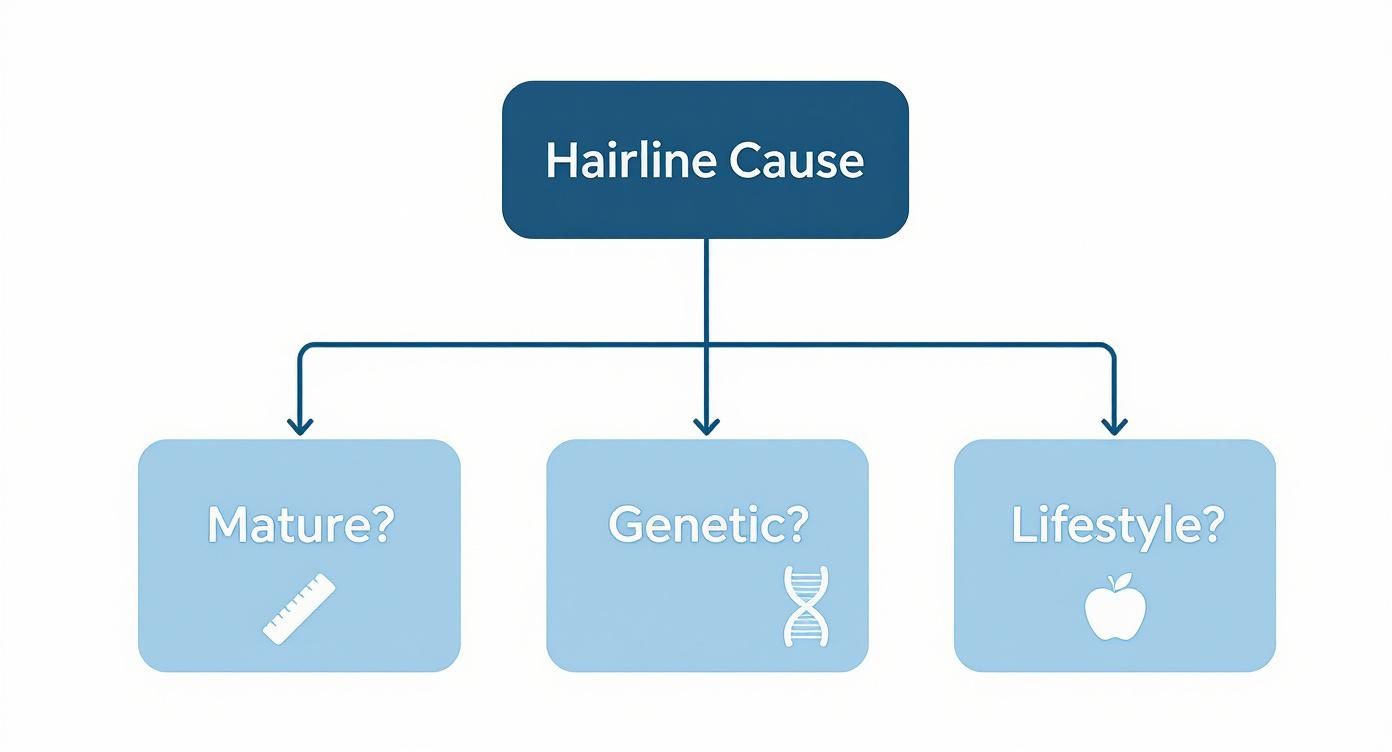
Understanding the root cause is everything. For most guys with a receding hairline, genetics is the primary driver, which is exactly why medical treatments targeting DHT are so effective.
What to Realistically Expect
I can't stress this enough: patience is absolutely critical. You will not see results overnight.
With Minoxidil, you might even see some initial shedding. Don't panic! That’s actually a good sign that the treatment is pushing out old, weaker hairs to make room for new ones. You’ll need to stick with it for 3-6 months before you start seeing new, fine hairs, with the most significant changes becoming visible after a year of consistent use.
It’s a similar story with Finasteride. The first signs of improvement usually show up around the six-month mark, but the peak benefits often take one to two years to fully materialize. And remember, studies have shown that 83% of users successfully stopped any further hair loss. That alone is a huge win.
It's also crucial to understand that these are long-term commitments. If you stop, your hair loss will pick up right where it left off. For men considering a DHT-blocking medication, it's worth knowing the nuances between the available options. You can dive deeper in our comparison of Finasteride vs. Dutasteride for hair loss to prepare for a more productive conversation with your doctor.
Pro Tip: The most powerful strategy for many guys is combination therapy. Using topical Minoxidil to stimulate the follicles from the outside while taking oral Finasteride to block DHT from the inside creates a one-two punch that often delivers far better results than either treatment on its own.
Medical Hair Loss Treatments at a Glance
To help you get a clearer picture, here's a quick rundown of the most common medical treatments and how they stack up.
| Treatment | How It Works | Best For | Average Time to See Results |
|---|---|---|---|
| Minoxidil | Increases blood flow to follicles, extending the hair's growth phase. | General thinning and hairline recession, especially in earlier stages. | 3-6 months |
| Finasteride | Blocks the conversion of testosterone to DHT, protecting follicles. | Men with genetically-driven male pattern baldness. | 4-6 months |
| PRP Therapy | Injects growth factors from your own blood to stimulate follicles. | Those seeking a non-daily, natural approach to boost hair density. | 4-6 months |
This table should give you a starting point for discussion, but a specialist can help determine the absolute best course of action for your specific situation.
Platelet-Rich Plasma (PRP) Therapy
Beyond daily meds, Platelet-Rich Plasma (PRP) therapy has become a game-changer in the world of hair restoration. This isn't a drug; it’s a procedure that uses your body's own powerful healing mechanisms to rejuvenate dormant hair follicles.
Here’s a quick look at the process:
- First, a small sample of your blood is drawn—no more than a routine blood test.
- That blood is then spun in a centrifuge, a machine that separates the platelet-rich plasma from everything else.
- This "liquid gold," which is teeming with growth factors, is then skillfully injected directly into the thinning areas of your scalp.
Think of these growth factors as a direct signal to your follicles, telling them to wake up, repair themselves, and start growing thicker, healthier hair again. It's a minimally invasive treatment, typically done in a series of sessions spaced a few weeks apart.
Many of my patients report seeing less shedding after just one or two sessions, with noticeable new growth and improved density becoming apparent around the four to six-month mark. It’s a fantastic option, especially for individuals looking for an effective solution that doesn't require taking a daily pill or applying a topical.
What About Minimally Invasive Options?
Maybe you're not ready to sign up for a daily pill, or perhaps you want to supercharge the routine you already have. The good news is that the field of non-surgical treatments has exploded with options that are more effective than ever. This is the sweet spot for many people—powerful, minimally invasive treatments that can seriously move the needle on a receding hairline.
You don't have to take my word for it; just look at the numbers. The global hair restoration market is on a trajectory to grow from USD 7.46 billion in 2025 to a massive USD 21.73 billion by 2032. That boom is being driven by people demanding these exact kinds of advanced, minimally invasive technologies that deliver real results without going under the knife. You can read the full market analysis from Coherent Market Insights if you want to dig into the data.
This shift tells us one thing loud and clear: people want effective, less intense solutions. Let's get into some of the best ones out there.
Low-Level Laser Therapy (LLLT)
Think of Low-Level Laser Therapy (LLLT) as a gentle wake-up call for your scalp. This tech uses very specific wavelengths of red light to get down to the cellular level and give your hair follicles a little nudge. Best of all, it's completely painless and non-invasive.
The science behind it is pretty straightforward. The light energy essentially energizes the mitochondria—the "powerhouses"—inside your follicle cells. This can help jolt follicles out of their resting phase and back into an active growth phase, while also boosting blood flow to the scalp.
These days, LLLT usually comes in the form of a cap, helmet, or headband you can use right at home. You just pop it on for a prescribed amount of time a few days a week. It's about as low-effort as it gets and plays very well with other treatments you might be using.
Professional Microneedling for Hair Regrowth
You’ve probably heard of microneedling for improving skin texture, but it’s also a game-changer for waking up dormant hair follicles. In a clinical setting, a trained professional uses a specialized device to create thousands of tiny, controlled micro-injuries on the scalp. This might sound intimidating, but it's a precise process that triggers the body's natural healing instincts.
That healing response does two critical things for your hair:
- It Summons Growth Factors: The micro-injuries are like a flare gun, signaling your body to rush growth factors and other healing agents to the scene to repair the tissue, which in turn can rejuvenate sluggish follicles.
- It Boosts Product Penetration: It opens up temporary micro-channels in your scalp, allowing topical treatments like Minoxidil to penetrate much deeper and work far more effectively. In fact, studies have repeatedly shown that pairing microneedling with Minoxidil yields significantly better results than just using Minoxidil on its own.
A quick but important note: Professional microneedling is worlds away from at-home dermarolling. A pro uses the correct needle depth and sterile techniques to maximize results and minimize any risks. This isn't something to DIY.
Scalp Micropigmentation (SMP)
While the other treatments are focused on regrowing hair, Scalp Micropigmentation (SMP) is a brilliant cosmetic fix that gives you the look of density right now. Think of it as a highly specialized, artistic tattoo where a skilled technician applies tiny dots of pigment to your scalp.
When done correctly, these layered dots perfectly replicate the look of individual hair follicles. For guys who rock a buzz cut, SMP can create a crisp, permanent five-o'clock shadow on your head, totally restoring your hairline. If you have longer hair that's thinning, it can be used to add color to the scalp, which dramatically reduces the contrast between your hair and skin, making your hair look instantly thicker.
A true SMP artist can deliver a result so natural that no one will know it’s not your real hair. It’s a fantastic way to get an immediate confidence boost while you wait for your other treatments to kick in. If you're curious about other alternatives, we have a complete guide to non-surgical hair restoration methods that covers a whole range of options.
Your Daily Habits for Healthier Hair

Let's be real: treatments are only one piece of the puzzle. Real, lasting hair health is built on the back of your daily habits. The choices you make every day create the foundation your hair follicles need to not just survive, but truly thrive. Think of this as the essential groundwork that makes any professional treatment that much more effective.
You can invest in the best treatments available, but they'll be fighting an uphill battle if your body isn't getting what it needs. Neglecting nutrition, scalp care, and stress is like trying to grow a prize-winning garden in sand. You might see a little progress, but you’ll never get the results you're after.
Fuel Your Follicles with the Right Nutrition
You wouldn't put cheap gas in a performance car and expect it to run well. Your hair follicles are no different. They are some of the most metabolically active cells in your entire body, constantly demanding a steady stream of specific vitamins and minerals to do their job.
When you're fighting a receding hairline, some nutrients are simply non-negotiable. If you're deficient in any of the key players, you can stall your progress or even trigger more shedding.
Here’s what to zero in on:
- Iron: This is a big one. Iron helps produce hemoglobin, which is responsible for carrying oxygen to all your cells—including the ones that build hair. Low iron is a well-known culprit behind shedding. You'll find it in lean red meat, spinach, and lentils.
- Zinc: Zinc is critical for hair tissue growth and repair. It also helps keep the oil glands around the follicles working properly. Oysters, beef, and pumpkin seeds are packed with it.
- Biotin (Vitamin B7): While a major biotin deficiency is uncommon, this vitamin is essential for producing keratin, the very protein your hair is made of. Make sure you’re getting enough from foods like eggs, salmon, and nuts.
A solid, nutrient-rich diet does more than just feed your hair. It bolsters your overall health, creating a much stronger foundation for any hair regrowth treatment to build upon.
Master Your Scalp Care Routine
A healthy scalp is the bedrock of healthy hair, yet it’s an area most guys completely overlook. Using harsh shampoos or letting product and sweat build up creates inflammation and can clog follicles—the exact opposite of what you want.
The goal here is a gentle, supportive routine that boosts circulation and keeps things clean without stripping away all your natural oils. A great first step is to ditch any harsh, sulfate-heavy shampoos for a gentler alternative. Look for ingredients that are known to soothe the scalp and support follicle health.
Something as simple as a scalp massage a few times a week can also make a surprising difference. Just use the pads of your fingers to apply gentle, circular pressure all over your scalp for a few minutes. This simple act can help increase blood flow, bringing more of those crucial nutrients directly to where they're needed most. For more ideas, you can find a ton of other strategies for how to boost hair growth naturally in our other guides.
Tackle Stress Head-On
Stress is one of the biggest silent saboteurs of hair health. When you're constantly stressed out, your body is flooded with the hormone cortisol. Chronically high cortisol levels can throw your hair growth cycle out of whack, prematurely pushing a huge number of follicles into the resting (telogen) phase.
A few months down the line, this often leads to a massive shed, a condition called telogen effluvium, which can make a receding hairline look dramatically worse. Getting a handle on your stress isn't just a "nice-to-have" for your mental health; it's a critical part of any serious plan to regrow your hair.
This doesn't mean you need to become a Zen master overnight. It’s about finding small, realistic ways to decompress that you can actually stick with. Maybe it's a 20-minute walk after work, listening to some music, or trying a short mindfulness app. Even small, consistent efforts can lower cortisol and help keep more of your hair in the growth phase where it belongs.
This holistic approach is gaining traction everywhere. The global market for hair loss treatment products is booming, projected to jump from USD 2.93 billion in 2025 to an incredible USD 4.26 billion by 2030. This massive growth is being driven by people looking for solutions that combine modern science with supportive, natural care—proving just how important what you put in and on your body really is.
How to Track Your Progress and Keep Your Expectations in Check

Starting any hair regrowth plan is a serious commitment. I've seen it time and time again: the biggest hurdle isn't the treatment itself, but the mental game of staying patient when you don't see changes overnight. Trust me, staring into the mirror every day looking for new sprouts is the fastest way to get discouraged.
That’s why you need a reliable, objective system for tracking your progress. This isn't just about feeling good; it's about seeing what's actually working. Hair growth is slow and happens in cycles, so having a method to see the small, incremental changes will keep you motivated for the long haul.
Nailing Your Progress Photos
Your phone is your best friend here. Our memories are terrible at noticing gradual changes, so a consistent photo log is the only way to get a true, unbiased look at how your hairline is responding over time. The secret sauce is consistency.
If you want photos that you can actually compare side-by-side, you have to control the variables. Here’s how I tell my clients to do it:
- Same Light, Same Room: Find a spot with good, consistent lighting. Natural daylight from a window is usually best because it’s far more revealing (and less harsh) than the overhead lights in most bathrooms. Stick to that spot every single time.
- Same Angles, Every Time: Don't just snap a quick selfie. Get a routine down: one straight-on view of your hairline, one of the left temple, one of the right temple, and one from above looking down at your crown.
- Same Hair, Same Day: Always take your photos when your hair is in the same condition. I recommend doing it when it's clean and completely dry, as wet hair tends to clump and can make thinning look much worse than it is.
Set a calendar reminder to do this once a month. That’s it. Resisting the urge to do it more often is part of the discipline. This simple habit gives you cold, hard evidence of what's happening.
What the Regrowth Timeline Really Looks Like
This is where you need to be realistic. Different treatments move at different paces, but they all require patience. Understanding the typical stages helps you spot the early wins and not get discouraged.
Hair regrowth rarely starts with a sudden explosion of thick hair. The first thing you'll see are tiny, almost invisible vellus hairs. They’re super fine and light-colored. It's easy to miss them, but they're the first sign that your dormant follicles are waking up.
Here’s a practical timeline of what you can expect:
- Month 1: Honestly? You'll probably see nothing. In fact, if you're using something like Minoxidil, you might even notice a bit more shedding. Don't panic. This is often a sign the treatment is working, pushing out old, weak hairs to clear the way for new, stronger ones.
- Months 3-6: This is when things start to get interesting. You should begin to notice those fine vellus hairs starting to poke through in thinning areas. You might also find that your overall shedding has slowed down, and your existing hair feels a bit healthier.
- Months 6-12: Now we're talking. This is typically when you'll see visible, cosmetic improvement. Those vellus hairs start to mature into thicker, darker "terminal" hairs. Your monthly photo comparisons will really start to show a difference during this phase.
And remember, when a treatment like Finasteride helps 83% of men stop further hair loss, that alone is a huge success. The regrowth that follows is a direct result of your consistency and patience.
Questions I Hear All The Time About Hairline Regrowth
When you first decide to do something about your hairline, a million questions start swirling around. It's completely normal. You're hopeful, but you're also probably a little skeptical and unsure where to even begin.
Let's cut through that noise. Here are the real-world, straightforward answers to the questions I get asked most often.
Can a Receding Hairline Actually Grow Back?
For many people, the answer is a definite yes. But it all hinges on one crucial factor: the state of your hair follicles. If they're just dormant—meaning they've shrunk but are still technically alive—then you've got a solid chance of coaxing them back to life.
Think of it like this: for standard male pattern baldness, treatments like Finasteride and Minoxidil work by creating a much better environment for those struggling follicles. They can hit the brakes on the shrinking process and kickstart new growth. The catch is that if follicles have been dormant for too long, they can eventually scar over and die off completely. This is exactly why getting a jump on treatment early makes such a massive difference.
How Long Before I Actually See a Difference?
This is where you need to dig in and be patient. It’s probably the hardest part, but it's non-negotiable.
When you're consistent with a treatment like Minoxidil, you might spot the first signs of fine, baby hairs—what we call "vellus" hairs—in about 3 to 6 months. But for more meaningful, noticeable changes that you can see in the mirror, you're realistically looking at closer to a full year.
Oral medications like Finasteride work on a similar clock. A major two-year study found that 66% of men on the drug saw significant improvement after that time. With something like PRP therapy, the timeline can sometimes feel a bit faster. Many of my patients notice less shedding after their first couple of sessions, with new growth becoming visible around the 4 to 6-month mark.
My rule of thumb: Stick with any new treatment for a minimum of six months before you even think about judging whether it's working. Throwing in the towel too early is the number one reason people get frustrated and give up.
Do Natural Things Like Oils or Scalp Massages Actually Work?
They can definitely help, but they are not the primary solution for genetic hair loss. Think of them as excellent supporting actors, not the main star. A good scalp massage, for example, is fantastic for increasing blood flow, which is how your follicles get the oxygen and nutrients they need to thrive.
Some oils, like rosemary oil, have even shown some decent promise in smaller studies. The right way to view these is as complementary habits. They boost the overall health of your scalp and hair, which in turn creates a better foundation for the medically proven treatments to do their job effectively. Looking deeper into the science of follicle health is key; you can read our detailed guide on whether dead follicles can be revived to understand the limits.
When Should I Finally See a Doctor?
Honestly? The moment it starts to bother you. If you've noticed your hairline is changing faster than you'd like, or if you're seeing more scalp than you used to, that’s your cue to book a consultation with a dermatologist or a hair loss specialist.
Getting a professional diagnosis is so important. They can confirm if you're dealing with male pattern baldness or rule out other underlying issues that could be at play. From there, you can build a treatment plan together that's actually designed for you, giving you the best possible shot at success. Don't wait until you feel like you've lost too much ground—expert advice is most powerful when you get it early.
At PRP For HairLoss, we're committed to providing you with the most accurate and practical information to help you navigate your hair restoration journey. Explore our resources to learn more about effective treatments and strategies. Find out more at https://prpforhairloss.com.
 PRP For Hairloss
Leave a comment