That morning cup of coffee does more than just drag you into the land of the living—it might also be the secret weapon for a better hair day. The whole idea behind caffeine shampoo for hair growth is pretty simple: applying caffeine directly to your scalp can give your hair follicles a jolt, much like that first espresso shot wakes up your brain. It's a popular option for giving your scalp an energy boost and maybe hitting the brakes on some types of hair loss, but let's get one thing straight from the jump: this is not a miracle cure for baldness.
The Connection Between Your Coffee and Your Hairline
Ever find yourself staring at the lineup of bottles in your shower, wondering if any of them can actually do something about thinning hair? The market is overflowing with choices, but caffeine shampoo has managed to stand out with its straightforward approach. The concept is genuinely appealing—take a stimulant we all know and love and put it right where you need it most: your scalp.
The real goal here isn’t about regrowing a full head of hair on a bald scalp. A better way to think of it is as a support system for the hair you've still got. The aim is to foster a healthier, more energized environment for your follicles, which in turn might help cut down on shedding and make your existing hair look and feel a bit thicker and stronger.
To give you a quick overview, here’s a simple breakdown of what caffeine shampoo is all about.
Caffeine Shampoo at a Glance
| Aspect | Key Takeaway |
|---|---|
| What It Is | A topical shampoo with caffeine as its main active ingredient. |
| Primary Claim | Stimulates hair follicles at the root to help reduce shedding and support growth. |
| Best Suited For | Guys in the early stages of hair thinning or those looking for a proactive maintenance product. |
Think of it as one piece of a much larger puzzle.
Setting Realistic Expectations from the Start
It's so important to go into this with the right mindset. Caffeine shampoo is a tool in your grooming kit, not a magic potion. How well it works for you often comes down to the root cause of your hair thinning and how consistently you stick with it. For many guys, it’s a solid, proactive step for maintaining hair density and scalp health.
Before we dive deep into the science, it helps to have a good grasp on the basics of hair health. This piece on unlocking the secrets to healthy hair growth is a fantastic starting point for understanding what creates the best environment for your hair to thrive.
The core idea behind caffeine shampoo is to support the hair you have and reduce shedding. It helps create a healthier scalp environment, but it's not going to reverse advanced hair loss.
This guide is here to help you cut through the marketing hype. We’re going to look at the science behind how caffeine shampoo for hair growth is supposed to work, review what actual clinical studies have found, and give you a clear-eyed perspective on what you can realistically expect.
What This Guide Will Cover
To make sure you get the full picture, we’ll break everything down. We'll start with the basics and move into practical advice, so you'll have all the info you need to decide if this is the right move for you.
Here’s a quick roadmap of what we’ll explore:
- The Science: How does caffeine actually interact with your hair follicles on a biological level?
- The Evidence: What do the clinical trials and studies really say about its effectiveness?
- Practical Use: A step-by-step on how to use these shampoos to get the best possible results.
- Safety and Side Effects: What you need to watch out for and who should probably skip it.
Of course, hair health isn't just about what you put on your head; it’s also about what you put in your body. While topical treatments play a role, don’t forget you can also support your hair from the inside out by learning about the best foods for hair growth. By the time you finish this guide, you’ll know exactly where caffeine shampoo fits into a modern strategy for managing hair loss.
How Caffeine Works on Your Scalp
To really get how caffeine shampoo is supposed to work, we first need to talk about the main villain in most male hair loss stories: a hormone called Dihydrotestosterone (DHT).
Think of DHT as a microscopic bully that picks on your hair follicles. It latches onto them, slowly shrinking and weakening them over time. This process, known as miniaturization, eventually makes it impossible for the follicle to grow a healthy hair, and it just gives up.
So, where does caffeine come in? The leading theory is that caffeine acts like a bodyguard for your follicles. When you apply it directly to your scalp in a shampoo, it’s thought to seep into the skin and directly counter DHT's damaging effects, essentially shielding the follicles from that shrinking process.
This protective role is the first half of the story. The second part is all about creating a better place for hair to grow in the first place.
Boosting Circulation and Nutrient Delivery
Beyond just blocking DHT, we all know caffeine is a stimulant. Just like your morning coffee gets your blood pumping, caffeine applied to the scalp is thought to ramp up blood flow in that specific area. Better circulation is like upgrading the delivery service to your hair roots.
This improved blood flow means a better supply of everything your follicles need to thrive:
- More Oxygen: The fuel for cellular energy and basic function.
- More Nutrients: The raw materials needed to build strong, healthy hair.
- A Healthier Environment: Flushing out waste products more efficiently.
By creating this more energized and well-fed scalp environment, the goal is to get your follicles working at their best. It's a foundational step, and our guide on how to stimulate hair follicles dives into more strategies that can complement this.
Extending the Hair Growth Phase
This two-pronged attack—defending against DHT and boosting the nutrient supply—is all geared toward one main objective: keeping your hair in its active growth phase for longer. This crucial stage is known as the anagen phase.
Every single hair on your head cycles through growing, resting, and shedding. When DHT runs wild, it cuts the anagen (growth) phase short. This means hairs fall out sooner and are replaced by progressively thinner, weaker ones.
The whole point is to keep more of your hair in that active growth phase for as long as possible. This doesn't mean growing brand new follicles, but rather strengthening the ones you have to reduce shedding and create a fuller look over time.
The idea of caffeine helping hair isn't exactly new. Early lab research from over a decade ago gave us the first hints. One key in-vitro study showed that applying a caffeine solution to human hair follicles in a petri dish stimulated hair shaft elongation by a whopping 46% compared to untreated follicles. This was a massive clue that it could extend that vital anagen phase.
You can find more on this foundational research on caffeine's effect on hair. Of course, we have to remember that results in a lab don't always translate perfectly to a real person's scalp, where the effects are often much more modest.
Ultimately, the science points to a mechanism that's more about playing defense and providing support than it is about a magical cure. By fighting off DHT and improving the supply line to your hair, caffeine shampoos aim to keep your existing hair healthier, stronger, and on your head for longer.
What the Clinical Evidence Actually Shows
Lab results in a petri dish are one thing, but what happens when you put a product in the hands of real people? When we dig into the actual clinical studies on caffeine shampoo, the picture becomes much clearer—and, frankly, a bit more realistic.
The evidence from these trials isn't about miracle cures. It's about tangible, measurable improvements. Researchers aren't just asking people if they feel like their hair is better. They’re tracking hard numbers: changes in hair density, the strength of the hair shaft, and how much shedding is reduced over time.
This is where the science bridges the gap between the lab bench and your bathroom shelf, helping set honest expectations for what you might experience.
Measuring the Impact on Hair Density
One of the gold standards in hair loss studies is hair density—the actual count of hairs growing in a small patch of scalp, usually a square centimeter. An increase here is a direct, undeniable sign that a treatment is doing something.
Some clinical trials have shown that caffeine-based formulas can move the needle. For instance, one study involving a shampoo with 0.4% caffeine and 0.2% adenosine followed 77 people for several months. They found that average hair density jumped from 118.25 hairs per square centimeter to 130.03 after just three months.
That’s an increase of nearly 12 hairs in that tiny area, which adds up to a roughly 10% improvement in overall density. This kind of data is what separates marketing claims from documented results.
User Feedback and Reduced Hair Loss
Beyond the microscope, what are people actually seeing in the mirror? Many studies also collect feedback from participants, which gives us valuable real-world context. In several placebo-controlled trials, users of caffeine shampoo consistently reported seeing a difference.
In one notable study, an impressive 73% of participants reported a noticeable drop in hair loss compared to the group using a placebo shampoo. This tells us that while the shampoo is working at a microscopic level, people are seeing the results in a very practical way: less hair in the shower drain and on their brush.
This infographic helps visualize what's happening behind the scenes.
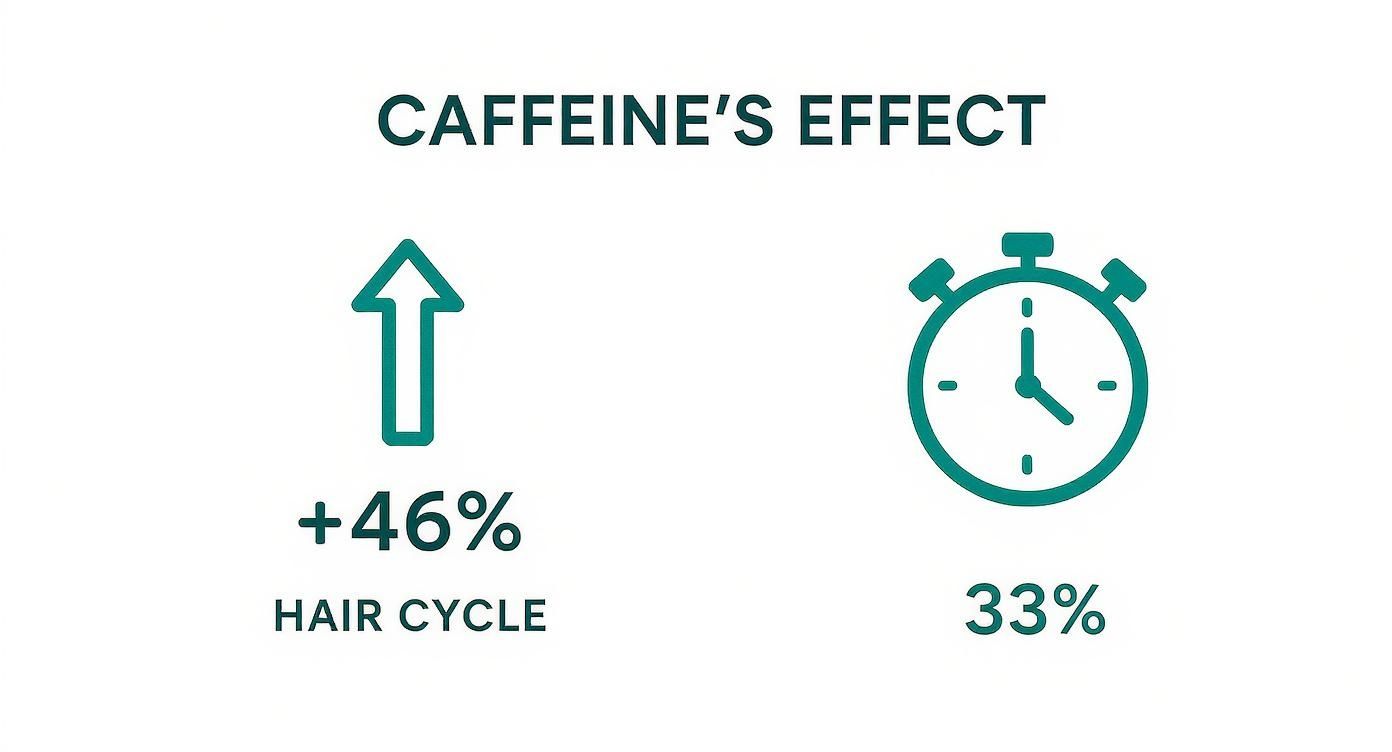
As you can see, the data points to caffeine extending the active growth phase and giving the hair cycle a boost, which is the mechanism behind that reduced shedding and improved density.
To give you a clearer snapshot of the research, here's a breakdown of findings from some key studies.
Clinical Study Outcomes for Caffeine Shampoo
This table summarizes key metrics and findings from notable clinical trials on caffeine-based hair products.
| Metric | Finding | Timeframe | Source Highlight |
|---|---|---|---|
| Hair Density | 10% increase in hair density (from 118.25 to 130.03 hairs/cm²) | 3 months | Combined 0.4% caffeine and 0.2% adenosine solution |
| Reduced Shedding | 73% of users reported a significant reduction in hair loss | 6 months | Placebo-controlled study on men with androgenetic alopecia |
| Hair Shaft Strength | Improved hair anchorage; 14% less force required to pluck hair | 6 months | TrichoScan analysis measuring hair pull test resistance |
| User Satisfaction | Significant improvements in "hair loss" and "hair thickness" scores | 4 months | Self-assessment questionnaires from male participants |
The takeaway from the data is pretty consistent: these products can produce modest, but statistically significant, results.
Putting the Numbers into Perspective
It's really important to interpret these findings correctly. A 10% increase in hair density is a solid, scientifically validated improvement. But it's not going to look like you've suddenly regrown a decade of lost hair. Think of it more like turning up the volume dial just a bit, creating a fuller look and a stronger foundation for the hair you already have.
The clinical evidence points toward modest but measurable benefits. The goal is not to reverse baldness but to slow down the thinning process, reduce shedding, and improve the overall density and health of existing hair.
Across the board, these studies highlight the need for patience and consistency. The positive changes, like that boost in hair density, typically showed up after three to six months of regular, often daily, use. This isn't an overnight fix; it's a long-term maintenance strategy.
Ultimately, the clinical data suggests that caffeine shampoo for hair growth is a credible tool for anyone looking for a non-prescription approach. It’s one of several hair growth products that actually work and can be a valuable part of a broader strategy. The evidence supports its role as a supportive treatment that can deliver real, though not dramatic, results for the right person.
Setting Realistic Expectations for Results
While the clinical data offers some glimmers of hope, let's have a frank conversation. The real-world experience of using a caffeine shampoo for hair loss can be all over the map. For every glowing review you find online, there’s someone else who felt let down, which is exactly why we need to set the right expectations from day one.
The simple truth is that not everyone who lathers up with a caffeine shampoo will see the results they're hoping for. It's not a silver bullet, and understanding its limitations is just as important as knowing what it might do. Its effectiveness really hinges on where you are in your hair loss journey.
I like to use a car maintenance analogy. Regularly changing the oil helps the engine run smoothly and can prevent bigger problems down the road. But if the engine has already seized up, a fresh oil change isn't going to bring it back to life. Caffeine shampoo works on a very similar principle.
Who Is Most Likely to Benefit
Caffeine shampoo shines as a proactive or early-stage tool. The ideal candidate is someone who's just started noticing more hair in the shower drain or the very first signs of thinning at the temples or crown. In these early stages, the hair follicles are still active, but they might be getting weaker under the influence of DHT.
For these guys, a caffeine shampoo can act as a solid support system by:
- Tapping the Brakes on Shedding: It helps encourage more hairs to stay in their active growth phase for longer.
- Strengthening Existing Hair: The goal is to create a better environment for follicles, helping them produce stronger, healthier hair shafts.
- Holding the Line on Density: It's really about slowing down the thinning process to help you keep the hair you've got.
Think of it this way: caffeine shampoo is most effective when you're playing defense, not when you're trying to reclaim significant territory that's already been lost.
Why It Is Not a Fix for Advanced Baldness
This brings us to a crucial reality check: caffeine shampoo will not reverse advanced male pattern baldness. Once hair follicles have shrunk to the point where they're dormant or have disappeared entirely—leaving those smooth, bald areas on the scalp—no shampoo can revive them. The "engine" in those spots has simply stopped running.
The entire mechanism of caffeine shampoo is based on stimulating and protecting existing, functioning follicles. It absolutely cannot regenerate follicles that are long gone. For men with significant baldness, more powerful, clinically proven treatments are required to see any meaningful change. You can get a better sense of timelines by reading our article on how soon you can expect results from other treatments like Rogaine.
The Critical Role of Consistency and Patience
Perhaps the single biggest reason people get disappointed is the gap between what they expect and the commitment required. The clinical studies that show positive results all involve consistent, long-term use. We're talking about needing three to six months of daily application before you might even begin to notice a difference.
This demands a level of patience that most people underestimate. This isn't a quick fix where you'll see a thicker head of hair in a few weeks. The process is slow, and the results, if they come, are often quite subtle.
The most common pitfall is giving up too soon. If you aren't prepared to use a caffeine shampoo daily for at least six months, you are unlikely to experience the modest benefits reported in clinical trials.
The data tells this story clearly. One study using a caffeine lotion found an 8.14% reduction in hairs lost during a pull test after two months. That number improved to 15.33% after four months, showing how the benefits can build over time.
But real-world data is a bit more sobering. An analysis of negative reviews for popular caffeine shampoos revealed that 41% of them came from users who saw no improvement at all. This is likely due to a mix of inconsistent use, more advanced hair loss, or simply having unrealistic expectations. You can discover more insights about these clinical findings to see the full context. It’s a stark reminder of the gap between a controlled study and your bathroom, making it clear that caffeine shampoo is a supportive player, not a miracle cure.
How to Use Caffeine Shampoo for Best Results
Just owning a bottle of caffeine shampoo won't do the trick. If you want to see any potential benefits, your technique is what really matters. Getting the most out of these shampoos involves a few key steps that, frankly, most guys get wrong. It's definitely not just a quick lather and rinse.
Think about it like watering a plant. You wouldn't just splash some water on the leaves and call it a day, right? You need to get that water down into the soil to nourish the roots. The exact same idea applies here. The entire goal is to get the caffeine directly to your scalp and give it enough time to actually sink in and reach the hair follicles.
The Two-Minute Rule Is Not a Suggestion
This is, without a doubt, the most important part of the whole process. For the caffeine to have any shot at penetrating your scalp and getting to the follicles, the shampoo must stay on your head for at least two minutes. This isn't just some casual recommendation from the manufacturer; it's the minimum time required for absorption to even begin.
Most of us are in and out of the shower in a flash, washing our hair in under a minute. That’s simply not going to cut it here. You need to lather it up, really massage it into your scalp, and then just let it sit there while you wash everything else. That waiting period is when all the work is supposed to get done.
Perfecting Your Application Technique
How you apply the shampoo is just as critical as how long you leave it on. A haphazard scrub won’t do. You need a more methodical approach to make sure you get even coverage and give your follicles the best chance at stimulation.
For every wash, follow these simple steps:
- Focus on the Scalp: Don't just dump the shampoo on your hair. Apply it directly to your scalp and use your fingertips—not your nails—to gently massage it in for about 30 seconds. Make sure you cover the entire area, paying extra attention to any spots where your hair is thinning.
- Let It Sit: Now, hit the mental stopwatch for your two-minute wait. This is the crucial contact time that allows the active ingredients to start their work before being washed down the drain.
- Rinse Thoroughly: After at least two minutes have passed, rinse the shampoo out completely. Use lukewarm water, as super hot water can be harsh on your scalp and hair.
Proper application isn't about scrubbing harder; it's about giving the active ingredients sufficient contact time with your scalp. Skipping the two-minute wait essentially renders the shampoo ineffective.
Consistency and Complementary Care
Like any approach to tackling hair loss, consistency is everything. The proposed benefits of caffeine shampoo are cumulative, meaning they build up over time with steady, regular use. The clinical studies that showed positive results had participants using the product every single day. If you want to see what it can do, you have to stick with it.
Finally, think about what comes after the wash. A caffeine shampoo is all about the scalp, but the rest of your hair needs attention, too. Following up with a good, nourishing conditioner is important to keep your hair from feeling dry or becoming brittle. It’s all about building a smart routine, and pairing your caffeine shampoo with the right products is a big part of that. Our guide to the best shampoo for thinning hair can help you figure out how to build a complete, effective system.
Are There Any Side Effects or Risks I Should Know About?
Whenever you're trying something new for your hair, especially for a sensitive issue like thinning, safety is front and center. So, let's cut right to it: caffeine shampoo is overwhelmingly safe. For most guys, it's a very low-risk addition to their grooming routine with little to worry about.
That said, nothing works perfectly for everyone. A small handful of people might run into some minor scalp irritation, but these issues are typically mild and easy to manage. Knowing what to look for will help you decide if it's right for you.
What to Watch for With a Sensitive Scalp
Most issues, when they do pop up, are confined to the scalp. While caffeine itself is rarely the problem when applied topically, other ingredients in the shampoo formula can sometimes cause trouble.
Here’s what a sensitive scalp might experience:
- Irritation: If you have a pre-existing skin condition like eczema or psoriasis, you might notice some redness or a temporary stinging feeling.
- Dryness and Itching: Some formulas contain harsh detergents (like certain sulfates) that can strip your scalp of its natural, protective oils. This can leave it feeling dry and itchy.
- Allergic Reactions: It's often the fragrances, preservatives, or other additives in a shampoo that cause an allergic reaction, not the active ingredient.
If you experience any of these, the caffeine is probably not the bad guy. More often than not, it's one of the supporting ingredients. Switching to a shampoo specifically formulated for sensitive skin—one that’s free of common irritants like sulfates and parabens—is usually all it takes to fix the problem.
The bottom line on safety is that caffeine shampoos are considered very safe. When negative reactions do happen, they are uncommon, mild, and almost always caused by other ingredients in the bottle, not the caffeine.
Will It Give Me the Jitters? Debunking the Absorption Myth
It’s a fair question: if caffeine in my coffee can make me jittery, will caffeine on my scalp do the same? You can relax. The answer is a clear no.
The amount of caffeine that actually gets absorbed through the skin on your head is tiny—nowhere near enough to have a "systemic" effect. It works right where you apply it, at the hair follicle level, without entering your bloodstream in any meaningful quantity.
So, you can wash your hair with confidence. Your caffeine shampoo won't mess with your sleep, cause anxiety, or give you the same buzz as your morning espresso.
Common Questions About Caffeine Shampoo
When you're thinking about adding a caffeine shampoo to your routine, a few questions are bound to pop up. This isn't just another bottle on the shower shelf; it's a targeted product for supporting your hair. To cut through the noise, let's tackle some of the most common questions guys have about using these shampoos.
Think of this as your practical, no-nonsense guide. We'll get straight to the "what ifs" and "how-tos" so you can decide if it’s the right move for you.
How Long Until I See Results?
This is the big one, and the honest answer is: be patient. Based on the clinical data we have, most guys who see a positive change start noticing it after three to six months of consistent, daily use.
Don't expect a dramatic overnight transformation. The first thing you're likely to notice is more subtle—a bit less hair in the drain or on your brush. It's all about letting those small, cumulative effects build up over time, so sticking with it is key.
Can I Just Put Coffee on My Hair?
It sounds like a clever life hack, but unfortunately, it's a non-starter. Rinsing your hair with your morning brew is not a substitute for a properly formulated caffeine shampoo.
Here’s exactly why that's a bad idea:
- Wrong Concentration: Shampoos are formulated with a very specific, stable concentration of caffeine—enough to be effective but not so much that it causes irritation.
- Poor Absorption: A good shampoo contains ingredients that help the caffeine actually penetrate the scalp and reach the hair follicles. Coffee on its own just doesn't have that delivery system.
- Potential Damage: Coffee is acidic. It can easily stain your hair and, worse, dry it out, leaving it brittle and looking dull.
It's best to stick with the products that have been scientifically designed for the job.
Does Caffeine Shampoo Work for All Hair Loss?
Caffeine shampoo has really only been studied for one thing: androgenetic alopecia, which you probably know as male pattern baldness. Its whole purpose is to try and run interference against the effects of DHT on your hair follicles.
Caffeine shampoo is designed to target the hormonal pathway behind genetic hair thinning. It’s not a fix for hair loss caused by other issues like medical conditions, major stress, or nutritional deficiencies.
If you’re dealing with a different kind of hair loss, like alopecia areata (patchy loss) or telogen effluvium (shedding after a stressful event), this kind of shampoo is unlikely to make a difference. The first step is always figuring out the real root cause of your hair loss.
What Happens if I Stop Using It?
If you've been using a caffeine shampoo for a while and you're happy with what you're seeing, stopping will almost certainly reverse any benefits. You have to think of it as ongoing maintenance for your hair. Once you stop applying caffeine to the scalp, its protective effect on the follicles goes away.
Within a few months, your natural hair loss pattern will likely pick up right where it left off. The takeaway here is simple: any results you get are entirely dependent on continuous, long-term use.
At PRP For HairLoss, we believe that knowing all your options is the first step toward building a smart hair loss strategy. While caffeine shampoo can be a great supportive player, it's crucial to explore proven treatments for a complete game plan. You can learn more about advanced solutions on our website. https://prpforhairloss.com
 PRP For Hairloss
Leave a comment