Spotting your hairline starting to creep backward can be a tough pill to swallow. But before you dive down the rabbit hole of "miracle cures" all over the internet, let's talk about what actually works. Think of this guide as your straightforward, no-nonsense look at how to realistically reclaim your hairline.
We're going to cut through the noise and focus on why hairlines recede in the first place—genetics and hormones are the main culprits—and then walk through the most effective, science-backed strategies you can start using today. This is all about giving you a clear, actionable plan.
This simple decision tree is a great starting point for thinking about your next steps.
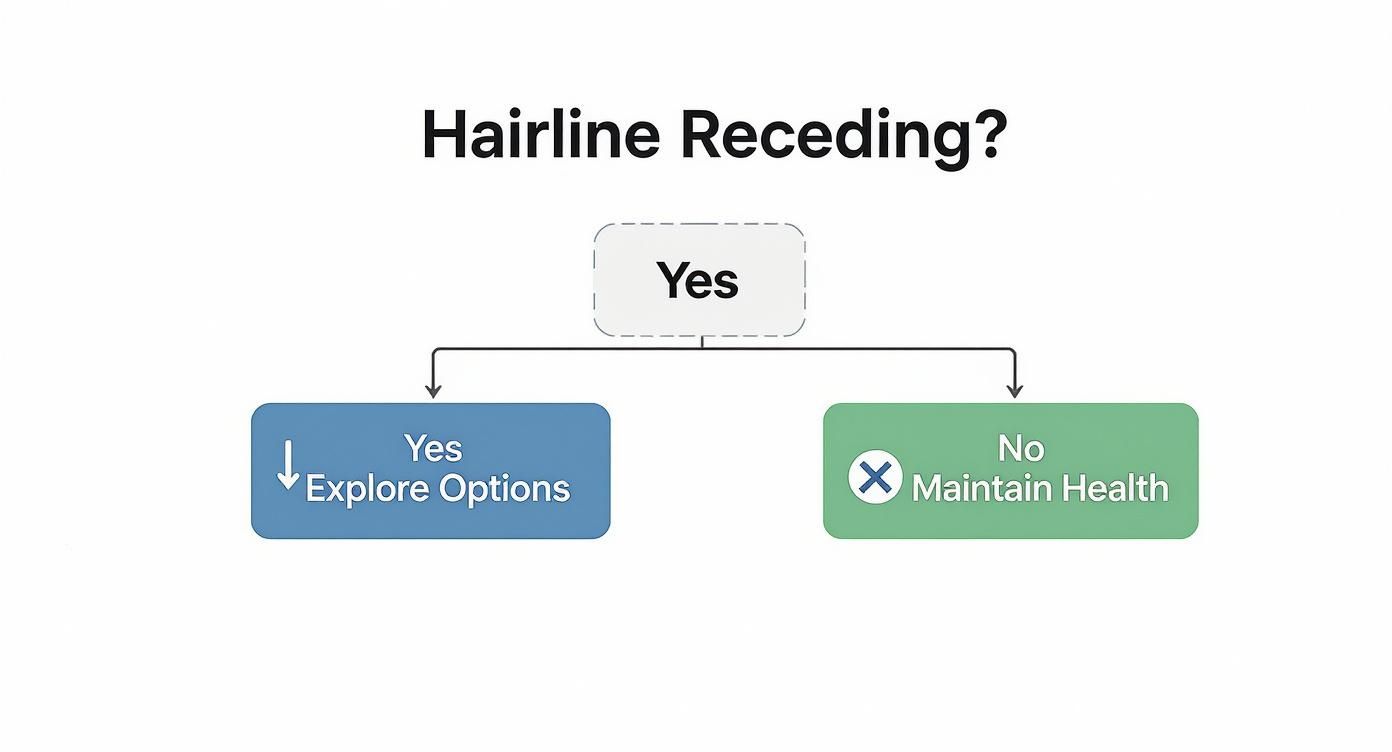
As you can see, the most important step is the first one: just acknowledging the change and deciding to be proactive instead of waiting around and watching it happen.
First, Understand Why It's Happening
Before we jump into the solutions, you need to know why your hairline is changing. For the vast majority of guys, the answer is androgenetic alopecia, which is just the clinical term for male pattern baldness. It really boils down to two things:
- Your Genes: You've inherited hair follicles that are extra sensitive to a hormone called dihydrotestosterone (DHT).
- Your Hormones: DHT, which your body makes from testosterone, latches onto these sensitive follicles and shrinks them over time. This process is called miniaturization, and it’s why your hair gets thinner and shorter until, eventually, it just gives up and stops growing.
While your DNA is the main driver, other things like chronic stress, a poor diet, or even some health issues can pour gasoline on the fire. Pinpointing the cause is the key to picking the right battle plan.
A receding hairline doesn't mean you did anything wrong. For most people, it’s just a genetic trait playing out. The real trick is to intervene early with proven methods to save the follicles you have and kickstart new growth.
To give you a quick overview of what's out there, here's a look at some of the most effective options available.
Hairline Regrowth Options at a Glance
| Treatment Type | How It Works | Average Time to See Results |
|---|---|---|
| Topical Minoxidil | Boosts blood flow to the scalp and nudges dormant follicles back into their growth phase. | 3-6 months |
| Oral Finasteride | A prescription pill that blocks the enzyme that turns testosterone into follicle-damaging DHT. | 3-6 months |
| PRP Therapy | Uses growth factors from your own blood, injected into the scalp, to heal follicles and wake up new hair growth. | 3-6 months |
| Low-Level Laser Therapy (LLLT) | Red light therapy (usually in a cap or headband) energizes cells in the follicle to spur on growth. | 4-6 months |
This table gives you a bird's-eye view, but remember that consistency is everything. No matter which path you choose, you have to stick with it to see any real results.
Whether you're looking at medical treatments, simple lifestyle shifts, or a mix of both, think of this as your personal roadmap. It’s here to help you navigate your choices and find a path that feels right for you, based on what truly works.
If you're interested in exploring the broader spectrum of regenerative medicine, which often includes hair restoration, you might consider looking into professional anti-aging services. The following sections will get into the nitty-gritty of each strategy to help you on your way.
Using Topical Treatments Like Minoxidil
For most guys just starting to tackle a receding hairline, the first stop is often the local pharmacy. And when you look at the options on the shelf, one name always seems to pop up: Minoxidil. There's a good reason it’s the most common over-the-counter choice—it's been around for ages, and it genuinely works for a lot of people.
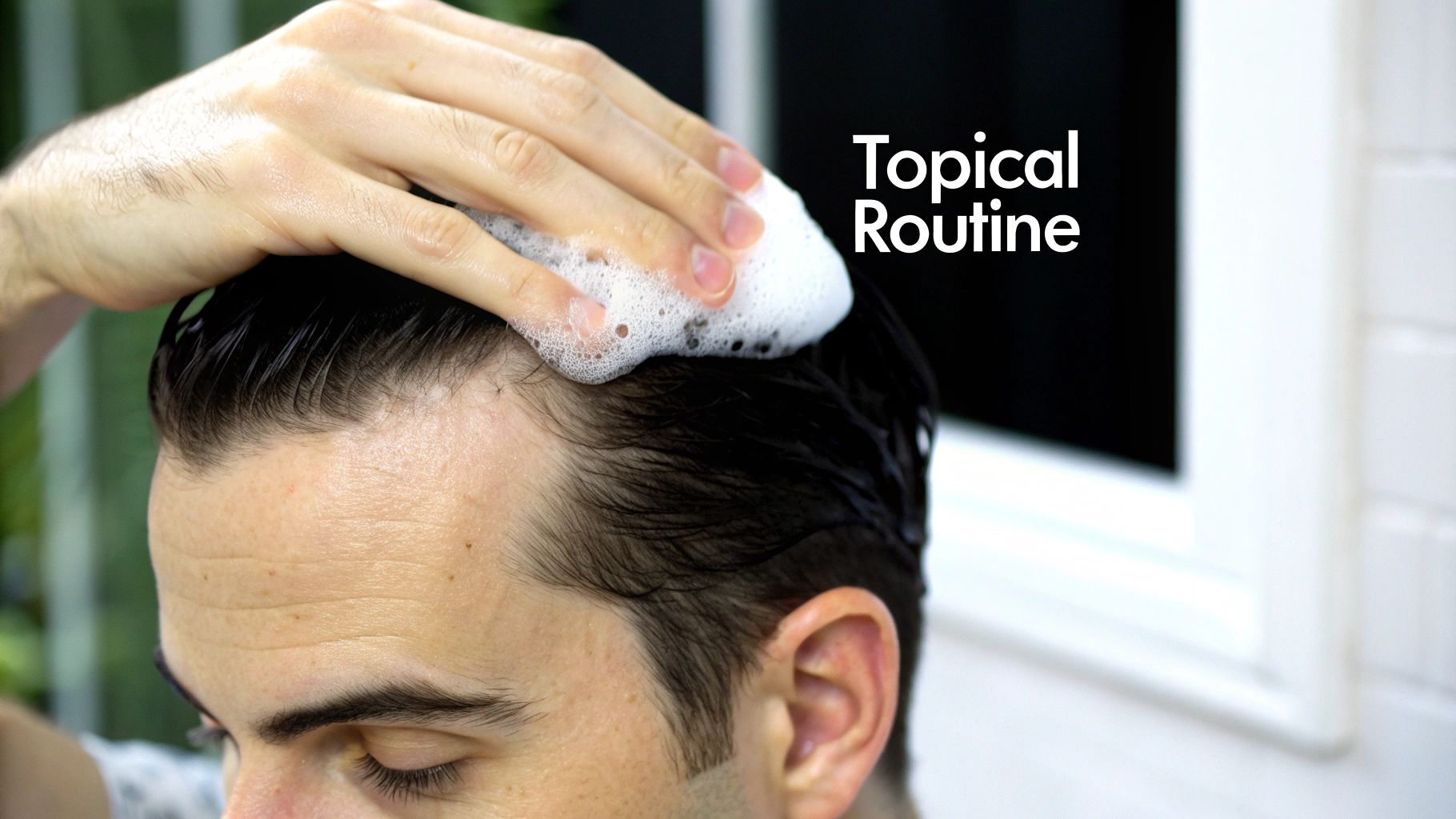
But how does that foam or liquid actually help? It’s not some miracle potion. Minoxidil is a vasodilator, a fancy term meaning it helps widen your blood vessels. When you apply it directly to your scalp, it ramps up blood flow to the hair follicles, giving them a much-needed shot of oxygen and nutrients.
Think of it as waking up dormant follicles. This extra nourishment can push them out of their resting phase and back into an active growth cycle, which over time, can lead to visibly thicker and healthier hair.
How to Apply Minoxidil for Best Results
Getting the application right is everything. You can't just splash it on and hope for the best. The real goal is to get the solution onto your scalp, not just all over your hair.
Here’s a simple, effective routine I recommend:
- Start Dry: Always apply it to a completely dry scalp. Any moisture will just dilute the formula and mess with how well it absorbs.
- Part Your Hair: Grab a comb and create clear parts in the thinning areas. This exposes the scalp so you can apply the product directly where it needs to go.
- Use the Right Dose: More isn't better. Stick to the recommended 1 milliliter dose. Overdoing it won’t make your hair grow faster, but it might increase your chances of side effects.
- Gently Massage It In: Use your fingertips to work the solution into the skin. A light massage helps with absorption and gets the blood flowing. Then, just let it air dry.
The absolute key here is consistency. To see real progress, you have to commit to applying it twice a day, every single day. Make it a non-negotiable part of your morning and evening routine, just like brushing your teeth.
Setting Realistic Expectations
Patience is probably the biggest challenge when using Minoxidil. You're not going to wake up with a new hairline in a week, and it’s critical to understand the timeline. In fact, you might even notice a bit of extra shedding at first.
Don't panic if you see more hair in the drain at first. This initial shedding is often a sign that the treatment is working. It's pushing out the old, weaker hairs to make way for new, stronger ones to grow in.
You'll need to stick with it for 3 to 6 months before you start seeing real, visible changes. The science backs this up. A huge one-year study involving nearly 1,000 men showed that 62% saw a reduction in the size of their hair loss area. What's more, dermatologists rated the treatment as effective for new growth in over 63% of the men. You can find more info about this research by exploring https://prpforhairloss.com/minoxidil-spray-for-male to get a clearer picture of what to expect.
Beyond Minoxidil: Other Helpful Topicals
While Minoxidil is the headliner, it’s not the only player on the team. To really create a healthy environment for hair growth, you can bring in other topicals, like a shampoo with ketoconazole.
Most people know ketoconazole as an anti-dandruff ingredient, but it also has mild anti-androgenic effects. That means it can help fight the DHT building up on your scalp—the very hormone that shrinks hair follicles in the first place.
- How to Use It: Lather up with a ketoconazole shampoo 2-3 times per week, leaving it on for a few minutes before rinsing.
- What It Does: It helps calm scalp inflammation, creating a much better foundation for hair to thrive.
- Combined Approach: Using it in tandem with your daily Minoxidil routine can be a powerful one-two punch against a receding hairline.
The creation of these hair regrowth formulas is a complex scientific process. Developing them requires precise, controlled environments, and understanding the function of equipment like pharmaceutical powder fume hoods offers a glimpse into the meticulous research behind the products we rely on. Ultimately, building a consistent topical routine is one of the most accessible and effective first steps you can take.
How Oral Medications Like Finasteride Work
While topicals get to work on the surface, oral medications are a powerful way to attack hair loss from the inside out. When we talk about how to regrow a receding hairline, the conversation almost always includes finasteride. It’s the go-to prescription for a reason: it tackles the hormonal cascade that triggers male pattern baldness in the first place.
Instead of just trying to coax dormant follicles back to life, finasteride gets to the root cause by targeting dihydrotestosterone (DHT). It belongs to a class of drugs called 5-alpha-reductase inhibitors. In plain English, that means it blocks the specific enzyme that converts testosterone into the follicle-killing hormone, DHT.
By drastically reducing DHT levels in your scalp, finasteride essentially runs interference for your hair follicles. It shields them from the shrinking process, giving them a fighting chance to recover, grow stronger, and start producing thicker, healthier hair again.
What Real-World Results Look Like
So, what can you actually expect? The great news is that finasteride is one of the most clinically-proven treatments we have. It doesn't just put the brakes on hair loss; for many guys, it helps regrow what's already been lost.
Study after study has shown that finasteride stops hair loss from getting worse in about 85% of men. Even better, it leads to noticeable regrowth in roughly 65% of them. A major 2017 review backed this up, finding it effectively halted hair loss at the crown for around 80% of men and for about 70% in other areas. You can dig into the research behind finasteride's effectiveness to see the data for yourself.
Finasteride is a long-term strategy, not a quick fix. Success hinges on consistency. Taking one pill daily gives your body the steady supply it needs to keep DHT levels suppressed and support continuous hair growth.
Understanding the timeline is key. You're not going to wake up with a new hairline next week, so patience is a must.
Your Timeline for Seeing Progress
- Months 1-3: Honestly, you probably won't see much. The medication is just starting to do its job lowering DHT and stabilizing the hair loss. Hang in there.
- Months 3-6: This is when things get interesting. Most guys start to see the first real signs of progress. Shedding should slow way down, and you might spot some fine, new hairs popping up along the hairline.
- Months 6-12: Now the results become much more obvious. You should see a tangible improvement in thickness and density as those new hairs mature and thicken up.
- Year 2 and Beyond: For many, peak results appear after about two years of consistent use.
It’s truly a marathon, not a sprint. Sticking with that daily pill is what ultimately delivers the significant, lasting results you're after.
A Balanced Look at Potential Side Effects
You can't talk about finasteride without having an honest conversation about side effects. While they are uncommon and affect only a small minority of users, it’s crucial to be aware of them before you start.
The most talked-about side effects are sexual in nature and can include:
- Decreased libido (sex drive)
- Erectile dysfunction
- A reduction in semen volume
It's really important to put this in perspective: these side effects happen in a very small fraction of men—typically less than 2%. For most who do experience them, they often fade with continued use or go away completely if the medication is stopped. For a deeper dive, check out our guide on if finasteride will stop hair loss and what you should consider.
The bottom line? Have a frank discussion with your doctor. They can help you weigh the proven benefits against the potential risks based on your health and medical history, making sure you land on a decision that feels right for you.
Exploring Hair Transplants for a Permanent Fix
When other treatments haven't delivered or you're just ready for a more definitive solution, a hair transplant is often the final stop. This isn't a temporary measure; it's a surgical procedure that physically rebuilds your hairline, offering what is essentially a permanent fix.
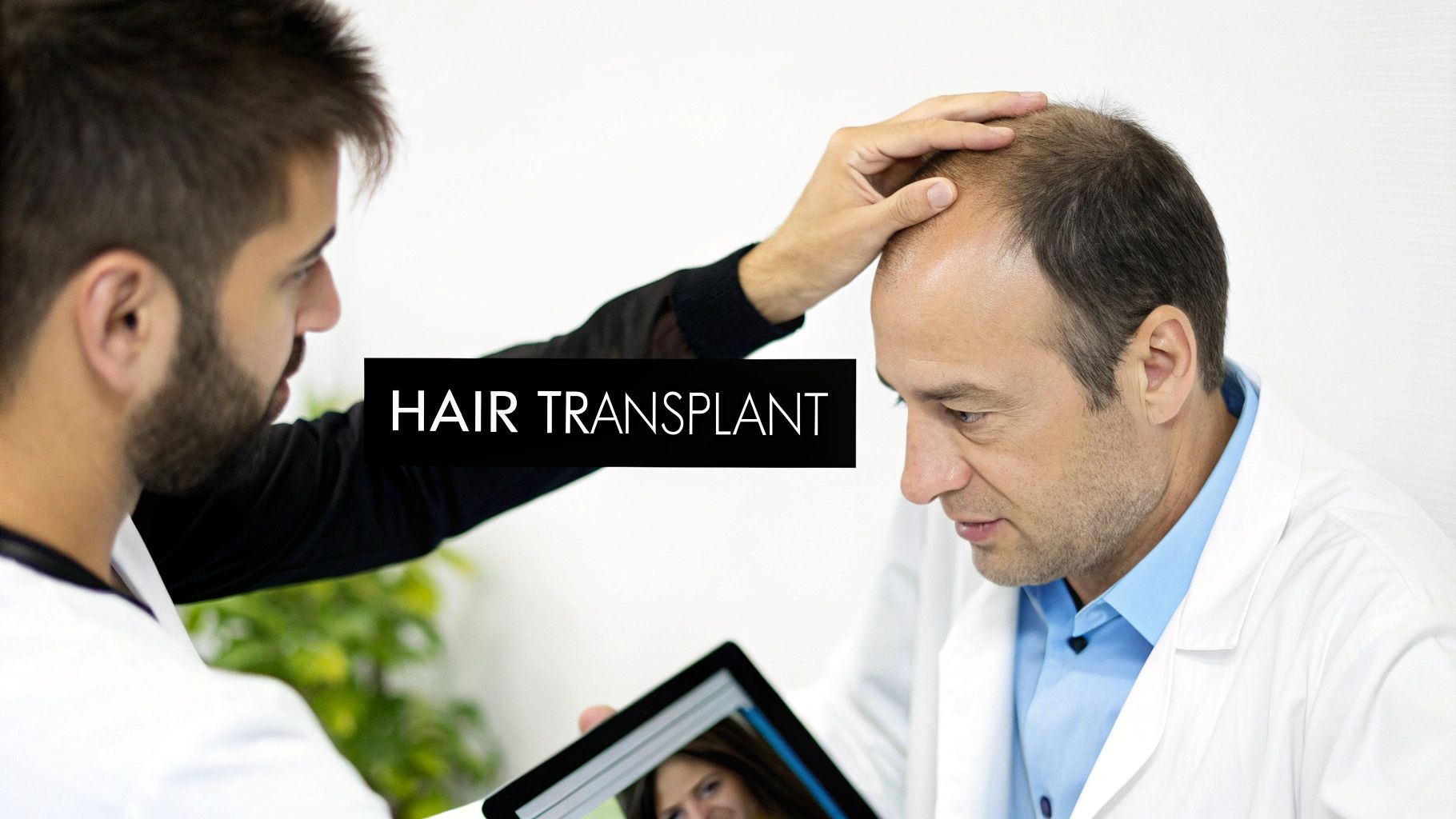
The concept behind it is pretty straightforward. A surgeon harvests healthy hair follicles from areas where your hair is still thick and resistant to balding—usually the back and sides of your head. These follicles are then meticulously transplanted, one by one, into the thinning areas.
Think of it like moving a hardy plant from one part of the garden to a patch that's gone barren. These transplanted hairs keep their original genetic resilience, meaning they won't be affected by the hormonal changes that caused the initial hair loss. They just keep growing naturally in their new home, for life.
FUE vs. FUT: The Two Main Techniques
As you dive into your research, you'll see two acronyms pop up everywhere: FUE and FUT. Both get you to the same end goal, but the journey there is a bit different.
-
Follicular Unit Extraction (FUE): This is the precision approach. The surgeon extracts individual follicular units (tiny bundles of 1-4 hairs) directly from the donor area with a micro-punch tool. This method leaves behind tiny, dot-like scars that are virtually invisible, making it a great choice if you ever want to rock a short haircut.
-
Follicular Unit Transplantation (FUT): Often called the "strip method," this technique involves removing a thin strip of scalp from the back of the head. A team of technicians then carefully separates that strip into individual hair grafts under high-powered microscopes. FUT can yield a massive number of grafts in a single session, but it does leave a fine linear scar, which is easily concealed by the surrounding hair.
The right choice for you isn't always obvious. It’s a detailed conversation you’ll have with your surgeon, weighing your degree of hair loss, the quality of your donor hair, and even your hairstyle preferences.
Are You a Good Candidate for a Transplant?
Wanting a transplant isn't quite enough to get one. A reputable surgeon will take a hard look at several key factors to make sure you'll be happy with the outcome for years to come.
So, what makes someone a good candidate? It’s more than just having a receding hairline.
- Stable Hair Loss: It's often best to wait until your hair loss has slowed down or stabilized. If you get a transplant too early, you risk losing more native hair behind the transplanted zone, which can create an unnatural, isolated patch of hair.
- A Healthy Donor Area: The whole procedure depends on having a good supply of healthy, dense hair on the back and sides of your head to draw from.
- Realistic Expectations: You have to understand that this is a long game. You won't walk out of the clinic with a full head of hair. The final results take a full 12 to 18 months to mature.
A hair transplant is as much an art as it is a science. A skilled surgeon doesn't just move hair; they design a new hairline that perfectly complements your facial structure, age, and future hair loss patterns for a truly undetectable result.
Modern hair transplantation is incredibly effective. For men committed to regrowing their hairline, the outcomes can be life-changing, with success rates often hitting over 90% at top clinics. When done right by an experienced surgeon, graft survival rates can be as high as 99%.
Ultimately, the only way to know for sure if it's right for you is to book a consultation. The surgeon will give you a straight, honest assessment of what's realistically achievable. To get a better handle on what goes into a successful procedure, you might want to read our article covering the hair transplant success rate and all the factors that play a part.
Lifestyle Habits That Support Hair Growth
Medical treatments are definitely the heavy hitters when you're looking to regrow a receding hairline, but they can't do the job alone. Your daily habits are what create the foundation for healthy hair, and getting them right can make your primary treatments work that much better.
Think of it this way: your body is the soil. The richer and more nourished that soil is, the better anything you plant is going to grow.

This whole support system starts with what you put on your plate. Hair follicles might be tiny, but they are incredibly active factories that demand a constant supply of specific nutrients. If your diet is lacking, your body will divert those precious resources to more vital functions, and hair is often the first thing to get short-changed.
Fueling Your Follicles With the Right Nutrients
You don't need to follow some complicated, restrictive diet. It’s really about focusing on a few key building blocks that create the ideal internal environment for hair growth.
Three of the most important players here are:
- Biotin: This B-vitamin is absolutely crucial for producing keratin, the very protein that makes up your hair. A true deficiency is rare, but getting enough can go a long way in supporting hair strength.
- Iron: This mineral is a workhorse, helping red blood cells ferry oxygen everywhere in your body. When iron levels dip, your follicles don't get the oxygen they need to thrive, which can easily stunt the growth cycle.
- Zinc: Zinc plays a huge part in hair tissue growth and repair. It also helps keep the oil glands around the follicles working properly, which is non-negotiable for a healthy scalp.
These nutrients don't work in a vacuum; they all support each other. A balanced diet ensures you're covering all your bases.
While supplements can help fill in any gaps, getting nutrients from whole foods is always the best way to go. Your body is much better at absorbing vitamins and minerals from actual food, plus you get all the other complementary nutrients that come along for the ride.
Your Hair Growth Grocery List
To make it even simpler, here's a look at the essential nutrients your hair needs and the best places to find them. Focusing on these foods will naturally boost your intake of everything your follicles are craving. You can also dive deeper into some of the best foods for hair growth to see how they directly support your goals.
Hair-Boosting Nutrients and Where to Find Them
| Nutrient | Role in Hair Health | Common Food Sources |
|---|---|---|
| Biotin | Essential for producing keratin, the protein that forms hair strands. | Eggs (especially the yolk), almonds, sweet potatoes, spinach. |
| Iron | Carries oxygen to hair follicles, which is critical for growth. | Red meat, lentils, chickpeas, dark leafy greens like kale. |
| Zinc | Supports hair tissue growth and repair, keeping follicles healthy. | Oysters, beef, pumpkin seeds, cashews. |
| Protein | The absolute foundation of hair; without enough, growth stalls. | Chicken, fish, Greek yogurt, beans, tofu. |
| Vitamin C | Helps your body absorb iron and produce collagen, strengthening hair. | Oranges, bell peppers, strawberries, broccoli. |
Loading your plate with these foods gives your body the raw materials it needs to build strong, healthy hair from the inside out.
The Real Impact of Chronic Stress
Stress isn't just a feeling; it's a physical response that floods your body with the hormone cortisol. In short bursts, that's perfectly fine. But when stress becomes a chronic, everyday thing, those constantly elevated cortisol levels can wreak havoc on your hair cycle.
High cortisol can actually push a large number of hair follicles into the resting (telogen) phase all at once. A few months down the line, you might notice a sudden, widespread shedding. This is a condition known as telogen effluvium. Managing stress isn't just good for your mind—it's a direct way to protect your hairline.
Practical ways to get stress under control include:
- Consistent Exercise: Even a 20-minute walk can lower cortisol levels and boost your mood.
- Mindfulness or Meditation: Apps like Calm or Headspace offer simple, guided breathing techniques to manage stress in the moment.
- Prioritizing Sleep: Seriously, aim for 7-8 hours a night. Sleep is when your body does its most important repair work, and that absolutely includes your hair follicles.
Gentle Hair Care Makes a Difference
Finally, how you treat your hair on the outside matters, too. Aggressive styling and harsh products cause physical damage, leading to breakage that can make a receding hairline look much more pronounced.
The goal is simple: be gentle.
Avoid tight hairstyles like man buns or tight braids that constantly pull on the hairline. Over time, this can cause traction alopecia—a type of hair loss from sheer physical tension. Opt for sulfate-free shampoos that clean your scalp without stripping away its natural, protective oils.
And when you get out of the shower, pat your hair dry with a soft towel instead of rubbing it like you're trying to start a fire. These small, simple changes add up, reducing daily wear and tear and giving your hair the best chance to grow strong.
Your Hairline Regrowth Questions, Answered
When you decide to tackle a receding hairline, it’s only natural for questions to start bubbling up. Getting solid answers is the best way to stay on track and feel good about your game plan. Let's walk through some of the most common questions I get asked.
Can You Really Stop or Reverse a Receding Hairline?
For most guys, the answer is a resounding yes. The key is catching it early and being consistent with a plan that gets to the root of the problem.
Treatments like minoxidil and finasteride have a solid track record for stopping hair loss in its tracks, and for many, they can even bring back a significant amount of hair. The degree of reversal often depends on how long the follicles have been inactive. The sooner you jump in, the better your chances are to not just hold the line, but actually reclaim some of the territory you’ve lost.
How Long Does It Actually Take to See Results?
This is where you need to play the long game. With daily treatments like topical minoxidil or oral finasteride, you probably won't see much happening for at least 3 to 6 months.
In fact, it’s pretty common to see a bit of shedding in the first few months. It can be unnerving, but it’s often a great sign. It means the treatment is pushing out the old, weaker hairs to make way for healthier ones. The real, noticeable results usually start showing up after you've been consistent for a full year.
The biggest mistake I see is people quitting too early. Hair growth is a marathon, not a sprint. Give any treatment a full year to really see what it can do for you.
If you go for a permanent fix like a hair transplant, new hairs will start sprouting after a few months, but it takes a good 12 to 18 months for everything to mature and fill in completely.
Are the Results from Minoxidil and Finasteride Permanent?
The results you get from medications like minoxidil and finasteride are only there for as long as you use them. Think of them as actively holding back the hormonal process that causes hair loss in the first place.
If you stop, that process kicks back into gear, DHT levels climb, and you'll likely see the hair you regrew start to disappear over the next several months. It's more of a long-term management plan than a one-time cure.
The only truly permanent solution is a hair transplant, since the follicles moved to the hairline are naturally resistant to DHT. It's also helpful to understand the science behind hair follicles, which you can do by learning more about whether dead follicles can be revived under the right conditions.
Is It Better to Combine Different Treatments?
Absolutely. Both from my own experience and from what top dermatologists will tell you, a multi-pronged attack almost always yields the best results. Different treatments work on different pathways, and when you combine them, you get a much stronger effect.
A classic, powerhouse combination looks something like this:
- Finasteride: Works from the inside out to block the formation of DHT, the hormone that damages hair follicles.
- Minoxidil: Works on the surface, directly stimulating follicles by increasing blood flow and nutrient delivery.
- Healthy Habits: A solid diet and smart hair care practices lay the foundation for everything else to work better.
Using these together gives you a much better shot at faster, more dramatic results than just relying on one method by itself.
At PRP For HairLoss, we're committed to giving you clear, trustworthy information to guide you on your hair restoration path. We specialize in deep-diving into treatments like Platelet-Rich Plasma therapy and other effective solutions for male pattern baldness. To explore all your options, visit us at https://prpforhairloss.com.

 PRP For Hairloss
Leave a comment