When you're looking to reverse male pattern baldness, the most reliable game plan involves a combination of FDA-approved treatments. I'm talking about Finasteride and Minoxidil—these are the heavy hitters that work in tandem to stop hair loss in its tracks and even kickstart regrowth. They get the job done by blocking the hair-killing hormone DHT and boosting blood flow right where you need it: your scalp.
For most guys, "reversing" the process means putting a hard stop to any more thinning and seeing real, noticeable regrowth. The secret sauce? Starting early. It gives you the best possible shot at success.
Getting to the Root of Male Pattern Baldness
Seeing more hair on your brush or noticing a shifting hairline can be a tough pill to swallow. But understanding what’s really going on is the first step toward getting back in control. That thinning you're seeing isn't just random; it has a name: androgenetic alopecia. It's a specific biological process unfolding on your scalp.
At its core, male pattern baldness boils down to two things: the genes you inherited and a particularly potent male hormone.
The Main Causes of Your Hair Loss
Here's a quick look at the primary drivers behind male pattern baldness and how they shape your treatment strategy.
| Factor | What It Is | How It Affects Hair Loss |
|---|---|---|
| Genetics | The sensitivity to hair loss you get from your family tree. | If your dad or grandfathers went bald, you're more likely to have follicles that are vulnerable to hormonal changes. |
| DHT | A powerful hormone called Dihydrotestosterone, converted from testosterone. | DHT attaches to those genetically sensitive hair follicles and shrinks them, causing hair to grow back thinner and weaker until it stops growing completely. |
Understanding these two factors is crucial. You can't change your genes, but you can definitely throw a wrench in the hormonal process that’s causing the damage.
How DHT Wreaks Havoc on Your Hair
Think of DHT as a bully that specifically targets your hair follicles. For guys with a genetic sensitivity, DHT latches onto receptors in the follicles and starts a process called miniaturization.
This process literally shrinks the follicle over time. With each growth cycle, the hair that pops out is thinner, shorter, and less pigmented than the one before it. Eventually, the follicle gets so small it just gives up and stops producing hair altogether. This is why jumping on it early is so important—you’re trying to save those follicles before they shut down for good.
If you want to get into the nitty-gritty of how this all works, our guide on what causes androgenetic alopecia is a fantastic resource.
The bottom line is this: Fighting male pattern baldness isn't some vague battle against "hair loss." It’s a targeted mission to stop DHT from destroying your genetically sensitive hair follicles.
What Does "Reversing" Hair Loss Actually Look Like?
Before you jump into any treatment, let's get real about what to expect. For most men, successfully "reversing" male pattern baldness means two things:
- You stop losing more hair.
- You get significant regrowth in areas that were thinning.
It doesn’t mean you’ll magically get back the exact hairline you had at 16. The real goal is a fuller, healthier head of hair and, most importantly, stopping baldness from progressing any further.
And if you feel like you're the only one dealing with this, you're not. Male pattern baldness is incredibly common, accounting for over 95% of hair loss in men.
Around 42% of men across the globe will deal with noticeable hair loss at some point. That number only goes up with age—by 35, about two-thirds of American men have some degree of thinning, and by 50, that figure hits 85%. So, this isn't some personal failure; it's a common genetic trait. And the good news is, it's one you can manage effectively.
The Core Treatments: Finasteride And Minoxidil
Alright, if you’re serious about reversing male pattern baldness, this is where we get into the heavy hitters. We're talking about the proven, FDA-approved solutions that are the foundation of any real regrowth plan: Finasteride and Minoxidil.
Think of them as a one-two punch. One plays defense against the hormonal attack on your follicles, while the other goes on offense to wake up your hair and get it growing again. Using them together is the most powerful strategy we have to stop hair loss and reclaim lost ground.
First, let's look at what's actually happening on your head.
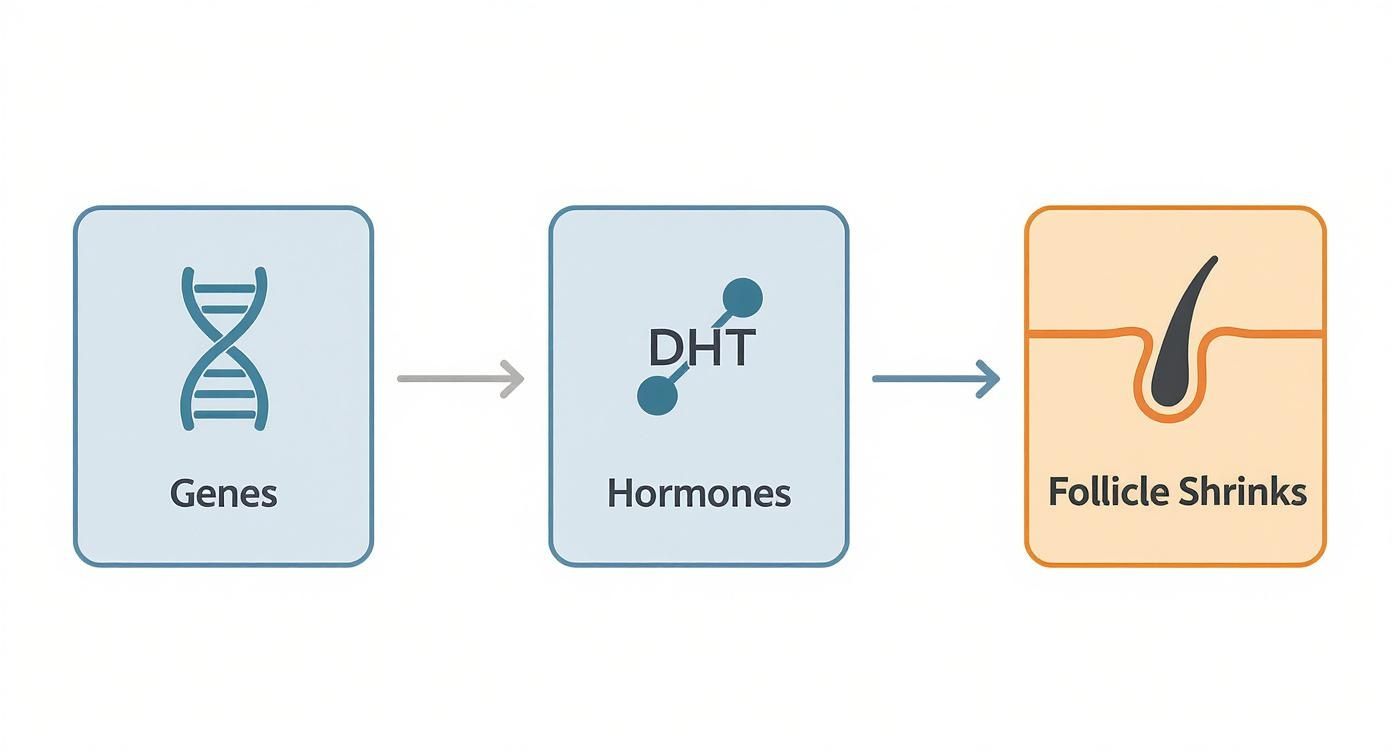
As you can see from this breakdown, your genetics make your hair follicles sensitive to DHT. This hormone latches on and slowly shrinks them until they can no longer produce healthy hair. Our goal is to throw a wrench in that exact process.
Finasteride: The DHT Bodyguard
Finasteride is your frontline defense. It's a pill that works from the inside out to get at the hormonal root of the problem.
Its whole job is to block an enzyme called 5-alpha-reductase. This is the enzyme that converts your regular testosterone into the much more aggressive Dihydrotestosterone (DHT)—the real culprit behind male pattern baldness.
By getting in the way of that conversion, Finasteride drastically lowers the DHT levels in your system. In fact, studies show it can drop them by as much as 70%. This takes the pressure off your follicles, giving them a fighting chance to stop shrinking and start recovering. For a much deeper dive, you can read our guide on if Finasteride will stop hair loss.
Finasteride isn't just about slowing down hair loss; it's about actively protecting your follicles from the hormonal assault that causes them to miniaturize.
This is exactly why it’s considered the cornerstone of treatment. You're not just patching a leak; you're turning off the valve.
Minoxidil: The Follicle Awakener
While Finasteride is holding the line, Minoxidil is your offensive powerhouse. This is a topical solution, usually a foam or liquid you apply directly to your scalp, and it works in a completely different—but complementary—way.
Minoxidil is a vasodilator. In simple terms, it opens up the blood vessels in your scalp. This simple action dramatically increases the flow of blood, oxygen, and nutrients to your hair follicles.
Imagine your follicles are being starved by DHT. Minoxidil is like airdropping a massive care package full of everything they need to get back in the game. This circulation boost helps in a few key ways:
- Wakes Up Dormant Follicles: It can jolt sluggish follicles out of their resting state and push them back into the active growth phase.
- Keeps Hair Growing Longer: It extends the anagen (growth) phase, letting individual hairs grow thicker and longer than they would have otherwise.
- Fortifies Existing Hair: More nutrients mean stronger, more resilient hair shafts.
Because Minoxidil doesn't touch your hormones, it’s the perfect partner for Finasteride. One stops the enemy at the gate, while the other rebuilds the city walls.
Setting Realistic Expectations For Treatment
Look, starting this journey is a commitment, and you need to have a realistic timeline. Hair growth is a marathon, not a sprint. You won’t wake up with a brand-new head of hair in a month.
Here’s what you can generally expect:
- Months 1-3: Don't freak out if you see more shedding at first. This is actually a good sign. The treatments are pushing out the old, weak hairs to make room for new, healthy ones to come in.
- Months 3-6: The shedding should calm down or stop. You might start to notice some fine, soft "vellus" hairs popping up in thinning areas. This is the first real sign of new growth.
- Months 6-12: This is when the magic usually happens. Those new hairs begin to thicken and darken, and you should see a tangible improvement in your hair's overall density.
The best clinical strategies all center on this combined approach. Studies have shown that sticking with it can stabilize hair loss in up to 80% of men and spark noticeable regrowth in about 30% to 40% of guys within that first 6 to 12 months.
Just remember, these treatments only work as long as you use them. If you stop, your DHT levels will creep back up, and any hair you've managed to save or regrow will likely start to disappear again. It’s a long-term play for long-term results.
Next-Level Therapies and Surgical Options
So, you're already on Finasteride and Minoxidil but want to push for even better results. Or maybe you're dealing with more advanced thinning and need to bring in the big guns. This is where we step into the next tier of hair restoration, with treatments that work directly on the scalp and surgical solutions that offer a permanent fix.
Platelet-Rich Plasma (PRP) Therapy
You've probably heard the buzz around Platelet-Rich Plasma, or PRP. The concept is pretty slick: we use your body's own healing machinery to give your hair follicles a serious boost.
It all starts with a simple blood draw from your arm, just like a routine lab test. We then spin that blood in a centrifuge to separate the platelets, creating a concentrated "liquid gold" packed with powerful growth factors. This PRP is then injected directly into the areas of your scalp where you're seeing thinning.
Think of those growth factors as a wake-up call for dormant or struggling follicles. They help stimulate the cells, encouraging them to produce thicker, healthier hair shafts again.
Now, PRP isn't a one-and-done solution. To really get things going, the standard protocol involves an initial series of treatments—usually one session a month for three months. After that, you'll need maintenance sessions every six to twelve months to keep those follicles firing on all cylinders.
Low-Level Laser Therapy (LLLT)
Another option is Low-Level Laser Therapy (LLLT), which you’ll typically find in high-tech caps, helmets, or combs. These devices use specific wavelengths of red light to gently stimulate the cells within your hair follicles.
It’s like a targeted energy boost for your scalp. The light is believed to improve blood flow and ramp up the metabolic activity in follicle cells. This can help extend the hair's growth phase, leading to better density and thickness over time.
Don't expect overnight results, though. The key to LLLT is consistency—most devices require use for about 15-20 minutes every other day. Stick with it, and you could see less shedding and improved hair caliber in as little as three months. It works best as a sidekick to treatments like Minoxidil.
While therapies like PRP and LLLT show promise, they represent an evolving area of hair loss treatment. They are often best used as powerful additions to a proven foundation of Finasteride and Minoxidil, not as standalone replacements.
If you're exploring injectable treatments, you might also want to delve into the truths about Hair Mesotherapy, which uses a cocktail of vitamins and other compounds.
Hair Transplantation: A Permanent Solution
When you're looking for a definitive, lifelong change, hair transplantation is the gold standard. This isn't about magic or creating new hair out of thin air. It’s a brilliant and strategic relocation of the healthy, DHT-resistant hair you already have.
The science is simple: the hair on the back and sides of your head isn't programmed to fall out. A surgeon carefully harvests these resilient follicles and meticulously moves them to the thinning or balding areas on top.
There are two primary techniques surgeons use today:
- FUT (Follicular Unit Transplantation): Also known as the "strip method," this involves removing a small strip of scalp from the donor area. Technicians then dissect this strip into individual follicular units (groups of 1-4 hairs) to be implanted. It’s great for covering large areas but does leave a fine linear scar.
- FUE (Follicular Unit Extraction): With FUE, the surgeon extracts follicular units one by one, directly from the scalp, using a tiny punch tool. It’s a more painstaking process but avoids the linear scar, leaving only tiny, pin-prick scars that are virtually invisible once your hair grows in.
Trying to decide between surgery and a non-surgical therapy like PRP? It’s a big decision. To help you weigh the pros and cons, check out our detailed comparison of a hair transplant vs PRP.
Ultimately, a hair transplant isn't for everyone. A successful outcome hinges on having enough healthy donor hair to work with. The only way to know for sure if it’s the right move for you is to sit down for a consultation with an experienced hair restoration surgeon.
Lifestyle Changes That Support Hair Growth

While medications and treatments are the heavy hitters in any plan to reverse male pattern baldness, don't overlook the power of your daily habits. Think of it like this: treatments are the seeds, but your lifestyle is the soil. You need a healthy foundation for anything to grow.
Fortifying your body from the inside out gives your hair follicles the best possible chance to respond to treatment. It all starts with what you put on your plate.
Fueling Your Follicles With The Right Nutrition
Your hair follicles are tiny protein-producing factories, and they need a steady supply of raw materials to function properly. When you’re low on certain key nutrients, hair production is one of the first things your body puts on the back burner.
To build strong, healthy hair, you need a solid mix of vitamins and minerals. Deficiencies in a few key areas can absolutely weaken your hair and slow down growth.
Here are the non-negotiables for hair health:
- Iron: This is vital for producing hemoglobin in your blood, which is the taxi service that delivers oxygen to your cells—including the ones that build hair.
- Zinc: Zinc is a workhorse. It helps with hair tissue growth and repair, and it keeps the oil glands around the follicles working as they should.
- Biotin: Often called the "hair vitamin," biotin helps produce keratin, the very protein your hair is made of.
- Protein: Since hair is basically all protein, skimping on it in your diet is a recipe for weak, brittle strands.
Loading up on foods rich in these compounds is something you can start doing today. Focus on lean meats, fish, eggs, spinach, nuts, and seeds. To get a more detailed grocery list, check out our guide on the best foods for hair growth.
A well-balanced diet does more than just keep you healthy; it directly provides the building blocks your follicles are starving for. Never underestimate nutrition's role in your hair regrowth strategy.
Because male pattern baldness is hormonal at its core, looking into natural ways to balance hormones can also be a game-changer. Creating internal balance gives your hair a much better environment to thrive in.
Taming The Silent Hair Killer: Stress
Stress is one of the biggest, and most overlooked, villains in the hair loss story. When you're constantly on edge, your body floods itself with a hormone called cortisol.
Chronically high cortisol levels can wreak havoc on your hair's growth cycle. It can prematurely force a huge number of your hair follicles into the shedding phase, a condition known as telogen effluvium. This can seriously accelerate hair loss and completely undo the progress you’re making with treatments.
Getting a handle on your stress isn't just a "nice-to-have" for your mental health; it's a critical part of any serious plan to get your hair back.
Practical Steps To Lower Cortisol And Protect Your Hair
You don't need to quit your job and move to a monastery to manage stress. Small, consistent changes can make a massive difference in lowering your cortisol and protecting your hair.
Here are a few simple techniques to weave into your daily routine:
- Make Sleep a Priority: Aim for 7-8 hours of quality sleep each night. This is when your body does its most important repair work and releases growth hormones—both are vital for a healthy hair cycle.
- Try Mindfulness: Even just 5-10 minutes of daily meditation or deep breathing can lower stress levels. If you're new to it, apps like Calm or Headspace are fantastic guides.
- Get Moving: Regular physical activity is a proven cortisol-buster. A brisk walk, a gym session, or a bike ride—whatever you enjoy. Just aim for at least 30 minutes on most days.
By making these lifestyle adjustments, you're actively creating a biological environment where your hair can thrive. This holistic approach gives your primary treatments the best possible shot at delivering the results you're after.
Building Your Long-Term Hair Maintenance Plan
Regaining lost ground on your hairline is a huge victory, but let’s be honest—the real challenge is holding that line for years to come. This isn't about a temporary fix. It’s about a permanent shift in how you approach your hair health. Think of this as the final, crucial piece of the puzzle that turns a short-term win into a lasting success.
If there’s one rule in this new phase, it’s this: consistency is non-negotiable. The treatments we’ve talked about work because they are actively fighting the biological triggers of hair loss. The moment you stop, that process simply kicks back into gear. Any hair you’ve regained is essentially living on borrowed time without that daily support.
The Unshakeable Importance Of Consistency
Let me be blunt: if you stop your treatment, you will lose the hair you've worked so hard to grow back. It’s not a maybe; it's a certainty. The DHT that was shrinking your follicles will get right back to its old ways, and the progress you've made will slowly but surely reverse over the next several months.
This is exactly why you have to build your treatment into a daily habit, just like brushing your teeth. Don't look at it as a project with an end date. See it as a new, permanent part of your personal care routine. Your results are entirely dependent on that commitment.
Your hair's future isn't decided by a few months of intense effort. It's secured by the small, consistent actions you take every single day, year after year.
Tracking Your Progress The Right Way
When you’re staring in the mirror every day, noticing slow, gradual changes is nearly impossible. This is the exact point where a lot of guys lose motivation and fall off the wagon. The solution is simple but incredibly powerful: take progress photos.
Here's a simple system that I've seen work time and time again:
- Once a Month: Pick the same day every month. Put a reminder in your calendar.
- Same Lighting: Always use the same room and lighting. Consistency is key for an accurate comparison.
- Multiple Angles: You need the full picture. Snap photos from the front (hairline), top (crown), and both sides.
- Keep Them Organized: Make a dedicated folder on your phone or computer.
After six months, you'll have a clear visual record of just how far you've come. This isn't just for tracking; it’s a massive psychological boost when you need it most. It’s the proof that your daily efforts are genuinely paying off.
Navigating The World Of Hair Care Products
The hair loss treatment industry is absolutely booming—valued at over USD 52.37 billion in 2022 and still growing. This means the market is flooded with shampoos, conditioners, and serums, all promising miracles in a bottle. You can read more about the trends in hair loss treatment on medihair.com.
Your job is to cut through all that noise. While a medication like Finasteride is the go-to prescription for about 66.4% of men, the right supporting products can definitely make a difference.
Forget the marketing hype and focus on ingredients known to support scalp health. For example, shampoos with ketoconazole can help reduce scalp inflammation, creating a much better environment for hair growth. On the flip side, try to avoid harsh sulfates that can strip your hair and scalp of essential moisture, which you want to preserve.
The goal isn't to find a magic shampoo that reverses baldness—that simply doesn't exist. The goal is to choose products that support the heavy lifting being done by your primary medical treatments. A gentle, nourishing routine is all you need.
To make things easier, here's a simple checklist you can build into your routine. Consistency here, just like with your treatments, is what delivers results over the long haul.
Your Daily Hair Health Checklist
| Action Item | Frequency | Why It Matters |
|---|---|---|
| Take Finasteride/Minoxidil | Daily | The foundation of your fight against DHT-driven hair loss. |
| Gentle, Sulfate-Free Shampoo | 2-4x a week | Cleanses without stripping natural oils, keeping your scalp healthy. |
| Ketoconazole Shampoo | 1-2x a week | Reduces scalp inflammation and creates a better environment for growth. |
| Progress Photos | Monthly | Your best tool for tracking visual changes and staying motivated. |
| Balanced Diet & Hydration | Daily | Hair follicles need key nutrients (protein, iron, zinc) to thrive. |
This isn’t about adding a dozen complicated steps to your day. It’s about creating a simple, sustainable system that keeps your hair in the best possible condition as it continues to grow back stronger.
Common Questions About Reversing Hair Loss
Deciding to tackle hair loss is a big step, and it's natural to have a bunch of questions before you dive in. After all, you're investing time, money, and hope into this. Let's walk through some of the most common things guys ask when they're ready to get their hair back.
How Long Does It Take To See Results From Hair Loss Treatments?
I get it—you want to see progress yesterday. But when it comes to hair, patience really is a virtue.
With a consistent routine using proven treatments like Finasteride and Minoxidil, the first positive sign you'll likely see is a slowdown in shedding. This usually happens within the first 3 to 6 months.
Actual, visible regrowth takes a bit longer. You might spot some new, fine hairs sprouting up, but real, noticeable changes in thickness and density typically show up around the 6 to 12-month mark. Hair growth is a marathon, not a sprint. This is exactly why I tell everyone to take monthly progress photos—it's the only way to track those subtle, gradual improvements that you'd otherwise miss in the daily mirror check.
Can I Stop Treatment Once My Hair Grows Back?
This is probably the most frequent question I hear, and the short, honest answer is no. It's best to think of male pattern baldness as a chronic condition you manage, not a cold you cure.
Finasteride and Minoxidil are essentially your follicle bodyguards, protecting them from the constant assault of DHT. The moment you stop, that protection vanishes. DHT gets right back to work shrinking your follicles, and you'll likely lose all the ground you gained within a few months. Think of it as a permanent part of your daily grooming routine, like brushing your teeth.
Stopping treatment isn't like hitting a pause button; it's like letting the enemy back inside the gates. The underlying cause of hair loss—DHT—is always present, and consistency is your only defense.
Do Natural Hair Loss Remedies Actually Work?
You'll find countless articles and videos online hyping up natural DHT blockers like saw palmetto or promoting biotin for hair growth. While these supplements can certainly improve the health and appearance of the hair you already have, they don't pack the punch needed to reverse male pattern baldness on their own.
The problem is they just don't have the robust clinical evidence to show they can effectively stop the hormonal process of follicle miniaturization. It's best to build your foundation on the proven, FDA-approved medications and view any supplements as a supporting cast, not the main star of the show.
Is It Too Late For Me To Start Treatment?
It’s almost never "too late" to start fighting back, but you have to set realistic expectations based on where you're at. These treatments are fantastic at reviving follicles that are weak or dormant, but they can't bring back ones that have been completely dead for years.
If a patch of your scalp has been slick-bald for a long time, resurrecting hair in that specific spot is a long shot. However, even for guys with more advanced hair loss, starting a treatment plan can work wonders for thickening up the remaining hair and, crucially, preventing any more loss.
Our guide on whether hair loss is truly reversible gets into the nitty-gritty of what's possible. The best first step is always an honest conversation with a dermatologist who can assess your scalp and give you a straight-up opinion.
At PRP For HairLoss, our goal is to give you clear, science-backed information so you can take back control. Explore our resources and build a strategy that’s right for you. Learn more at https://prpforhairloss.com.
 PRP For Hairloss
Leave a comment