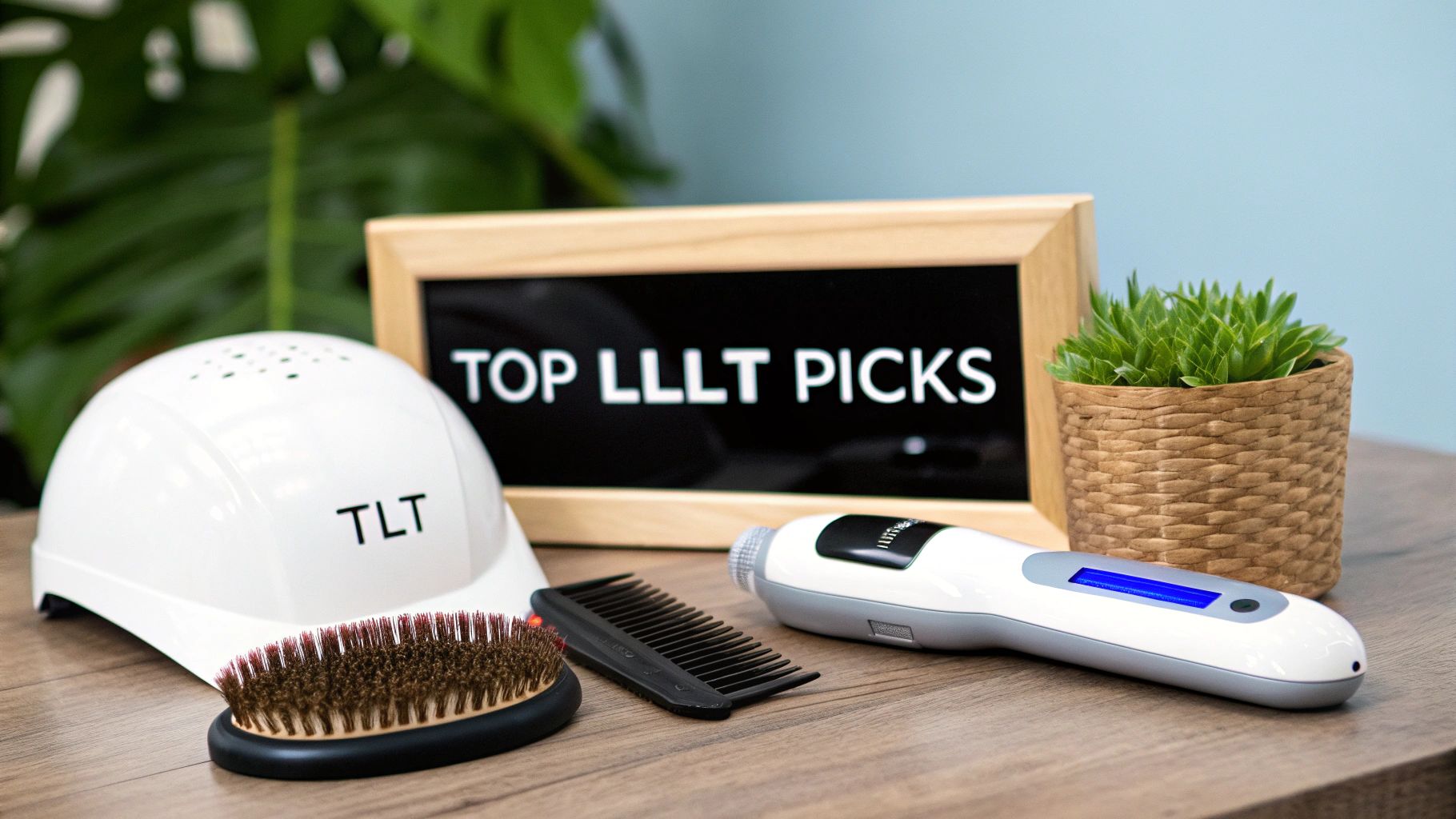
If you're starting your search for the best low level laser therapy devices, you'll quickly see a few key players and device types popping up. The market is pretty much dominated by laser caps, bands, and combs from well-known brands like Capillus, HairMax, and iRestore. All of these are designed as non-invasive, at-home treatments that use targeted light to wake up sleeping hair follicles.
Making the right choice really boils down to what matters most to you—things like how much of your scalp needs coverage, the density of the lasers, and, of course, your budget.
Your Guide to LLLT Devices for Hair Regrowth
So, you're looking for real solutions to hair loss and have probably stumbled upon Low-Level Laser Therapy (LLLT). This guide is here to cut through all the marketing noise and give you a straight-up look at the best devices for men. We’ll break down how this science-backed therapy works on a cellular level to jumpstart hair follicles, all in plain English.
First, let’s get a quick lay of the land. We've put together a summary table of our top picks so you can see the main contenders at a glance. Think of it as a cheat sheet before we dive into the nitty-gritty of how they stack up against each other. Our main goal here is to arm you with the confidence and knowledge to pick the right device for your hair regrowth journey.
The image above illustrates the core idea behind LLLT, also known as photobiomodulation. It’s all about sending low-energy light into the scalp to give the cells in your hair follicles a much-needed boost. We're not talking about heat or damage, which is exactly why it's a safe and popular option for at-home use.
Understanding the Growing Market
The buzz around LLLT isn't just talk; it's a reflection of a bigger trend toward non-invasive treatments. The entire market for laser therapy devices is booming as more and more people are on the hunt for effective options that don't involve surgery.
In fact, experts project the market will hit around USD 8.3 billion by 2035, which just goes to show how much faith people are putting into these technologies, especially in fields like dermatology. You can learn more about these laser therapy devices market trends to see the bigger picture.
For you, this growth is a double-edged sword. On one hand, it means better technology and more choices. On the other, it makes wading through all the options a bit overwhelming. It's important to remember that LLLT is just one of several proven non-surgical hair restoration methods out there today.
Top LLLT Device Picks at a Glance
To help narrow down your search, this table gives you a quick summary of our top-rated LLLT devices for hair loss, highlighting their key features and what they're best for. It’s a great way to get a feel for what’s out there and which type of device might be the best fit for your lifestyle and needs.
| Device Name | Device Type | Laser Count | Best For | Price Range |
|---|---|---|---|---|
| CapillusPlus | Cap | 202 Diodes | Overall Scalp Coverage & Discretion | $1,500 – $2,000 |
| HairMax LaserBand 82 | Headband | 82 Medical-Grade Lasers | Fast Treatment Times (as little as 90 seconds) | $700 – $900 |
| iRestore Laser Pro | Helmet | 282 Lasers & LEDs | Maximum Coverage & Combination Therapy | $1,000 – $1,300 |
| HairMax LaserComb Ultima 12 | Comb | 12 Medical-Grade Lasers | Targeting Specific Thinning Areas | $350 – $450 |
This is just the starting line. Now that you have an idea of the top players, we can dig deeper into how each one performs and which might be the right investment for you.
How Laser Therapy Wakes Up Your Hair Follicles
Before you start comparing the best low level laser therapy devices, it’s worth understanding what’s actually happening under the surface. The science, known as photobiomodulation, might sound complicated, but the idea is actually pretty straightforward: using specific wavelengths of light to give your hair follicle cells an energy kick.
Think of your hair follicles as tiny, dormant factories. When they run low on power, production grinds to a halt. LLLT sends targeted red light through the scalp where it’s absorbed by the cells inside these follicles, essentially flipping the "on" switch.
This light gets the mitochondria—the powerhouses of your cells—to ramp up production of something called adenosine triphosphate (ATP). ATP is pure cellular fuel. With more of it, follicles can stay in the hair's natural growth phase (the anagen phase) for longer. It can even nudge dormant follicles back into action.
Lasers vs. LEDs: What’s the Difference?
As you look at different devices, you'll see terms like "medical-grade lasers" and "LEDs" thrown around. They both emit light, but they don't work in quite the same way. Knowing the difference is key when you're sizing up the technology in each product.
-
Lasers: These produce a single, focused wavelength of light. Because the light is coherent and travels in a straight line, it can penetrate deeper into the scalp, delivering a concentrated dose of energy right to the base of the hair follicle where it matters most.
-
LEDs (Light Emitting Diodes): These emit a broader, more scattered spectrum of light. While LEDs give you wider coverage across the scalp, the energy doesn't go as deep as laser light. You'll find many of the top-tier devices use a combination of both to get the best of both worlds—deep stimulation and broad coverage.
If you want to get into the nitty-gritty of how different light therapy systems are built, you can find some great information in this in-depth guide on Dermalux LED Light Therapy.
The whole point of LLLT isn’t to create brand new follicles, but to bring existing ones back from the brink—the ones that have become weak or have gone dormant. By boosting cellular function and blood flow, the therapy creates a much healthier scalp environment for hair to grow back thicker and stronger.
This approach is a big part of why non-invasive hair loss therapies are getting so much attention. The market for these photobiostimulation devices, including LLLT, was valued at a massive USD 207.71 billion in 2024 and is expected to keep climbing. That trend signals a real shift toward treatments that support the body’s own natural processes.
Revitalizing Your Follicles
So, what does all this cellular activity actually mean for your hair? Over time, the increased energy and improved circulation from LLLT can lead to some noticeable changes. It's a slow and steady process of strengthening your hair from the root up.
The therapy helps reboot a healthier hair growth cycle. Often, the first thing you might notice is less shedding, which is a great sign. Then, new, thicker hairs start to emerge. This is a marathon, not a sprint, and consistency is everything if you want to see real results.
To get a better sense of how this fits into a complete hair restoration plan, you might find our article on red light therapy for hair helpful, as it explains how it works alongside other strategies. Picking the right device is all about finding the technology that will best support this revitalization process for your particular situation.
Comparing the Top LLLT Hair Growth Devices
Alright, you've got the science down. Now for the hard part: picking the right tool for the job. Choosing from the best low level laser therapy devices isn't as simple as grabbing the one with the most lasers. It's really about matching the device to your specific hair loss, your lifestyle, and what you're willing to spend. We're going to cut through the marketing noise and look at what actually counts: FDA clearance, laser quality, scalp coverage, treatment time, and how comfortable it is to use.
I want to give you a clear, side-by-side look at the top players in the game. We'll dig into their real strengths and weaknesses so you can decide based on what you prioritize, whether that's lightning-fast treatments, total discretion, or sheer power.
This infographic neatly summarizes the entire process—delivering targeted red light, which in turn energizes the follicle cells and kicks off new growth.
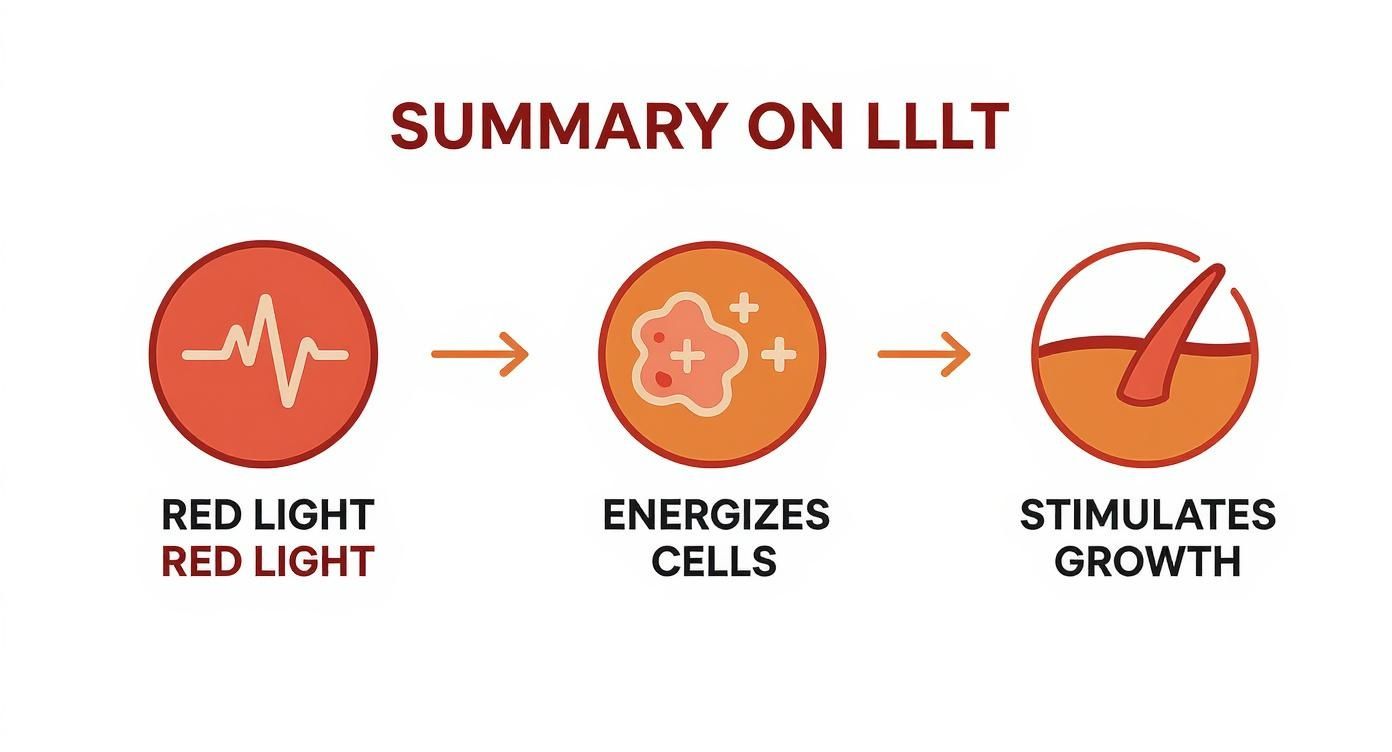
Think of it this way: LLLT is creating a healthier, more fertile environment on your scalp. That’s the foundation for turning the tide on thinning hair.
First Things First: FDA Clearance and Safety
When you're looking at any medical device you'll use on your body, the first question should always be about safety and legitimacy. The non-negotiable starting point is FDA-clearance. This isn't just a fancy sticker; it means the FDA has reviewed the device and agrees it's "substantially equivalent" to another product already legally on the market, confirming it meets specific safety and performance standards.
Understanding the FDA approval process for medical devices can give you a lot of insight into why this clearance matters so much.
This benchmark is critical. It’s your assurance that you're buying a piece of medical equipment, not just a gadget. You'll notice that every reputable brand in this space makes their FDA clearance a prominent feature, as they should.
Laser Diodes: The Engine of Hair Regrowth
The number of laser diodes is an easy metric to advertise, but it's not the whole story. The quality of those diodes and the type of light they produce are arguably more important. The best devices use medical-grade laser diodes that emit a pure, focused beam of light, almost always at a wavelength around 650 nanometers. Research has repeatedly shown this is the sweet spot for penetrating the scalp and reaching the hair follicle.
You’ll see some devices, like the iRestore Laser Pro, use a mix of lasers and LEDs. The idea is that lasers provide that deep, concentrated energy to the base of the follicle, while the LEDs cast a wider, more diffuse light over the scalp’s surface. It's a hybrid approach aiming for comprehensive stimulation.
Key Differentiator: A device loaded with a high count of true laser diodes, such as the Capillus models, is built to deliver more potent, concentrated energy. For someone with more advanced thinning who needs that maximum kickstart, this can be a real game-changer.
At the end of the day, you just need to get enough light energy down to the follicles. It's like watering your lawn—you need both adequate pressure (power) and the right kind of sprinkler (coverage) to get real results.
Here's a quick table to help you see the key specs of the most popular devices at a glance.
Feature-by-Feature Device Showdown
| Feature | CapillusPlus (S1) | HairMax LaserBand 82 | iRestore Laser Pro |
|---|---|---|---|
| Device Type | Flexible-fitting cap | Headband | Rigid helmet |
| Laser Diodes | 202 medical-grade lasers (no LEDs) | 82 medical-grade lasers (no LEDs) | 82 lasers & 200 LEDs |
| Treatment Time | 6 minutes, daily | 90 seconds, 3x per week | 25 minutes, every other day |
| Best For | Discretion, ease of use, diffuse thinning | Speed, receding hairlines, targeted areas | Maximum scalp coverage, combination therapy |
| Unique Feature | Worn discreetly under any hat | Patented hair-parting teeth | Hybrid laser/LED system |
| Scalp Coverage | Full, uniform coverage | Section-by-section coverage | Full top-of-scalp coverage |
This table gives you a snapshot, but the experience of using each device is where the real differences emerge. Let's look at what that means for you.
The Big Three: A Head-to-Head Showdown
Let's dive into three of the most popular and proven LLLT devices on the market. Each one is built for a slightly different person, so understanding the nuances will point you toward the right one.
1. The Hands-Free Powerhouse: CapillusPlus
The CapillusPlus is a laser cap designed with one thing in mind: convenience. You slip it on under a baseball cap or beanie, and nobody knows you're doing a hair treatment. You can wear it at your desk, walking the dog, or during your commute.
- Its Edge: The biggest win here is compliance. A quick, six-minute daily session is incredibly easy to stick with, and consistency is the absolute key to seeing results with LLLT.
- The Tech: It's packed with 202 laser diodes—no LEDs, just pure laser energy. This provides a dense and even blanket of light over the entire scalp, which is perfect for guys dealing with diffuse thinning all over the top of their head.
2. The Speed Specialist: HairMax LaserBand 82
If you're short on time, the HairMax LaserBand 82 is your answer. It's not a cap but a lightweight, flexible band that you glide over your scalp in three sections.
- Its Edge: The treatment time is unbelievably fast—as little as 90 seconds, three times a week. Its secret weapon is the set of patented teeth that part your hair as you move it, ensuring the light hits your scalp directly instead of getting blocked by your existing hair.
- The Tech: It features 82 medical-grade lasers. While that's fewer than a full cap, the design is all about efficient, targeted delivery. This makes it a fantastic option for tackling a receding hairline or thinning at the crown.
3. The Maximum Coverage Contender: iRestore Laser Pro
The iRestore Laser Pro operates on a "more is more" philosophy. It's a full helmet designed to drench your scalp in therapeutic light, using both lasers and LEDs.
- Its Edge: It boasts one of the highest light counts out there, with 282 total sources. The goal of the combination therapy is to deliver deep stimulation from the lasers while providing broader surface rejuvenation from the LEDs.
- The Tech: The helmet design guarantees complete coverage for the top of the scalp. The treatments are longer, at 25 minutes every other day, so this device is better for someone who has the time to dedicate to a more intensive session. For more on how LLLT fits into a complete plan, our guide to non-surgical hair loss treatments provides a wider view.
The market for these devices is booming because people are looking for at-home solutions that actually work. The global LLLT device market is expected to grow from USD 1.2 billion in 2023 to USD 2.5 billion by 2032, climbing at an 8.2% compound annual growth rate.
This growth is great news for you—it means more competition, more innovation, and better options. It also means you need to be even smarter about comparing these devices to find the one that's truly built for your needs.
Choosing the Right Device for Your Lifestyle
Picking the best low-level laser therapy device isn't about finding the one with the most lasers or the fanciest features. It really boils down to you—your daily routine, your specific hair loss pattern, and how much time you're actually willing to set aside. The truth is, the most technologically advanced gadget is useless if it just sits in a closet.
Let's move past the technical jargon and think about how these devices fit into real life. We'll look at who really benefits from a hands-free cap versus a targeted comb, and what to consider if you're always on the move. The goal here is to match the product to your life, not force your life to fit the product.
The Busy Multitasker
If your calendar is a mess and finding a spare minute feels impossible, a hands-free laser cap is your best friend. These things are built for passive use, meaning you can get your treatment done while you're doing something else entirely.
Just think about it: you put on the cap and go about your evening. Make dinner, answer emails, watch the game. This "set it and forget it" approach is a game-changer for consistency, which is the single most important part of getting results.
- Who it’s for: The guy working from home, the busy dad, or anyone who knows they simply won't sit still for a dedicated 20-minute session.
- Top Feature to Look For: A comfortable, flexible fit that you can even wear discreetly under a baseball cap. A short daily treatment time, like 6 minutes, is a massive win.
- Example Scenario: Pop it on during your commute (if you're not driving!), while you walk the dog, or during your morning coffee. It slides right into things you already do, so there's no "wasted" time.
Honestly, this convenience factor can make or break your success. A powerful device you never use is a very expensive paperweight.
The Precision-Focused User
What if your hair loss is more specific? Maybe it's a receding hairline or that one spot on your crown that's starting to thin out. If that's you, a laser comb or a smaller headband might be a smarter, more affordable choice.
These devices let you aim the laser energy exactly where you need it most. Instead of a blanket approach covering your whole scalp, you can hit those problem areas with a focused dose of light.
For men in the early stages of hair loss or those looking to maintain specific areas, a targeted device offers an efficient solution without the cost of a full-coverage cap. It’s about applying the right amount of therapy in the right place.
The main benefit is efficiency. You're not wasting time or battery on parts of your scalp that are perfectly fine. This makes them a great starting point for guys just beginning their hair restoration journey. Our guide on hair restoration without surgery actually dives deeper into how targeted, non-invasive methods like LLLT fit into a bigger picture.
The Dedicated Home User
If you have a pretty set schedule and don't mind carving out dedicated time for treatment, a full-on laser helmet could be the ticket. These models often pack the highest number of lasers and LEDs, going for maximum scalp coverage and light density.
The trade-off, however, is usually a longer session time—often around 25 minutes every other day. This requires a real commitment. You have to consciously build it into your routine, maybe while you read a book or just unwind at the end of the day.
This is the perfect fit for someone who treats their hair care as a serious part of their self-care routine and wants the most powerful at-home system they can get.
Device Comparison by Lifestyle
Ultimately, the best choice comes from being honest about your own habits. This table breaks down which type of device lines up best with different routines and levels of commitment.
| Lifestyle Factor | Laser Cap | Laser Comb/Band | Laser Helmet |
|---|---|---|---|
| Commitment Level | Low (passive use) | Medium (active use) | High (dedicated time) |
| Best for Multitasking | Excellent | Poor | Fair |
| Ideal Hair Loss Pattern | Diffuse thinning | Targeted spots | Widespread thinning |
| Portability & Travel | Good (often battery-powered) | Excellent (compact) | Poor (bulky) |
| Treatment Time | Short & daily | Very short & frequent | Long & less frequent |
At the end of the day, consistency is king. The best low-level laser therapy device for you is simply the one you will actually use day in and day out. Whether that’s a discreet cap you can wear anywhere or a quick band that’s done in 90 seconds, pick the path of least resistance. That’s how you’ll stick with it long enough to see results.
Getting the Most from Your LLLT Device

So, you've unboxed your new LLLT device. That's the easy part. The real challenge—and the key to seeing results—is using it correctly and consistently. This is where most guys fall off the wagon, so let's move beyond the instruction manual and talk about building a routine that actually works.
The single biggest factor here is consistency. I tell my clients to think of LLLT like going to the gym for your scalp; one workout won't change anything, but sticking with it over time builds real strength in your hair follicles. The best devices are designed to be convenient, but you're the one who has to commit to the schedule.
Setting Up a Routine for Success
To give the laser light the best chance to work its magic, you need to clear the path. A clean scalp is non-negotiable. Any buildup of oil, sweat, or styling products can literally block the light from ever reaching the follicles it’s meant to energize.
The best habit you can form is to use your device right after a shower when your hair is clean and completely dry. This simple step ensures maximum light penetration, making every single session as effective as it can possibly be.
You also have to be realistic. Hair growth is a notoriously slow biological process. LLLT is a marathon, not a sprint.
Brace yourself for a commitment of 3 to 6 months before you see the first real signs of progress. It usually starts with less shedding, followed by the appearance of tiny, fine hairs that, over time, will hopefully thicken up. Patience is everything.
Best Practices for Optimal Results
Beyond just showing up for your sessions, a few simple pointers can really amplify your results. First and foremost, stick to the manufacturer’s guidelines on treatment time and frequency. Overdoing it won't speed things up and could be counterproductive.
Here are a few tips I always give my clients:
- Prep Your Scalp: Always start with a clean, dry scalp. Don't let anything get between the laser and your skin.
- Follow the Schedule: Stick to the plan, whether it's 6 minutes every day or 25 minutes every other day. Don't let yourself get lazy and skip sessions.
- Take Progress Photos: The mirror lies. You won't notice slow, incremental changes. Take photos once a month in the same room with the same lighting to track your progress objectively.
Sticking to these rules ensures every minute of treatment counts. If you're looking to build a strong foundation for hair health, our guide on how to strengthen hair follicles is a great read that pairs perfectly with LLLT.
Creating a Powerful Multi-Pronged Strategy
While LLLT is a solid treatment on its own, it truly shines when you team it up with other proven hair loss solutions. Think of it as a tag team. Different treatments attack hair loss from different angles, and when you combine them, you can create a powerful synergistic effect that hits the problem from all sides.
This multi-pronged approach is how you get ahead of hair loss, often delivering far better results than any single treatment could on its own.
Consider pairing your LLLT device with one or both of these heavy hitters:
- Minoxidil (Topical): This stuff works by widening blood vessels in the scalp, which pushes more follicles into the growth phase. LLLT provides the energy, and minoxidil improves the supply line for nutrients.
- Finasteride (Oral): A prescription drug that gets to the root hormonal cause of male pattern baldness by blocking DHT. LLLT works to revive the follicles that DHT has already damaged.
By using LLLT to stimulate your follicles at a cellular level while also blocking DHT and boosting blood flow, you've created a truly robust strategy. This comprehensive plan gives you the absolute best shot at reclaiming thicker, healthier hair.
Common Questions About Laser Hair Therapy
Deciding to jump into low level laser therapy can bring up a lot of questions. Before you invest your hard-earned money and time, you want to be sure you're making the right call. To clear up any lingering doubts, let's walk through some of the most common questions men have about LLLT.
Is Low Level Laser Therapy Safe? What About Side Effects?
This is usually the first thing on everyone's mind, and for good reason. The short answer is yes, it's very safe. When you stick with an FDA-cleared device, you're using technology that has been thoroughly reviewed to meet strict safety standards. LLLT is completely non-invasive, meaning no needles, no incisions, just light.
Most guys report feeling nothing at all during a session, maybe a slight, gentle warmth on the scalp. The light used is a low-energy, therapeutic light designed to wake up your hair follicles, not the high-power lasers used for cutting or burning. When used as directed, there are no reported side effects for the vast majority of users.
How Long Does It Really Take to See Results?
This is where you need to be patient. Hair growth happens at a snail's pace, and LLLT works by supporting that natural biological cycle. You won't see a brand-new head of hair overnight, so setting realistic expectations is key to sticking with it.
Generally, most men start to see the first signs of progress within 3 to 6 months of consistent use.
The first thing you'll likely notice isn't new growth, but less shedding. That's a huge win and a clear sign your follicles are getting the message. After that, you might see some fine, baby-like "vellus" hairs popping up, which can mature into thicker, healthier hair over time.
Can I Use LLLT Devices with Other Hair Loss Treatments?
Absolutely, and you probably should. Think of LLLT as a valuable player on a team. It works incredibly well alongside proven treatments like topical minoxidil and prescription finasteride.
Combining treatments is so effective because each one tackles hair loss from a different angle.
- Finasteride gets to the root of the problem by blocking DHT, the hormone that causes male pattern baldness.
- Minoxidil acts like a delivery driver, widening blood vessels to get more oxygen and nutrients to your follicles.
- LLLT provides the fuel, giving your follicular cells the energy they need to get back to the business of growing hair.
When you hit the problem from all three sides, you create a powerful synergy that often delivers far better results than relying on just one method.
Are At-Home Devices as Good as Professional Clinic Treatments?
It’s a great question. While the big, dome-like machines in a dermatologist's office might be more powerful, "better" depends on what matters most. The number one advantage of at-home devices is the powerful duo of convenience and consistency.
Hair loss isn't a one-and-done issue; it requires an ongoing commitment. Being able to do a quick session while watching TV, without booking appointments or driving to a clinic, is the secret sauce for long-term success. Consistency is what drives results, and at-home devices make it incredibly easy to maintain that routine, making them a more practical and effective solution for most guys.
At PRP For HairLoss, we're committed to giving men straight, honest information on all their hair restoration options. Whether you're looking into LLLT, PRP therapy, or other non-surgical routes, we want to help you understand the science so you can make the best choice for your situation. You can find more guides and insights over at https://prpforhairloss.com.
 PRP For Hairloss
Leave a comment