Finding a clump of hair in the shower drain when you're only 25 can be a genuine shock. For a lot of guys, this is the first real sign of hair loss, and it's way more common than you'd think. It usually starts small—maybe a little thinning at the temples or the crown—but the root cause is often a hereditary thing that's just starting to kick into gear.
The Real Reasons You're Losing Hair at 25
If you're noticing your hairline starting to retreat, you are far from alone. The most common culprit behind hair loss in your twenties is a condition called androgenetic alopecia, which you probably know as male pattern baldness. You can think of it as a genetic switch that gets flipped on by your own hormones.
This whole process is driven by a hormone called dihydrotestosterone, or DHT. It’s a natural byproduct of testosterone, but for some of us, our hair follicles are genetically programmed to be overly sensitive to it. This sensitivity causes the follicles to shrink over time, a process known as miniaturization. As the follicles get smaller, the hair they produce becomes finer and shorter, until eventually, they just stop producing hair at all.
This infographic breaks down how your genes, DHT, and follicle shrinkage all connect to cause thinning hair.
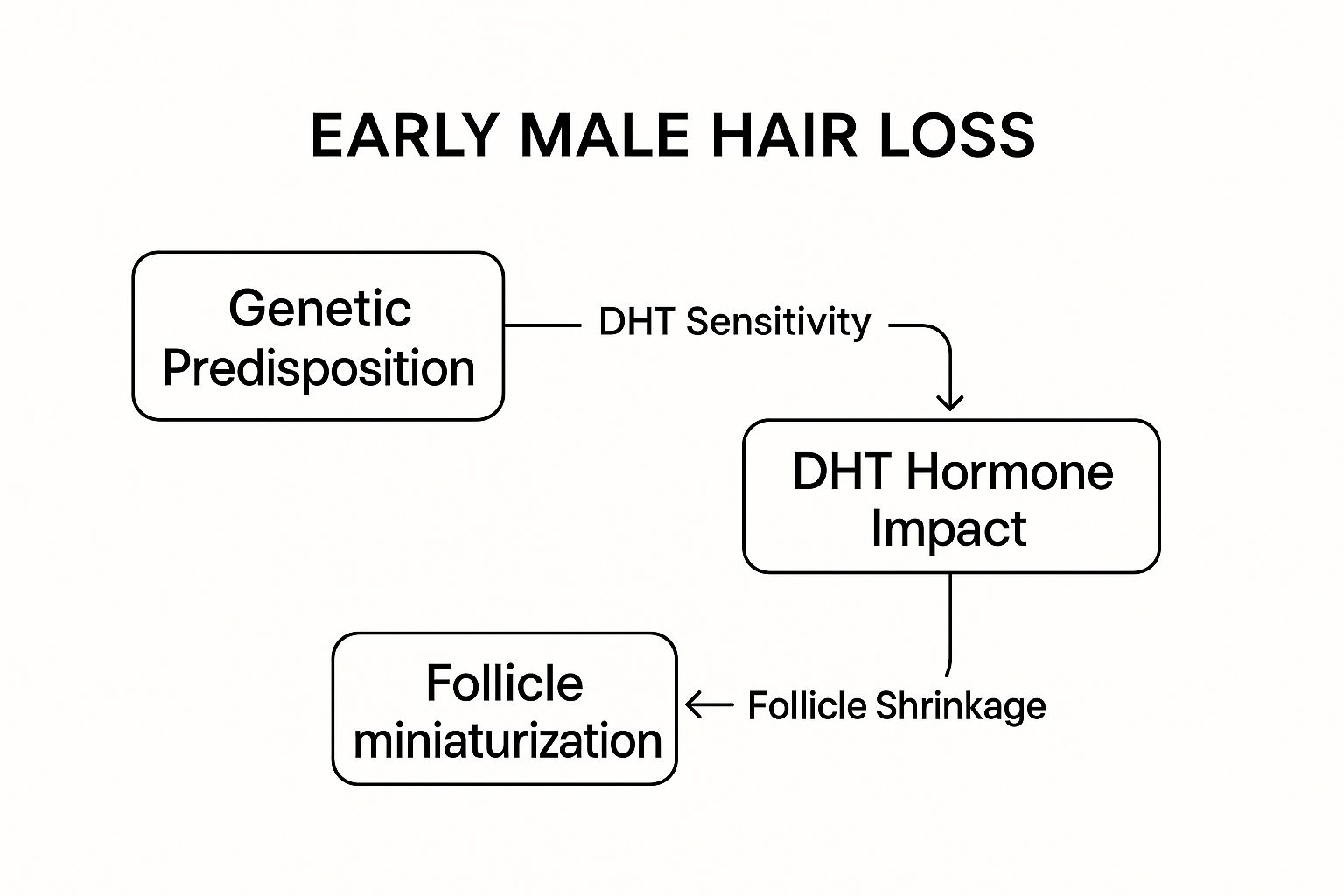
As you can see, it all starts with your genetic makeup. Your DNA basically sets the stage for how your follicles will react when DHT shows up.
Factors That Can Speed Up Hair Loss
While your genes are the main driver, other things in your life can definitely put the process on the fast track. It's super important to understand these influences because managing them can make a real difference in your hair's overall health.
- High Stress Levels: Chronic stress isn't just bad for your head; it can seriously mess with your natural hair growth cycle, pushing more hairs than usual into the shedding phase.
- Poor Diet: If you're not getting enough key nutrients like iron, zinc, and B vitamins, your hair can get weak and struggle to grow properly.
- Lifestyle Choices: Things like smoking or consistently getting bad sleep can interfere with scalp circulation and harm follicle health over time.
The numbers don't lie. Statistics show that about 25% of men will see some noticeable hair loss before they even hit their 25th birthday. That figure jumps to roughly 40% by age 35, which really drives home how early this hereditary condition can start to progress. The family connection is undeniable; if baldness runs in your family, your odds of seeing it at 25 are significantly higher.
The key takeaway is that male pattern baldness isn't about having "too much" testosterone. It's about how your hair follicles are genetically programmed to react to DHT.
To give you a clearer picture, here's a quick rundown of the main culprits behind hair loss for guys in their mid-twenties.
Common Causes of Hair Loss in Young Men
| Cause | What It Is | How It Affects Hair |
|---|---|---|
| Genetics (Androgenetic Alopecia) | An inherited sensitivity to the hormone DHT. | DHT binds to hair follicles, causing them to shrink (miniaturize) and eventually stop producing hair. This leads to the classic receding hairline and thinning crown. |
| High Stress (Telogen Effluvium) | Physical or emotional stress that disrupts the hair's natural growth cycle. | A large number of hairs are pushed prematurely into the shedding (telogen) phase, resulting in sudden, diffuse thinning across the scalp. |
| Poor Nutrition | A diet lacking in essential vitamins and minerals like iron, zinc, and biotin. | Hair follicles don't get the building blocks they need, leading to weaker hair strands that are more prone to breakage and shedding. |
| Unhealthy Lifestyle Habits | Smoking, excessive alcohol consumption, and lack of sleep. | These habits can impair blood circulation to the scalp, starving follicles of oxygen and nutrients, which can accelerate genetically-driven hair loss. |
Getting a handle on these biological and environmental factors is the absolute first step toward taking back control. Once you know what's adding to your hair loss, you can make smarter, more informed decisions about treatments and lifestyle changes.
You can also explore our detailed guide on the various hair loss causes to get an even fuller picture.
How to Spot the First Signs of Thinning Hair
Catching hair loss early isn't about panicking every time you look in the mirror. It's more about becoming a detective—learning to spot the small, subtle clues that show up long before any obvious bald spots. Seeing these early signs gives you a massive head start on taking action.
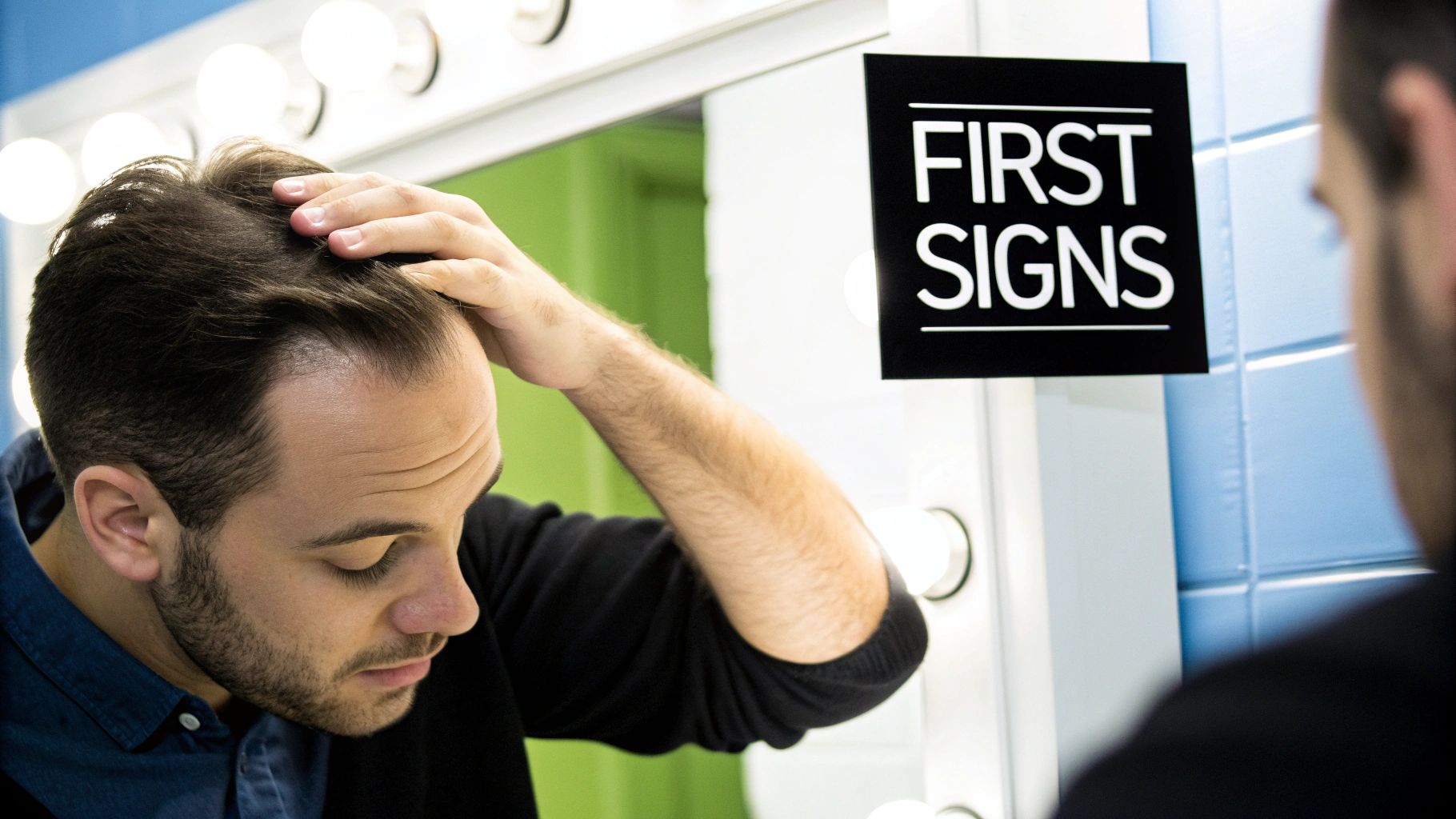
A lot of guys fixate on a receding hairline, but that's just one piece of the puzzle. The first signs of hair loss at 25 male are often much less dramatic. You might just feel like your hair doesn’t "sit right" anymore, or maybe that hairstyle you've had for years suddenly looks flat and lifeless.
These small shifts matter. They can be the first whispers of follicle miniaturization—the process where individual hairs gradually grow back finer and weaker over time.
Beyond the Receding Hairline
While that classic "M" shape forming at your temples is a dead giveaway, it's far from the only sign. You have to look a bit closer and pay attention to how your hair behaves day-to-day. This helps you figure out if you're just dealing with normal shedding or the first stages of male pattern baldness.
Here are some of the less obvious clues to watch for:
- Your Scalp is More Visible: Ever notice more scalp peeking through when your hair is wet or under the bright lights of a bathroom? This is often one of the earliest signs that your overall hair density is decreasing, even if your hairline hasn't budged.
- A Change in Hair Texture: Does your hair feel softer, limper, or just plain finer than it used to? That's a direct result of DHT shrinking the hair follicles, which forces the new strands to grow back thinner with each cycle.
- The "See-Through" Crown: The vertex—the very top of your head—is another hotspot for male pattern baldness. It's tough to see yourself, so ask a friend to snap a picture or use a second mirror to check for any thinning back there.
Sometimes the best evidence isn't even on your head. A sudden increase in the amount of hair you find on your pillow, clogging the shower drain, or tangled in your comb is a red flag that your shedding phase is kicking into a higher gear.
Don't freak out over a few stray hairs. Losing up to 100 hairs per day is completely normal. The key is to look for a consistent and noticeable increase over several months. That’s when it might be a bigger issue.
Taking an Honest Look
Let's be real—it's hard to be objective about your own hair. It’s easy to either dismiss the changes or, on the flip side, stress over every single hair that falls out. A simple and effective trick is to take clear, well-lit photos of your hairline and crown once a month. Comparing these pictures over a three-to-six-month period gives you undeniable proof of any changes.
Another great reality check is the ponytail test. If your hair is long enough, do you find your ponytail feels thinner or that you need an extra wrap of the hair tie to get it tight? That change in volume is a tangible sign of declining density. For a deeper dive, you can learn more about how to tell if my hair is thinning in our detailed guide.
Spotting these signs early doesn't mean you're doomed to lose your hair. Far from it. It means you’ve bought yourself precious time. The sooner you know what’s going on, the more options you have to explore treatments and make changes to help you keep the hair you've got.
Proven Treatments That Can Help Your Hair
Feeling like you're losing the battle against thinning hair can be tough, but the reality is you have more options than ever before. There are several proven, science-backed treatments that can effectively slow down hair loss. For some guys, they can even help regrow some of what's been lost.
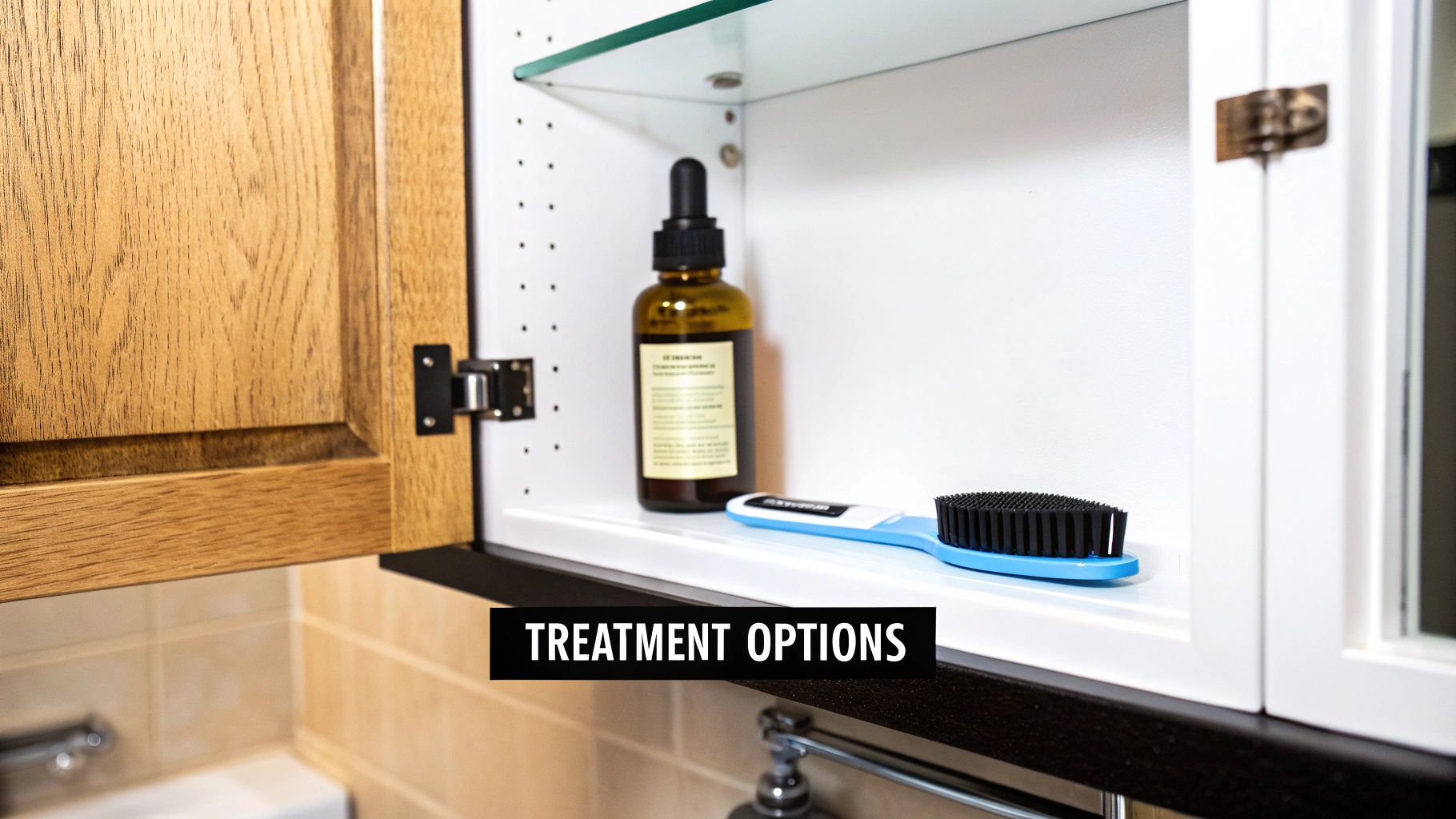
This isn't about chasing overnight miracle cures. It's about understanding the legitimate, science-backed solutions that have helped countless men tackle male pattern baldness head-on. Let's dig into the most trusted and effective choices you have right now.
Your First Line of Defense: Minoxidil and Finasteride
When you first start looking into hair loss at 25 male, you'll see two names pop up everywhere: Minoxidil and Finasteride. These are the heavy hitters in the hair loss world for a very good reason—they are both FDA-approved and have a long, well-documented track record of getting results.
Minoxidil, which you probably know by the brand name Rogaine®, is a topical solution or foam you apply right to your scalp. Think of it like a personal trainer for your hair follicles. It helps kickstart blood flow, delivering a rush of oxygen and nutrients that can awaken dormant follicles and push them back into the growth phase.
Finasteride, on the other hand, is a prescription pill that attacks the problem at its hormonal source. It works by blocking the specific enzyme that turns testosterone into DHT—the main culprit behind shrinking hair follicles in male pattern baldness.
By dramatically lowering DHT levels in your scalp, Finasteride acts like a bodyguard for your hair follicles, protecting them from the miniaturization process that causes thinning and eventual hair loss.
Both of these treatments have been studied extensively. Minoxidil has been shown to boost hair count by 12-18% over a 48-week period. Finasteride is even more direct, shown to slash scalp DHT levels by about 60-70%. Long-term studies found that up to 86% of men taking it were able to either maintain their hair count or see an increase. The key takeaway? Both require consistent, long-term use to see and keep your results.
Exploring Low-Level Laser Therapy (LLLT)
Another option that's been gaining a lot of ground is Low-Level Laser Therapy (LLLT). This is a totally non-invasive treatment that uses medical-grade lasers to gently stimulate cellular activity inside your hair follicles. You can find LLLT devices in all sorts of forms, from hands-free caps and helmets to combs you can easily use at home.
The science behind it is pretty cool: specific wavelengths of light essentially "energize" the cells within the follicle, which may help extend the anagen, or growth phase, of the hair cycle. Many guys use LLLT alongside Minoxidil or Finasteride for a more comprehensive, multi-pronged attack against hair loss.
Comparing Popular Hair Loss Treatments
With a few strong options available, it can be tough to figure out which path is right for you. This table breaks down the key differences to give you a clearer picture.
| Treatment | How It Works | Application | Average Cost | Best For |
|---|---|---|---|---|
| Minoxidil | Increases blood flow to follicles, stimulating growth. | Topical foam or liquid, applied 1-2 times daily. | $20 – $50 / month | Early-stage thinning, especially at the crown. |
| Finasteride | Blocks the conversion of testosterone to DHT. | Oral pill, taken once daily. | $30 – $70 / month | Slowing overall hair loss and maintaining existing hair. |
| LLLT | Stimulates follicle cells with red light energy. | At-home device (cap, comb), used several times a week. | $600 – $3,000 (one-time device cost) | Men seeking a non-drug option or to enhance other treatments. |
| PRP Therapy | Injects concentrated platelets from your own blood to stimulate follicles. | In-office procedure, initial series of 3-4 treatments. | $600 – $1,500 / session | Those with thinning hair but still-active follicles. |
Ultimately, the best treatment plan is a personalized one.
Deciding where to start really begins with a conversation with your doctor or a dermatologist who specializes in hair loss. They can assess your specific situation, help you weigh the pros and cons, and build a strategy that fits your pattern of hair loss, health, and lifestyle. For a complete overview of your options, check out our in-depth guide on hair loss treatment for men.
Exploring PRP Therapy for Natural Hair Regrowth
If you're looking for an alternative to daily medications or topical foams, Platelet-Rich Plasma (PRP) therapy is an increasingly popular option. This isn't a synthetic drug or a surgical procedure; it’s a treatment that taps into your body's own natural healing abilities to kickstart hair regrowth.
Imagine your hair follicles are like tiny, sleeping seeds in a garden. Due to factors like DHT sensitivity, these seeds can go dormant and stop producing healthy hair. PRP therapy essentially acts as a highly concentrated, all-natural fertilizer designed to wake those follicles up.
The process itself is surprisingly simple. It starts with a standard blood draw, no different from a routine physical. That sample is then spun in a centrifuge, a device that separates your blood into its core components. The goal is to isolate the platelet-rich plasma, a golden-hued liquid supercharged with natural growth factors.
How PRP Works to Stimulate Hair Growth
This concentrated plasma is then meticulously injected into the areas of your scalp where you’re seeing the most thinning. Once there, the platelets release their payload of growth factors, which go to work stimulating the dermal papilla cells—the very cells that control hair growth. This process helps extend the anagen, or growth phase, of your hair cycle.
In fact, a major review of multiple studies showed that PRP injections resulted in a significant boost in both hair thickness and the sheer number of hairs. Patients, on average, saw an increase of 22 to 33 new hairs per square centimeter after finishing their initial treatment series. And since the treatment uses your own biological material, the risk of an allergic reaction is virtually nonexistent.
This targeted stimulation can nudge dormant follicles back into an active growth phase and fortify existing hairs, leading to a visibly fuller, healthier head of hair over time.
Are You a Good Candidate for PRP?
PRP isn't a magic bullet for everyone, but it tends to be most effective for guys in the earlier stages of male pattern baldness. The ideal candidate is someone who is dealing with thinning hair but still has a good number of viable, albeit weakened, follicles.
PRP might be a great fit for you if:
- You're noticing gradual thinning rather than large, completely bald patches.
- Your hair follicles are considered dormant, not completely dead.
- You want a non-surgical option that can work on its own or alongside other treatments.
A key advantage of PRP is its natural approach. It doesn't introduce any foreign substances into your body; it simply concentrates and redirects your own powerful healing agents to where they're needed most.
A typical treatment plan usually starts with three or four sessions, spaced about a month apart. After that initial push, most people come back for maintenance treatments every four to six months to keep the results going strong. It’s important to be patient, as results don't appear overnight. It often takes a few months to see noticeable changes as your hair follicles respond to the treatment.
If this sounds like something you’d want to explore further, our in-depth guide on PRP therapy for hair loss breaks down the process in even more detail.
Lifestyle Changes That Support Healthy Hair
While genetics are a huge piece of the puzzle, and treatments can be incredibly effective, you can't overlook the foundation: your daily habits. Think of it this way—you can buy the most expensive sports car, but if you fill it with low-grade fuel and never change the oil, its performance is going to suffer. The same principle applies to your hair.

It often comes as a surprise to guys dealing with hair loss at 25 just how much their diet and stress levels can accelerate thinning. These things won't cause male pattern baldness on their own, but they can absolutely pour fuel on an existing genetic fire.
Fuel Your Follicles with the Right Nutrients
Your hair follicles are like tiny, non-stop factories. To produce strong, healthy hair, they need a steady supply of the right raw materials. If your diet is lacking, your body gets smart and starts rationing, sending crucial nutrients to your vital organs first. Your hair is often last in line.
This nutrient shortage can weaken the hair strands themselves and even throw your entire growth cycle out of whack. It's well-established that deficiencies in key nutrients like iron, protein, and zinc can make hair loss worse. For example, a severe iron deficiency can trigger a type of diffuse shedding called telogen effluvium. By loading up your plate with hair-friendly foods, you're creating the best possible internal environment for growth.
Get started by focusing on these essentials:
- Iron: Crucial for carrying oxygen to your follicles. You'll find it in lean red meat, spinach, and lentils.
- Zinc: This is a key player in hair tissue growth and repair. Oysters, beef, and pumpkin seeds are packed with it.
- Biotin: Often called the "hair growth vitamin," biotin is essential for producing keratin. Eggs, nuts, and sweet potatoes are great sources.
For a deeper dive into what to eat, we've put together a comprehensive guide on building the ideal hair loss diet.
Master Your Stress for Healthier Hair
Chronic stress is another major enemy of healthy hair. When you're constantly on edge, your body pumps out the stress hormone cortisol. Over time, elevated cortisol levels can short-circuit the hair growth cycle, pushing way more follicles than normal into the shedding phase.
Think of chronic stress as constantly revving a car's engine in neutral. It doesn't move you forward, but it causes a lot of internal wear and tear—and your hair follicles are often the first to show the strain.
Beyond what you eat and how you feel, even the water you shower with can make a difference. Hard water and chlorine can strip your hair and scalp of natural oils, leaving them dry and brittle. Installing anti-hair fall shower filters is a simple change that can protect your hair from these harsh elements.
Bringing your stress levels down doesn't have to be complicated. Try incorporating a few of these simple habits:
- Get Moving: Just 30 minutes of moderate exercise, like a brisk walk, can do wonders for lowering cortisol.
- Practice Mindfulness: Taking 10-15 minutes a day to meditate or just sit quietly can help calm your entire nervous system.
- Prioritize Sleep: Aim for 7-8 hours of quality sleep a night. This is your body's prime time for repair and regeneration, including for your hair follicles.
Let's be clear: these lifestyle tweaks won't reverse genetic hair loss. But they are powerful supporting players. They create the optimal conditions for your hair to thrive, making any medical treatments you choose that much more effective.
When You Should Talk to a Doctor About Hair Loss
Let's be honest, trying to figure out why your hair is thinning by scrolling through WebMD is a recipe for anxiety. While it's tempting to self-diagnose, the single best thing you can do when you're dealing with hair loss at 25 is to get a professional opinion. An expert can cut through the internet noise and tell you what's actually going on.
A lot of guys shrug off their thinning hair, figuring it's just an inevitable part of aging. But some symptoms are a clear signal to book an appointment.
If you suddenly start shedding a lot more hair than usual, find distinct bald patches, or feel any scalp irritation—like itching, redness, or pain—it's time to see a doctor. These could be clues that something other than male pattern baldness is at play.
What to Expect at Your Appointment
Seeing a dermatologist for hair loss isn't nearly as intimidating as it might sound. The first thing they'll do is just talk to you. They'll ask about your family history, your lifestyle, and when you started noticing the changes.
Then, they'll do a physical check of your scalp. Sometimes they'll use a special magnifying tool to get a really close look at your hair and follicles. It's a straightforward process.
Getting an early, accurate diagnosis is the key to managing hair loss effectively. A specialist can tell the difference between male pattern baldness and other conditions like alopecia areata or telogen effluvium, which need totally different approaches.
They can spot "miniaturization"—a tell-tale sign of genetic hair loss where follicles shrink—and might run blood tests to check for things like thyroid problems. Getting professional advice means you’re not just guessing; you’re building a safe and effective plan. For a deeper dive into professional diagnosis, check out these insights on male pattern baldness from the AAD.
The whole point of the visit is to get a confirmed diagnosis. Once you have that, you can create a treatment plan that actually works for you, instead of throwing money away on products that might be completely wrong for your situation.
To get the most out of your appointment, do a little prep. Snap a few photos of your hair from different angles to track the changes over time and jot down any questions you have. Getting an expert in your corner is the best way to tackle this with confidence.
Your Questions About Hair Loss at 25, Answered
Look, when you first notice your hair thinning, a million questions start racing through your mind. It’s completely normal. Let's tackle some of the big ones I hear from guys all the time.
Can Stress Alone Make Me Go Bald for Good?
It's a common question, and the answer is a little nuanced. Extreme stress can definitely cause a temporary shedding condition called telogen effluvium. But on its own, stress doesn't cause male pattern baldness—that’s a genetic thing.
However, think of chronic stress as gasoline on a fire. If you're already genetically predisposed to hair loss, constant stress can absolutely speed up the process. That's why getting a handle on your stress is a non-negotiable part of keeping the hair you have.
Is Wearing a Hat Making My Hair Fall Out?
This one is a classic myth that just won't die. Let's set the record straight: wearing a normal, clean hat will not cause or worsen hair loss at 25 male. The real drivers are your genes and hormones, not your headwear.
The only time a hat can be a problem is if it's so tight that it's constantly pulling on your hair follicles. That can lead to a type of hair loss called traction alopecia, but that's a completely different issue from male pattern baldness.
A lot of guys think supplements are a magic bullet. While they're crucial for your overall health, their power to fight genetic hair loss is often blown way out of proportion.
The vast majority of over-the-counter supplements simply aren't proven to stop or reverse hereditary hair loss. They're really only effective if a doctor has found you're deficient in a specific nutrient. So, always talk to a pro before you start popping a bunch of new pills.
At PRP For HairLoss, we're committed to giving you clear, honest information grounded in science. If you're ready to explore effective treatments tailored to you, check out the resources at PRP For HairLoss.
 PRP For Hairloss
Leave a comment