So, can shining a red light on your head actually help you grow more hair? The short answer is yes, and the science behind it is pretty fascinating. Let's cut through the noise and get straight to what you need to know about this non-invasive approach to tackling hair loss.
Your Guide to Red Light Therapy for Hair
Think of this as your complete roadmap. We'll walk through everything from how the light energizes your hair follicles at a cellular level to picking a device that actually works for you. By the end, you'll understand how red light therapy for hair operates, what to expect, and how to get started with confidence.
Understanding The Basics
At its heart, red light therapy—also known as photobiomodulation—is a treatment that uses very specific wavelengths of red and near-infrared light. The idea is simple: this specialized light penetrates your scalp to reach the cells inside your hair follicles.
Imagine it as a battery charger for those cells. It gives them a jolt of energy, which helps kickstart dormant follicles and keeps your hair in its active growth phase for longer. This isn't magic; it's just biology. The goal is to create the ideal environment for healthy, robust hair to grow.
Red light therapy uses targeted light to stimulate a cellular response. For hair, this means waking up underperforming follicles, which can lead to better hair density and thickness over time.
This is a totally different ballgame compared to topical creams that sit on the surface or medications that work by altering your body's chemistry. Red light therapy supports your body's own natural hair-growing processes from the inside out.
What To Expect From This Guide
I’ve laid this guide out to give you a clear, step-by-step understanding without drowning you in technical jargon. We're going to cover all the essentials for using red light therapy to restore your hair.
- How It Works: We’ll dive into the science of how light energy interacts with your hair follicles.
- Clinical Evidence: We'll look at the actual studies and see what they say about its effectiveness.
- Device Selection: You’ll get practical advice on how to choose the right at-home device.
- Treatment Protocols: I’ll give you a simple plan for making this a consistent part of your routine.
While our focus here is squarely on hair, you can explore the broader applications of light therapy to see just how versatile this technology is.
To get us started, here’s a quick overview of what you can expect when using red light therapy for hair restoration.
Red Light Therapy For Hair At A Glance
| Aspect | Typical Expectation | Key Takeaway |
|---|---|---|
| Mechanism of Action | Energizes hair follicle cells (mitochondria) | It's like a charger for your follicles, helping them work better. |
| Treatment Frequency | 3-5 sessions per week, 15-20 minutes each | Consistency is the most critical factor for seeing results. |
| Time to Results | 3-6 months for noticeable changes | Patience is essential; growth happens at a cellular level first. |
| Safety Profile | Excellent; minimal and rare side effects | It is a non-invasive treatment with a strong safety record. |
| Device Types | Helmets, caps, combs, and panels | Choose a device based on coverage, convenience, and your specific goals. |
| Best For | Androgenetic alopecia (pattern hair loss) | It's most proven for the most common type of hereditary hair thinning. |
This table gives you a bird's-eye view, but now it's time to dig into the details of how this all works.
How Red Light Awakens Hair Follicles
So, how does shining a light on your head actually make your hair grow? It’s not magic—it's all about what's happening at a cellular level. The simplest way to think about it is to imagine your hair follicle cells have tiny batteries inside them called mitochondria.
As we deal with things like age, stress, or just plain genetics, these tiny batteries can start to lose their charge. When that happens, the cells don't have enough energy to do their job properly. Hair growth slows, some follicles go dormant, and the overall health of your scalp takes a hit.
This is exactly where red light therapy comes into play. It acts like a very specific type of charger for these cells. It uses precise wavelengths of light, usually around 650 nm, that can pass through the skin to reach the follicles. These light particles get absorbed by the mitochondria, giving them a serious energy boost.
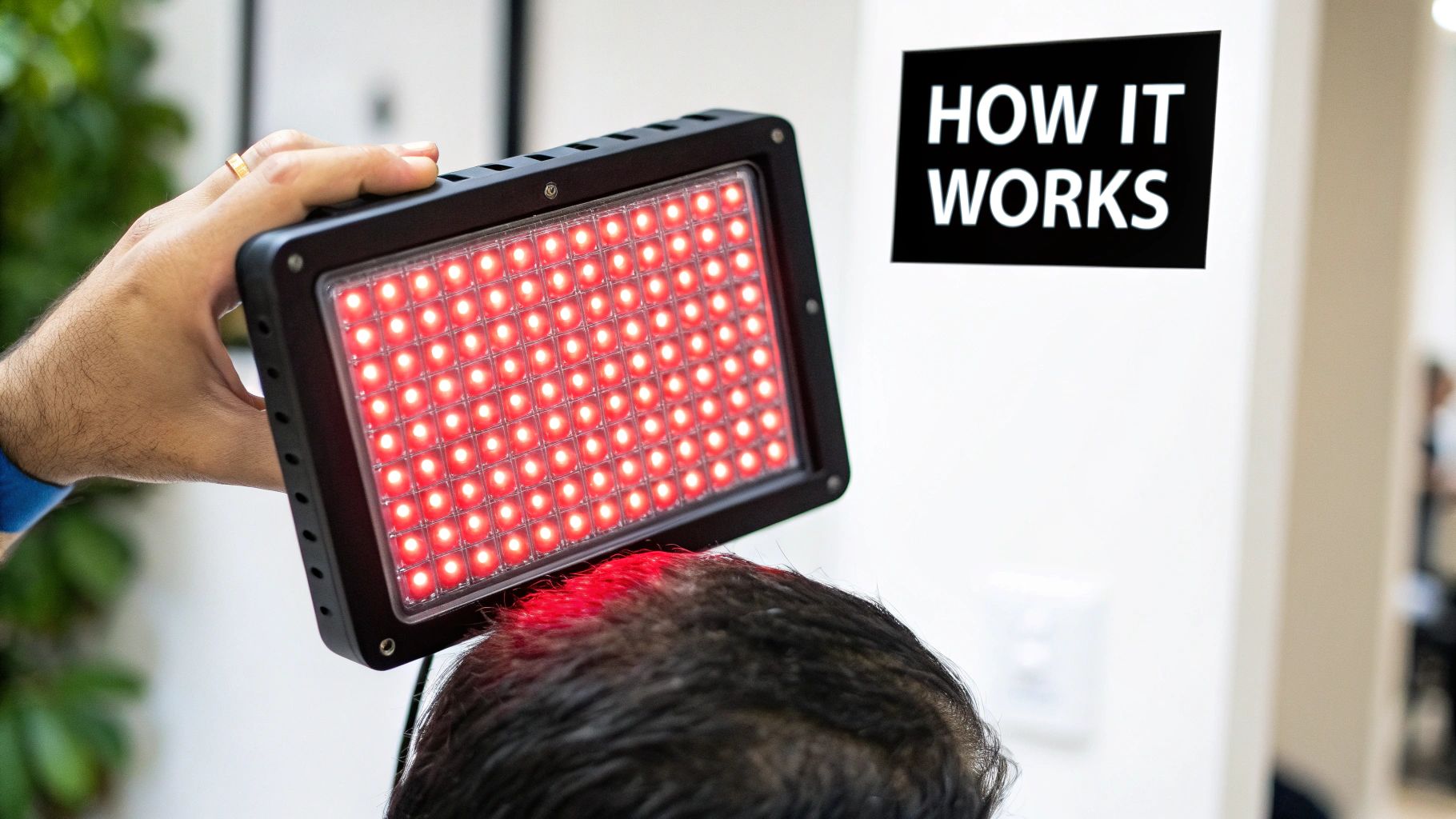
Powering Up Your Hair Follicles
Once your follicle cells are "recharged," they get back to work. And their main job? Growing hair. This surge in cellular energy kicks off a few important changes that make your scalp a much better place for hair to grow.
- It extends the growth phase: Your hair grows in cycles. With more energy, the follicles can stay in the active growth (anagen) phase longer.
- It wakes up dormant follicles: The light can nudge follicles that have stopped producing hair back into the growth cycle.
- It improves scalp circulation: Red light also helps boost blood flow, which means more oxygen and vital nutrients are delivered right where they're needed—the hair follicles.
At its core, red light therapy helps reset the conditions for healthy growth, working with your body's natural processes. You can dive deeper into the different stages of the hair growth cycle to see just how this all fits together.
The concept is pretty straightforward: Energized cells are productive cells. By giving the mitochondria in your hair follicles the fuel they need, red light therapy helps them produce thicker, stronger hair.
This isn't just about appearances; it’s a powerful biological process. In fact, one study looked specifically at the 650 nm wavelength and found it could significantly trigger hair follicle proliferation. When researchers treated isolated human hair follicles with this light, they saw a noticeable increase in hair shaft length compared to the follicles left alone. The reason? The light actively spurred an increase in key cell proliferation markers, confirming it was kickstarting cellular activity at the source.
The Role of The Anagen Phase
To really get why this is such a big deal, you need to understand the anagen phase. This is the active "growing" stage for each hair on your head. The longer a follicle can stay in this phase, the longer and healthier your hair will be.
When follicles are weak or starved for energy, they often cut this phase short and jump right into the resting or shedding stages. Red light therapy helps push back against this trend by providing the consistent energy needed to keep that anagen phase going strong.
This is exactly why consistency with the therapy is so important. Regular sessions keep those cellular batteries topped up so they never run low. This steady supply of energy allows the follicles to produce thicker, more resilient hair over the long haul. The goal isn't a quick, temporary fix—it's about creating a fundamental, lasting improvement in the health of your scalp and hair.
Exploring the Clinical Proof for Hair Regrowth
Understanding the science of how red light therapy wakes up sleeping hair follicles is one thing. But seeing the real-world results? That’s what really matters.
So, let's step out of the lab and into the clinic to see what the actual studies and human trials have to show. This isn't just theory anymore; it’s about documented evidence gathered over years of serious research.
The journey of low-level light therapy (LLLT) really started to pick up steam after it first got the FDA's nod back in 2007. That was a huge milestone. It opened the door for proper scientific investigation and took red light therapy from a niche idea to a legitimate, science-backed option for hair restoration. Since then, a mountain of clinical data has come out, painting a pretty clear picture of how well it works.
Time and again, these studies point to major improvements in the things we care about most with hair health. Researchers weren't just looking for a few new sprouts; they were measuring real, tangible changes in hair count, overall density, and the thickness of the hair shafts themselves.
What the Numbers Actually Mean
When a study talks about a "significant increase in hair density," what does that actually look like and feel like for someone with thinning hair? Simply put, it means a fuller-looking head of hair and less scalp showing through.
This often comes from reversing follicle miniaturization—that frustrating process in pattern hair loss where follicles shrink over time, producing thinner and weaker hairs until they eventually give up.
Red light therapy steps in to fight this process. It gives the follicles the energy boost they need to get back to producing thicker, more robust strands of hair. It's why so many people say their hair not only looks denser but feels stronger and healthier, too.
Key Findings from Clinical Trials
The evidence backing red light therapy hair treatments is pretty compelling, and it just keeps growing. Plenty of randomized controlled trials—the gold standard of clinical research—have been done on both men and women with androgenetic alopecia (pattern hair loss). And the results are consistently positive.
One major multicenter trial, for instance, focused on women who used visible red light at a 655 nm wavelength. The results were pretty eye-opening: they saw a 37% increase in hair count compared to the group that got a placebo treatment. That meant their hair count in a targeted patch of the scalp jumped from around 210 hairs to 310. That's a huge, statistically significant leap.
This growing body of evidence makes one thing crystal clear: Red light therapy isn't some hopeful trend. It's a validated, non-invasive, and effective tool in the fight against pattern hair loss, with a strong safety profile confirmed across multiple studies.
This is just one of several options for tackling hair loss without going under the knife. You can learn more by checking out these other non-surgical hair loss treatments.
Consistent Results for Men and Women
Crucially, these positive results aren't just for one gender. Research has shown that both men and women see significant improvements in hair growth after using red light therapy consistently.
Here’s a quick rundown of the common outcomes documented in the research:
- Increased Hair Count: More individual hairs are physically counted in a specific area of the scalp.
- Enhanced Hair Density: The hair looks fuller, providing better scalp coverage.
- Improved Hair Thickness: The actual diameter of individual hair shafts gets bigger, leading to stronger, less brittle hair.
- Patient Satisfaction: Beyond the hard data, a high percentage of people in these studies report being genuinely happy with their results and seeing a real difference in the mirror.
These consistent findings, repeated across different studies and for different people, are what give doctors and users alike real confidence in the power of red light therapy for hair. The proof, as they say, is in the measurable, repeatable results.
How to Choose the Right Device for You
Alright, you're ready to give red light therapy a try, but the sheer number of devices out there can feel a bit overwhelming. Let's cut through the noise. This section is your no-nonsense buyer's guide to finding the right tool for the job.
You've got helmets, caps, combs, panels… you name it. Each one has its place, but they're not all created equal. My goal here is to help you look past the slick marketing and zero in on what actually works for hair restoration.
Decoding the Tech Specs
When you start comparing devices, you'll run into a few technical terms. Don't let them intimidate you. We only need to focus on two key specs to understand what really matters for stimulating hair growth.
- Wavelength (nm): This is just a fancy way of saying "color of light." For hair follicles, the magic happens in a very specific slice of the red light spectrum—between 630 nm and 670 nm. This is the range that countless studies have shown can effectively wake up dormant follicles.
- Power Density (mW/cm²): Think of this as the intensity or concentration of the light hitting your scalp. Here, more isn't necessarily better. Too much energy can actually stress the cells out. You're looking for a device that delivers enough of a kick to be effective, typically in the 5-10 mW/cm² range for hair growth.
It's all about finding that Goldilocks zone—the right color of light at the right intensity to get the best results without overdoing it.
This image really drives home what consistent, proper treatment can accomplish compared to doing nothing at all.
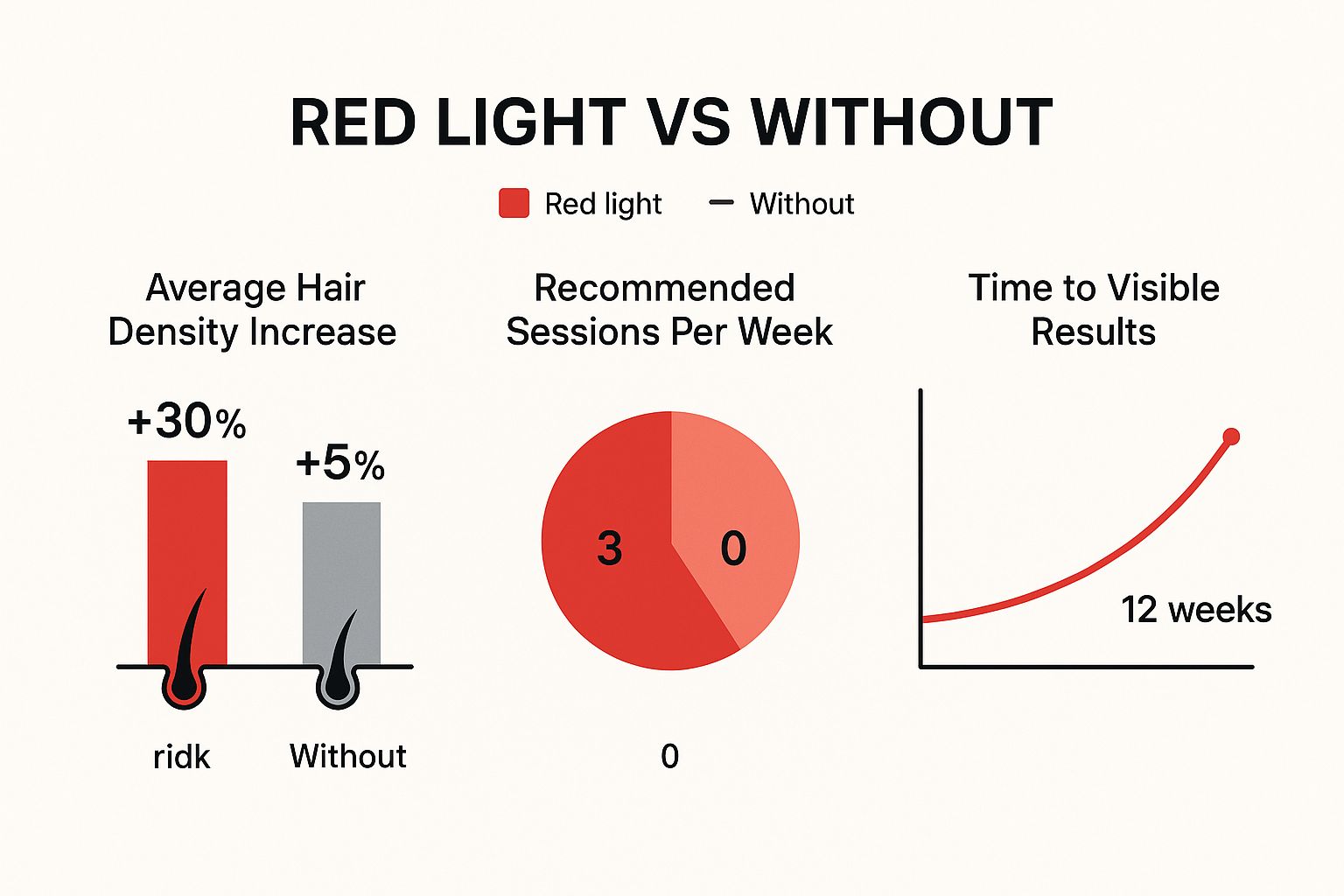
The data clearly shows the potential impact of a dedicated routine, with users seeing an average hair density increase of 30% in just 12 weeks.
Comparing Red Light Therapy Device Types
Now, let's talk about the different types of devices you'll find. The best one for you really boils down to your lifestyle, your budget, and the specific pattern of your hair loss. I've put together a simple breakdown to help you decide.
Comparing Red Light Therapy Device Types
A breakdown of common RLT device types to help you choose the best fit for your needs.
| Device Type | Best For | Pros | Cons |
|---|---|---|---|
| Helmets & Caps | Overall thinning and pattern baldness | Hands-free and provides full, even scalp coverage. You just put it on and relax. | Can be a significant upfront investment and might be bulky to store or travel with. |
| Combs & Wands | Targeted thinning spots or receding hairlines | More affordable and portable. Great for focusing on specific problem areas. | Requires you to manually move it across your scalp, making even coverage a challenge. |
| Panels | Multi-purpose use beyond just hair | Versatile enough to be used for skin and pain relief on other parts of the body. | Not specifically designed for the scalp, so it can be awkward to position correctly. |
For most people whose primary goal is tackling hair loss, a helmet or cap is the most practical and effective option. The hands-free design and total scalp coverage make it incredibly easy to stick with the routine.
One of the most important things to look for when choosing a device is FDA clearance. This doesn't mean the FDA has approved it as a medical cure, but it does mean the agency has determined the device is substantially equivalent to another legally marketed device and is safe for public use.
Think of it as a crucial safety check. It tells you the manufacturer has met specific federal standards, giving you peace of mind. It’s a good sign that you're looking at a quality product, as many reputable non-surgical hair restoration methods rely on safe, proven technology.
At the end of the day, the best device is the one you’ll actually use consistently. Whether that's a cap you wear while watching your favorite show or a comb you use for a few minutes each day, consistency is what will ultimately get you the results you’re after.
Creating Your At-Home Treatment Plan
Alright, so you’ve got a handle on the types of red light therapy devices out there. Now comes the important part: putting it all together into a simple, effective at-home routine. Let’s map out exactly what that looks like so you can get the results you're after.
If there's one secret to making this work, it's consistency. Think of it like going to the gym—you won't see results from a single workout. The real magic with red light therapy hair treatment happens when you make it a regular habit.
Building Your Weekly Schedule
So, what does a typical week look like? Most of the clinical research and the device manufacturers themselves point to a pretty standard protocol. The goal is to give your follicles a consistent dose of energy without overwhelming them.
A solid plan usually involves:
- Frequency: Shoot for 3 to 5 sessions every week. Spreading them out—maybe Monday, Wednesday, and Friday—is a great way to go.
- Duration: Each session should last about 15 to 20 minutes. The good news is most modern helmets and caps have built-in timers, so they do the clock-watching for you.
- Timing: Honestly, the time of day doesn’t matter. Just pick a time you can stick with, whether it’s during your morning coffee or while you’re winding down with a show at night.
This steady rhythm is what keeps your hair follicles stimulated, nudging them to stay in the anagen, or active growth, phase. It’s like watering a plant; sporadic watering won't help it thrive, but a consistent schedule will.
Maximizing Your Treatment Results
To really get the most bang for your buck, a little prep can make a big difference. These simple steps ensure the light is actually reaching your scalp and that your body is ready to build new hair.
Here are a few tips to work into your routine:
- Start with a Clean Scalp: Always, always use your device on clean, dry hair. Any oils, dirt, or leftover styling products can act as a barrier, blocking the light from getting to the follicles where it needs to go.
- No Topicals Beforehand: Hold off on applying things like minoxidil right before a session for the same reason. It's much better to apply those treatments after you’re done with the red light.
- Support from the Inside Out: What you eat truly matters for hair health. It's worth looking into some of the best foods for hair growth to make sure your body has all the building blocks it needs.
Following these simple best practices can seriously impact how well—and how quickly—your red light therapy hair routine works for you.
It's so important to set realistic expectations here. The hair growth cycle is a slow, biological process. The changes start at a cellular level, long before you'll ever see them in the mirror. While the magic starts happening right away, it often takes a solid 3 to 6 months of consistent use to see noticeable improvements in thickness and density.
Patience really is a virtue on this journey. The key is to trust the science, stick to your schedule, and give your follicles the time they need to wake up and respond. This mindset will help you build a routine that you can stick with for the long haul to get real, lasting results.
Addressing Common Myths and Safety Concerns
When you're looking into any new treatment for something as personal as hair loss, it’s completely normal to have questions. Is this actually safe? What are the side effects? Let's cut through the noise and tackle these concerns directly.
First off, the safety profile for red light therapy is fantastic. This isn't like the UV light from the sun that can damage your skin. The specific wavelengths used in these devices are non-invasive, meaning they don't break the skin, and side effects are extremely rare.
On the rare occasion that they do occur, they are usually minor. Some people might experience a bit of temporary scalp irritation or notice a slight uptick in shedding when they first start. Don't panic—this initial shed is often a good sign, showing that follicles are pushing out old, weak hairs to make room for new, healthier ones.
Debunking Common Misconceptions
Beyond basic safety, a couple of persistent myths can cause a lot of frustration. Getting these straight from the beginning will give you a much clearer, more realistic outlook.
-
Myth 1: More Power Is Always Better. It's a common assumption that blasting your scalp with a high-powered device will speed things up. That's not how this works. Hair follicles are delicate and respond best to a specific, gentle dose of light energy. Too much power can actually stress the cells and backfire, giving you worse results.
-
Myth 2: Results Should Be Instant. Patience is everything here. The hair growth cycle is a slow, biological process. You might not see visible changes in the mirror for a while, but the work is happening at a cellular level. You need to commit to at least three to six months of consistent use before you can really judge how well it's working for you.
The whole idea behind red light therapy hair treatment is gentle, consistent stimulation. You're not trying to shock the follicles into action. Success comes from patience and sticking to the routine, not from cranking up the intensity.
Setting Realistic Expectations for Your Journey
It’s also crucial to understand the limitations. While red light therapy is great at waking up weakened or dormant follicles, it's not a miracle worker for areas that have been bald for many years. To get a better handle on the science, check out our article on whether dead follicles can be revived.
That said, the evidence for its effectiveness is compelling. One study on laser therapy for hair loss found a 60% reduction in hair follicle miniaturization—the very process that drives pattern baldness. This reversal led to a 17% increase in hair count and thickness in just three months. You can read the full research about these findings to see the data for yourself.
It all goes to show that with the right expectations and a consistent approach, you can create a much healthier environment for your hair to thrive.
Answering Your Top Questions
Even with all the science covered, you probably still have a few practical questions. I get it. Let's tackle some of the most common ones that come up when people are starting their red light therapy journey.
How Long Until I See Results?
This is the big one, and the honest answer is: it takes time and consistency. While you might feel some subtle changes earlier on, most of the clinical evidence points to noticeable improvements in hair count and thickness after about 3 to 6 months.
Think about what's happening beneath the surface. The light is working to energize your hair follicles at a cellular level, a process that doesn't happen overnight. Sticking to a regular schedule, usually 3-5 times a week, gives those follicles the steady "diet" of light they need to wake up and start producing healthier, stronger hair.
Does It Work for All Hair Loss Types?
Red light therapy really shines when it comes to androgenetic alopecia—the classic male and female pattern baldness. This is where the bulk of the research has been done, and the results are most promising. The therapy is great at reinvigorating follicles that are dormant or shrinking due to genetic and hormonal factors.
What about other types, like alopecia areata (an autoimmune condition) or telogen effluvium (stress-related shedding)? The jury is still out. There's less research on its effectiveness for these conditions, so it's incredibly important to talk to a dermatologist first. They can help you figure out the root cause of your hair loss and the best way to treat it.
Can I Combine It with Other Treatments?
Absolutely, and in many cases, it's a great strategy. Many people find they get better results by pairing red light therapy with proven treatments like minoxidil or finasteride. It’s like a one-two punch against hair loss.
The thinking is that red light therapy boosts blood flow and cellular health in the scalp, which might create a better environment for topical treatments like minoxidil to be absorbed and do their job.
Combining therapies can create a powerful, multi-pronged attack against hair loss. However, it is crucial to speak with your doctor before starting any new combination of treatments to ensure it's the right approach for you.
Are the Results from Red Light Therapy Permanent?
The results last as long as you keep up with the treatment. Because pattern baldness is a progressive, ongoing condition, you can't just stop therapy and expect to keep the new hair forever.
It’s best to think of it like going to the gym for your hair follicles. You have to continue with maintenance sessions to hold onto the gains you've made. It simply becomes a long-term part of your hair care routine.
At PRP For HairLoss, we're dedicated to providing you with clear, science-backed information on effective hair restoration strategies. Explore more insights and options for tackling male pattern baldness on our website.
 PRP For Hairloss
Leave a comment