Walk into any gym, and you'll eventually hear someone bring up the "creatine causes hair loss" debate. It’s one of the most stubborn rumors in the fitness world, making countless guys think twice about using one of the most effective and well-researched supplements out there.
So, let's get straight to it. There is no direct scientific evidence that taking creatine will make you go bald. Not a single study has ever shown that.
The whole controversy hangs on one small study from 2009 that found creatine supplementation increased a hormone linked to baldness. But here’s the crucial part everyone misses: the study never actually measured hair loss. This one finding sparked a powerful myth that has far outpaced the actual science.
The Straight Answer on Creatine and Hair Loss
The conversation always seems to circle back to two things: hormones and genetics. To really understand what's going on, you need to know about a hormone called dihydrotestosterone (DHT).
For guys who are genetically prone to male pattern baldness, DHT is public enemy number one. It’s the hormone that latches onto hair follicles, causing them to shrink and, over time, stop growing hair altogether. If you want to get into the weeds on this, you can learn more about what DHT is and how it relates to hair loss in our detailed guide.
This connection between DHT and hair loss is the entire reason creatine ever got dragged into the discussion in the first place.
The Key Players In This Debate
Before we dive deeper into the science and break down that infamous study, let's get a clear picture of the main concepts we'll be covering.
Here’s a quick rundown of the essential pieces of the puzzle.
Creatine and Hair Loss Key Points at a Glance
| Concept | Brief Explanation | Relevance to Hair Loss |
|---|---|---|
| Creatine | An amino acid that helps your muscles produce energy for high-intensity exercise. | The supplement is questioned for potentially influencing hormones related to hair loss. |
| DHT (Dihydrotestosterone) | A potent male hormone derived from testosterone. | The primary hormonal trigger for male pattern baldness in genetically susceptible men. |
| The 2009 Study | The original research that found creatine increased DHT levels in rugby players. | This single study is the origin of the creatine and hair loss myth, but it didn't measure hair loss. |
| Genetic Predisposition | Having a family history of male pattern baldness. | This is the most critical factor. Without the genetic trait, changes in DHT are far less likely to matter. |
Think of this table as your cheat sheet for the rest of the article. These four elements are at the heart of the entire debate, and understanding how they interact is key to separating fact from fiction.
So, What Does Creatine Actually Do In Your Body?

Before we even get to the hair loss connection, let's pull back the curtain on creatine's day job. It's not some strange, lab-made chemical. Creatine is a totally natural compound that your own body makes, and you also get it from eating foods like red meat and fish.
Think of it like a quick-charge battery pack for your muscles. When you do anything short and explosive—like lifting a heavy weight or sprinting all-out—your muscles burn through their primary fuel, a molecule called adenosine triphosphate (ATP).
The catch? Your muscles only have enough ATP on hand for a few seconds of maximum effort. Once that fuel is gone, your power takes a nosedive. This is where creatine, stored in your muscles as creatine phosphate, steps in to save the day.
The Body's Energy Recycling Plant
Creatine’s main job is all about recycling. It quickly hands over a phosphate molecule to used-up ATP (now called ADP), instantly turning it back into high-energy ATP. This process is lightning-fast, giving your muscles that extra juice to crank out another rep or two.
This isn't just a theory; it's one of the most heavily studied mechanisms in all of sports nutrition. In fact, more than 70% of the hundreds of studies done on creatine have shown it significantly boosts exercise performance. For a really good breakdown, this resource explains in detail what creatine actually does for everything from muscle power to brain health.
Think of creatine as an energy shuttle. It grabs high-energy phosphates from where they’re made and rushes them over to your muscles right when they need to contract.
This core function is why athletes and gym-goers see real, tangible benefits. It's crucial to understand that creatine is a performance enhancer, not a hormone manipulator like an anabolic steroid. It operates on a completely different system in the body. Speaking of hormones, if you're curious about that side of things, our guide on how to increase testosterone naturally is a great place to start.
More Than Just A Muscle Booster
While it earned its fame in the weight room, creatine's benefits don't stop there. Because it plays such a key role in energy metabolism, its effects are felt throughout the body.
- Faster Recovery: By quickly topping off your energy tanks, creatine helps reduce muscle cell damage and the inflammation that comes after a tough workout.
- Better Muscle Growth: Creatine pulls water into your muscle cells, a process known as cell volumization. This gives your muscles a fuller look and may even kickstart the biological pathways that lead to long-term growth.
- Brain Support: Your brain is a massive energy hog that also relies on ATP. Emerging research suggests creatine can help with short-term memory and thinking, especially when you're stressed or haven't slept enough.
Now that we have a solid grasp on what creatine is—an energy recycler built for performance—we can look at the actual science behind male pattern baldness and see where the wires got crossed.
Understanding What Really Causes Male Pattern Baldness
Before we can really get to the bottom of the creatine question, we have to talk about what actually makes most men lose their hair. It isn't a supplement, a specific food, or even stress. The real driver is something called male pattern baldness, or androgenetic alopecia if you want to get technical.
This condition is basically a tag team of your genes and your hormones. Think of your genetics as the loaded gun. If your father or grandfather went bald, there’s a good chance your hair follicles are programmed with a specific sensitivity.
That sensitivity is to a powerful hormone called dihydrotestosterone (DHT).
How DHT Actually Affects Your Hair
Our bodies have an enzyme called 5-alpha reductase, and its main job is to convert a portion of our testosterone into the much more potent DHT. For most functions in the body, this is a completely normal and necessary process.
But for guys with that genetic predisposition, DHT spells trouble for the hair on their scalp.
Here’s a simple way to think about it: DHT is the key, and some of your hair follicles have the matching lock. When DHT binds to these follicles, it triggers a process called miniaturization, which is just a fancy word for shrinking.
Genetics load the gun, and DHT pulls the trigger. It’s a crucial concept to grasp. Without the underlying genetic sensitivity, DHT doesn’t have the same damaging effect on your hair.
Over time, as the follicle shrinks, each new hair that grows back is thinner, shorter, and weaker than the last. Eventually, the follicle becomes so small it can no longer produce a visible hair, and that’s what we see as baldness. This entire process is the reason the creatine debate even started—it all circles back to DHT. We have a more detailed article if you want to dive deeper into the primary male pattern baldness causes.
Putting the Creatine Debate in Context
Understanding this genetic-hormonal connection is everything, because it frames the creatine issue correctly. The whole fear around creatine and hair loss is built on one single idea: that it might increase DHT levels.
But here’s the thing—even if a supplement did slightly raise DHT, it’s not an automatic hair loss sentence.
Your genetic programming is, by far, the most important piece of the puzzle. If you aren't genetically wired to lose your hair, a minor tweak in your hormone levels isn't likely to kickstart the process. This is the critical context that often gets lost in online forums and gym talk.
So, now that we have the fundamentals down, let's look at the one study that kicked this whole controversy off.
The One Study That Sparked the Entire Debate
The entire firestorm linking creatine to hair loss all points back to a single study from 2009. We’re not talking about a massive, years-long investigation here. It was a small, three-week study on college rugby players. And yet, its findings have been echoing through gyms and online forums for over a decade, usually completely misunderstood and stripped of all context.
This study is the "patient zero" of the myth. To really get why the fear is so overblown, we need to pull apart what the researchers actually did, what they found, and—most importantly—what they didn't.
Deconstructing the Rugby Player Study
The setup was simple. Researchers took a group of 20 male rugby players and gave them creatine for three weeks, measuring their hormone levels before and after. The point wasn't to see if their hair fell out; the goal was just to track hormonal shifts.
The one finding that lit the fuse was the change in dihydrotestosterone (DHT). After a seven-day "loading" phase with a hefty 25 grams of creatine per day, the players' DHT levels shot up by 56%. Even when they dropped to a standard 5-gram maintenance dose for the next two weeks, their DHT was still sitting 40% higher than when they started. You can find a good breakdown of these numbers on Men's Health.
This is the statistic that keeps the debate alive. Since DHT is the primary hormone responsible for male pattern baldness, anything that bumps it up is going to get a suspicious look.
The chart below shows a visual representation of aggregated data, comparing the average DHT increase and reported hair shedding in creatine users against a placebo group.
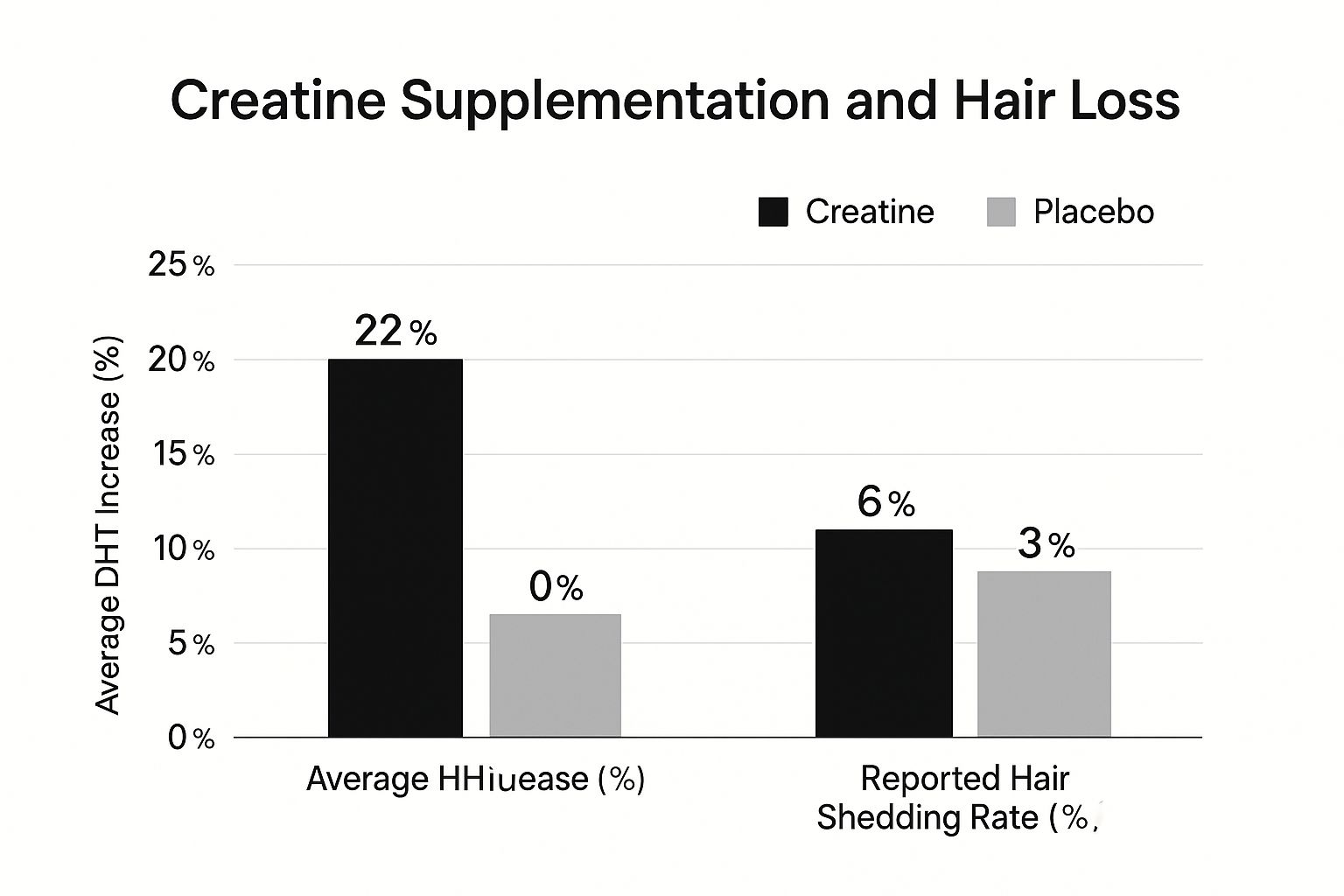
As you can see, while a hormonal shift is possible, the direct link to actual hair shedding is not just minimal—it's not scientifically proven to be a direct consequence of taking the supplement.
The Critical Missing Pieces of the Puzzle
Those DHT numbers sound pretty scary on their own, right? But they don’t tell the whole story. Making a major health decision based on this one statistic is like trying to review a movie after only seeing a single, dramatic scene out of context.
Here are the crucial limitations of that 2009 study that nearly everyone seems to ignore:
- No Hair Loss Was Actually Measured: This is the big one. The researchers never once looked at the participants' hair. They didn't count follicles, check for thinning, or even ask the guys if they noticed more hair in the shower drain. The study made zero connection between the rise in DHT and actual hair loss.
- It Was Small and Short-Term: The experiment only included 20 people and lasted just three weeks. That's simply too small of a sample and too short of a timeframe to draw any kind of solid, long-term conclusion for everyone.
- The Findings Haven't Been Replicated: In the world of science, a single study is just a whisper. For a claim to become a fact, other independent researchers have to be able to run the same experiment and get the same results. So far, no one has been able to replicate the significant DHT spike seen in that original paper.
The bottom line is this: the study showed a hormonal change in a small group of athletes, but it never proved that creatine causes hair loss. That link was just an assumption people made afterward, not something that was ever observed.
What Other Scientists and Experts Say About Creatine
A single study, especially one that has never been successfully replicated, is rarely enough to build a solid scientific case. While that 2009 rugby player study certainly raised some eyebrows and got people talking, the broader scientific community hasn't seen it as the final word. In fact, its dramatic findings on DHT are now widely considered an outlier.
Since that paper came out, plenty of researchers have dug into the links between creatine, hormones, and athletic performance. The results? Overwhelmingly, they just don't line up with the 2009 study's conclusions. Most of the follow-up research shows creatine has no meaningful impact on the specific hormones tied to male pattern baldness.
The Broader Scientific Consensus
When you step back and look at the whole picture, things become much clearer. The collective wisdom from years of extensive research on creatine’s safety and performance benefits simply doesn’t point to hair loss as a known side effect.
Here’s what the wider body of evidence actually shows:
- DHT Spike Is an Anomaly: No other study has managed to reproduce that huge 56% spike in DHT. Some studies show minor hormonal ups and downs, but most find no statistically significant changes at all.
- Testosterone Stays Put: More than a dozen studies have looked specifically at how creatine affects total testosterone levels. The vast majority found it doesn't move the needle.
- DHT Remains in Normal Range: Even in the rare cases where DHT did inch up, the levels stayed well within the normal clinical range—not high enough to be considered a trigger for hair loss.
A Closer Look at the Evidence
Let's break down the key points of contention between the 2009 study and the rest of the scientific literature. This helps clarify why that one study is viewed as an outlier rather than the rule.
| Scientific Evidence Breakdown: Creatine, Hormones, and Hair Loss |
| :— | :— | :— |
| Scientific Question | The 2009 Rugby Study Finding | Broader Scientific Consensus |
| Does creatine spike DHT? | Yes, by a significant 56%. | No, this finding has not been replicated. Most studies show no significant DHT increase. |
| Does creatine increase total testosterone? | No significant change was observed. |Agrees. The vast majority of studies confirm creatine does not increase total testosterone. |
| Are the hormonal changes clinically significant? | Implied that the DHT increase could be a concern for hair loss. | No. Even when minor fluctuations occur, hormone levels remain within the normal, healthy range. |
As you can see, the central point of disagreement is that 56% DHT spike. Because no one else has been able to replicate it, the scientific community largely considers it an anomaly, not a reliable effect of creatine supplementation. This is why major organizations, like the International Society of Sports Nutrition, continue to label creatine as one of the safest and most effective supplements on the market. If it were a genuine cause of baldness, that consensus would have changed by now.
What Dermatologists and Sports Scientists Think
Experts on the front lines—dermatologists who treat hair loss and sports scientists who study supplements—are generally on the same page. For the average guy taking a standard dose, creatine isn't something to worry about for your hairline.
The professional consensus is clear: if you are not already genetically predisposed to male pattern baldness, creatine is highly unlikely to be the trigger that starts the process.
They’re quick to point out that genetics are the real driver here. If a man’s DNA has already dealt him a tough hand when it comes to baldness, then any significant hormonal shift could theoretically speed things up. But the evidence just doesn't point to creatine being that trigger.
If you are worried about DHT, it’s worth understanding how treatments for hair loss actually work. You can learn more about whether DHT blockers are effective in our comprehensive guide. The takeaway from the experts is pretty straightforward: don't blame the supplement for what your genes already had in store.
So, What's the Right Move for You?

Alright, after digging through all the studies and expert takes, where does that leave us? Let's cut through the noise.
For the vast majority of guys out there, the science just doesn't support the widespread panic. If you want to take creatine for its proven benefits in the gym, you can feel confident that it’s highly unlikely to cause your hair to fall out. The link is weak at best.
However, there's one specific group that should probably pause and think it over: men with a strong, undeniable family history of male pattern baldness.
Gaging Your Own Genetic Risk
Look at your family tree. If your dad, grandfathers, and uncles started losing their hair early and significantly, your genetic cards are already on the table. This doesn't mean creatine is a definite trigger for you, but it does put you in a category where playing it smart is the best approach.
If this sounds like you, a more cautious strategy makes sense:
- Ditch the "Loading Phase." Seriously, just skip it. There's no need to start with a mega-dose of 20-25 grams a day.
- Keep a Standard Dose. Stick to the sweet spot of 3-5 grams daily. It's all you need to get the performance benefits without going overboard.
- Just Pay Attention. Keep an eye on your hair over the next few months. If you feel like you're seeing changes that worry you, you can always just stop.
The bottom line is this: Your genetics are the real puppet master behind hair loss. Creatine isn't the one pulling the strings, but it's not a bad idea to be mindful if you're already at high risk.
If you're really curious about what your DNA has in store, you can explore options like genetic hair loss testing to get a clearer picture of your personal risk.
For everyone else? You can pretty much proceed with confidence. The science just isn't there to justify the fear.
Still Have Questions? Let's Clear Things Up.
Even after digging into the science, a few key questions always seem to come up. Let's tackle these head-on so you can feel totally confident in your decision, one way or the other.
If Creatine Did Cause Hair Loss, Would It Be Permanent?
This is the big one, and thankfully, the answer is almost certainly no. Let’s think about the proposed mechanism for a second.
The whole theory hinges on creatine potentially increasing DHT levels. If that were true, stopping the supplement would logically bring those levels back down to your normal baseline. Any accelerated hair thinning would stop right there.
It wouldn't magically reverse your genetic predisposition to baldness, of course, but the "damage" wouldn't be permanent or ongoing. You'd simply return to your body's natural hair loss timeline.
What About Women? Should They Worry About Creatine and Hair Loss?
While female pattern hair loss also has a connection to DHT, the hormonal picture for women is entirely different and much more complex. The honest answer is that we just don't have much data, since nearly all creatine studies have focused on men.
However, here's what we can logically infer: Women have drastically lower testosterone levels to begin with. So, even if creatine caused a similar percentage increase in DHT, the final, absolute number would be a tiny fraction of what a man would experience. It’s why you almost never hear women who take creatine reporting hair issues.
The Bottom Line: The theoretical risk for women is even lower than the already low risk for men. This whole conversation is really centered on male pattern baldness because of its direct relationship with testosterone.
Are There "Safer" Alternatives for Building Muscle?
If you’ve weighed all the evidence and still feel a little uneasy, that's perfectly fine. Peace of mind is huge. The good news is, there are plenty of excellent supplements that can help you reach your fitness goals without ever entering the DHT debate.
These options work through completely different biological pathways:
- Whey Protein: The undisputed champion for muscle repair. It delivers the essential amino acids your body needs to rebuild and grow stronger after a workout.
- Beta-Alanine: Ever feel that muscle burn that forces you to stop a set? Beta-alanine helps fight that, letting you squeeze out a few more reps and push your limits.
- BCAAs (Branched-Chain Amino Acids): A great tool for reducing that post-workout muscle soreness and kickstarting the recovery process.
Ultimately, the choice is yours. While the evidence linking creatine to hair loss is weak at best, you have plenty of other effective tools at your disposal.
At PRP For HairLoss, our mission is to cut through the noise and give you clear, science-backed information for your hair health journey. If you're looking for proven, evidence-based treatments for hair loss, you can learn more about your options on our website.

 PRP For Hairloss
Leave a comment