When you're weighing a hair transplant against PRP, the fundamental difference is pretty straightforward. A hair transplant surgically adds brand new hair follicles to areas that have gone completely bald. On the other hand, PRP therapy works to awaken and strengthen the follicles you already have.
Think of it this way: a transplant is a permanent, surgical fix for significant hair loss, while PRP is a non-surgical treatment aimed at boosting hair density and putting the brakes on thinning.
Understanding Your Hair Restoration Options
Choosing the right hair loss treatment can feel like a huge decision, but it really comes down to one critical question: are you trying to regrow hair in a spot where the follicles are long gone, or are you trying to beef up the hair you still have? This is the core distinction between a surgical hair transplant and regenerative PRP therapy.
A hair transplant is essentially an architectural solution. It's like landscaping a bare patch of ground by moving healthy turf from a lush area. Surgeons physically relocate healthy, genetically resilient hair follicles from a donor area (usually the back or sides of your head) and implant them into thinning or bald spots. The result is a permanent, new pattern of hair growth.
PRP (Platelet-Rich Plasma) therapy takes a more biological approach. It's all about using your body’s own healing mechanisms. We take a small sample of your blood, concentrate the platelets, and inject this "liquid gold" back into your scalp to stimulate follicles that are weak or dormant, but not dead.
Quick Look Hair Transplant vs PRP
To make things even clearer, here’s a simple breakdown of the main differences between these two popular hair restoration methods.
| Aspect | Hair Transplant | PRP Therapy |
|---|---|---|
| Primary Goal | Create new growth in bald areas | Thicken and strengthen existing hair |
| Procedure Type | Surgical and invasive | Non-surgical and minimally invasive |
| Permanence | Permanent results | Requires ongoing maintenance sessions |
| Best For | Advanced hair loss, bald spots | Early stages of thinning, diffuse loss |
| Recovery Time | 1-2 weeks of noticeable recovery | Minimal to no downtime |
This table gives you a fast, high-level view, but the right choice always depends on your specific situation, budget, and long-term goals.
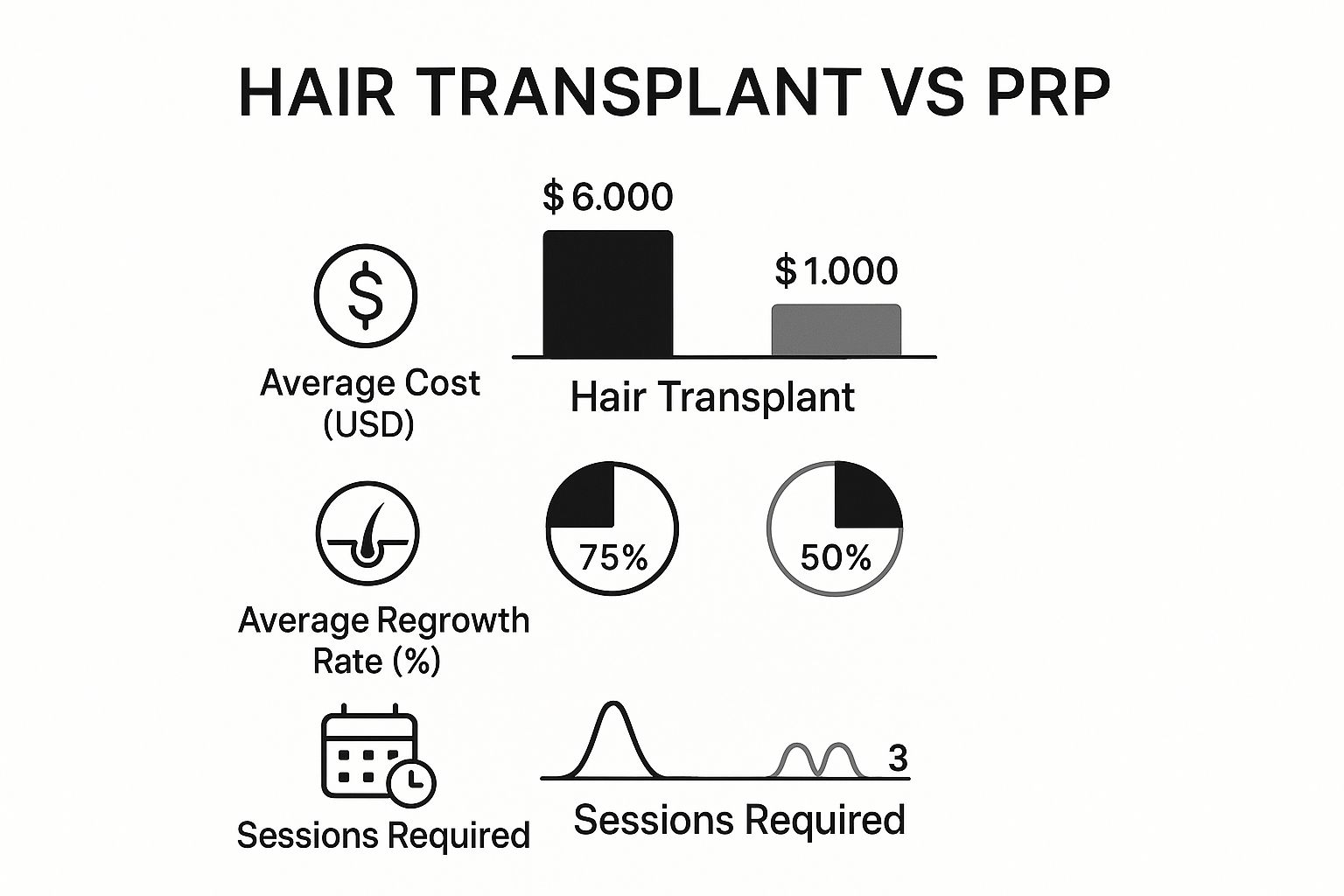
The image above gives you a great visual comparison of the average cost, success rates, and the number of sessions typically required for each treatment. You'll notice that while a hair transplant comes with a much higher upfront cost, it's generally a one-and-done procedure. PRP, in contrast, involves a series of lower-cost sessions over time.
Before committing to a major procedure, it's also smart to get a handle on the overall health of your hair. Understanding what causes hair damage and how to fix it can provide a solid foundation, ensuring your existing hair is in the best possible shape. This knowledge will help you set realistic expectations, no matter which path you decide to take.
How a Hair Transplant Creates Permanent Results
When you’re looking at a hair transplant versus PRP, think of the transplant as a permanent, architectural fix. It's a surgical procedure where healthy hair follicles are physically moved from a dense area of your scalp to a thinning or bald one. This isn't about coaxing old follicles back to life; it’s about bringing in brand-new ones that are genetically programmed to stick around.
The whole concept works because of something called donor dominance. The hair on the back and sides of your head is naturally resistant to DHT, the hormone that causes most male pattern baldness. A transplant simply takes these tough, resilient follicles and relocates them to the front or crown. They don't forget where they came from—they bring that genetic resilience with them and keep growing for good.
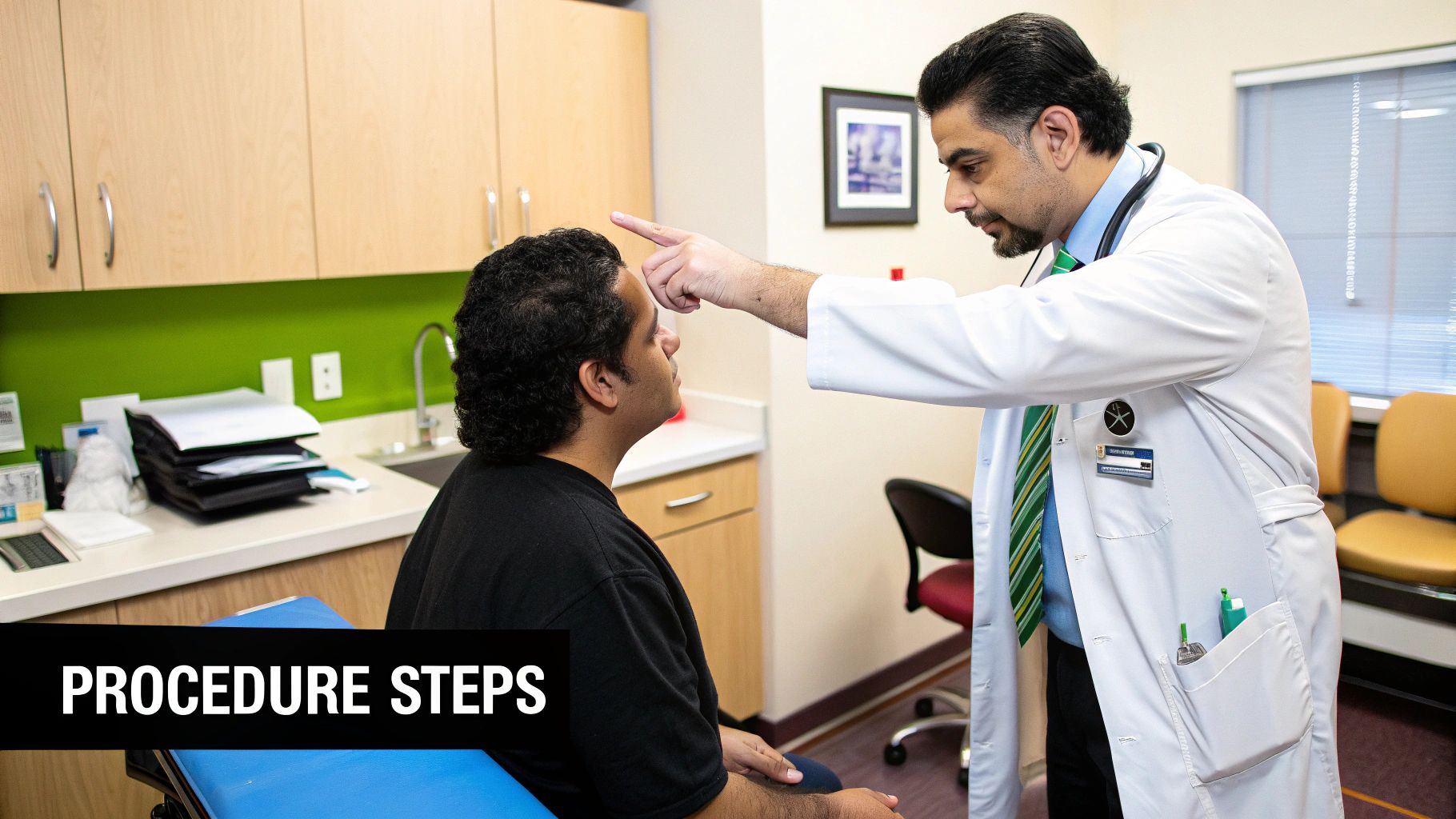
The Two Main Transplant Methods
Surgeons generally rely on two different techniques to get those donor hairs. The best one for you usually comes down to your pattern of hair loss, your goals, and what your surgeon thinks is the right fit.
- Follicular Unit Transplantation (FUT): Often called the "strip method," this technique involves removing a thin, linear strip of scalp from the donor area. Highly skilled technicians then dissect this strip under powerful microscopes to isolate individual follicular units for implantation.
- Follicular Unit Extraction (FUE): This is a more modern approach where the surgeon extracts individual follicular units directly from the scalp, one by one, using a tiny, specialized punch tool. The big advantage here is that it avoids a linear scar, leaving only tiny, dot-like scars that are virtually invisible once everything heals.
No matter how the grafts are harvested, the next step is the same. The surgeon meticulously creates tiny incisions in the balding area and then places each graft at just the right angle, depth, and density to mimic how hair naturally grows.
The true skill in a hair transplant isn't just about moving hair. It’s about artistry—recreating a natural-looking hairline that fits your face and looks right as you age. A great surgeon ensures the new hair blends perfectly with the old.
What to Expect During and After Surgery
The procedure itself is done with local anesthesia, meaning you're awake but won't feel a thing. Be prepared to set aside a full day, as it can take anywhere from 4 to 8 hours, depending on how many grafts you need.
Recovery is usually pretty straightforward. You can expect a few days of minor swelling, some scabbing, and a bit of discomfort. Most people are back to work and their usual (non-strenuous) routines within about a week. The one thing that often catches people by surprise is when the transplanted hairs fall out a few weeks later. Don't panic! This "shock loss" is a completely normal part of the hair's growth cycle.
The real, new hair growth starts to appear around the three to four-month mark. From there, the results just keep getting better. The hair will thicken and mature over the next year, with the final, full result typically visible at the 12 to 18-month point. While the transplanted hair is permanent, some guys still use PRP to help maintain and support the surrounding, non-transplanted hair. You can learn more about how it works as a complementary treatment by reading up on PRP for male pattern baldness.
Exploring PRP Therapy for Natural Hair Regrowth
If a hair transplant is the architectural fix for hair loss, Platelet-Rich Plasma (PRP) therapy is the biological approach. It doesn't move hair follicles around. Instead, it’s all about revitalizing and beefing up the ones you already have. This non-surgical treatment uses your body's own natural healing power to push back against thinning hair.
The idea behind it is pretty simple. Imagine giving a struggling lawn a dose of high-powered, organic fertilizer. The process starts with a standard blood draw, just like you’d have at a doctor’s office. That blood sample goes into a centrifuge, a device that spins incredibly fast to separate the blood into its core components.
This spinning action isolates the platelets, creating a highly concentrated serum we call platelet-rich plasma. This plasma is absolutely loaded with growth factors—the very proteins that are crucial for healing and cell regeneration throughout your body.
How Growth Factors Stimulate Hair Follicles
Once this "liquid gold" is ready, it's carefully injected directly into the areas of your scalp where you’re seeing thinning. The growth factors immediately get to work, basically sending a wake-up call to any hair follicles that have become dormant or weak.
Their role is a triple-threat:
- Stimulate Follicles: They nudge follicles from a resting phase back into an active growth phase.
- Improve Blood Flow: These growth factors encourage new blood vessels to form around the follicles, which boosts the supply of essential oxygen and nutrients.
- Thicken Hair Strands: When a follicle's health improves, the hair it produces can grow back thicker and stronger, leading to an overall look of greater density.
This is a key difference in the hair transplant vs. PRP debate. A transplant fills in areas where hair is completely gone. PRP, on the other hand, works to improve and hold onto the hair you still have, making it a fantastic choice for people dealing with diffuse thinning rather than clear bald spots.
The real power of PRP therapy is its ability to slow down hair loss while making the hair you currently have healthier and thicker. It's a strategy built on preservation and enhancement, not replacement.
The Typical Treatment Schedule
Unlike a hair transplant, which is usually a one-off procedure, PRP therapy requires a series of treatments to get things going. A standard plan starts with an initial round of three to four sessions, typically scheduled about a month apart.
After that initial push, it's all about maintenance. Most experts suggest follow-up treatments every six to twelve months to keep the results going strong. This ongoing schedule is necessary because PRP doesn't change the underlying cause of your hair loss; it just gives your follicles a consistent, powerful boost to fight back. For a closer look at the whole process, you can find more information about the complete PRP treatment for hair and how it’s customized for each person.
Finding the Right Candidate for Each Treatment
So, how do you figure out which path is right for you? It really boils down to taking a hard, honest look at where your hair loss is right now. The choice between a hair transplant and PRP isn't a one-size-fits-all answer; it's entirely personal to your situation.
A hair transplant is the heavy hitter, the go-to solution for more significant, advanced hair loss. We're talking about a noticeably receded hairline, bald spots on the crown, or areas where the scalp has gone smooth. In these cases, the follicles have likely been dormant for years, and the goal isn't just to thicken what's left—it's to repopulate areas that are completely bare.
On the flip side, PRP therapy is all about early intervention. It’s most effective for people who are just starting to see the signs of thinning. If your hair is losing its overall density, or you're noticing more shedding than usual but don't have distinct bald patches, PRP is designed to jump in and reinforce your existing hair. It’s a proactive measure to slow down loss and give your current follicles a much-needed health boost.
The Ideal Hair Transplant Candidate
Just because you have hair loss doesn't automatically make you a perfect candidate for a transplant. Surgeons are looking for a few key things:
- Sufficient Donor Hair: The entire procedure hinges on having a healthy, dense "donor area" on the back and sides of your head. Without a good supply of hair to move, the results will be limited.
- Realistic Expectations: It’s crucial to understand that a transplant redistributes hair—it doesn't create new follicles from scratch. The surgeon’s job is to create the most effective illusion of fullness with the hair you have.
- Stabilized Hair Loss: Often, it’s best to wait until your pattern of loss has settled. This allows the surgeon to design a mature, natural-looking hairline that will stand the test of time, rather than one that looks out of place in a few years.
Who Benefits Most from PRP Therapy
PRP shines when there are still active—even if they're weak—hair follicles to work with. The best candidates for PRP therapy usually fit this profile:
- Early-Stage Thinning: This is the sweet spot. PRP is fantastic for people who have just started to notice their part widening or their ponytail feeling thinner.
- Active But Weak Follicles: The treatment needs something to stimulate. If your follicles are struggling but haven't completely shut down, PRP can be the wake-up call they need.
- A Goal of Preservation: If your main aim is to hold onto the hair you have and make it stronger and healthier, PRP is an excellent non-surgical strategy.
Think of it this way: A hair transplant is for rebuilding. PRP is for reinforcing. One addresses the ground you’ve already lost, while the other strengthens your current defenses to prevent losing more.
Ultimately, understanding the different hair loss treatment options is about aligning your expectations with what each procedure can realistically deliver. If you're looking at a hairline that has clearly retreated, a transplant is probably the conversation to have. But if you're just starting to see a little more scalp than you used to, PRP could be the perfect way to get ahead of the problem.
How Combining PRP with a Hair Transplant Boosts Results
The conversation around hair restoration often pits a hair transplant versus PRP. But what if the best approach isn't choosing one over the other? In reality, many of the best clinics are now using these two treatments together, creating a powerful combination that gets the absolute most out of a hair transplant.
This strategy re-frames PRP's role. It stops being a standalone fix and becomes a powerful support system for the surgery itself.
Think of it this way: a hair transplant is like planting thousands of tiny, new seeds in a garden. The surgery is the essential first step, but the quality of the soil ultimately determines how well those seeds will sprout and flourish. PRP is that rich, organic fertilizer for your scalp, creating the perfect environment for newly transplanted follicles to take root and grow strong.

This one-two punch delivers benefits at every stage of the process, turning a good hair transplant into a great one.
Enhancing Graft Survival and Healing
One of the most vulnerable moments for a hair follicle is the time it spends outside the body between being harvested and implanted. To boost its chances of survival, surgeons can actually soak the harvested grafts in a prepared PRP solution. This gives the follicles a bath in growth factors, keeping them nourished and viable.
PRP is also used right after the surgery to kickstart the recovery process. When injected into both the recipient and donor areas, it can:
- Accelerate healing by stimulating tissue repair at a cellular level.
- Reduce scalp inflammation and minimize post-op redness.
- Encourage faster growth in both the newly transplanted and existing hair.
This isn't just theory; it’s backed by solid clinical evidence. A study running from 2019 to 2022 on patients with androgenetic alopecia found that adding PRP to the transplant process made a real difference. The group that received PRP had significantly higher follicle survival rates, saw increased hair growth, and developed stronger hair compared to the control group.
The science is clear: PRP improves the microenvironment for the grafts by promoting cell growth and encouraging new blood vessel formation. You can read more about the research on PRP in hair transplantation to see the data for yourself.
Using PRP alongside a hair transplant isn't about redundancy; it's about optimization. It helps protect your investment by giving every single transplanted graft the best possible chance to survive and thrive for the long term.
Ultimately, this dual approach is about getting the maximum return on your hair restoration investment. It creates the ideal healing environment to deliver superior, lasting results.
Comparing the Cost and Long-Term Commitment
When you’re looking at a hair transplant versus PRP, the conversation almost always turns to two things: how much it costs and what you’re signing up for long-term. The financial models for these two treatments couldn't be more different, and understanding that is key to making the right choice. One is a major, one-time investment, while the other is more like a subscription for your scalp.
A hair transplant has a significant upfront cost, there’s no getting around it. You're typically looking at a range from $4,000 to over $15,000. That price depends heavily on how many grafts you need, the specific technique (FUE usually costs more than FUT), and the surgeon's expertise. It's a big number, but for most people, it's a one-and-done deal for a permanent solution.
PRP therapy plays a completely different game. It’s priced per session, which makes it much more accessible to start. Think of it less like buying a house and more like renting—smaller, regular payments instead of one huge down payment.
Breaking Down the Financial Models
To really get a feel for the costs, you have to look past the initial price tag and think about the lifetime value.
-
Hair Transplant (The Single Investment): You pay a large sum once. After you've healed up, that new hair is permanent. It grows like your normal hair and doesn't require any special, ongoing treatments to keep it there. It’s a complete fix.
-
PRP Therapy (The Subscription Model): You'll start with an initial series of about 3-4 treatments. To keep the results going, you'll need to come back for maintenance sessions every 6-12 months. Those costs add up year after year because the treatment's effects depend on consistency.
The choice really comes down to your financial philosophy: Do you prefer a single, major investment for a permanent fix, or a smaller, ongoing expense for continuous maintenance and prevention?
For anyone leaning toward the recurring cost of PRP, it's smart to map out the financial commitment. Getting a clear idea of the average PRP cost for hair helps you see the full picture, from the initial round of treatments to the follow-ups you'll need down the road. This way, you can budget for the long haul without any surprises.
Answering Your Questions About Hair Transplants and PRP
Even with all the details laid out, you probably still have a few questions rolling around in your head. That's completely normal. This last section is all about tackling those common concerns—the "what ifs" and "how much" questions—so you can feel genuinely confident in your decision.
Let's dig into the big ones: pain, longevity, and side effects.
How Painful Are These Procedures?
Let's get right to it—pain is a major concern for almost everyone. With a hair transplant, the surgeon uses local anesthesia to completely numb your scalp, so you won't feel the procedure itself. Afterwards, most guys report mild soreness or discomfort for a few days, which is easily handled with standard over-the-counter pain medication.
PRP therapy is a bit different. It involves a series of quick injections across the scalp. While "uncomfortable" is a fair description, the sensation is very brief and stops almost as soon as the injection is done. Good clinics will use numbing creams or other agents to make the whole process much more tolerable.
The reality is, neither procedure is completely free of sensation, but both are very manageable. Any discomfort is short-lived and, for most people, a small price to pay for the results they're hoping for.
How Long Do the Results Last?
This is where the two paths really diverge. A hair transplant delivers permanent results. The follicles moved to the thinning areas are taken from the back and sides of your head, where they are genetically programmed to resist balding. They'll keep growing for the rest of your life.
PRP, on the other hand, is all about maintenance. It gives your existing hair a fantastic boost, but it doesn't stop the underlying cause of hair loss. To keep the benefits going, you'll need to schedule follow-up sessions, usually every 6 to 12 months. Think of it as ongoing care for your scalp.
What Are the Potential Side Effects?
Both treatments are known for being incredibly safe, largely because they work with your body's own tissues.
-
Hair Transplant Side Effects: The common stuff is all temporary and minor. Expect some swelling, a bit of scalp tenderness, and scabbing where the follicles were placed. Like any surgical procedure, there's a very small risk of infection, but it's rare when you follow aftercare instructions.
-
PRP Side Effects: Since PRP is made from your own blood, the chance of an allergic reaction is practically nonexistent. Most side effects are limited to the injection sites—think minor soreness, a little pinpoint bleeding, or some swelling that disappears in a day or two.
Ultimately, choosing between a hair transplant and PRP comes down to your unique situation: the extent of your hair loss, what you hope to achieve, and your budget. Armed with these final details, you're now in a great position to have a productive conversation with a specialist and find the right solution for you.
At PRP For HairLoss, we're committed to giving men the straightforward, honest information needed to tackle their hair restoration journey. You can find more resources and explore your options at https://prpforhairloss.com.

 PRP For Hairloss
Leave a comment