When we talk about hair loss in men, the conversation almost always defaults to male pattern baldness. And for good reason—it’s the most common culprit. But what happens when the hair thinning isn't following that classic receding hairline or crown-balding pattern? What if it's more diffuse, happening all over the scalp?
That's when it's time to look beyond genetics and consider other underlying health issues. One of the most significant, yet often overlooked, players in this scenario is the thyroid gland.
What is the Thyroid Gland?
Think of the thyroid as the master control center for your body's metabolism. This small, butterfly-shaped gland sits at the base of your neck and produces hormones that regulate everything from your heart rate and body temperature to, you guessed it, the growth and maintenance of your hair follicles.
When this gland goes haywire—either producing too much hormone (hyperthyroidism) or too little (hypothyroidism)—it can throw your entire system out of whack. And your hair follicles are particularly sensitive to these hormonal shifts.
The Thyroid and Your Hair Follicles: A Delicate Balance
Your hair grows in a continuous cycle with three main phases: anagen (growth), catagen (transition), and telogen (rest). Thyroid hormones, specifically T3 and T4, are crucial for keeping this cycle running smoothly. They help regulate the energy metabolism of the cells in your hair follicles, making sure they have the fuel they need to stay in the growth phase.
When thyroid hormone levels are off, this cycle gets thrown off course.
The disruption can prematurely push a large number of hair follicles from the anagen (growth) phase directly into the telogen (resting) phase. This leads to a type of hair loss called telogen effluvium, where you see excessive shedding and diffuse thinning all over your scalp, rather than in a specific pattern.
This is a key difference from typical male pattern baldness, which is driven by DHT and genetics. Thyroid-related hair loss tends to be more uniform and widespread.
Hypothyroidism vs. Hyperthyroidism: Two Sides of the Same Coin
While both conditions can cause hair loss, they do so in slightly different ways.
-
Hypothyroidism (Underactive Thyroid): This is the more common of the two. With insufficient hormone production, your body’s processes slow down. Hair can become dry, brittle, and coarse. The shedding is often slow but persistent, and you might also notice thinning of the hair on your eyebrows, particularly the outer third.
-
Hyperthyroidism (Overactive Thyroid): With an excess of thyroid hormones, your metabolism goes into overdrive. This can shorten the hair growth cycle, leading to fine, thin hair and accelerated shedding. The hair loss is typically diffuse and can come on more suddenly than with hypothyroidism.
The good news? In most cases, once the underlying thyroid condition is diagnosed and properly treated, the hair loss is reversible. As your hormone levels stabilize, the hair follicles can re-enter their normal growth cycle, and your hair can begin to grow back.
Is It Your Thyroid or Just Male Pattern Baldness?
It’s easy to see hair thinning and jump to the conclusion that it’s male pattern baldness. That’s a common pitfall. But assuming it's genetics can mean you miss the real culprit, like a thyroid problem, which delays getting the right help.
The truth is, these two conditions look and feel completely different once you know what to look for.
Think of androgenetic alopecia (AGA), or male pattern baldness, as following a predictable script. It’s a slow, steady thinning that usually shows up as a receding M-shaped hairline or a bald spot on the crown. It's driven by your genes and hormones, specifically DHT.
Thyroid hair loss, on the other hand, doesn't play by those rules. It's a completely different story. Instead of a set pattern, you'll see a diffuse, widespread shedding all over your scalp. This is a classic sign of telogen effluvium, where a hormonal imbalance shoves a huge number of your hair follicles into their resting (and shedding) phase all at once. If this sounds familiar, our guide on the differences between telogen effluvium vs. male pattern baldness can help you sort it out.
The Telltale Signs Beyond Your Hairline
The biggest giveaway that you're dealing with thyroid hair loss men often experience isn't on your head at all. It's the other symptoms that come along for the ride. Male pattern baldness is an isolated event; it only affects your hair. An underactive thyroid, or hypothyroidism, impacts your entire body.
If you’re suddenly feeling exhausted, gaining weight for no reason, or constantly cold, those are major red flags. These systemic symptoms just don't happen with genetic hair loss and signal that something more fundamental is going on inside.
This decision tree gives you a clear visual of how a doctor might approach a diagnosis, using your symptoms to point toward the likely cause.
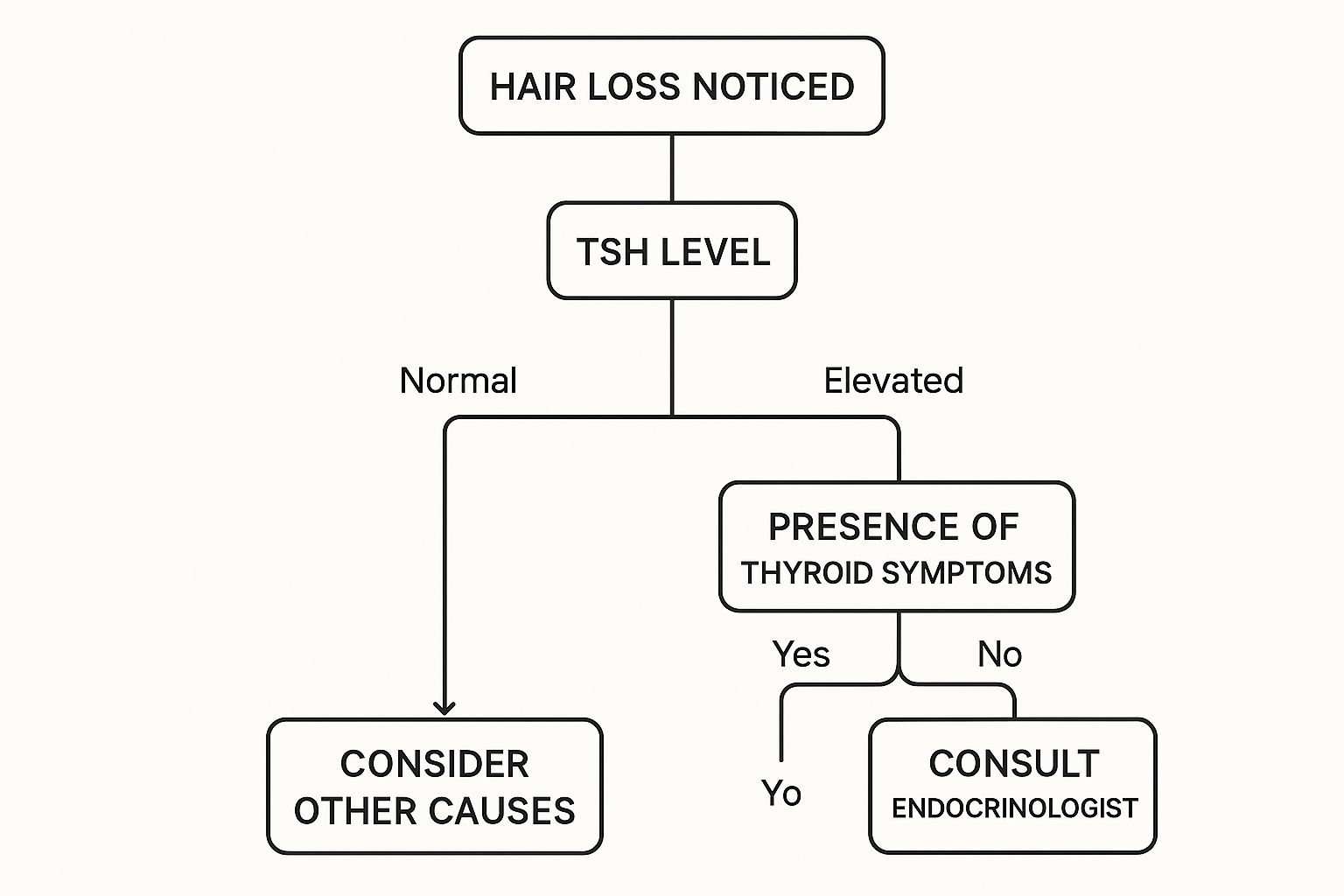
As you can see, when hair loss shows up with other thyroid-related symptoms, it's a strong signal that it’s time to see a doctor for some tests.
Key Differences Between Thyroid Hair Loss and Male Pattern Baldness
To make it even clearer, this table breaks down the key distinctions. Seeing the differences laid out side-by-side can help you connect the dots between what you're experiencing and its potential cause.
| Symptom | Thyroid-Related Hair Loss (Hypothyroidism) | Male Pattern Baldness (Androgenetic Alopecia) |
|---|---|---|
| Pattern of Loss | Diffuse, even thinning across the entire scalp. | Predictable pattern, usually M-shaped receding hairline or thinning crown. |
| Speed of Onset | Can be relatively sudden or progress over a few months. | Very gradual, progressive thinning over many years. |
| Hair Texture | Hair often becomes dry, coarse, and brittle. | Hair texture usually remains unchanged, just thinner in affected areas. |
| Body Hair | May include thinning of eyebrows (especially outer third) and body hair. | Typically affects only scalp hair; body hair is often unaffected or may increase. |
| Associated Symptoms | Fatigue, weight gain, feeling cold, dry skin, constipation, and brain fog. | No other systemic symptoms are associated with this type of hair loss. |
The main takeaway is this: if your hair loss is happening alongside a bunch of other unexplained health issues, your thyroid should be a prime suspect. Male pattern baldness doesn't make you feel tired, cold, or foggy.
Science backs this up. Recent research has uncovered a clear causal link between hypothyroidism and alopecia areata (an autoimmune hair loss), noting a 34% higher risk for men with an underactive thyroid. Interestingly, that same study found no significant connection between hypothyroidism and male pattern baldness.
This just confirms what we see in practice—while a thyroid issue can absolutely cause hair loss, it works on a completely different biological pathway than genetic baldness. Knowing this helps you have a more productive conversation with your doctor, leading to a faster, more accurate diagnosis and the right treatment plan.
Getting the Right Diagnosis With a Complete Thyroid Panel
Noticing your hair is thinning and connecting it to other symptoms is a great first step, but it’s not a diagnosis. To know for sure if a thyroid issue is the culprit behind your hair loss, you need to move past the guesswork and get a proper medical workup. That means getting a comprehensive blood test known as a complete thyroid panel.

Often, a doctor might start by ordering just a TSH test. While it's a useful screening tool, this single marker can easily miss the full story. Understanding what a complete panel involves will help you have a much more productive conversation with your doctor about the thyroid hair loss men often face.
Why a TSH Test Alone Isn't Enough
The Thyroid Stimulating Hormone (TSH) test is the go-to starting point. Your pituitary gland, located at the base of your brain, produces TSH to signal your thyroid to make its hormones. If your TSH levels are high, it’s like your pituitary is shouting at a sluggish thyroid, which points toward hypothyroidism.
But here’s the catch: a "normal" TSH level doesn't automatically mean your thyroid function is perfect. You could still have problems with how your body converts or uses the actual thyroid hormones, T4 and T3. This is where a more detailed look becomes essential for an accurate diagnosis.
Think of it this way: a TSH test is like checking the main power switch to a factory. A complete panel, on the other hand, inspects the actual output on the assembly line (T4 and T3) to see if the factory is really producing what it's supposed to.
The Key Players in a Thyroid Panel
A thorough thyroid assessment needs to look beyond just TSH. Here are the essential tests that paint a complete picture of your thyroid health and how it might be affecting your hair.
- TSH (Thyroid Stimulating Hormone): This measures how loudly the pituitary gland is "asking" the thyroid to work. It’s the first clue.
- Free T4 (Thyroxine): This measures the primary storage hormone produced by your thyroid that is readily available for your body to use. Low levels can be a sign of hypothyroidism.
- Free T3 (Triiodothyronine): This is the "active" hormone. Your body must convert T4 into T3 for your cells—including your hair follicles—to actually use for energy. Low T3 can cause hair loss and other symptoms even if your T4 levels look fine.
Looking at these three markers together reveals the entire communication chain, from the initial signal (TSH) to the available reserves (Free T4) and the final, usable hormone (Free T3).
If your body is bad at converting T4 into T3, your hair follicles are essentially starved of the active hormone they need to stay in their growth phase. This disruption is what leads directly to thinning and shedding.
Uncovering the Autoimmune Connection
For a lot of men, hypothyroidism isn't just a lazy gland; it's the result of an autoimmune condition. This is where testing for antibodies becomes absolutely critical.
By far, the most common cause of an underactive thyroid is Hashimoto's disease, an autoimmune disorder where your own immune system mistakenly attacks your thyroid tissue.
To check for an autoimmune link, your doctor should order two key antibody tests:
- Thyroid Peroxidase Antibodies (TPOAb): High levels of these antibodies are a hallmark sign of Hashimoto's.
- Thyroglobulin Antibodies (TgAb): These are also frequently elevated in autoimmune thyroid disease.
Pinpointing an autoimmune cause is a game-changer because it shifts the entire long-term management strategy. It confirms the problem is an immune system attack, not just a simple hormone deficiency, which helps you and your doctor make better-informed decisions. Knowing the root cause is the first real step toward stabilizing your hormones and, in time, restoring your hair.
Your Action Plan for Treating Thyroid Hair Loss
Getting that diagnosis can feel like a huge weight has been lifted. The confusion and worry finally have a name, and more importantly, a clear path forward. You can stop asking "why is this happening?" and start taking action. Let's walk through the proven strategies for tackling the thyroid hair loss men face, focusing on what actually works.
First things first: the most critical step is to correct the thyroid imbalance itself. This isn't about fancy shampoos or miracle serums—it's about getting your body's internal engine running smoothly again.
The Medical Foundation for Hair Regrowth
For hypothyroidism, the gold standard treatment is hormone replacement therapy. In nearly all cases, this means a daily medication called levothyroxine, which is a synthetic form of the T4 hormone your body is struggling to produce.
Think of it this way: your metabolism is like a factory, and your thyroid hormones are the factory managers. With hypothyroidism, the manager isn't showing up for work. Levothyroxine is like sending in a reliable substitute manager every day, giving your body the T4 it needs to kickstart production and convert it into the active T3 hormone that powers your cells—including your hair follicles.
The entire goal of treatment is to get your thyroid hormone levels back into a healthy range and keep them there. Once your system is stable, your dormant hair follicles get the signal that it's safe to wake up and get back to growing.
It’s important to go into this with the right mindset. This is a marathon, not a sprint. The hair growth cycle is naturally slow, so you'll need to be on your medication for a few months before you see a real difference. Patience is your best friend here.
Managing Expectations: The Timeline for Recovery
Once you start treatment, your body gets to work rebalancing itself, but your hair is usually the last part of your body to get the memo.
Here’s a realistic look at what you can expect:
- First 1-3 Months: The main job here is to stabilize your hormone levels. You and your doctor will be fine-tuning your medication dosage based on follow-up blood tests. Don’t be discouraged if you don’t see any hair changes yet; shedding might even continue for a bit.
- Months 3-6: This is when things start to look up. As your levels even out, you should see a lot less hair in the drain or on your brush. This is the first solid sign that the treatment is working. You might even spot some fine, new "baby hairs" popping up around your hairline.
- Months 6-12 and Beyond: Now the regrowth should become more obvious. Your hair may start to look and feel thicker, and that dry, brittle texture should improve. A full recovery can easily take a year or more, since every single hair has to complete its own slow-and-steady growth cycle.
This gradual timeline really highlights why sticking with your treatment plan is so crucial, even when you don't see dramatic changes right away.
Supportive Strategies to Boost Your Results
While medication is doing the heavy lifting, you can give your hair a serious boost with smart nutrition and lifestyle choices. Think of it as giving your hair follicles the high-quality raw materials they need to build strong, healthy hair.
A nutrient-rich diet is a game-changer. A few key vitamins and minerals are especially important for hair, and running low on them can really slow down your progress.
- Iron: Your hair follicles need oxygen to thrive, and iron is essential for the hemoglobin that delivers it. Low iron levels (specifically ferritin) are a very common culprit behind hair shedding.
- Zinc: This mineral is a workhorse for hair. It plays a big part in tissue growth and repair, and it helps the oil glands around your follicles function properly.
- Selenium: This is a big one for thyroid health. Selenium is vital for metabolizing thyroid hormones, so a deficiency can make everything worse, including your hair loss.
Beyond what you eat, being kind to your scalp creates a better environment for new growth. Using gentle scalp shampoos can minimize irritation and support the recovery process.
These supportive steps work hand-in-hand with your medical treatment. You can also explore treatments that stimulate the follicles directly. We cover one of the most promising options in our guide to PRP therapy for hair loss. By combining the right medication with smart, supportive care, you build a powerful, comprehensive plan to get your hair back.
Frequently Asked Questions About Thyroid Hair Loss in Men
When you're dealing with something as personal as hair loss, it's natural to have a ton of questions. Trying to sort through the medical details can feel overwhelming, but getting clear answers is the first step toward feeling back in control. Let's tackle some of the most common questions men have about this condition.
My goal here is to give you straightforward, practical information so you can approach your recovery with confidence and realistic expectations.
Will My Hair Grow Back After Starting Thyroid Treatment?
This is the big one, isn't it? The short answer is, for the vast majority of men, yes. Hair loss triggered by a thyroid problem is almost always temporary. The entire issue stems from a hormonal imbalance, so once you fix the root cause, your body can get back to business.
When your doctor gets your thyroid medication dialed in and your hormone levels get back to normal, it’s like a green light for your hair follicles. They can finally wake up from that extended resting phase and start growing again.
But you have to be patient. Hair growth is a slow process, chugging along at about half an inch per month. You probably won't see a dramatic difference for 3 to 6 months after your hormone levels have stabilized. Sticking with your treatment consistently is the single most important thing you can do.
Can I Have Both Thyroid Hair Loss and Male Pattern Baldness?
Absolutely, and it happens all the time. It’s best to think of them as two completely separate things happening at once. Male pattern baldness is genetic—it's all about how sensitive your follicles are to the hormone DHT. Thyroid-related hair loss, on the other hand, is a systemic problem caused by a body-wide hormonal glitch.
This means you could have the classic M-shaped receding hairline from your genetics, but also notice a general, all-over thinning that seems to be coming from everywhere. The patterns are different, but they can definitely overlap.
Treating your thyroid is the critical first move. It will stop the excessive shedding and allow the hair you lost from the hormonal imbalance to grow back. But it’s crucial to understand that thyroid medication will not stop genetic balding. For that, you'll need a different game plan. A dermatologist can help you tackle both problems at once, maybe by pairing your thyroid treatment with proven solutions like minoxidil or finasteride.
Are There Any Supplements That Can Speed Up Hair Regrowth?
While your thyroid medication is doing the heavy lifting, certain nutrients can absolutely play a supporting role in your recovery. In fact, if you're deficient in key vitamins and minerals, it can make hair loss worse and put the brakes on regrowth.
Think of supplements as the support crew, not the main event. They’re most effective when they’re filling a specific, identified nutritional gap, which in turn helps your primary medical treatment work better.
Before you start popping pills, get a simple blood test from your doctor to see if you're actually low on anything. If you are, supplementing under their guidance can make a real difference.
Here are a few of the most important nutrients for healthy hair:
- Iron (Ferritin): Low iron is a classic, well-known culprit behind excess hair shedding.
- Zinc: This mineral is a workhorse for hair tissue growth and repair, keeping follicles healthy.
- Selenium: Your body needs selenium to properly metabolize thyroid hormones, so it helps you make better use of the hormones you have.
- B Vitamins: Biotin (B7) is famous for a reason, but the whole B-complex family is essential for building strong keratin, the very protein your hair is made of.
A healthy, balanced diet is always your best first step. It's also worth noting that not getting enough protein can cause shedding; you can read more about the connection between protein deficiency and hair loss.
How Will I Know if My Hair Loss Is Getting Better?
Since progress is slow, it helps to know what to look for. The very first good sign is usually a drop in shedding. You'll just start noticing fewer hairs in the shower drain, on your brush, or on your pillow in the morning. That’s a clear signal that your follicles are shifting back into their growth phase.
A few months down the line, look closely. You might start to see fine, fuzzy "baby hairs" popping up, especially along your hairline and part. They’ll be light and delicate at first, but they'll thicken up and gain pigment over time.
One of the best things you can do is take pictures. Find a spot with consistent lighting and snap a few clear photos of your scalp once a month. When you compare photos taken three or four months apart, you’ll often see a noticeable improvement that you’d miss just by looking in the mirror every day.
For anyone with broader questions about their overall well-being, exploring general health resources can be incredibly helpful. You can Visit Salthea for general health insights to learn more.

 PRP For Hairloss
Leave a comment