When you start digging into platelet rich plasma therapy reviews, you'll find a whole spectrum of experiences. But what pretty much everyone agrees on is the basic idea: it's a treatment that uses your body's own healing powers to tackle hair loss. To put it simply, PRP therapy takes the platelets from your own blood, concentrates them, and puts them back to work stimulating your hair follicles.
Understanding how this actually works is the first real step in figuring out why some people get incredible results and others… well, don't.
What Is PRP Therapy and How Does It Work?
Picture the platelets in your blood as your own personal team of tiny medics. Whenever you get a cut, these little cell fragments are the first ones on the scene. They jump into action to stop the bleeding and, more importantly, they release powerful proteins called growth factors that tell the body it's time to start rebuilding and repairing the damaged tissue.
PRP therapy is all about grabbing a super-concentrated dose of these medics and deploying them right where your hair follicles are struggling on your scalp.
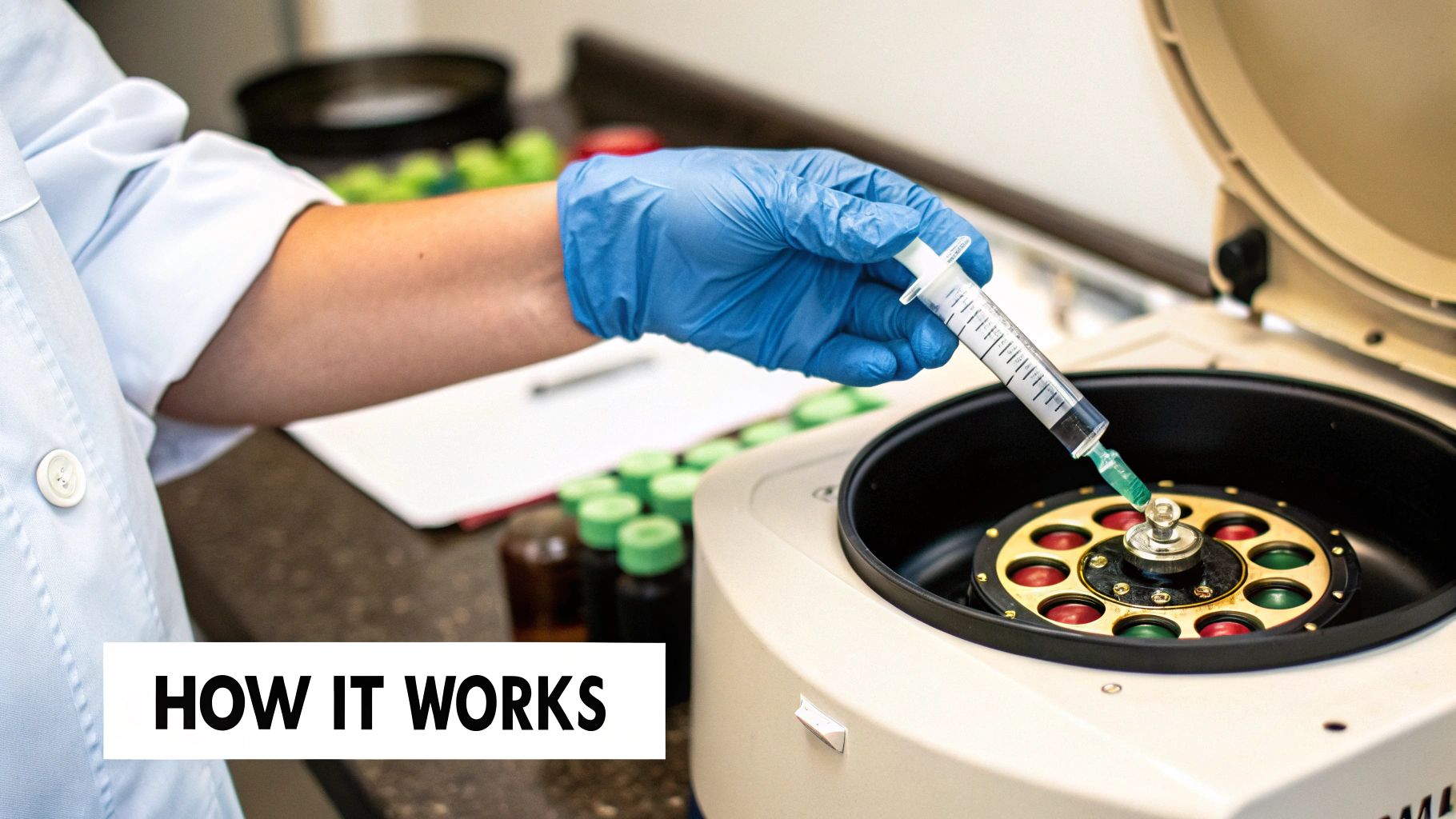
The whole process kicks off with a simple blood draw, no different from one you'd get at a regular check-up. That blood sample then goes for a spin in a machine called a centrifuge. This machine spins so fast that it separates your blood into its different parts by weight. The heavier red blood cells sink to the bottom, while the lighter plasma—which holds all the platelets—settles at the top.
Creating the "Liquid Gold"
From that top layer of plasma, the clinician carefully pulls out the part that's packed with platelets. This is the Platelet-Rich Plasma, and you'll often hear it called "liquid gold." Why? Because this solution has 5 to 10 times more platelets and growth factors than what’s normally floating around in your blood.
These growth factors are the real MVPs of the treatment. They're the signals that tell your follicles to wake up and get back to business. When this potent serum is injected into the scalp, the goal is to jolt dormant or thinning hair follicles back into an active growth phase.
This image lays out the whole process, from start to finish, in three simple steps.
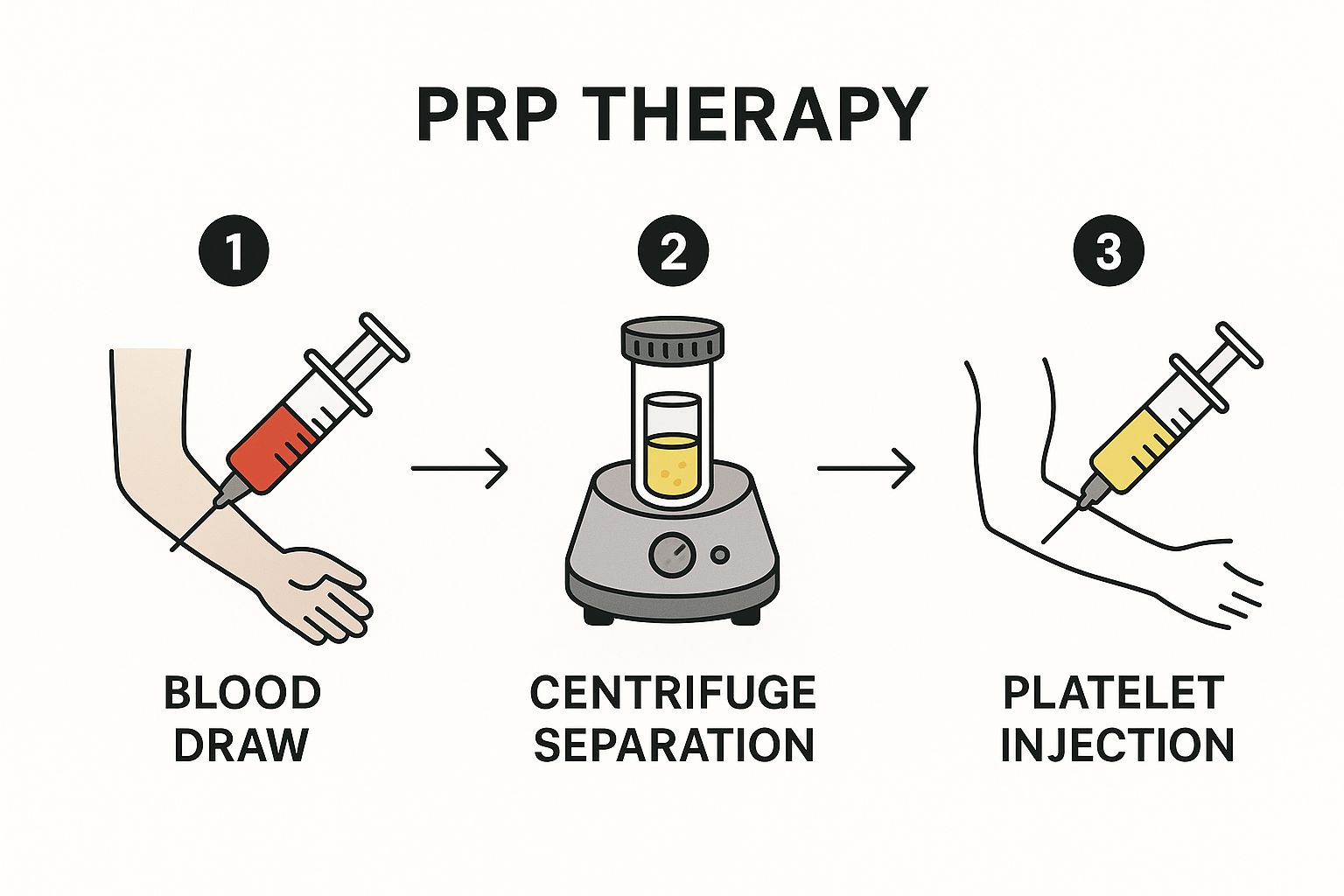
As you can see, it's a clever way of harnessing your body's built-in regenerative power and focusing it exactly where you need it most.
Think of It Like Revitalizing a Garden
A good way to picture how PRP works is to imagine your scalp as a garden. Your hair follicles are the seeds. For different reasons—genes, age, hormones—the soil in that garden can get depleted over time, making it tough for the seeds to grow strong.
PRP therapy is like applying a highly concentrated, organic fertilizer directly to the soil around those seeds. It’s not adding anything new or foreign. Instead, it’s enriching the environment with a powerful boost of the very nutrients and growth signals it’s been missing.
This "fertilizer" helps improve blood supply to the follicles, can thicken the hair shaft itself, and nudges inactive follicles back into a growth cycle. If you're looking for a deeper dive into the science, you can learn more about how platelet rich plasma therapy for hair works on a cellular level.
Now that we've demystified the science, you'll have a much better framework for making sense of the clinical studies and real patient reviews we're about to dive into.
Analyzing the Clinical Evidence on Success Rates
The theory behind PRP sounds fantastic, but let’s get down to brass tacks: what does the actual science say? When researchers put PRP to the test, they aren't just looking for some vague "improvement." They're measuring specific, concrete changes to see if it really works.
These clinical studies are our best reality check. They help cut through the noise of online forums and personal anecdotes, grounding our expectations in cold, hard data. Without them, it's impossible to separate the marketing hype from what's actually achievable.
How Success Is Actually Measured
When scientists want to know if PRP is working, they focus on two key metrics that directly affect how your hair looks and feels. If you understand these, you'll be able to make sense of any study or review you come across.
-
Increased Hair Density: This is the big one. Using powerful cameras, researchers literally count the number of hair strands in a tiny, marked-off section of the scalp—think a single square centimeter. A successful treatment means there's a real, measurable jump in the number of hairs in that little zone. For example, many studies report a 15-30% increase in hair count after a full course of treatment.
-
Improved Hair Shaft Thickness: Hair loss isn't just about losing strands; it's also about the ones you have getting thinner and weaker. This process, called miniaturization, is a classic sign of pattern baldness. PRP aims to reverse this by bulking up the hair shaft. This makes your hair feel fuller and gives you better scalp coverage, even if the total hair count doesn't skyrocket.
These two factors are a powerful combination. More hairs that are also thicker create a much more visible improvement than either one could achieve on its own.
What the Numbers From Studies Tell Us
So, what kind of results are researchers actually seeing? A solid and growing body of research, including the gold-standard randomized controlled trials, points to genuinely positive outcomes for a lot of people.
When you look at systematic reviews—which are studies that pool the data from many different trials—the conclusion is pretty consistent: PRP leads to significant improvements in both hair density and thickness when compared to a placebo. The success rates reported often land in the 70-80% range, which means the vast majority of participants see a noticeable, positive change.
It's really important to understand what "success" means in a clinical setting. It’s not about magically getting your teenage hairline back. It means a statistically significant improvement that stops hair loss from getting worse and achieves visible regrowth.
But here's the catch. While the overall numbers are encouraging, the treatment is definitely not a one-size-fits-all miracle. Your personal results can be heavily influenced by several key factors.
Why Do Results Vary So Much?
If the science is so promising, why do you see some people online calling PRP a lifesaver while others say it did absolutely nothing? The answer is simple: we're all different. Your unique biology and the specific nature of your hair loss play the biggest roles in how you'll respond.
-
Type and Stage of Hair Loss: PRP seems to work best for androgenetic alopecia (pattern baldness) and is much more effective when started in the earlier stages. It's designed to wake up struggling or "sleeping" follicles. If the follicles have been dormant for years and are essentially gone, PRP can't bring them back from the dead.
-
Your Overall Health: That "liquid gold" used in the procedure comes from your own body. This means its quality is a direct reflection of your general health. Things like smoking, a poor diet, or underlying health issues can lower the concentration of growth factors in your platelets, making the treatment less effective.
-
The Treatment Protocol: There isn't a single, universal way to perform PRP. The number of sessions, the time between them, and even the type of centrifuge used can vary wildly from one clinic to another. All these little details can have a big impact on the final outcome.
This variability is exactly why a one-on-one consultation with an expert is non-negotiable. They can assess your specific type of hair loss, look at your overall health, and give you a realistic idea of what to expect. It's also the perfect time to get the full picture, including potential PRP hair treatment side effects, so you can weigh the scientific evidence against your personal situation.
Patient Experiences: Platelet Rich Plasma Therapy Reviews
Clinical studies give us the hard data, but they don't always capture the whole story. To get a real feel for what PRP is like, you have to listen to the people who've actually been in the chair. The unfiltered truth is found in their platelet rich plasma therapy reviews.
I've spent a lot of time sifting through forums, patient testimonials, and online communities. When you read hundreds of these personal stories, you start to see clear patterns. It paints a pretty vivid picture of the highs, the lows, and everything in between on the PRP journey.
The Positive Side of PRP Patient Reviews
For a lot of people, PRP for hair loss is a genuine game-changer. The word that comes up over and over in positive reviews is "subtle." It’s not some overnight miracle.
The first thing most happy patients notice isn't a sudden explosion of new hair, but that they’re shedding less. It’s that sigh of relief when you see fewer hairs in the shower drain or on your pillow. This often kicks in within the first couple of months.
After that, people start talking about the quality of their existing hair. They'll mention that it feels thicker, stronger, and just healthier in general. That shift in texture alone can make your hair look fuller and give you better scalp coverage, long before any brand-new hairs are even visible.
A common feeling shared by satisfied patients is one of empowerment. As one reviewer put it: "It wasn't just about the new hair, which was amazing. It was about finally doing something proactive that actually worked. It's a huge confidence booster."
This emotional impact is a massive part of the success stories. The benefits clearly go way beyond just the physical changes.
The Flip Side: Common Criticisms and Frustrations
Of course, not every story ends with a win. It's just as important to look at the reviews from people who were left disappointed with their experience.
By far, the most common complaint is the cost versus the results. People who feel the treatment didn't pan out are understandably frustrated after investing significant time and money for little to no visible change. This really highlights how crucial it is to be a good candidate for PRP in the first place.
Another point of friction is the discomfort. Even with numbing creams, getting multiple injections across your scalp isn't exactly a walk in the park. Reviews often describe it as "tolerable but not comfortable," and some people mention tenderness or a mild headache for a day or so afterward.
Finally, the waiting game is a major source of anxiety. It can easily take four to six months before you see the first real signs of progress, and that’s a long time to hang in there. Patients who go in expecting a quick fix are often the most let down. To get a better handle on what to expect, you might want to read our guide that tackles the question, "Does PRP work for hair loss?"
Common Themes in Patient PRP Reviews
When you lay out all the feedback, you realize that experiences aren't just good or bad; they exist on a spectrum. To help make sense of it all, I've summed up the most common points—both positive and negative—that pop up time and time again in patient reviews.
| Common Positive Feedback | Common Negative Feedback |
|---|---|
| Noticeable Reduction in Hair Shedding: Often the first win, usually seen in the first 2-3 months. | High Cost for Minimal Results: The number one complaint from unsatisfied people. |
| Increased Hair Thickness and Fullness: Existing hair feels stronger, making the scalp less visible. | Discomfort During Injections: Even with numbing agents, the procedure can be painful for some. |
| Visible New Growth in Thinning Areas: Spotting "baby hairs" is a key sign the treatment is working. | Slow or Unpredictable Timeline: The long wait for results can be a major source of frustration. |
| Major Boost in Confidence and Self-Esteem: Taking control and seeing progress provides a huge psychological lift. | Temporary Side Effects: Minor swelling, headaches, or scalp tenderness for a day or two. |
This comparison makes one thing crystal clear: managing your expectations is everything. Success with PRP is so often tied to patience, realistic goals, and whether you were a good candidate to begin with.
The Growing Acceptance and Market Trends
The explosion of online discussions about PRP reflects a much bigger trend: this treatment is going mainstream. The global PRP market was valued at around USD 627.9 million in 2022 and is projected to hit USD 1,936.0 million by 2030. That kind of growth shows just how significant its role is becoming in both aesthetics and medicine.
Interestingly, while the pandemic briefly slowed things down as clinics closed, it was followed by a massive rebound. Once people could get back to elective treatments, the demand for PRP surged, pushing the market's growth even further.
What to Expect: The Real Cost and Time Commitment of PRP

Okay, we've covered the science and heard what real patients are saying. Now for the million-dollar question—or, hopefully, a bit less: what's this actually going to cost me? Before you dive in, you need a real-world picture of both the financial and time commitments you're looking at.
It helps to think of PRP not as a one-time fix, but as a long-term investment in your hair's future. The price tag isn’t for a single shot; it covers an entire strategy designed to get results and, just as importantly, maintain them. Shifting your mindset to this from the very beginning will help you set much more realistic expectations.
Breaking Down the Cost Per Session
One of the first things you'll notice when looking at platelet rich plasma therapy reviews is that prices are all over the place. Generally speaking, a single PRP session for hair loss in the U.S. will probably cost you somewhere between $700 and $1,500.
So, what's with the huge range? A few key things come into play:
- Geographic Location: A clinic in downtown Manhattan or Beverly Hills has much higher overhead costs than one in a smaller city, and that gets passed on to the patient.
- Clinic and Practitioner Reputation: You're paying for expertise. A board-certified dermatologist who specializes in hair restoration with a portfolio of great results is going to charge more than a general practitioner.
- Technology and Equipment: Not all PRP systems are the same. The quality of the centrifuge used to process your blood directly impacts how concentrated the platelets are. Clinics that invest in top-of-the-line equipment that delivers a higher yield of growth factors often have higher prices.
As with most things in life, the old saying "you get what you pay for" really applies here. It can be tempting to hunt for the cheapest deal, but when it comes to a medical procedure, choosing an experienced, high-quality provider is your best bet for both safety and results.
The growing interest in PRP is more than just talk; the market numbers back it up. Valued at roughly USD 620.5 million in 2025, the global PRP market is on track to hit about USD 1,433.7 million by 2032. That's a clear signal that this isn't just a fad—it's becoming a widely accepted treatment in medicine and aesthetics.
Understanding the Full Treatment Schedule
PRP for hair loss is a marathon, not a sprint. To see a real difference, you need to commit to a plan that first kick-starts new growth and then keeps that momentum going. Think of it like getting in shape: you work out intensely at the beginning to build a foundation, then you shift to a maintenance plan to keep your progress.
A standard PRP treatment plan usually looks something like this:
- Initial Loading Phase: You'll almost always start with a series of three treatments, each spaced about four to six weeks apart. This initial burst is all about flooding the scalp with growth factors to wake up dormant hair follicles.
- Maintenance Phase: After that initial round, your provider will assess how your hair is responding. From there, you'll likely settle into a maintenance routine, coming back for a follow-up session every four to six months to sustain the results.
When you do the math, a full year of treatment usually means four to six sessions. It's a significant commitment, so it's smart to plan for it. For a more detailed look at the numbers, you can check out our complete guide on the full PRP hair treatment cost.
Are You a Good Candidate for PRP?
If you've spent any time reading platelet rich plasma therapy reviews, you've probably seen that results are all over the place. One person's miracle cure is another's big disappointment. So why the massive difference? A lot of it boils down to one simple question: were you a good fit for the procedure in the first place?
Figuring out if you're a good candidate is the single most important step you can take before investing your time, hope, and money. It’s really about matching the right tool to the right problem.
The Ideal PRP Candidate Profile
So, who gets the best results? In my experience, the people who walk away happiest with their outcome usually share a few common traits. It helps to think of PRP as a way to wake up and supercharge struggling hair follicles, not raise them from the dead.
This means the ideal candidate is often someone who:
- Is in the early stages of hair loss. We're talking about people with androgenetic alopecia (your typical pattern baldness) who have noticed thinning but still have a decent amount of hair left.
- Has follicles that are shrinking, not gone. Your hair is getting thinner and finer—a process called miniaturization—but the follicles haven't completely shut down for good.
- Is in good overall health. The "magic" in PRP comes from your own blood. The healthier you are, the better the raw materials your doctor has to work with.
Simply put, the sooner you tackle the problem, the more active follicles there are for the PRP to work its magic on. Being proactive nearly always leads to a better outcome.
Who Might Not Be a Good Candidate
On the flip side, PRP isn't the right solution for everyone. A consultation is the only way to know for sure, but some conditions are almost always red flags.
This treatment is likely not for you if you have:
- Very advanced hair loss. If you have large patches of your scalp that have been completely smooth for years, those follicles are probably dormant and can't be revived.
- Certain medical conditions. Things like chronic liver disease, skin cancer, metabolic disorders, or any active infections can make the treatment unsafe or ineffective.
- Blood or bleeding disorders. A condition like thrombocytopenia, which means you have a low platelet count, undermines the entire foundation of the therapy.
- Are taking blood-thinning medications. Anticoagulants can interfere with the platelet activation process that’s so essential for success.
The bottom line is this: a professional medical evaluation is non-negotiable. Only a qualified doctor can properly diagnose the cause of your hair loss, examine your scalp up close, and give you an honest opinion on what you can realistically expect.
The growing interest in these kinds of personalized treatments is clear when you look at the market. The global PRP market was valued at USD 834.74 million in 2024 and is expected to soar to USD 3,466.13 million by 2034, driven by new applications and better tech. You can find more details on this expanding market at Precedence Research.
Walking into your consultation armed with this knowledge, along with an understanding of the expenses from our guide on the PRP for hair loss cost, will help you have a much more productive conversation with your doctor and set you up for success.
Your PRP Questions, Answered
Okay, we've covered the science, sifted through reviews, and talked numbers. But you probably still have a few practical questions bouncing around in your head. That's totally normal. Let's tackle the most common ones that pop up when people start getting serious about PRP. My goal is to give you straight answers so you can feel confident in your decision.
So, Does PRP for Hair Loss Actually Hurt?
This is usually the first thing people ask, and for good reason. Let's be real: the treatment involves a series of injections into your scalp, so it’s not entirely sensation-free. But how much it hurts really varies from person to person.
Any good clinic has ways to make you comfortable. They'll typically apply a strong numbing cream to your scalp about 30-45 minutes before they start. Some doctors also use a neat little trick with a vibrating device held near the injection site—it helps distract the nerves so you barely notice the needle.
Most people describe the feeling as a series of quick pinpricks or a mild stinging that’s over in a flash. You might feel a little tender or sore for a day or two afterward, kind of like a light sunburn, but significant pain is extremely rare.
What Are the Main Side Effects of PRP?
This is where PRP really shines. Because the treatment is made from your own blood, the risk of an allergic reaction or infection is incredibly low. Your body is just accepting its own biological material back. It’s one of the biggest reasons people feel so good about choosing this therapy.
The side effects you might see are all temporary and directly related to the injections themselves. We're talking about things like:
- A bit of swelling: You might notice some minor puffiness on your scalp or forehead, but it usually goes away within a day or two.
- Scalp tenderness: The area might feel a little sore, but this also fades quickly.
- Minor bruising or bleeding: It's possible to see tiny pinprick spots at the injection sites, but they heal up almost immediately.
- A slight headache: Some people get a mild headache on treatment day, but it’s nothing some over-the-counter pain reliever can't handle.
The key to a safe experience is simple: go to a qualified medical professional who is meticulous about sterile procedures. When you're in the hands of an experienced practitioner in a clean, clinical setting, you can be confident that the treatment is both effective and exceptionally safe.
How Long Does It Take to See Results from PRP?
This is the big one, and the key word here is patience. PRP isn't a magic wand; it's a biological process that kick-starts your body’s own growth cycle, and that just takes time. Setting the right expectations from day one is so important.
The journey usually follows a pretty standard timeline. The very first sign that things are working is often a noticeable drop in hair shedding, which can happen within the first two to three months. It’s a subtle but powerful clue that the treatment is taking hold.
The more exciting changes—like your hair feeling thicker or spotting new, fine "baby hairs"—tend to pop up around the four-to-six-month mark. This is usually right after you've completed your initial series of sessions. For the full, most impressive results, you really want to give it about a year, as those new hairs need time to grow out and mature.
How Does PRP Compare to Minoxidil or Finasteride?
That's a great question because it gets to the heart of building a smart hair loss strategy. The best way to think about it is that they aren't really competitors. They're different tools that tackle the problem from completely different angles.
- Minoxidil (Rogaine): This is a topical solution you apply directly to your scalp. It’s a vasodilator, which is just a fancy way of saying it widens blood vessels to get more blood flow and nutrients to the follicles, helping to wake them up.
- Finasteride (Propecia): This is a pill that works from the inside out. It’s a DHT blocker, meaning it targets the hormone that’s the main culprit behind male pattern baldness.
- PRP Therapy: This is a regenerative treatment. It uses the powerful growth factors in your own blood to directly heal and rejuvenate struggling hair follicles.
Because they all work so differently, many doctors now recommend combining them. Using PRP alongside minoxidil or finasteride can create a powerful synergy, attacking hair loss from every possible angle for a much better result. PRP is also a fantastic option for anyone who wants to avoid daily medications, or for women who can't take finasteride. Ultimately, the best game plan is one you create with your doctor.
Navigating the world of hair loss treatments can feel overwhelming, but with the right information, you can make choices that feel right for you. At PRP For Hairloss, we're committed to providing clear, evidence-based insights to help you on your journey. To continue learning and explore more resources, visit us at https://prpforhairloss.com.

 PRP For Hairloss
Leave a comment