So, you’ve just had a PRP injection and you're probably asking yourself, "When am I going to feel better?" It's the number one question on everyone's mind. The honest answer is that your PRP recovery time isn’t some overnight miracle. It’s more of a gradual healing journey.
While the initial soreness might fade within a few days, the real, lasting improvements in pain and function typically start to appear somewhere between 4 to 12 weeks after your treatment. A good way to think about it is like planting a seed. You don't see a flower the next day; it needs time to sprout and build a solid root system below the surface before you can appreciate the final bloom.
Setting Realistic Recovery Expectations
Unlike a painkiller that just puts a bandage on your symptoms, PRP therapy is all about jump-starting your body's own natural repair crew. This is a regenerative process, not a temporary fix.
What that means is you have to give your body the time it needs to do its thing. That soreness you're feeling right after the injection? Believe it or not, it's a good sign. It means the healing cascade has been set in motion, and your body is responding to those concentrated growth factors to start building new, healthy tissue.
Key Recovery Milestones
Knowing what to expect can make the waiting game a lot less frustrating and help you stay focused on your healing. Most people begin to feel a significant difference around the 4 to 10-week mark after their injection. But for more severe or long-term injuries, a full recovery might take a bit longer, sometimes stretching beyond three months.
If you want to dig deeper into what influences these timelines, you can find more details on PRP injection recovery from expert sources.
Here’s a general breakdown of the stages of healing:
- The Inflammatory Phase (First 3-7 Days): Right after the shot, you should expect some swelling, soreness, and stiffness at the injection site. This is completely normal. Your main job here is to rest the area and let the healing process begin.
- The Rebuilding Phase (Weeks 2-6): This is where the real work happens behind the scenes. Your body is busy rebuilding damaged tissue. You might not feel huge changes from one day to the next, but rest assured that cellular repair is in full swing.
- The Remodeling Phase (Week 6 and Beyond): Now, that new tissue starts to mature and get stronger. This is the stage where most people really start to feel a tangible, lasting improvement in their pain and ability to function.
To give you a quick reference, here’s how the PRP recovery timeline generally breaks down.
PRP Recovery Timeline At a Glance
| Recovery Phase | Typical Duration | What to Expect |
|---|---|---|
| Inflammatory Phase | First 3-7 Days | Soreness, swelling, and stiffness are common. Focus on rest and protecting the area. |
| Rebuilding Phase | Weeks 2-6 | Cellular repair begins. Pain may start to subside as new tissue forms. |
| Remodeling Phase | Week 6+ | New tissue strengthens. Noticeable improvements in pain, strength, and function. |
Just remember, this is a general guide. Your personal timeline will really depend on your specific injury and how your body responds.
The most important thing to keep in mind is that PRP recovery is a marathon, not a sprint. The real magic happens over weeks and months as your body meticulously rebuilds itself from the inside out.
How PRP Taps Into Your Body's Natural Healing
Before we jump into a day-by-day recovery timeline, it's really helpful to understand what’s actually happening inside your body after a PRP injection. This isn't like a painkiller that just numbs the area. Instead, think of PRP as sending a highly specialized construction crew directly to the site of your injury.
The whole process starts with your own blood. A small amount is drawn, spun in a centrifuge to separate and concentrate the platelets, and then turned into a powerful healing serum. These platelets are packed with growth factors—your body's own "foremen" that give the signal to start repair and regeneration.
This approach doesn't offer a quick, overnight fix. It’s all about kick-starting your body's own powerful healing cascade, and that takes a little time to unfold properly.
Why That Initial Discomfort Is Actually a Good Sign
When this super-concentrated team of growth factors shows up at the injury site, they get right to work. This activity deliberately triggers an inflammatory response, which is exactly why you'll feel some initial soreness and swelling. It's easy to think this is a step backward, but it's actually a crucial first phase of healing.
That initial flare-up is the sound of the construction project starting. It’s a clear signal that your body's repair mechanisms have been activated and the rebuilding process has officially begun.
This isn't the same kind of inflammation you might be used to. After PRP, most people experience a brief flare-up that lasts about 3 to 7 days, and then things gradually start to get better. This is a world away from something like a steroid shot, which offers fast relief by shutting down inflammation but can also interfere with true, long-term healing. You can discover more insights about PRP injection recovery on regenexx.com to see just how different the approach really is.
At its heart, PRP is about amplifying what your body already knows how to do. It calls in your own repair cells and gives them the resources they need to build new, healthy tissue. While we're mostly talking about joints and tendons here, this same idea is used in other areas, too. You might want to check out our guide on how long PRP hair treatment lasts to see another application.
Your Week-by-Week PRP Recovery Timeline
When you're trying to figure out what to expect after a PRP injection, having a clear roadmap can make a huge difference. Try thinking of your recovery not as one long waiting game, but as a series of distinct stages. Knowing what's happening at each step—and what's considered normal—can make the whole process feel much more manageable.
Every person's healing journey is a little different, but the biological process itself follows a predictable pattern. Let's break down exactly what your body is up to from the moment you leave the doctor's office.
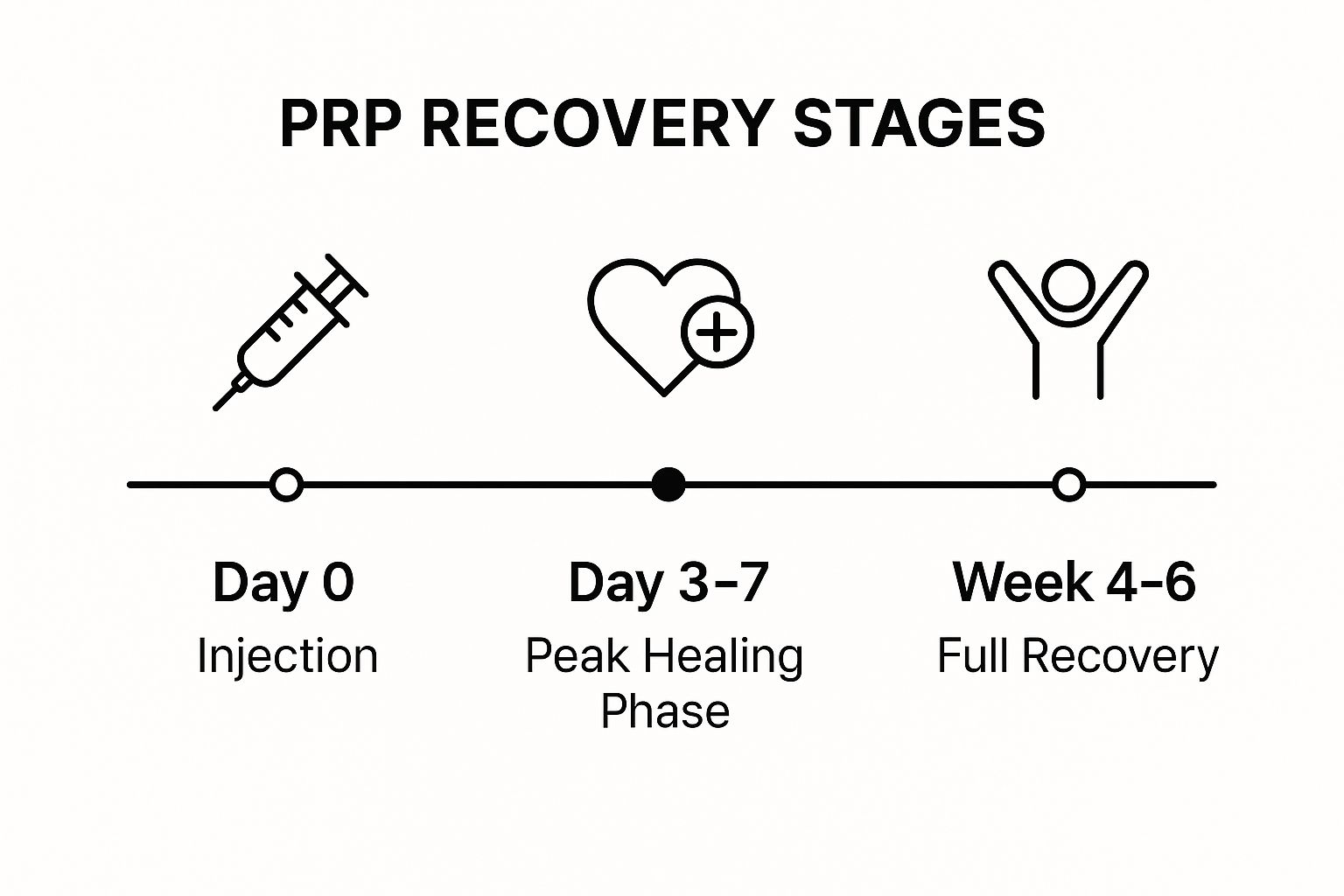
As you can see, the real action starts right away, with some of the most important healing work happening in that very first week. For many people, a significant recovery milestone is reached somewhere between weeks four and six.
The First 72 Hours: The Inflammatory Phase
Right after your injection, your body’s natural alarm system goes off. This is a good thing! You can expect some soreness, swelling, and a bit of stiffness right at the injection site. This isn't a side effect to worry about; it's the first sign that those powerful platelets are on the job, signaling for an "all hands on deck" healing response.
During these first couple of days, your only real job is to rest. Avoid anything that puts stress on the area and listen closely to your doctor's advice for staying comfortable.
Week 1: The Proliferative Phase Kicks Off
As you get through the first week, that initial sharp soreness should start to die down, often turning into more of a dull, manageable ache. The swelling will begin to go down as well. This marks the start of the proliferative stage, which is when your body gets serious about building new tissue.
Your doctor might encourage some very gentle, controlled movement to keep the blood flowing, but it's critical not to overdo it. You're laying the foundation for new tissue, and you don't want to disrupt the construction site. While this guide focuses on orthopedic recovery, the initial response is quite similar in other applications, which you can see when learning about the normal PRP hair treatment side effects.
Weeks 2 to 4: The Quiet Rebuilding Period
This is the phase that tests everyone's patience. On the outside, it might feel like not much is changing from day to day. But don't be fooled—under the surface, a ton of rebuilding is taking place.
This is where the magic really happens. Your body is meticulously weaving new collagen fibers, creating a strong scaffold for healthy, brand-new tissue to grow upon.
Stick with your physical therapy plan during this time. Those specific exercises are designed to help the new tissue form in a strong, organized pattern, which is crucial for long-term success.
Weeks 4 to 8: Finally Feeling the Difference
Here we go. For most people, this is the turning point where you start to feel a real, noticeable improvement. That new tissue is getting stronger and more organized, which leads to less pain, better stability, and improved function.
Your doctor will likely give you the green light to slowly start ramping up your activity levels. The key word here is slowly. Follow their guidance to the letter, since pushing too hard now could easily cause a setback.
Month 3 and Beyond: Maturation and Long-Term Strength
From the three-month mark onward, it's all about the final remodeling phase. The new tissue continues to mature, growing stronger and becoming fully integrated with the surrounding area. You'll keep working with your physical therapist to safely get back to all the things you love, whether that's sports, hobbies, or just going about your daily life without pain.
Factors That Shape Your Healing Speed
Ever wonder why one person’s PRP recovery time seems to fly by while a friend's feels like it's dragging on? It’s not just random luck. Your personal healing timeline is a unique mix of factors, and understanding them is the key to setting realistic expectations for yourself.
Think about it: no two bodies are the same, and neither are their injuries. A big piece of the puzzle is simply where you were treated. A tendon in a busy joint like your shoulder is a completely different ballgame than a less mobile area. Blood flow is king here—tissues that have a rich blood supply will almost always bounce back faster.
The nature of the injury itself also tells a huge part of the story. There's a big difference between treating a fresh, acute tear and managing a chronic, degenerative condition that’s been bothering you for years. Newer injuries tend to have a much more direct path to recovery.
Your Health and the Healing Equation
Your body’s ability to rebuild and repair is directly linked to your overall health. It’s a pretty simple equation. A few key personal factors can either hit the accelerator on your healing or gently tap the brakes.
- Age: It’s just a fact of life that younger bodies tend to have more robust cellular repair systems, which can definitely speed things up.
- Overall Health: Things like chronic health conditions, smoking, or a poor diet can throw a wrench in the works by slowing down your body's natural healing rhythm.
- Lifestyle: This is where you have the most control. Actually following your post-procedure instructions—getting good sleep, staying hydrated, eating well—gives your body the raw materials it needs to do its job.
The bottom line is this: your healing journey is yours alone. Comparing it to someone else’s is like comparing apples and oranges—it just isn’t helpful.
Knowing how these elements fit together will help you have a much better, more informed conversation with your doctor. This applies to all aspects of PRP, not just recovery. For instance, you can see how other factors create a personalized experience by reading about the average PRP hair treatment cost and how it can vary from person to person.
Practical Ways to Support Your PRP Recovery
You have a lot more influence over your PRP recovery time than you might think. While the treatment itself kicks off the healing process, your daily habits are what truly set the stage for success.
Think of it this way: the PRP injection is like planting a seed. Your job is to provide the best possible soil, water, and sunlight to help it grow strong. Giving your body the right support can make a world of difference in your final results.
The Recovery Do's
To help your body's natural repair crew work at its best, focus on these simple but powerful actions:
- Hydrate Relentlessly: Water is the unsung hero of recovery. It’s essential for cellular function and for getting nutrients to the treatment area. Keeping a water bottle handy is a non-negotiable.
- Eat for Repair: Fuel your healing with a diet packed with vitamins, minerals, and anti-inflammatory foods. Think leafy greens, colorful berries, and lean proteins. These are the literal building blocks your body needs.
- Prioritize Sleep: Your body does its most important repair work while you're sleeping. Aim for 7-9 hours of quality rest each night to give your tissues the time they need to regenerate.
For musculoskeletal injuries, a key piece of the puzzle is a structured physiotherapy program. Following your therapist’s guidance is vital for safely rebuilding strength and getting back to your full range of motion.
The Recovery Don'ts
What you don't do is just as important as what you do. Be sure to avoid these common recovery roadblocks:
One of the most critical rules to follow is to avoid NSAIDs like ibuprofen or naproxen. These over-the-counter anti-inflammatories can actually block the very healing process PRP is meant to trigger.
It’s also smart to limit alcohol and avoid smoking, as both can hamper your circulation and slow everything down. And maybe the toughest one of all: don't rush back into strenuous activity. This is all about long-term healing, not a short-term race to the finish line.
Sticking to these guidelines gives your body its best chance to heal effectively. In fact, some studies show PRP can shorten muscle injury recovery by as much as a third. For more detailed advice, check out our guide on after PRP hair treatment care.
Common Questions About PRP Recovery
It's completely normal to have questions when you're considering a new treatment. When it comes to PRP recovery, getting straight answers can help you feel much more comfortable and prepared. Let's tackle some of the most common things people ask.
Is It Normal to Feel Worse After a PRP Injection?
Yes, absolutely. It might sound strange, but feeling an initial spike in pain and swelling for a few days is not only normal—it's expected. In fact, it's a good sign.
The injection is designed to trigger a controlled inflammatory response. This is your body's natural alarm system, telling it to rush a "repair crew" of healing cells to the site of the injury. That initial discomfort is proof that the growth factors are on the job and the healing process has officially kicked off.
Think of it like a construction project. Before the new structure goes up, there's a bit of noisy, messy demolition. That initial soreness is just the sound of your body getting to work.
When Can I Go Back to Work After PRP?
This really depends on what you do for a living. The key factor is how physically demanding your job is.
- Desk Jobs: If you have a more sedentary role, you can often head back to work in just a day or two. The main goal is just to make sure you can keep the treated area comfortable.
- Physically Demanding Roles: For jobs that involve heavy lifting, standing all day, or repetitive movements, you’ll need to give yourself more time. Plan on taking at least a few days, maybe even a week, before slowly getting back into your regular duties.
How Many PRP Injections Will I Need?
There’s no single answer here; the treatment plan is built around your specific situation. If you’re dealing with a recent, acute injury, a single injection might be all it takes to jumpstart a powerful healing response.
On the other hand, for more chronic or long-standing issues, a series of 2-3 injections spaced several weeks apart is usually the way to go for the best results. Your specific plan and associated costs will vary, but understanding the general PRP hair loss treatment cost can give you a better idea of how these multi-session plans are typically structured.
At PRP For HairLoss, we believe in giving you clear, reliable information. You can explore more about how PRP might be a fit for you at https://prpforhairloss.com.

 PRP For Hairloss
Leave a comment