It's an incredibly common frustration: you feel like your hair has hit a growth plateau and simply won't get any longer. But here’s the thing—your hair doesn't just decide to stop growing one day. What you're almost certainly experiencing is a disruption in your natural hair growth cycle, which makes new growth slow to a crawl.
Getting to the Root of the Problem: The Hair Growth Cycle
To get a handle on why your hair seems stuck, we first need to look at how it grows in the first place. Imagine each hair follicle as a tiny, dedicated factory on a production line. This factory follows a very specific, three-phase cycle. As long as that cycle is running like clockwork, your hair grows steadily.
But if anything throws a wrench in the works—be it genetics, hormonal shifts, or even your diet—that entire production line can falter. This slowdown is what makes it feel like your hair has stopped growing entirely. In reality, it’s just not growing as quickly or as long as it once did.
The Three Phases of Hair Growth
Every single strand of hair on your head goes through a journey defined by three distinct stages. Each follicle works on its own schedule, cycling through these phases independently of its neighbors.
- Anagen (The Growth Phase): This is the active, productive stage. Cells inside the follicle divide rapidly to build new hair, which typically grows about half an inch per month.
- Catagen (The Transitional Phase): A very brief pit stop where the hair follicle shrinks and detaches from the tiny blood vessels that nourish it.
- Telogen (The Resting Phase): The follicle takes a break for a few months. The old hair strand stays put until it's eventually shed, making way for a new anagen phase to start all over again.
Understanding this cycle is the first real step toward a solution. When the anagen (growth) phase gets shorter or the telogen (resting) phase gets longer, you’ll notice less length and more shedding. This imbalance is the root cause of most hair growth problems.
One of the biggest reasons hair growth stalls is directly tied to a change in this cycle. This is especially true as we get older, when the anagen phase naturally shortens and the number of active follicles can start to decline. This process is a hallmark of androgenetic alopecia—the most common type of hair loss, affecting an estimated 85% of men and 33% of women worldwide. You can find more insights about hair loss statistics and their causes from the American Hair Loss Association.
To help you visualize this, here’s a quick breakdown of what’s happening on your scalp during each phase.
Quick Guide to Hair Growth Phases
| Phase | What Happens | Typical Duration | Percentage of Hair in this Phase |
|---|---|---|---|
| Anagen | The follicle is actively producing new hair fiber. | 2–7 years | 85-90% |
| Catagen | The hair follicle shrinks and detaches. | 2–3 weeks | ~1% |
| Telogen | The follicle is dormant and the old hair is shed. | 2–4 months | 10-15% |
This table shows just how important that long anagen phase is for healthy, full hair.
The infographic below really brings this to life, showing how a healthy hair cycle is distributed across the three phases.
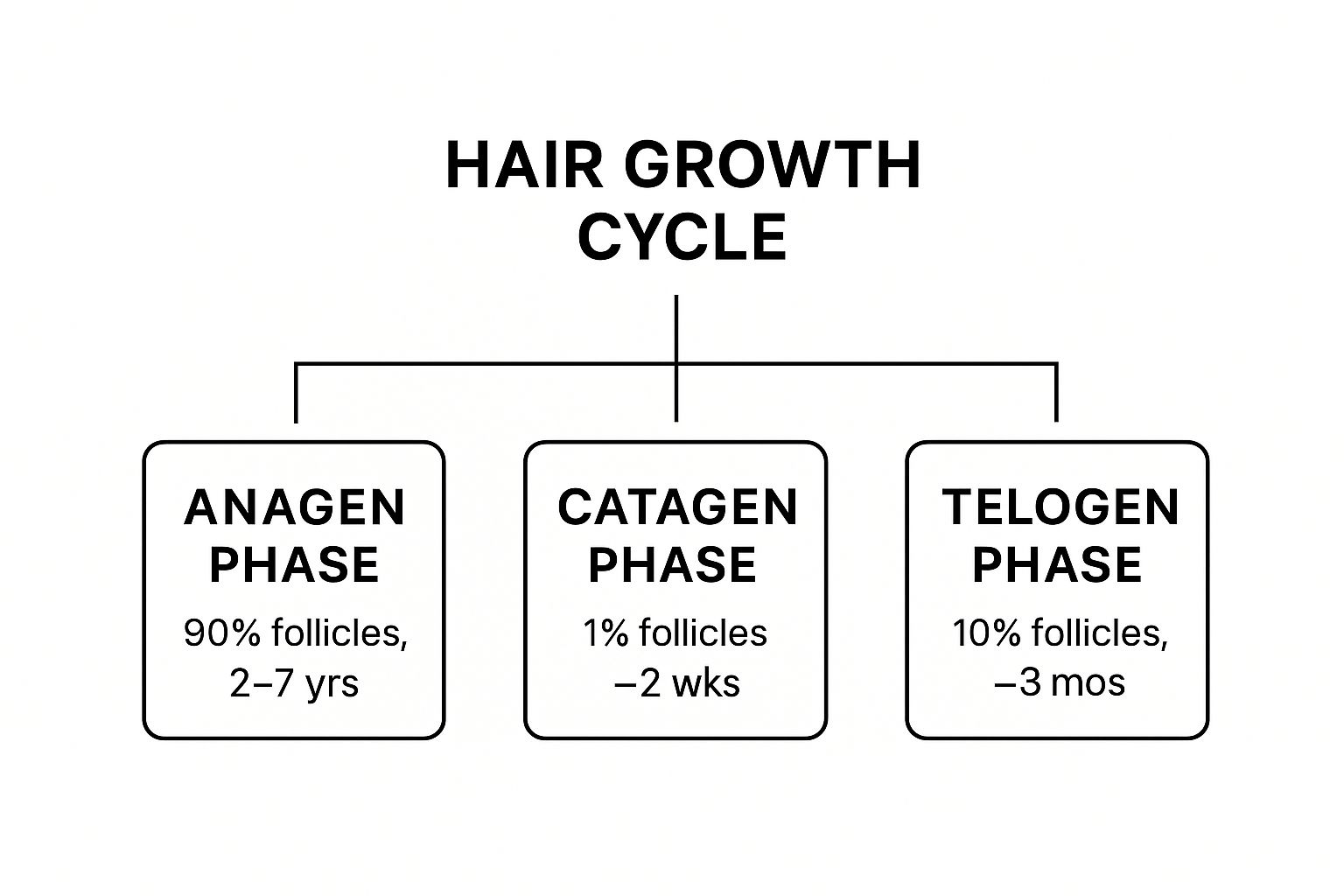
As you can see, the overwhelming majority of your hair should be actively growing at any given time. That’s what keeps your hair looking dense and allows you to gain noticeable length over time. When that balance shifts, the trouble begins.
How Your Genes Influence Hair Growth

Have you ever wondered if your hair's future is written in your family's past? It’s a common question, and the answer is a resounding yes. Your genes are the fundamental blueprint for your hair, dictating just about everything from its texture and color to its ultimate potential.
This genetic instruction manual is powerful. It determines how long your hair can grow, how thick it will be, and, most critically, how your hair follicles will react to hormonal shifts throughout your life. So, if you're asking why your hair seems to have hit a wall, your DNA often holds the primary clue.
The Genetic Trigger: Androgenetic Alopecia
When we talk about hereditary hair loss, we're almost always talking about a condition called androgenetic alopecia. This is just the clinical term for what most of us know as male or female pattern baldness, and it’s the number one reason hair growth appears to stop in its tracks.
Think of it this way: your genes decide if your hair follicles have a hypersensitive "switch." This switch is flipped by a specific hormone called DHT (dihydrotestosterone), a byproduct of testosterone. If your DNA codes for this sensitivity, DHT will gradually cause the follicle to shrink over time.
This process is called miniaturization, and it's the root cause of genetic hair loss. With each new growth cycle, the shrinking follicle produces a hair that's a little thinner, weaker, and shorter than the last. Eventually, the follicle can become so small that it either produces a nearly invisible "peach fuzz" hair or simply shuts down production entirely. This slow, progressive thinning creates the illusion that your hair has just stopped growing.
Your genetic programming dictates:
- When it starts: The age you might first notice thinning.
- Where it happens: The classic patterns, like a receding hairline, a thinning crown, or a widening part.
- How fast it progresses: The speed at which thinning advances over the years.
Your Family Tree: A Roadmap for Your Hairline
Looking at your parents and grandparents can give you a surprisingly clear glimpse into your own potential hair journey. This isn't just an old wives' tale; it's a well-established scientific fact. A strong family history of baldness—on either your mother's or father's side—significantly raises your own risk.
The numbers don't lie. Research shows that about 70.5% of people experiencing hair loss have a family history of it. In fact, androgenetic alopecia is the hereditary culprit behind an incredible 95% of all hair loss cases worldwide. For many, this genetic clock starts ticking early; roughly 25% of men see noticeable thinning by the time they're 30. If you want to see more data, you can explore these hair loss statistics and their genetic connections.
This might sound discouraging, but it’s actually a huge advantage.
Knowing your genetic predisposition isn't about accepting your fate. It's about empowering yourself to be proactive. When you understand your risk, you can seek out effective and targeted treatments, like PRP therapy, long before the thinning becomes advanced.
What This All Means for Your Hair
Your genetic code doesn't just influence thinning; it also sets your hair's "terminal length" by defining the duration of its anagen (growth) phase. For some people, this phase is naturally shorter, meaning their hair simply won't grow past a certain point, no matter what products they use.
For those with androgenetic alopecia, this is even more critical. Miniaturization actively shortens the anagen phase in the affected follicles. The hair simply doesn't get enough time to grow long and robust before it's shed. This is what creates that gradual, thinning appearance that looks and feels like your hair has stopped growing. Recognizing this genetic influence is the first, most important step toward finding a realistic solution that works.
Understanding the Hormonal Triggers Behind Hair Loss

While your genetics might load the gun for hair loss, it’s often your hormones that pull the trigger. Think of hormones as the powerful messengers directing your body’s most important jobs, and that absolutely includes the intricate cycle of growing hair. When these signals get mixed up or out of balance, they can tell your hair follicles to simply stop working, bringing growth to a grinding halt.
This hormonal disruption is a massive piece of the puzzle for why your hair might stall out or begin to thin. For men, one hormone, in particular, tends to play the lead role in this unfortunate drama.
The Role of DHT in Halting Hair Growth
For most men experiencing pattern baldness, the main culprit is a hormone called dihydrotestosterone (DHT). It’s a powerful by-product of testosterone, and for people with a genetic sensitivity, it becomes public enemy number one for hair follicles.
Think of your hair follicle as having a specific lock on it. DHT happens to be the perfect key. When it binds to the receptors in the follicles on your scalp, it sends a strong signal to shrink the follicle and dramatically shorten the anagen (growth) phase of the hair cycle.
Over time, this constant assault from DHT causes the follicles to go through a process called miniaturization. Each new hair that manages to grow comes in a little thinner, shorter, and weaker than the last. Eventually, the follicle can shrink so much that it stops producing any visible hair at all. This is the core reason hair growth can completely stop in certain areas and is a key factor for the estimated 85% of men and 33% of women who face hair loss worldwide. You can discover more insights about the hair loss treatment market on coherentmarketinsights.com.
This slow, creeping shutdown is why you might suddenly ask, "why did my hair stop growing?" when, in reality, it's been a gradual decline orchestrated by this potent hormone.
Major Life Events and Hormonal Shifts
While DHT is a primary driver, especially for men, it’s far from the only hormonal influence that can throw your hair for a loop. Other major life events can shift your internal chemistry and lead to very real changes on your head.
-
Thyroid Imbalances: Your thyroid acts as your body’s metabolic thermostat. If it's overactive (hyperthyroidism) or underactive (hypothyroidism), it can disrupt the hair growth cycle. This often shoves a large number of follicles into the telogen (resting) phase all at once, leading to noticeable, widespread shedding.
-
Pregnancy and Postpartum: During pregnancy, soaring estrogen levels lock hair into the growth phase, resulting in that famously thick, luscious hair. But after giving birth, estrogen levels plummet. This sudden drop triggers a massive, synchronized shed as all that extra hair finally enters the resting phase. We call this postpartum telogen effluvium.
-
Menopause: The hormonal shifts during menopause echo what happens postpartum. As estrogen and progesterone levels fall, the hair's growth cycle can shorten. This also changes the hormonal balance, potentially increasing the relative influence of androgens like testosterone and making the effects of DHT more apparent in women.
These examples really show just how finely tuned our hair follicles are to the body's internal hormonal landscape.
The Surprising Link Between Stress and Hair
It isn't just major hormonal milestones that cause trouble. Chronic, day-to-day stress has a powerful impact, too. When you are constantly under pressure, your body pumps out a stress hormone called cortisol.
Think of cortisol as your body's built-in alarm system. It's incredibly useful in short bursts, but when the alarm is always blaring, it creates problems. A constant state of high alert can force a significant number of your hair follicles into the resting phase, derailing the natural growth cycle.
This condition, known as telogen effluvium, causes diffuse shedding all over the scalp and can easily make it feel like your hair growth has come to a complete standstill. Getting a handle on stress isn't just good for your mind—it's absolutely critical for maintaining the hormonal balance your hair needs to thrive.
How Your Lifestyle and Environment Shape Your Hair's Future
While genetics and hormones certainly lay the groundwork for your hair, don't underestimate the power of your daily habits and surroundings. These factors are like the director of a play—they can either help the story of your hair unfold beautifully or bring the production to a screeching halt.
The great thing is, unlike your DNA, these are the elements you can actually control. Understanding this connection is empowering. It means you can stop focusing on what you can't change and start making practical adjustments that give your hair a real fighting chance.
Your Hair's Nutritional Blueprint
Think of your hair follicles as tiny, high-demand factories. To churn out strong, healthy hair, they need a steady supply of very specific raw materials. If your diet is missing these crucial building blocks, production naturally slows down, and eventually, it can just stop.
It’s a bit like trying to build a house with only half the necessary bricks and mortar—you're not going to get very far. This is one of the most common, yet overlooked, reasons why hair growth seems to hit a wall. If that sounds familiar, taking a hard look at your diet is the perfect place to start.
A few nutrients are absolute non-negotiables for the hair growth cycle:
- Iron: This mineral is essential for creating hemoglobin, the protein in your red blood cells that ferries oxygen everywhere—including to your hair follicles. An iron deficiency can starve follicles of the oxygen they need to grow, leading to a type of shedding known as telogen effluvium.
- Zinc: Zinc is a workhorse when it comes to hair. It plays a massive role in tissue growth and repair, and it also helps keep the oil glands around the follicles functioning properly. A zinc deficiency is a well-documented culprit behind hair loss.
- Biotin (Vitamin B7): You've probably heard of this one. Biotin is vital for producing keratin, the very protein your hair is made of. While a true deficiency is uncommon, ensuring you get enough is a smart move for supporting hair structure.
Simply put, a poor diet can starve your hair at the root, making it impossible to sustain a healthy growth phase. If you're asking, "why did my hair stop growing?", the answer might just be on your plate.
The Toll of Stress and Styling
Beyond what you put in your body, what you do to your hair and how you manage stress can be just as impactful. These physical and psychological pressures can directly sabotage your efforts to grow longer, stronger hair.
When you're constantly under pressure, your body pumps out cortisol, the main stress hormone. Persistently high cortisol levels can shock a significant number of your hair follicles, pushing them prematurely from their active anagen (growth) phase into the dormant telogen (resting) phase.
What does this mean for you? More of your hair is resting and shedding at any given time, and less is actually growing. The result is often a diffuse, all-over thinning that creates the frustrating feeling that your hair growth has completely stalled.
This is exactly why managing stress isn't just a mental health nice-to-have; it's a fundamental part of any serious hair care routine.
On top of this internal stress, the external physical stress from our styling habits adds another layer of damage. Over time, these routines can cause so much breakage that it completely masks any new growth.
Here are some of the most common offenders:
- Harsh Chemical Treatments: Overdoing it with bleach, chemical straighteners, or even some dyes strips the hair's protein structure, leaving it brittle and fragile.
- Excessive Heat Styling: Frying your hair with flat irons or curling wands without a good heat protectant literally boils the water within the hair shaft, causing irreversible damage and breakage.
- Aggressive Handling: Simple things like rough towel-drying, yanking a brush through wet hair, or wearing super-tight hairstyles pull on the follicles and can snap strands right in the middle.
When your hair breaks off at the same rate it's growing, you'll be stuck at the same length forever. This is often what's happening when people think their hair has stopped growing—it's not a growth problem, it's a retention problem. Even daily exposure to things like pollution and UV rays adds to the damage. By getting a handle on these lifestyle factors, you can create a much more supportive environment for your hair to finally grow long and strong.
Actionable Solutions to Revitalize Your Hair Growth
Understanding why your hair growth has stalled is one thing; doing something about it is another. Now, let’s shift our focus from the "why" to the "how." Consider this your roadmap for taking back control, starting with proven strategies to wake up those follicles and get them back on track.
Our journey starts at home with the fundamentals. From there, we'll explore trusted medical treatments and dive into advanced clinical options like Platelet-Rich Plasma (PRP) therapy. This will give you a complete picture of the solutions available.
Start with a Strong Foundation
Before even thinking about advanced treatments, you have to get the basics right. You can't build a sturdy house on a shaky foundation, and the same principle applies to growing healthy hair. Your body needs the right raw materials.
- Targeted Nutrition: Think of your hair follicles as tiny, high-energy factories. They need a constant supply of specific nutrients to keep production running. If key supplies run low, the assembly line grinds to a halt. Make sure your diet includes iron-rich foods like spinach and lean meats, zinc from seeds and legumes, and plenty of quality protein to build strong keratin.
- Smart Supplementation: While a whole-food diet is always best, targeted supplements can bridge any nutritional gaps. Biotin, iron, and zinc are well-known hair boosters, but it's wise to chat with a doctor first. They can help pinpoint exactly what you need, so you're not just guessing.
Getting your nutrition in order means you're fueling growth from the inside out. This creates the ideal internal environment for your hair follicles to do what they do best.
Common and Effective Topical Treatments
Once your nutritional base is solid, topical treatments that work directly on the scalp are a logical next step. The most famous and widely used of these is minoxidil.
Minoxidil was actually first developed as a medication for high blood pressure. But doctors quickly noticed an unexpected side effect: it made hair grow. It works in part by widening blood vessels in the scalp, which boosts the delivery of oxygen and nutrients to the follicles. It also helps kick dormant follicles out of their resting phase and back into the active anagen (growth) phase. For many men, it’s a reliable first line of defense.
Key Insight: Think of minoxidil like an alarm clock for sleepy hair follicles. It doesn't necessarily block the root cause of hormonal hair loss, like DHT, but it effectively counteracts the resulting slowdown and nudges follicles to get back to the business of growing.
Advanced Clinical Intervention with PRP Therapy
For those looking for a more direct and potent approach, clinical treatments offer the next level of support. One of the most exciting options available today is Platelet-Rich Plasma (PRP) therapy, a procedure that harnesses your body's own healing mechanisms to rejuvenate struggling hair follicles.
So, how does it all work? It's surprisingly straightforward.
- Simple Blood Draw: It all starts with a standard blood draw from your arm, no different than a routine lab test.
- Concentrating the Good Stuff: That blood sample is placed into a centrifuge—a device that spins it at an incredibly high speed. This separates the blood into its core components, allowing us to isolate a golden solution packed with platelets. This is the platelet-rich plasma, and it's a reservoir of powerful growth factors.
- Strategic Injections: Finally, this concentrated plasma is carefully injected into the specific areas of your scalp where hair is thinning.
These growth factors act like potent messengers, signaling the stem cells within your follicles to wake up and get to work. This process can help reverse the miniaturization of hairs, improve the local blood supply, and push follicles into a longer, more robust growth phase. The result? Thicker, stronger, and healthier hair in the treated areas. You can get a deeper look into the science behind PRP for hair loss here.
To help you weigh your options, this table offers a straightforward comparison of the treatments we've discussed.
Comparing Hair Growth Treatment Options
| Treatment | How It Works | Best For | Considerations |
|---|---|---|---|
| Nutritional Support | Supplies the essential raw materials (vitamins, minerals, protein) for hair production. | General thinning or slow growth caused by dietary deficiencies. | Results are gradual and depend on long-term consistency. |
| Minoxidil (Topical) | Increases blood flow to the scalp and "wakes up" dormant hair follicles. | Men experiencing early to moderate signs of pattern baldness. | Must be used continuously to maintain the results. |
| PRP Therapy | Uses growth factors from your own blood to rejuvenate and stimulate follicles. | Men with thinning hair who still have active (but weakening) follicles. | A series of initial treatments is typically needed for optimal results. |
Each path offers unique benefits. Whether you start with diet, add a topical solution, or explore a clinical procedure like PRP, the key is to take informed and consistent action.
So, What's Your Next Move for Healthier Hair?
Feeling like your hair growth has hit a wall is incredibly frustrating, but it's almost never a permanent dead end. As we've uncovered, what seems like a growth stall is usually a complex mix of things—genetics, hormonal shifts, and lifestyle factors you absolutely have control over. The good news? Once you understand the real reasons, you're no longer just guessing.
The most important thing to remember is that you have a whole toolbox of powerful options. You can tackle this from multiple angles, from tweaking your diet and exploring treatments like PRP to making simple changes in how you handle your hair. There's no single magic pill, but there is a path forward built on smart, informed choices.
Building Your Personal Game Plan
First things first: let's shift from a mindset of frustration to one of action. Your hair's future isn't written in stone. You can actively nurture a healthier growth cycle by getting to the root of the issues we've talked about.
Here’s a practical starting point:
- Take an Honest Look at Your Lifestyle: How's your diet, really? Are you getting the nutrients your follicles are craving? Is constant stress keeping your hair stuck in that long resting phase? A little self-audit goes a long way.
- Gentle Hair Care Isn't Optional: Remember, breakage can easily trick you into thinking your hair isn't growing. If your ends are snapping off as fast as new hair appears at the root, you'll never gain any length. This means dialing back the heat, brushing with care, and ditching those super-tight styles that pull on your scalp.
- Think About Professional-Grade Help: For a lot of people, especially if genetics are a major factor, at-home care can only do so much. This is where treatments like Minoxidil or more advanced options like PRP therapy really shine, giving your follicles a direct, powerful nudge.
Your journey to longer, healthier hair starts with one well-informed step. The goal isn't to throw everything at the wall at once, but to build a consistent strategy that fits your hair, your body, and your life.
Let's Bring in the Experts
While this guide gives you a solid foundation for understanding why your hair might have stopped growing, it's no substitute for personalized, professional advice. Think of this information as your pre-game prep—it equips you to have a much more productive conversation with an expert who can diagnose what's really going on.
A dermatologist, trichologist, or hair restoration specialist can help you:
- Pinpoint the true culprit behind your hair issues, using exams and sometimes blood tests.
- Rule out any underlying health conditions, like thyroid problems or vitamin deficiencies, that could be a factor.
- Map out a custom treatment plan that could involve diet shifts, topical products, or procedures like PRP.
Don't let the "what ifs" keep you stuck. Use what you've learned here to take decisive action. By talking to a specialist, you can finally stop wondering "why did my hair stop growing?" and start building a real, effective strategy for getting it back on track. Your path to revitalized hair starts today.
Answering Your Top Questions About Hair Growth
Once you start digging into genetics, hormones, and lifestyle, you're bound to have more specific questions pop up. It's totally normal. Let's tackle some of the most common things people ask when they're staring in the mirror, wondering why their hair seems stuck.
Can My Hair Actually Stop Growing?
It's extremely rare for all your hair follicles to just give up and stop producing hair all at once. What feels like a complete growth shutdown is usually one of two culprits: either your hair's growth phase is getting cut short, or your hair is breaking off just as fast as it grows.
Think of it this way: If your anagen (growth) phase is shortened by things like hormonal shifts, your hair simply doesn't get the time it needs to reach its full potential length before it sheds. The other possibility is a hair retention issue—your hair is growing from the scalp, but the ends are snapping off, keeping you stuck at the same length forever.
The Bottom Line: Your hair is almost certainly still growing. The real mystery is whether it's shedding too soon or breaking too easily. Figuring out which one it is gives you a clear starting point.
How Can I Tell if It's a Breakage Problem or a Growth Problem?
This is a great question, and figuring it out is key. The answer is often sitting right in your hairbrush or on your pillow. Go take a close look at the strands you're losing.
- Shed Hairs: If you find a full-length hair with a tiny white bulb on one end, that’s a shed hair. It’s totally normal to lose these, as they’ve completed their natural life cycle. However, a sudden, massive increase in shed hairs could point to an internal issue like telogen effluvium, often triggered by stress or diet.
- Broken Hairs: If the strands you find are shorter, of all different lengths, and have no white bulb, you're looking at breakage. This is a sign of physical damage, usually from heat styling, chemical treatments, or even just being too rough with your hair.
Tackling breakage means shifting to gentler care routines and focusing on moisture. Dealing with excessive shedding, on the other hand, often means looking at the bigger picture—your health, diet, and possibly consulting a professional for conditions like androgenetic alopecia.
Can a Hairstyle Really Stop Hair Growth?
Absolutely. Hairstyles that constantly pull on your scalp can cause a specific kind of hair loss known as traction alopecia. We're talking about tight ponytails, unforgiving braids, or heavy extensions that put relentless tension on your hair follicles.
This isn't just a temporary problem. That constant pulling can inflame the follicles, and over a long period, it can cause permanent scarring. Once a follicle is scarred, it can't grow hair anymore. It's so important to give your scalp a rest, vary your styles, and avoid anything that feels painfully tight.
At PRP For HairLoss, we know that finding the true source of your hair concerns is the only way to find a real solution. For men struggling with thinning, advanced treatments can make a world of difference. To see how PRP therapy can help rejuvenate your hair follicles, we invite you to learn more at prpforhairloss.com.

 PRP For Hairloss
Leave a comment