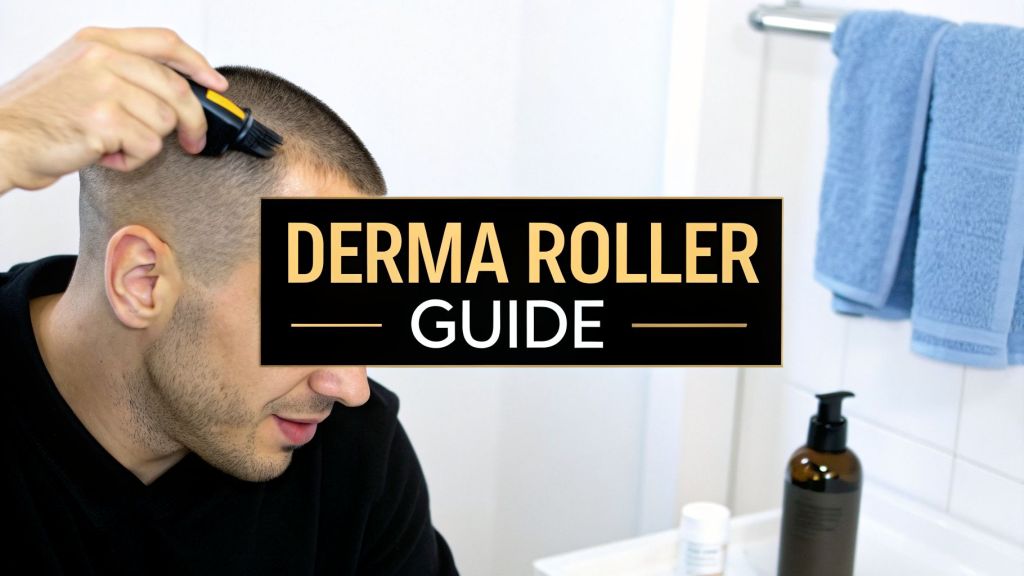
Thinking about using a derma roller on your scalp? It’s a technique that’s gained a lot of ground, and for good reason. The idea is to create tiny, controlled punctures in the skin to wake up your body's natural healing process, which in turn boosts blood flow and collagen production.
Let's walk through exactly how to do this safely and effectively at home to support your hair regrowth journey.

Why Is Everyone Talking About At-Home Derma Rolling?
It seems like derma rolling for hair loss just popped up everywhere overnight. What was once an in-clinic-only treatment is now a staple in many guys' grooming arsenals, especially for those of us dealing with thinning hair.
And this isn't just barbershop talk. The numbers back it up. The global derma roller market was valued at a cool $297.4 million in 2020 and is projected to hit $565.6 million by 2030. That kind of growth shows just how many people are taking matters into their own hands. You can see the full breakdown in this market analysis from Allied Market Research.
The Science Behind the Spikes
So, what’s really going on when you roll those tiny needles over your scalp? The process is called microneedling, and it’s surprisingly straightforward. You're creating thousands of microscopic channels in the skin. It sounds a bit intense, I know, but these are controlled micro-injuries that trigger a powerful healing response.
Your body sees these punctures and immediately kicks into repair mode. Here’s what that means for your scalp:
- A Rush of Blood Flow: Your system sends a surge of nutrient-rich blood to the area to repair the tissue. For your hair, this means a fresh supply of oxygen and nutrients delivered directly to struggling or dormant follicles.
- A Boost in Growth Factors: The healing process also signals the production of collagen and other critical growth factors. These are the essential building blocks for healthy skin and can help prompt hair follicles to get back to work.
You're essentially creating a controlled problem that your body is perfectly equipped to solve. Your hair follicles just happen to be in the right place to benefit from that solution.
A Quick Reality Check
Before you start, it’s really important to set the right expectations. Derma rolling is not an overnight fix for baldness. Think of it more as a powerful supportive therapy. When done right and consistently, it improves the overall health of your scalp, creating a much better environment for hair to grow.
For a deeper dive into the mechanics, our guide on microneedling for hair growth is a great resource. For many men, adding derma roller use at home to their routine is a game-changer that helps make other treatments (like minoxidil) more effective and can even reawaken some of those follicles that have gone quiet.
How to Choose the Right Derma Roller for Your Scalp
Alright, let's talk about picking your tool. When you’re getting started with derma rolling at home, choosing the right device is easily the most important step for getting results safely. Before you even think about the technique, you have to get comfortable with the tool itself, like a quality skin roller.
The single most critical choice you'll make is the needle length. What works for one person’s goals might not be right for yours, so let's break it down.
Decoding Needle Sizes for Scalp Use
I like to think about needle sizes in two simple groups: shorter needles for helping products sink in, and longer ones for actually waking up the follicles.
Shorter needles, in the 0.25mm to 0.5mm range, are fantastic for boosting the absorption of your topical treatments, like minoxidil or other hair serums. They create tiny, superficial channels on your scalp, allowing those expensive products to get where they need to go instead of just sitting on the surface. They’re a great, low-risk way to ease into microneedling.
Then you have the longer needles, from 1.0mm to 1.5mm. This is the range where the real magic for hair growth happens. These needles are long enough to create micro-injuries that kickstart your body’s natural wound-healing response. This is what we want. That process signals your body to ramp up blood flow and collagen production right at the follicle's base.
Just remember, longer needles mean more downtime. Your scalp needs to fully heal between sessions, so you’ll be rolling much less frequently—think every few weeks, not every few days.
To make it simple, here’s a quick guide to help you choose.
Derma Roller Needle Size Guide for Scalp Use
This table maps out the most common needle sizes used for the scalp, what they're best for, and a safe frequency to follow. It’s your starting point for choosing the right roller for your specific hair goals.
| Needle Size (mm) | Primary Goal | Recommended Frequency |
|---|---|---|
| 0.5mm | Enhanced Product Absorption | 1-3 times per week |
| 1.0mm | Follicle Stimulation & Collagen Production | Once every 2-3 weeks |
| 1.5mm | Advanced Follicle Stimulation (use with caution) | Once every 3-4 weeks |
Choosing a size from this table is a solid first step. Stick to the recommended frequency, especially when you’re just starting out, to avoid irritating your scalp.
Choosing Your Needle Material
The other decision you'll face is the needle material, which almost always comes down to stainless steel vs. titanium. Honestly, both can work, but they have distinct pros and cons.
Stainless steel is the gold standard in medical and tattoo settings for a reason: it’s inherently sterile and can be sharpened to a very fine, precise point. The downside is that it can dull or bend a bit more easily with repeated use.
Titanium, on the other hand, is a much stronger metal. Those needles will last longer and are less likely to bend. The trade-off is that titanium can’t be sharpened to the same degree as stainless steel, and it isn't naturally as sterile.
For anyone doing this at home, I always recommend high-quality stainless steel. When it comes to putting hundreds of tiny punctures in your skin, hygiene is everything. You might have to replace the roller head more often, but you’re ensuring the cleanest, sharpest entry, which means less trauma to the skin and a lower risk of infection. It's also a good idea to get a baseline of your current hair situation with a hair density test so you can track your progress safely and effectively.
The Right Way to Derma Roll Your Scalp at Home
Getting great results from at-home derma rolling isn't just about owning the tool—it's about technique. The difference between stimulating new growth and just irritating your scalp comes down to preparation and a consistent, gentle method. Let's get these details right from the start.
Prep Work: Your Non-Negotiable First Steps
Before you even think about touching the roller to your scalp, you have to create a sterile field. This is the single most important part of the process.
First, sterilize your derma roller. I do this by submerging the entire roller head in a small glass of 70% isopropyl alcohol for a good 5 to 10 minutes. Don't rush this. While it’s soaking, wash your hands thoroughly with soap and water.
Next, make sure your scalp is perfectly clean. You’ll want to wash your hair with a gentle shampoo to get rid of any natural oils or product buildup. Pat your hair and scalp completely dry with a clean towel. You always want to roll on a dry, clean surface.
The Rolling Method: Gentle and Methodical
Now that you're prepped, it's time to roll. The biggest mistake beginners make is pressing too hard. You are not trying to cause pain. The goal is a light, prickling sensation—never a painful scrape. Think of it as gently aerating your scalp, not plowing it.
To get even coverage without overdoing it, use what's often called the "star pattern." Here’s how you do it on a small section of your scalp:
- Gently roll the device up and down (vertically) 4-5 times.
- Lift the roller completely off your scalp.
- Now, roll side-to-side (horizontally) over that same patch 4-5 times.
- Lift the roller again.
- Finally, roll diagonally in both directions across the same spot, 4-5 times each way.
Once you’ve finished that star pattern, lift the roller and move to the next section, overlapping just slightly to ensure you don’t leave any untreated gaps.
My most critical tip: Always lift the roller off your scalp entirely when you change direction. Never drag or pivot the tool while the needles are on your skin. That’s how you cause micro-tears instead of the clean, beneficial micro-channels you’re aiming for.
This process starts with picking the right tool for the job. The guide below breaks down the key things to look for.

Session Timing and What to Expect Afterward
Keep it brief. A full scalp treatment should take no longer than 10-15 minutes. More is not better here; going overboard will only increase inflammation and won't speed up your results.
This kind of careful, at-home treatment is becoming incredibly popular. The home-use segment of the derma roller market is set to grow at a 6% CAGR from 2026 to 2035, and the entire global market is projected to hit $610.1 million by 2035. It’s a trend that really took off after 2020 when people started taking their grooming routines into their own hands.
After you finish, expect your scalp to be a bit red and feel warm, much like a mild sunburn. This is completely normal. In fact, it's a good sign—it means you've created the controlled inflammatory response needed to stimulate your hair follicles effectively. This redness should fade within a day or so.
What To Do After You Roll: Nailing Your Aftercare for Maximum Growth

Alright, you’ve finished your session. Your scalp probably feels warm, looks a little pink, and is tingling. That’s completely normal. But what you do right now, in the hours immediately following your session, is just as critical as the rolling itself.
Think of it this way: you’ve just created thousands of tiny, clean pathways into your scalp. This is your window of opportunity to deliver soothing, growth-promoting ingredients directly to your hair follicles. But it also means your skin is more vulnerable, so getting the aftercare right is non-negotiable.
Soothe and Hydrate Immediately
Your first priority is to calm the skin and give it a huge drink of moisture. The micro-channels are open, so anything you apply will be absorbed far more deeply than usual.
This is the perfect moment for a gentle, hydrating serum. Personally, I always reach for something with hyaluronic acid. It’s incredibly soothing and acts like a moisture magnet for the skin, all without causing irritation. Peptides or natural extracts known for their calming properties, like aloe or green tea, are also excellent choices.
What to Avoid for the First 24 Hours
Just as important as what you put on your scalp is what you keep off it. Applying the wrong product to freshly microneedled skin can cause a world of trouble, from intense irritation and inflammation to unwanted systemic side effects.
For at least the next 24 hours, make sure you steer clear of these:
- Minoxidil (Rogaine): This is a big one. Applying it right after rolling can cause too much to absorb into your bloodstream, which can lead to side effects like dizziness, heart palpitations, or a seriously irritated scalp. Wait a full day.
- Products with Alcohol: Anything with alcohol will sting like crazy and severely dry out your skin when it needs moisture the most. Check your labels.
- Scented or Fragranced Products: Fragrance is a top-tier irritant. On freshly treated skin, it’s practically begging for an inflammatory reaction.
- Harsh Acids: Keep any chemical exfoliants, like shampoos or serums with salicylic or glycolic acid, far away. You’ve just performed a physical exfoliation; don’t overdo it. You can learn more about striking the right balance with our guide on scalp exfoliation for hair growth.
My rule of thumb is simple: If you wouldn't put it on a sunburn, don't put it on your scalp after derma roller use at home. Your goal is to calm the skin, not challenge it.
Pairing Your Roller with Professional Treatments Like PRP
If you're also investing in in-clinic treatments like Platelet-Rich Plasma (PRP), your at-home derma roller can be a fantastic complementary tool. By creating these micro-channels, you're essentially priming the scalp to better receive the powerful growth factors from your PRP.
This isn't just a hunch. We've seen in clinical practice that using a 1.0mm derma roller at home can potentially enhance the efficacy of PRP treatments by 15-25%. It's a key reason the global market for derma rollers is projected to hit USD 560 million by 2030.
The key is timing. Never roll immediately before or right after a PRP session. A smart strategy is to use your derma roller about one week before your scheduled PRP appointment. This preps the scalp without causing any acute inflammation that could interfere with the treatment.
As always, talk to your practitioner. They can help you build a safe and effective schedule that integrates your at-home rolling with your professional treatments for the best possible results.
Common Mistakes and When to See a Professional
Let's be real for a second. Even if you follow every step perfectly, derma rolling at home can go wrong if you're not paying close attention. This is a powerful technique, but cutting corners can cause some genuine problems, not just a lack of results.
From my own experience and hearing from countless guys trying this, the biggest mistakes almost always come down to two things: impatience and hygiene. Pushing down too hard, rolling way too often, or—the most common sin—using a roller that isn't perfectly sterile are the classic culprits behind irritation and even infection.
Another trap people fall into is ignoring what their body is telling them. If your scalp is still bright red more than a day later, feels unusually itchy, or is outright painful when you roll, that's your cue to stop. Your skin needs a break.
Knowing the Limits of DIY Treatment
At-home derma rolling is fantastic for giving your current hair loss routine a boost, but it has hard limits. It is not a fix for active skin conditions. In fact, rolling over inflamed or irritated skin is a recipe for disaster.
You need to put the derma roller away, no exceptions, if you're dealing with:
- Active Scalp Acne or Folliculitis: Rolling over pimples will just spread bacteria all over your head, turning a small problem into a big one.
- Psoriasis, Eczema, or Severe Dandruff: These conditions mean your skin barrier is already weak. Microneedling can easily trigger a nasty flare-up.
- Any Open Sores or Cuts: This should be obvious, but it's worth repeating. Never, ever roll over broken skin. You're practically inviting a serious infection.
The whole point is to stimulate healthy tissue, not to aggravate an existing problem. If your scalp isn't calm and clear, derma rolling is off the table until it is.
When It's Time to Call in a Professional
Sometimes, the smartest move you can make is admitting that a DIY approach has hit its ceiling. If you've been consistent with your technique and aftercare but just aren't seeing any change, or if your hair loss is suddenly getting worse, it's time to get a professional opinion.
This is especially true if at-home treatments feel too risky for your particular skin type. For a lot of people, seeking out professional microneedling treatments in a clinic is a much safer and more effective option. A trained expert uses medical-grade tools that are worlds beyond anything you can buy online.
If you're on the fence, our guide on when to see a dermatologist for your hair loss breaks down the specific signs to look for. A dermatologist can give you a proper diagnosis and build a treatment plan that might include powerful options like PRP, which often works incredibly well with professional microneedling.
Common Questions About At-Home Derma Rolling
Even with the best instructions, a few key questions always come up when guys start derma rolling at home. Let's tackle some of the most common ones I hear to make sure you're heading into this with confidence.
How Often Should I Actually Use a Derma Roller on My Scalp?
This is probably the biggest point of confusion, and the answer hinges entirely on the needle length you're using. Getting the frequency wrong can completely undermine your results.
If you're using shorter needles, like 0.25mm to 0.5mm, the goal is primarily to boost the absorption of topicals like minoxidil. Your scalp recovers fast from this, so rolling two or even three times a week is perfectly fine.
But for the heavy hitters—the 1.0mm to 1.5mm needles designed for true collagen induction—you have to respect the healing process. These sessions create more significant micro-injuries that need time to repair and rebuild.
The rule I live by is this: roll with a 1.0mm needle only once every 2 to 4 weeks. Pushing it more often is the fastest way to cause inflammation and damage, which will hurt your progress, not help it. Always listen to your scalp; if it's still tender, give it more time.
Is Derma Rolling Painful and Will It Make My Scalp Bleed?
Pain is a big concern. I get it. But let’s be clear: this process shouldn't be truly painful. You're looking for a noticeable prickling sensation—not a sharp, wince-inducing pain. It should feel active, but it has to be manageable.
When you use the right technique with a home-appropriate needle size (like 0.5mm-1.0mm), you won't be pressing hard enough to draw much blood. A few tiny, pinpoint specks of blood are normal and show you've reached the right depth. A bloody mess is not the goal.
Your scalp will probably get red for a few hours afterward, almost like a mild sunburn. If you’re feeling real pain or seeing more than just those tiny specks, you are pressing way too hard. Ease up immediately.
When Do I Need to Replace My Derma Roller?
This is a non-negotiable safety issue. Derma roller needles get dull over time, just like a shaving razor. A dull needle doesn't puncture the skin cleanly; it tears it. That's a recipe for scarring and infection, and it makes the whole process less effective.
- A good rule of thumb: I toss my roller after about 10-15 uses.
- Inspect every time: Before every single session, hold the roller up to a light and look for any bent or damaged needles.
- No exceptions: If you find even one bent needle, the roller goes in the trash. Don't risk it, even if it's new.
And remember, your derma roller is a personal medical device. Never share it with anyone.
Can I Derma Roll if I Also Use Minoxidil (Rogaine)?
Yes, and this is a powerhouse combination. In fact, one of the main benefits of derma roller use at home is how it can supercharge Minoxidil's effectiveness by boosting absorption.
But the timing is absolutely critical. Do NOT apply Minoxidil immediately after rolling. Your scalp is full of open micro-channels, and applying it right away can cause way too much of the product to absorb systemically. This can trigger side effects you don't want, like dizziness, heart palpitations, or intense irritation.
The safest play is to wait a full 12-24 hours after rolling before you apply Minoxidil again. This gives the channels enough time to partially close, allowing for enhanced absorption without the risk of overdoing it.
At PRP For HairLoss, our mission is to provide honest, practical information to help you navigate your hair regrowth journey. We focus on proven treatments and realistic expectations, empowering you to make the best decisions for your scalp. You can explore more of our resources and insights at https://prpforhairloss.com.
 PRP For Hairloss
Leave a comment