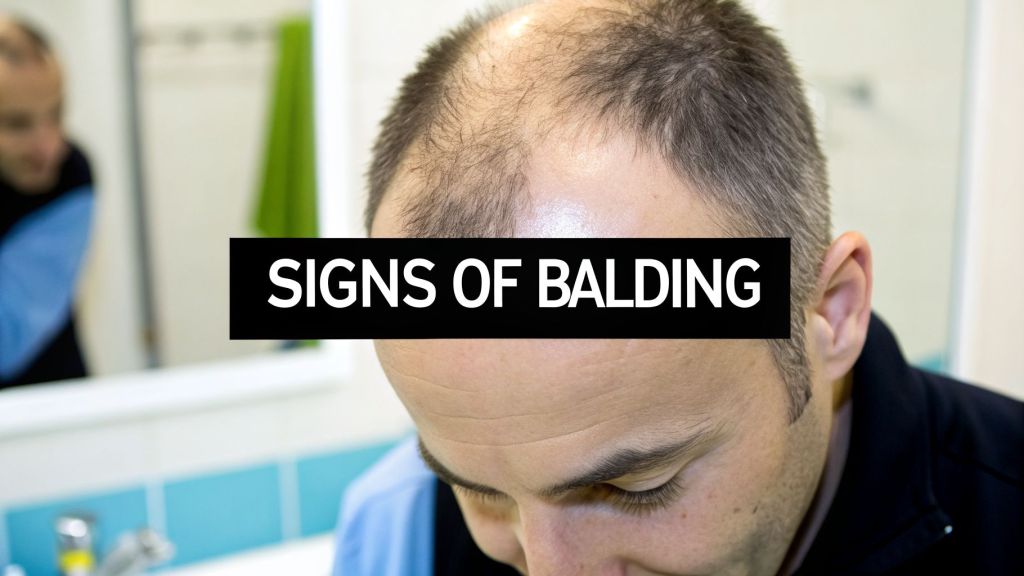
It usually starts quietly. Maybe you notice a few more hairs than usual in the shower drain, or you catch a glimpse of more scalp in a photo than you remember. Sometimes, it’s a casual comment from a friend. For most guys, hair loss isn’t some sudden event but a slow, creeping realization. The anxiety that follows is real, and the questions feel endless: Is this just normal shedding, or am I seeing the first real signs of balding? It’s all too easy to fall into a cycle of denial or outright panic. But what if you could swap that uncertainty for some clarity?
Getting a handle on the specific, often subtle signs of androgenetic alopecia (that's the technical term for male pattern baldness) is the first and most powerful move you can make. This isn't about obsessing over every stray hair; it’s about getting empowered. By learning to accurately identify what's happening up there, you can shift from a place of worry to one of proactive decision-making. Tools like the Norwood Scale are what pros use to classify the stages of male pattern baldness, and they can help you figure out where you stand.
This guide is here to do just that. We're going to cut through the noise and give you a clear, no-nonsense breakdown of the definitive signs, what they actually mean for your hair's future, and what you can actually do about it right now—including when it might be time to look into something like a PRP evaluation. Let's get ahead of it, together.
1. Receding Hairline
A receding hairline is often the first, and most obvious, sign of male pattern baldness. What’s happening is that the hairline gradually pulls back from your forehead, usually kicking off at the temples. This isn't a sudden disappearing act but a slow retreat. It’s caused by hair follicles that are sensitive to dihydrotestosterone (DHT), a byproduct of testosterone that shrinks them down until they just stop growing hair.

For a lot of men, this creates a distinct "M" shape as the hair at the temples recedes faster than the bit in the middle. We’ve all seen it on public figures like Prince William, which brought this early sign into the spotlight and showed how temple recession can start as early as a man's 20s or 30s.
How to Spot and Manage a Receding Hairline
The key is telling the difference between a maturing hairline and actual male pattern baldness. A maturing hairline moves back a little bit and does it evenly, usually less than an inch. A truly receding hairline, on the other hand, keeps going, especially at the temples.
Here are a few practical steps to take if you think your hairline is on the move:
- Establish a Baseline: Take some clear, well-lit photos of your hairline from the front and both sides. Check back on these photos every few months to see if there are any real changes. This helps you avoid the daily anxiety of staring in the mirror.
- Early Consultation: The minute you confirm a receding trend, it's a good idea to talk to a dermatologist or a hair loss specialist. Acting early is huge because treatments work best while the follicles are still active, even if they're starting to shrink.
- Consider Modern Treatments: Platelet-Rich Plasma (PRP) therapy is a solid option for early-stage recession. It uses growth factors from your own blood to wake up dormant hair follicles. For a deeper dive, you can check out resources on how to regrow a receding hairline.
- Style Smart: Work with what you’ve got, not against it. A hairstyle that tries to cover up recession can actually draw more attention to it. Think about shorter styles or ask a barber who knows how to suggest cuts that flatter your changing hairline.
2. Crown Thinning or Vertex Baldness
Crown thinning, sometimes called vertex baldness, is another classic sign of androgenetic alopecia. This one can be trickier to spot on your own since it's on the top and back of your head. It’s a slow-burn hair loss that starts from the vertex (the very top of your scalp) and gradually expands into a circular bald patch. This area is a prime target because the follicles there are often super sensitive to DHT, the same hormone that causes a receding hairline.

Unlike a receding hairline you see in the mirror every day, crown thinning can sneak up on you. Often, it's a friend, a family member, or a photo that first brings it to your attention. Public conversations about figures like Donald Trump have often focused on this type of hair loss, showing how it can be the main event or happen right alongside temple recession.
How to Spot and Manage Crown Thinning
The name of the game with vertex baldness is early detection. Since the thinning is gradual and out of your direct line of sight, you have to be a little proactive to monitor it. This gives you a chance to step in while the follicles are still capable of growing hair.
Here’s a game plan for dealing with a thinning crown:
- Perform Regular Checks: Use a hand mirror and your bathroom mirror together to get a good look at your crown. Try to do this once a month to spot any changes in hair density or how much scalp you can see.
- Create a Photo Log: Ask a trusted friend or family member to take clear, well-lit pictures of your crown every few months. Using the same lighting and angle each time gives you an objective way to see what's happening.
- Seek an Expert Opinion: If you notice a clear thinning pattern, don't just wait and see. A dermatologist can give you a definite diagnosis and walk you through treatment options. The sooner you act, the more hair you can potentially save and even regrow.
- Explore Targeted Treatments: Since the crown is such a common spot for hair loss, it tends to respond well to targeted treatments. To find out more about specific solutions like Platelet-Rich Plasma (PRP) therapy, you can get more info on tackling crown thinning hair.
- Choose Strategic Styling: Volumizing shampoos and conditioners can help the hair you have look fuller. A good barber can also suggest a cut that minimizes the appearance of the thin spot, often by keeping the surrounding hair a bit shorter.
3. Overall Hair Thinning and Density Loss
Unlike the localized retreat of a receding hairline, overall hair thinning is a more diffuse sign of balding that can affect your whole scalp. This type of androgenetic alopecia shows up as a gradual drop in hair volume and density. The process is sneaky; progressive miniaturization shrinks hair follicles all over your head, which makes your scalp more visible through the hair that's left, but without creating a distinct bald spot.
This widespread thinning is one of the most common signs of balding, though it can be tough to notice day-to-day. A lot of guys first realize what's happening when their hair feels lighter, their part line looks wider, or a once-thick ponytail feels noticeably thinner. It's a clear signal that hair follicles are becoming less productive thanks to the effects of DHT.
How to Spot and Manage Overall Thinning
Because this kind of hair loss is so gradual and spread out, you need to track it objectively to confirm your suspicions and take action. It's easy to second-guess what you're seeing in the mirror, so having a solid method for assessment is key.
Here are some practical tips for managing diffuse hair thinning:
- Photo Documentation: Dig up old photos and compare them with new ones taken in similar lighting. Look at pictures from a few years back to get a real sense of how your hair density has changed. This can provide undeniable proof that daily glances in the mirror might miss.
- The Ponytail Test: If your hair is long enough, wrap an elastic band around your ponytail and measure its circumference. Keep a log of this measurement every few months. A consistent decrease is a strong sign of progressive hair loss.
- Consult a Professional: As soon as you confirm a trend of decreasing density, go see a dermatologist. They can properly diagnose the cause, which is critical because diffuse thinning can also be linked to other health issues.
- Consider Systemic Treatments: Since thinning is happening all over, treatments that work systemically are often the way to go. Platelet-Rich Plasma (PRP) therapy is an excellent choice because it can be applied across the whole scalp to stimulate follicles and improve overall thickness. You can explore how PRP works to increase hair density and reverse thinning.
- Adopt Smart Styling: Shorter haircuts can create an illusion of more volume by reducing the weight that pulls hair down. Using texturizing products can also help give your hair a fuller look.
4. Increased Hair Shedding (Telogen Effluvium)
Seeing a lot more hair in your shower drain, on your pillow, or in your brush can be a jarring early warning sign of balding. While losing 50 to 100 hairs a day is perfectly normal, a significant and lasting increase in shedding often means there's a disruption in your hair's growth cycle. This condition, known as telogen effluvium, pushes more hair follicles than usual into the resting and shedding phase (the "telogen" phase) too early.
This ramped-up shedding can be a prelude to more visible, permanent hair loss. For men who are genetically prone to androgenetic alopecia, a bout of telogen effluvium can unmask or even accelerate the underlying male pattern baldness. It's often this sudden increase in lost hair that first makes guys concerned enough to seek help, even before a receding hairline or thinning crown becomes obvious.
How to Spot and Manage Increased Shedding
The main goal is to figure out if you're dealing with a temporary shedding event or the beginning of progressive, genetic hair loss. A big stressful event, an illness, or a nutritional deficiency can trigger temporary telogen effluvium. But if the shedding sticks around, it might be linked to androgenetic alopecia.
Here are some practical things to do if you notice excessive shedding:
- Establish a Baseline: To get a real measure, try to count the hairs you lose in the shower or find in your sink over a two-week period. This gives you a concrete number to track, which helps you determine if the shedding is getting worse or better.
- Consult a Specialist: If you're consistently losing more than 150 hairs a day for several weeks, it’s time to talk to a dermatologist. A pro can help pinpoint the root cause, whether it's stress, genetics, or another underlying issue.
- Manage Stress and Lifestyle: High stress is a known trigger for telogen effluvium. Bringing stress-reduction techniques into your routine—like regular exercise, getting enough sleep (7-9 hours), and mindfulness—can help regulate your body’s stress response and potentially get your hair cycle back to normal.
- Handle Hair Gently: Avoid aggressive brushing, tight hairstyles like man buns, and harsh chemical treatments. Too much physical stress on the hair and follicles can make shedding worse.
- Consider Early Treatment: If a dermatologist confirms that your increased shedding is an early sign of male pattern baldness, acting fast is key. Treatments like Platelet-Rich Plasma (PRP) therapy can be especially effective in these initial stages to help stimulate follicles and slow down the rate of loss.
5. Miniaturization of Hair Follicles
While a receding hairline or a thinning crown are the signs of balding you can see, hair miniaturization is the microscopic process driving it all. This is the biological engine behind androgenetic alopecia, where hair follicles that are sensitive to DHT (dihydrotestosterone) gradually shrink over time. As they get smaller, they produce hairs that are progressively thinner, shorter, and weaker, eventually turning healthy, thick hairs into fine, almost invisible "vellus" hairs.
Miniaturization is a stealthy process. You won't see it happening with your own eyes in the early stages, but it’s the definitive signal that genetic hair loss has kicked off. A dermatologist can use a special tool called a dermoscope to see this process up close. They look for a mix of thick and thin hairs in the same area, which is a classic giveaway for androgenetic alopecia.
How to Identify and Address Miniaturization
Since you can't really spot miniaturization in the mirror until it causes visible thinning, a professional diagnosis is your best bet for early intervention. The sooner you confirm that miniaturization is happening, the better your chances are of turning it around.
Here are the key steps to take if you suspect your hair quality is changing:
- Request a Trichoscopy Exam: This is a non-invasive diagnostic technique where a specialist uses a dermoscope to get a magnified view of your scalp and hair follicles. They can assess the variation in hair shaft diameter, which provides solid evidence of miniaturization and helps rule out other causes of thinning.
- Understand Reversibility: In the early stages, miniaturization is often reversible. The whole point of treatment is to counteract the shrinking process and coax the follicle into producing a thick, healthy hair again. Acting while the follicles are still alive and kicking is crucial.
- Target the Root Cause with PRP: Platelet-Rich Plasma (PRP) therapy is designed specifically to fight miniaturization. It uses growth factors from your own blood to stimulate and revitalize shrunken follicles, helping restore their size and function. You can check out a deeper explanation of how PRP works on miniaturized hair follicles.
- Combine Treatments for Better Results: For more advanced miniaturization, many specialists suggest a tag-team approach. Using PRP alongside FDA-approved treatments like minoxidil (which widens blood vessels) and finasteride (which lowers DHT levels) can create a powerful, synergistic effect for getting your hair density back.
6. Widening Hair Part Line
A widening hair part is a subtle but very real sign of balding that often gets overlooked until it's pretty obvious. This type of hair loss shows up as diffuse thinning across the top of the scalp, making the part line look wider and letting more scalp show through. Unlike a receding hairline at the front, this thinning tends to happen more uniformly. It's one of the main signs of balding for men who wear their hair a bit longer or have a consistent part. It's a direct result of hair follicle miniaturization, which reduces the diameter and density of hairs along that line.
This gradual change is frequently one of the first things people notice when they look down at their own head or see a photo taken from above. In fact, dermatological studies often use overhead photos to track how well treatments are working, precisely because a narrowing part line is a clear sign of increased hair density. For guys who don't have that classic "M" shape recession, a widening part can be the primary signal that androgenetic alopecia is starting.
How to Spot and Manage a Widening Part Line
Catching a widening part early takes a methodical approach since the day-to-day changes are almost impossible to see. This slow creep can make you wonder if you're just imagining things, so creating some objective evidence is super important.
Here are a few practical steps to take if you think your part line is getting wider:
- Create a Photo Log: Part your hair in the same spot and take a clear, brightly lit photo from directly overhead. Use a specific light source, like your bathroom vanity, to keep the conditions consistent. Do this every month to build a visual record of any changes.
- Measure for Objectivity: For even more precise tracking, you could place a tiny, non-permanent mark (like a dot from a washable marker) at the front and back of your usual part line. Use a flexible measuring tape to check the width at the same point each month. A consistent increase, even just by millimeters, is a strong indicator.
- Consult a Specialist with Your Evidence: Once you have a few months of photos that show a clear widening trend, book an appointment with a dermatologist. This visual proof is incredibly helpful for your doctor, enabling them to make an accurate diagnosis and recommend a treatment plan sooner.
- Consider Early Intervention: A widening part means follicles are shrinking but are likely still active. Treatments like Platelet-Rich Plasma (PRP) therapy are particularly effective at this stage. The growth factors in PRP can help re-thicken miniaturizing hairs and improve overall density, which effectively "tightens up" the appearance of your part line.
7. Changes in Hair Texture and Quality
Beyond just how much hair you have, the quality and texture of the individual strands can offer big clues about balding. A progressive change where hair becomes finer, weaker, and duller is another observable sign of androgenetic alopecia. This is because the hair follicles, under assault from DHT, aren't just vanishing; they're miniaturizing. As they shrink, they produce lower-quality hairs that are more likely to break and just don't have their old shine and strength.
These changes in quality often happen before you notice significant hair loss in terms of volume. Men sometimes report that their hair simply feels different when they wash or style it, describing it as "wispy" or "lifeless" compared to how it used to be. This shift in texture is a direct result of the follicle's declining health and is one of the more subtle but very telling signs of balding.
How to Spot and Manage Changes in Hair Texture
It’s important to distinguish these changes from damage caused by harsh styling products or heat. Texture degradation from balding is a persistent, progressive decline, whereas styling damage might get better if you improve your hair care routine.
Here are some practical things to do if you notice your hair's quality is going downhill:
- Perform a Texture Check: Pay close attention to how your hair feels when you wash or run your fingers through it. Does it feel thinner or more fragile? Use this hands-on feedback as a regular way to monitor things.
- Compare with Old Photos: Look at high-quality photos from a few years ago. Even if the density looks similar, you might be able to spot a visible loss of shine, thickness, or vibrancy in your current hair.
- Assess Natural State: Check out your hair's quality when it’s clean and free of styling products. This gives you a true baseline for its natural texture, removing the variable of damage from gels, heat, or chemicals.
- Consult Early: Don't wait for thinning to become super obvious. A change in texture is a clear signal that follicles are being affected. A chat with a specialist can confirm the cause, and acting early gives you the best shot at preserving and improving your hair quality. Treatments like PRP are often considered at this stage to help revitalize shrinking follicles and improve the quality of the hair they produce.
8. Increased Scalp Visibility and Shine
When you start seeing more of your scalp through your hair, it’s one of the more definitive signs of balding. It's a clear signal that hair density has noticeably dropped. This often comes with an increased shine, as light reflects directly off the skin of your scalp instead of being absorbed and scattered by a full head of hair. This effect isn't just an illusion; it’s a direct result of hair follicles shrinking and producing thinner, shorter hairs, or just giving up on production altogether.

Unlike a receding hairline that's all about the front, increased scalp visibility can happen anywhere. It's common on the crown (the vertex) and along the part line. For many guys, seeing more scalp, especially under bright lights or in photos, is the "uh-oh" moment when hair loss becomes undeniable and pushes them to look for solutions. Before-and-after photos from treatments often use this exact metric—a clear reduction in visible scalp—as a sign of success.
How to Track and Address Scalp Visibility
Objectively monitoring your scalp visibility is the best way to know for sure if you're experiencing progressive hair loss. Bright overhead lighting can make thinning look worse than it is, so being consistent is crucial for accurate tracking.
Here are some practical steps for managing this sign of balding:
- Create a Photo Log: Stand under the same natural light source (like a particular window) once a month and snap some photos of your scalp from above. This consistent documentation gives you a reliable, long-term view of any changes in hair density.
- Use Consistent Angles: When you take photos, always use the same angle and camera position. This removes variables and makes comparing the pictures much more accurate. Documenting your scalp this way provides a clear baseline before you start any treatment.
- Consult a Specialist Promptly: The moment you confirm that more of your scalp is showing, that’s a strong signal to talk to a professional. Treatments are most effective when started early, as they work to revive follicles that are still capable of producing hair.
- Evaluate PRP Therapy: For those with noticeable scalp visibility, Platelet-Rich Plasma (PRP) therapy is a direct approach. It aims to stimulate miniaturized follicles so they produce thicker hair shafts, which in turn reduces how much scalp can be seen. Patients often see a gradual reduction in scalp shine and visibility over 6 to 12 months of consistent treatment.
8-Point Comparison: Signs of Balding
| Sign | 🔄 Implementation Complexity | Resources & Requirements | ⚡ Speed / Response Timeline | ⭐ Expected Outcomes | 💡 Ideal Use Cases & Tips |
|---|---|---|---|---|---|
| Receding Hairline | Low–Moderate — visually obvious; intervention needs clinician | Photos, Norwood assessment, dermatologist consult; PRP/minoxidil/finasteride | Slow progression; treatment effects seen 3–6+ months | Good if caught early; PRP often effective on viable follicles | Early-stage temple recession; take baseline photos, begin PRP/meds early |
| Crown Thinning / Vertex Baldness | Moderate — requires overhead views; can progress faster | Overhead photos, mirror checks, derm evaluation; targeted PRP | Can progress more rapidly than hairline; response 3–6 months | Often responsive to PRP; measurable improvement possible | Use overhead photos, target injections to crown, use volumizing styling |
| Overall Hair Thinning & Density Loss | Moderate — diffuse pattern, harder to date precisely | Full‑scalp photos, ponytail measurement, dermatology assessment; systemic PRP & meds | Gradual onset; systemic response over 4–9 months | Good with early, comprehensive treatment; density can improve | Compare historical photos, use volumizing cuts/products, consider full‑scalp PRP |
| Increased Hair Shedding (Telogen Effluvium) | Moderate–High — needs quantification and differential diagnosis | Hair counts, medical history, lab tests, dermatologist; PRP preventative | Shedding often precedes thinning by 2–3 months; recovery variable | Variable — early intervention can prevent permanent loss; PRP can help | Count hairs over 2 weeks, check for triggers (stress/meds), treat underlying cause |
| Miniaturization of Hair Follicles | High — requires trichoscopy/dermoscopy to detect | Specialized dermoscopy/trichoscopy, clinician assessment; multi‑modal therapy (PRP + meds) | Biological process is slow; reversal requires multiple months/sessions | High potential if treated early; PRP targets follicle restoration | Request trichoscopy, combine PRP with minoxidil/finasteride, expect multi‑session course |
| Widening Hair Part Line | Low — easy to document with consistent photos | Consistent part photos, simple measurements, localized PRP | Subtle change; improvement visible over several months | Highly responsive to focal treatments like PRP | Maintain same parting for photos, document monthly, start localized PRP early |
| Changes in Hair Texture & Quality | Low–Moderate — subjective but detectable early | Sensory checks, photos, optional microscopic hair exam; PRP and hair care changes | Texture improvements typically lag 3–6 months after treatment | Good — patients often notice texture/strength gains before volume | Monitor feel when washing, avoid styling damage, expect texture gains ahead of density |
| Increased Scalp Visibility & Shine | Low — objective and easy to photograph | Overhead/parting photos in consistent lighting, derm consult, PRP | Visibility increases can be rapid; reduction usually seen over 6–12 months | Clear, satisfying visual improvement with effective treatment | Take monthly overhead photos in consistent light; begin treatment when visibility appears |
From Awareness to Action: What's Your Next Move?
Navigating the early signs of balding can feel pretty isolating, but understanding the signals your body is sending is the first, and most powerful, step toward getting back in control. From a slowly receding hairline and a less dense crown to that unsettling increase of hair on your pillow, you're now armed with the ability to spot these changes early. Recognizing the subtle shift from temporary shedding to the persistent follicular miniaturization of male pattern baldness is no longer a mystery. You've got the tools to tell the difference and understand what's happening.
The single most important takeaway is this: early detection creates options. Hair loss is a progressive condition, but you don't have to be a spectator. Your proactive response can significantly change the outcome, helping you keep the hair you have and, in many cases, restore some of what's been lost. The journey from just noticing these signs of balding to taking decisive action is where your power lies. Don't write off a widening part or a shinier scalp as just "getting older." See these observations as your cue to act.
Your Action Plan: From Diagnosis to Treatment
So, what should you do right now? The path forward is clear and totally manageable.
- Document Your Observations: Start taking photos of your hairline, crown, and part line every month in consistent lighting. This visual diary provides concrete proof of any changes and will be incredibly helpful when you talk to a professional.
- Seek a Professional Diagnosis: Self-diagnosing can lead to a lot of anxiety and dead-end treatments. Schedule an appointment with a dermatologist or a hair loss specialist. They can use tools like a trichoscope to examine your scalp, confirm if you have miniaturized follicles, and rule out other potential causes like scalp conditions or nutritional issues.
- Explore Your Options with an Expert: Once you have a confirmed diagnosis of androgenetic alopecia, you can build a targeted plan. While you discuss medical treatments, it’s also smart to look into supportive measures. For instance, understanding the best supplements for hair growth can complement a professional treatment by making sure your body has the nutritional building blocks for healthy hair.
Key Insight: The ideal time to think about advanced treatments like Platelet-Rich Plasma (PRP) is when you first spot these early signs. PRP works by using your body's own growth factors to stimulate and rejuvenate hair follicles. It's most effective when the follicles are dormant or struggling, not gone for good. Waiting until hair loss is extensive really limits the potential for regrowth. If you've seen the initial signs of balding, you are in the perfect window for a PRP evaluation.
Taking control of your hair health journey is about more than just looks; it's about confidence and feeling like yourself. By turning awareness into action, you move from a place of uncertainty to one of empowerment.
Ready to take the next step? At PRP For HairLoss, we specialize in using your body's natural healing ability to combat the early signs of balding. PRP For HairLoss offers a scientifically backed, non-surgical solution to help you preserve and regrow your hair, and your initial consultation is the perfect place to start.
 PRP For Hairloss
Leave a comment