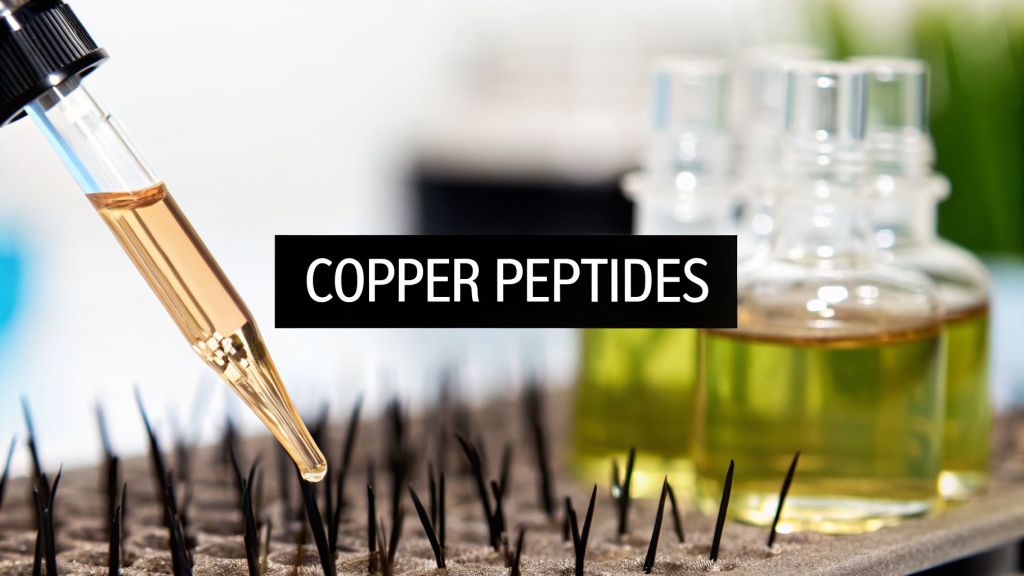
If you're wondering whether copper peptides are the real deal for hair growth, let's cut to the chase: yes, they are a legitimate tool for improving your hair. They work by creating a healthier, more supportive scalp environment, essentially reinforcing the very foundation from which your hair grows.
Think of them less like a magic bullet and more like a specialized maintenance crew for your hair follicles.
What Are Copper Peptides and How Do They Work?

Let's get practical and skip the dense scientific jargon for a minute. Picture your scalp as a construction site where each hair follicle is a tiny, complex structure being built. As we get older or due to our genes, this site can get a bit run down—inflammation kicks in, blood flow slows, and the delivery of crucial building materials (like nutrients) gets delayed.
This is where copper peptides come into the picture. They aren't some new-age fad; they're actually compounds your body naturally produces to manage healing and tissue repair.
The Role of GHK-Cu
When people talk about copper peptides for hair growth, the main one we’re interested in is called GHK-Cu. This little molecule is just a copper ion linked to a chain of three amino acids (glycyl-L-histidyl-L-lysine). Think of it as the expert foreman for that scalp construction site.
Once you apply it to your scalp, GHK-Cu gets to work on a few critical tasks:
- Calms Inflammation: Scalp irritation is a huge culprit behind follicle damage and hair thinning. GHK-Cu helps put out that fire.
- Improves Circulation: It encourages the formation of new blood vessels, which means more oxygen and vital nutrients can actually get to your hair follicles.
- Reinforces Follicle Structure: It helps your body produce more collagen and elastin—the proteins that give the skin around your follicles its strength, anchoring your hair more firmly.
In short, GHK-Cu doesn't just slap a band-aid on hair loss. It gets to work on the underlying problems that are holding back healthy hair growth in the first place, revitalizing the whole scalp environment.
A Practical Solution for Hair Loss
By tackling these core issues, copper peptides help your hair follicles get back to functioning the way they should. A plant can't thrive in dry, depleted soil, right? Well, GHK-Cu essentially "fertilizes" and "irrigates" the soil of your scalp, creating the perfect conditions for hair to grow stronger and healthier.
For men who are tired of all the hype and just want something that works, copper peptides offer a tangible, science-backed approach to managing hair loss.
This focus on improving scalp health is why so many people are now looking into different types of peptides for hair growth as part of their daily routine. It’s a non-hormonal way to support your hair right from the root, making it a smart addition to any guy's hair care strategy.
How Copper Peptides Get Your Hair Growing Again
To really get what copper peptides can do for your hair, we need to zoom in and look at what's happening on your scalp at a microscopic level. It all boils down to your hair's natural life cycle and how these peptides can jump in to get things back on track.
Every single hair on your head goes through a three-phase cycle: growth, transition, and rest. For guys dealing with thinning, the main problem is that the growth phase gets cut short while the resting phase drags on for way too long. Copper peptides work to rebalance this cycle in your favor.
Extending Your Hair's Growth Phase
The most important part of the cycle for thick, healthy hair is the anagen phase—this is when your hair is actively growing. In a healthy follicle, this can last for years. But with male pattern baldness, this growth window shrinks, leading to shorter, weaker hairs that fall out much faster.
This is where copper peptides intervene directly. They send signals that encourage your hair follicles to stay in that anagen phase for longer.
Think of it like a personal trainer for your follicles. The trainer pushes them to keep going, extending their workout (the growth phase) so they can build more strength and length before hitting their rest period.
This extension is a total game-changer. It gives each strand more time to grow longer and thicker before it naturally sheds, which is what creates a fuller look. By keeping more of your hair in this active growth stage at any given time, you start to win the battle against thinning.
Reversing Follicle Miniaturization
One of the classic signs of male pattern baldness is follicle miniaturization. Over time, your hair follicles literally shrink. They start producing finer, shorter, and less pigmented hairs until, eventually, they just give up. This is the main reason why a once-thick head of hair starts to look sparse.
Copper peptides fight this process head-on by working to increase the physical size of the hair follicles. They do this by stimulating the cells in the dermal papilla, which you can think of as the follicle's "command center" or "foreman."
- The Foreman's Job: This group of cells at the base of the follicle is in charge of how big the follicle gets and how thick the hair it produces will be.
- Copper Peptides' Role: They basically wake up this foreman, signaling it to ramp up production and build a larger, more robust follicle structure.
A larger follicle naturally produces a thicker, stronger hair shaft. This directly counters the shrinking process that defines androgenetic alopecia, helping you get back to thicker, healthier-looking hair.
Boosting Scalp Circulation and Nutrient Delivery
Your hair follicles are hungry. To work right, they need a constant supply of oxygen and nutrients, which they get from your bloodstream. Poor scalp circulation is like a roadblock on the supply chain, starving your follicles of what they need to thrive.
This is another area where copper peptides really shine. They promote angiogenesis, which is just a fancy word for the formation of new blood vessels. More blood vessels mean better circulation and a more efficient delivery of vital nutrients directly to the hair root.
Imagine finding a peptide that could turn back the clock on your receding hairline without the harsh side effects of some drugs. Copper peptides, especially GHK-Cu and AHK-Cu, have been making waves in hair restoration circles, and for good reason. One landmark study found that AHK-Cu significantly stimulated follicle lengthening and boosted the proliferation of those key "foreman" cells at very low concentrations. More recent evidence reported a 27% increase in hair density after six months of daily copper peptide serum use. For guys dealing with thinning, this means fewer hairs clogging the shower drain and a scalp that feels revitalized, as these peptides help enlarge follicle size and flood them with oxygen. You can explore more about these findings and how peptides work at a biological level to find out if it's the right choice for you and your goals. Learn more about their potential for hair restoration on omiwellbeauty.com.
By improving this critical supply line, you ensure your follicles have everything they need to get back to work. For anyone looking to improve their hair, learning how to stimulate hair follicles is a fundamental step, and boosting circulation is a key part of that process.
Reviewing The Clinical Evidence And Real-World Results
The science behind copper peptides is fascinating, but what every guy really wants to know is, "Does this stuff actually work?" It's time to move past the theory and dig into the hard data. Let's see what the clinical trials and lab studies tell us about real-world results.
This is where the rubber meets the road. Personal stories are one thing, but documented evidence gives you the solid proof needed to feel confident in a treatment. The research on copper peptides for hair growth zeroes in on a few key areas that directly tackle the signs of male pattern baldness.
What The Studies Show About Hair Density
Hearing about a percentage increase in a clinical trial can sound a bit abstract. But for a man with thinning hair, these numbers represent something tangible and, frankly, exciting.
If you're a guy who has seen old family photos and is dreading your genetic destiny, copper peptides might just give you the fighting chance you’ve been looking for. These tiny copper-bound protein fragments don't just make promises; they deliver stats that hit home. Clinical trials have documented a 27% surge in hair density and reduced shedding after six months of using a topical copper peptide serum. That's a significant development for anyone dealing with the diffuse thinning so common in male pattern baldness.
So, what does a 27% increase in density actually look like? It means seeing less scalp when you get out of the shower. It’s the difference between feeling self-conscious under bright office lights and feeling like your hair has more substance and coverage. It's a real, visible improvement.
The diagram below breaks down the three core ways copper peptides work to revitalize hair follicles.

As you can see, the strategy is multifaceted. It's not just about one single action but a combination of extending the growth phase, enlarging the follicle itself, and improving the delivery of vital nutrients.
From The Lab To Your Scalp
This isn't just a concept; research has demonstrated how these peptides influence the hair growth cycle. The evidence points to a clear pattern of follicle revitalization.
- Prolonging the Anagen Phase: Studies confirm that copper peptides help keep hair in the active growth (anagen) phase for longer. This gives your hair more time to grow longer and stronger before it enters the resting phase, which ultimately means less shedding over time.
- Enlarging Follicle Size: Research on human scalp follicles shows that copper peptides like AHK-Cu promote cell survival and proliferation. This is huge because it directly fights the follicle miniaturization caused by DHT, helping shrunken follicles produce thicker, healthier hair shafts once again.
- Boosting Scalp Health: It’s not just about the follicles. Studies also highlight how these peptides improve the very foundation of your scalp. They help produce more collagen, which strengthens the skin anchoring your hair, and their anti-inflammatory effects create a calmer, more supportive environment for growth.
The body of evidence makes it clear: copper peptides aren't a superficial fix. They work at a biological level to address the root causes of thinning hair, creating measurable improvements in both hair density and follicle health.
Real-World Wins For Men
This isn't just happening in a petri dish. For the 50 million American men affected by androgenetic alopecia, these scientific findings translate into practical wins. While not every follicle can be brought back from the brink, you might be surprised by the potential for reviving dormant ones. You can check out our guide on whether dead hair follicles can be revived to get a better sense of what's possible.
Reports from men using copper peptide serums consistently mention their hair feeling denser and more resilient after just 3 to 6 months of use. These real-world observations align perfectly with the clinical data, showing that the science truly translates into results you can see and feel in the mirror.
A Practical Guide to Using Copper Peptides

Knowing the science behind copper peptides is great, but it’s the daily application that actually delivers results. So, let’s get practical and lay out a clear plan for making copper peptides for hair growth a part of your routine. It's not rocket science, but paying attention to the details can make a world of difference.
Think of this less like buying a product and more like starting a long-term strategy. The game plan is simple: pick the right formula, apply it the right way, and stick with it.
Choosing Your Product: Serum or Foam?
Your first move is to select a high-quality copper peptide product. You’ll mostly see them available as either a serum or a foam. There's no single "best" option here; it really boils down to your hair type and what you find easiest to use.
- Serums: These are typically water-based and come with a dropper for pinpoint accuracy. They’re perfect for targeting specific areas where you’re seeing the most thinning, like your temples or the crown of your head.
- Foams: Foams are much lighter and can be a breeze to spread over larger sections of your scalp. They have the added benefit of not leaving your hair feeling greasy or weighed down.
When you're checking out product labels, pay attention to the concentration. A great starting point for a daily topical is a concentration between 1-3%. This range has been shown to be effective while being gentle enough for most people to tolerate without issue.
Remember, when it comes to active ingredients, more isn't always better. You’ll get far better results by starting with a moderate concentration and using it consistently than by jumping straight to a high-strength formula that might just irritate your scalp.
The Correct Application Method
How you apply your copper peptides is just as critical as what you apply. The goal is to deliver the active ingredients directly to the skin of your scalp—where the hair follicles are—not just to coat your hair strands.
Here’s a straightforward process to follow every day for the best results:
-
Start with a Clean Scalp: The best time to apply is after a shower on a towel-dried, damp scalp. A clean scalp is free from oils and other product buildup, which helps the peptides penetrate more effectively. You can apply it to a dry scalp, too, but most people find the slight dampness helps with even distribution.
-
Apply Directly to the Scalp: Whether you're using a dropper or a foam nozzle, get the product right onto the skin in your thinning areas. Part your hair as you go to make sure you're hitting the scalp and not just getting it on your hair.
-
Massage It In: This step is crucial, so don't skip it. Use your fingertips to gently massage the product into your scalp for at least 30-60 seconds. This simple action helps spread the product evenly and also boosts circulation to the area, which can further improve absorption.
If you purchase a lyophilized (freeze-dried) powder version, knowing how to reconstitute peptides correctly is a vital first step. This ensures the mixture has the proper concentration and is safe for you to apply.
Setting Realistic Expectations For Results
Finally, let’s talk about the timeline, because this is where many people get discouraged. Hair growth is a marathon, not a sprint. You aren't going to see a full head of new hair overnight, so setting realistic expectations is key to staying motivated.
Most guys start to see the first positive signs—like less shedding and a healthier-feeling scalp—within about 3 to 4 months of consistent, daily use. More noticeable improvements in hair density and thickness usually take closer to the 6-month mark to become apparent. For those looking to get even more out of their routine, combining peptides with other treatments can be a smart move; you can learn more about how microneedling for hair growth can enhance product absorption and stimulate follicles.
Patience really is your best friend here. Stick with the routine, and give the peptides the time they need to do their work.
Combining Copper Peptides With PRP and Other Hair Treatments
While copper peptides can be effective on their own, many people find the best results come from layering them with other proven hair restoration treatments. Think of it less as a single solution and more as building a comprehensive strategy. By attacking hair loss from multiple angles, you create a powerful, synergistic effect.
At the top of the list for combination therapy is pairing copper peptides with Platelet-Rich Plasma (PRP) treatments. These two work together in a beautifully complementary way, with each one enhancing the benefits of the other.
The Synergy Between PRP and Copper Peptides
PRP therapy uses a concentration of your own blood platelets, which are rich in growth factors, and injects them directly into the scalp. You can think of a PRP treatment as the "spark" that provides a powerful jolt to wake up dormant or underperforming hair follicles. It's an intense signal for them to get back into the growth phase.
But once PRP provides that initial wake-up call, what happens next? This is where copper peptides step in to play a crucial, supportive role.
If PRP is the spark that starts the engine, copper peptides are the high-quality fuel and oil that keep it running smoothly. They create the perfect, nutrient-rich environment for that newly awakened hair to grow strong, healthy, and resilient.
By preparing the scalp and reducing inflammation before a PRP session, copper peptides create a more receptive environment. Afterward, they support the healing process and ensure the new growth factors have an ideal foundation to work from. This one-two punch can lead to more significant and longer-lasting results than either treatment could on its own.
If you're considering this powerful combination, it’s a good idea to get a solid grasp of the basics. You can learn more about what PRP for hair loss involves in our detailed article to see how it might fit into your overall plan.
Layering Copper Peptides with Minoxidil and Microneedling
Beyond just PRP, copper peptides also pair extremely well with other common treatments for male pattern baldness, like minoxidil and microneedling. This is where you can start to really customize a routine based on your specific hair loss pattern and goals.
Here’s a quick look at how they can work together:
- With Minoxidil: This well-known topical works by increasing blood flow to the scalp and extending the hair's growth phase. When you add copper peptides to the mix, you’re not just boosting circulation; you're also fighting scalp inflammation and supplying the building blocks for healthier collagen and elastin. The two actions are a natural fit.
- With Microneedling: This practice uses a device with tiny needles to create micro-channels in the scalp. Not only does this trigger the body’s natural wound-healing response (which stimulates growth), but it also dramatically increases the absorption of any topicals you apply afterward. Applying a copper peptide serum right after a microneedling session helps drive the active ingredients much deeper into the skin for a bigger impact.
By combining these different methods, you're building a truly comprehensive system. Minoxidil and PRP focus on stimulating growth, microneedling enhances delivery, and copper peptides work behind the scenes to improve the health and resilience of the entire scalp. This integrated approach gives you the best possible shot at reclaiming thicker, healthier hair.
Copper Peptides vs PRP At a Glance
To help you decide what's right for you, here’s a head-to-head comparison of Copper Peptides and Platelet-Rich Plasma (PRP). This table breaks down their individual strengths and shows why they work so well together.
| Feature | Copper Peptides | PRP (Platelet-Rich Plasma) |
|---|---|---|
| Mechanism | Reduces inflammation, supports collagen/elastin, strengthens follicles. | Delivers concentrated growth factors to stimulate dormant follicles. |
| Application | Topical (serum, foam, or shampoo). | In-office procedure (injections into the scalp). |
| Primary Role | Creates a healthier scalp environment for growth. | Provides a powerful, direct signal for hair to grow. |
| Best For | Daily maintenance, scalp health, supporting other treatments. | "Kickstarting" growth in thinning areas, jumpstarting a regimen. |
| Pain/Invasiveness | None. | Mild to moderate; involves injections. |
| Cost | Generally low to moderate (monthly product cost). | Higher (cost per session). |
| Frequency | Daily application. | Typically a series of 3-4 initial sessions, then maintenance every 6-12 months. |
Ultimately, it’s not always about choosing one over the other. As you can see, their mechanisms are distinct but complementary. Using them together allows you to both stimulate new growth with PRP and create the optimal scalp foundation with copper peptides to sustain it.
Understanding the Safety and Potential Side Effects
Whenever you’re thinking about a new hair loss treatment, one of the first questions is always: “Is it safe?” Let's cut right to it. For topical copper peptides for hair growth, the safety profile is excellent. The vast majority of men find them incredibly well-tolerated, with a very low risk of side effects.
This high safety standard is a big part of what makes copper peptides so appealing. They get to work right where you need them—on your scalp—improving the health of your skin and hair follicles without getting into your system and causing problems elsewhere.
What to Expect When You Start
While serious side effects are rare, it’s smart to know about the minor, temporary issues you might run into. Knowing what’s normal (and what’s not) takes the guesswork out of the process.
The most common complaint, if any, is some mild scalp irritation. You might notice a bit of redness, itching, or dryness right after you start using a new product. This is usually just your skin getting used to a new active ingredient, and it almost always clears up on its own within a week or two.
Some men also notice a temporary increase in shedding at first. Try not to worry—this is often a good sign. It can mean the peptides are successfully resetting your hair follicles, pushing out older, weaker hairs to make room for new, stronger ones to grow in. This "shedding phase" is a well-known part of the process for many effective hair treatments.
Here’s the key difference: The minor, localized effects of copper peptides are a world away from the systemic side effects that can sometimes be linked to prescription hair loss medications.
How to Handle Minor Irritation
If you do run into a little irritation, there are a few simple things you can do to get it under control without giving up on the treatment.
- Reduce Frequency: Instead of applying the product every day, try switching to every other day to give your scalp a little more time to adjust.
- Check for Other Irritants: Look at your shampoo or other styling products. Sometimes, it's a combination of products causing the issue, not just the peptides.
- Apply to a Dry Scalp: Applying products to a damp scalp can increase penetration and sometimes sensitivity. Make sure your scalp is completely dry first.
Usually, these small tweaks are all it takes. But if the irritation feels severe or just won’t go away, it’s always best to stop using the product and talk to your doctor or a dermatologist. It's also worth noting the broader regulatory environment; understanding the FDA regulations for dietary supplements can offer useful context on how these types of products are overseen. At the end of the day, listening to your body is what matters most.
Common Questions About Copper Peptides for Hair Loss
Diving into a new hair loss treatment always raises a few last-minute questions. We get it. Here, we'll tackle the most common things men ask about using copper peptides for hair growth, providing clear, straightforward answers to help you decide if it's the right move for you.
How Long Until I See Results from Copper Peptides?
This is a long game, so patience and consistency are key. Most guys first spot subtle improvements—like less hair in the drain and a healthier feel to their hair—within 3 to 4 months of daily application.
For more noticeable gains in density and thickness, you'll want to look toward the 6-month mark. Remember, hair growth happens in cycles. You're essentially waiting for new, stronger hairs to emerge and mature. Don't feel let down if you don't see a dramatic transformation in the first month; the magic is happening beneath the surface.
Will My Hair Fall Out if I Stop Using Copper Peptides?
Copper peptides work by nurturing a healthier scalp environment. If you stop using them, your scalp will slowly return to its previous state, and the benefits you've seen will gradually diminish.
The good news is you won't experience a sudden, dramatic shed like you might with certain prescription drugs. But because the root cause of your hair loss is still there, the gains aren't permanent without ongoing use. It’s best to think of copper peptides as a long-term commitment to your hair health, not a one-and-done fix.
Are Copper Peptides Effective for a Receding Hairline?
Yes, they can be a helpful part of your strategy, but it’s crucial to have realistic expectations. The hairline and temples are notoriously tough spots to treat because the follicles in these areas are often the most sensitive to DHT, the hormone driving male pattern baldness.
Copper peptides help by fighting off follicle miniaturization and boosting circulation, which strengthens the hair you still have and can sometimes encourage new growth. To give yourself an extra advantage, many find that combining them with microneedling enhances absorption and improves results in these stubborn zones. They are a valuable tool, but just one piece of a larger puzzle for a receding hairline.
Can I Use Copper Peptides After a Hair Transplant?
Absolutely—in fact, many surgeons actively encourage it. Following a hair transplant, copper peptides are brilliant for supporting the healing process.
Their anti-inflammatory nature helps soothe the scalp and reduce post-procedure redness. Even more critically, their role in promoting new blood vessel formation (angiogenesis) helps ensure your newly transplanted grafts get the robust, nutrient-rich blood supply they need to settle in and flourish. Just be sure to get the green light from your surgeon on their specific timeline for when to start applying topical products.
At PRP For HairLoss, our mission is to provide you with the clear, honest insights you need to make the best choices for your hair. To discover more about advanced hair restoration strategies, explore our resources at https://prpforhairloss.com.
 PRP For Hairloss
Leave a comment