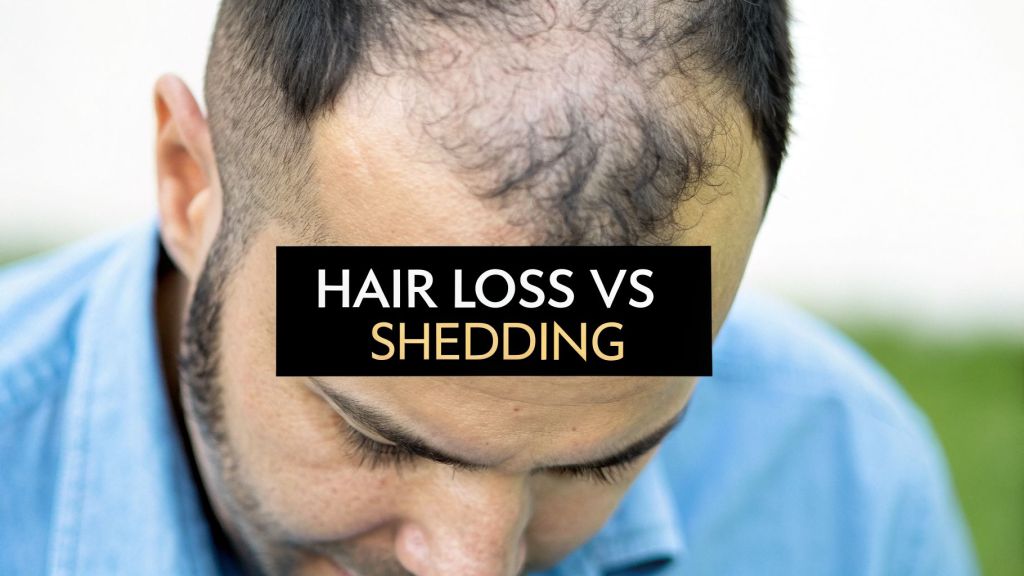
The line between hair loss and hair shedding is the difference between renewal and retreat. Let's put it this way: shedding is a completely normal, temporary part of your hair’s life cycle. On the flip side, true hair loss is a progressive condition where the follicles themselves shrink and eventually just give up on producing new hair. It’s like the difference between leaves falling in autumn (shedding) versus the whole tree getting smaller year after year (loss).
Shedding Hair or Losing It? What's the Real Difference?

It’s the question every guy asks himself when he sees a clump of hair in the shower drain or a few too many strands on his pillow. Is this just a phase, or is it the beginning of the end for my hair? Let's cut through the noise and get this sorted out.
Knowing which one you're dealing with is the crucial first step. It gives you the power to either relax or take the right action, saving you a ton of unnecessary stress.
The Normal Hair Cycle Is All About Renewal
Your scalp is a busy place, constantly working to renew itself. This includes shedding hair, a totally healthy process where everyone loses about 50 to 100 hairs a day. This is just your body's way of making room for new, healthy growth, and it’s all part of the natural hair growth phases.
This cycle breaks down into three main stages:
- Anagen (Growth Phase): This is the active growth period. At any given moment, about 85-90% of your hair is in this phase, just growing.
- Catagen (Transition Phase): A very brief pit stop where hair growth comes to a halt.
- Telogen (Resting Phase): The final stage. The follicle takes a break before the old hair is pushed out to make way for a new one. About 10-15% of your hair is resting right now.
The real takeaway is simple: Shedding is about quantity—a temporary uptick in the number of hairs you lose. True hair loss is about quality—the hair that does grow back is noticeably thinner, weaker, and shorter over time.
Quick Guide: Shedding vs. Loss at a Glance
To make this crystal clear, let's put the two head-to-head. This quick comparison table is designed to help you instantly spot the signs and figure out what’s really going on up there.
| Attribute | Normal Hair Shedding | Progressive Hair Loss |
|---|---|---|
| Daily Hair Fall | 50-100 hairs; may increase temporarily due to stress or seasonal changes. | A gradual increase that's often hard to notice day-to-day. |
| Duration | Usually temporary, lasting just a few weeks or months. | Ongoing and gets worse over time without intervention. |
| Hair Appearance | Full-length hairs, often with a tiny white bulb at the end. | Hairs become finer, shorter, and sometimes lighter in color (miniaturization). |
| Pattern | Diffuse, all-over shedding from the entire scalp. | Typically follows a distinct pattern, like a receding hairline or thinning crown. |
Seeing the differences laid out like this makes it much easier to assess your situation. If you're noticing a distinct pattern and weaker hair, it's likely more than just shedding.
The Science Behind Your Daily Hair Shed

To really get to the bottom of hair loss versus shedding, we have to talk biology. Your hair isn't just sitting there; it's constantly moving through a three-part cycle of growing, transitioning, and resting. This natural rhythm is precisely why you find hairs in the shower drain or on your comb.
I often tell my patients to think of their scalp as a garden. Each hair follicle is a tiny plot of soil, and just like a plant, each hair goes through its own lifecycle before making way for a new one. It's a built-in system of renewal.
Decoding the Hair Growth Cycle
The hair on your head is only what you see on the surface. Understanding the phases happening beneath the scalp is the key to knowing if what you're seeing is normal shedding or something more concerning.
The entire process plays out in three main acts:
- Anagen (The Growth Phase): This is the long game. Your hair is actively growing, and this phase can last anywhere from 2 to 7 years. At any given moment, about 85% to 90% of the hair on your head is in this stage.
- Catagen (The Transition Phase): A very brief intermission that lasts just a couple of weeks. The hair follicle starts to shrink and cuts itself off from the blood supply, which signals the end of its growth spurt.
- Telogen (The Resting Phase): This is the final stage, lasting about 3 months. The hair, now called a club hair, just sits dormant in the follicle while a brand-new hair starts to form beneath it.
Eventually, the new hair grows and pushes the old club hair right out. That’s the hair you find on your pillow. It's not "falling out" in a problematic way—it's being methodically replaced. To get a better sense of the numbers, you can read up on how much daily hair loss is normal and what it means for you.
A "club hair" is simply a fully formed hair that's done growing. You can often spot one by the small, white, hard bulb of keratin at the root. Finding these is a clear indicator of natural shedding, not permanent hair loss.
When Shedding Goes Into Overdrive
So if shedding is totally normal, why do some guys go through periods where it feels like they’re losing handfuls of hair? This is usually a condition called Telogen Effluvium.
The name sounds complex, but the idea is simple. A major stressor—either physical or emotional—can shock your system, pushing a large number of hairs from the active growth phase (Anagen) straight into the resting phase (Telogen) all at once.
A few months down the line, all those hairs that were pushed into the resting phase together start to shed at the same time. This creates a sudden, and often alarming, increase in hair fall that is thankfully temporary.
Common triggers I see for Telogen Effluvium include:
- High Stress: A brutal work project, a family crisis, or any major life event can throw your hair cycle off-kilter.
- Illness or Surgery: The sheer physical stress of being sick, especially with a high fever, is a classic trigger.
- Dietary Shifts: Sudden, drastic weight loss or not getting enough key nutrients like iron or protein can starve your follicles.
- Seasonal Changes: It's not just in your head—some guys notice a temporary spike in shedding during the fall months.
The most important thing to remember about Telogen Effluvium is that it’s almost always temporary. Once you identify and remove the trigger, the excessive shedding stops, and your hair’s natural cycle gets back to business. It's a passing phase, not a permanent problem.
Understanding Male Pattern Hair Loss
While shedding is a normal part of your hair’s life cycle, genuine hair loss—specifically Male Pattern Hair Loss, or Androgenetic Alopecia—is a different beast entirely. This isn't your hair cycle hitting a temporary snag. It's a predictable, progressive retreat dictated by your genes and hormones, and it's the real reason the vast majority of men lose their hair.
This kind of hair loss doesn't just show up one morning. It’s a slow, methodical process where the hair follicle itself is fundamentally changed over time. Getting a handle on this mechanism is the first step toward finding a solution that actually works, cutting through the noise to focus on what’s really happening up there.
The Real Culprits: Genetics and DHT
At its core, Male Pattern Hair Loss comes down to a genetic sensitivity to a hormone called Dihydrotestosterone (DHT). DHT is derived from testosterone, and if you’ve got the genes for it, this hormone becomes the main villain in your hair’s story.
Here's the play-by-play:
- Hormonal Action: An enzyme in your hair follicles, known as 5-alpha reductase, converts some of your testosterone into DHT.
- Follicle Sensitivity: If your follicles are genetically predisposed to be sensitive to DHT, the hormone latches onto receptors within them.
- The Miniaturization Process: This connection kicks off a process called follicular miniaturization. You can think of it as a slow-motion strangulation of the hair follicle.
With every growth cycle, the DHT-affected follicle gets a little smaller. The anagen (growth) phase gets shorter, and the hair that comes out is thinner, weaker, and less colorful. Eventually, the follicle shrinks so much that it can no longer produce a visible hair, and that's when you see baldness.
Think of it this way: hair shedding is like a healthy tree dropping its leaves in the fall to make way for new ones in the spring. Male pattern hair loss is like a pest slowly weakening the tree's roots, causing it to produce smaller, weaker leaves each year until it stops producing them altogether.
This genetic battle is far more common than you might think. In fact, an estimated 95% of all hair loss in men is caused by this exact process. Globally, that adds up to about 42% of men experiencing noticeable hair loss—a massive number that shows just how common this genetic trait is. You can see the full picture by exploring more data on global hair loss prevalence.
Debunking Common Hair Loss Myths
Because male pattern hair loss is so widespread, it’s surrounded by a ton of myths and bad advice. Let’s clear the air on a few of the most stubborn ones so you can focus on what’s real.
-
Myth 1: Wearing Hats Causes Baldness
Completely false. A hat would have to be so ridiculously tight that it literally cut off blood flow to your follicles to cause damage (a condition called traction alopecia). For everyday wear, your favorite cap has zero effect on male pattern baldness. -
Myth 2: Washing Your Hair Too Often Makes It Fall Out
Nope. The hairs you find in the shower drain were already destined to fall out as part of the telogen (shedding) phase. In reality, keeping your scalp clean by washing it regularly is crucial for a healthy hair growth environment. -
Myth 3: Your Hair's Fate Is Only in Your Mother's Hands
While the hair loss gene on the X chromosome (which you inherit from your mother) is slightly more dominant, you can absolutely inherit the trait from either side of your family. Looking at the men on both your mom's and dad's sides will give you a much more accurate picture of what might be in store.
To get a more thorough understanding, you can learn about the specific causes of male pattern baldness and separate the science from the old wives' tales.
Recognizing the Telltale Signs
Unlike the scattered, all-over thinning you see with temporary shedding, male pattern hair loss follows a very clear and recognizable script. The classic signs to watch out for are:
- A Receding Hairline: This typically starts at the temples, carving out that distinctive 'M' shape.
- Thinning at the Crown: You might notice a bald spot starting to form on the vertex, which is the top-back of your head.
- Overall Thinning on Top: Over time, the receding hairline and the thinning crown often expand and meet, leaving a horseshoe pattern of hair around the sides and back of the head.
Comparing the Key Signs and Symptoms
Trying to figure out if you're dealing with hair loss or just shedding can feel confusing. At first glance, they look the same—more hair in your brush, on your pillow, or circling the shower drain. But if you know what to look for, the clues they leave behind tell two very different stories. It really comes down to the details.
The most obvious difference is often the sheer volume and speed. A sudden increase in shedding can feel dramatic, like someone flipped a switch and your hair started falling out. Male pattern hair loss, on the other hand, is a much sneakier process. The thinning happens so gradually that it’s often impossible to notice day-to-day.
The Volume and Pattern of Hair Fall
When you’re going through a temporary shedding phase, the hair fall is usually diffuse, meaning it’s coming from all over your scalp. You won’t find a specific bald spot forming. Instead, you might just notice your hair feels a bit thinner overall, or you're cleaning out that shower drain more often than you used to. This all-over thinning is a classic sign of a condition like Telogen Effluvium.
Male pattern hair loss is a completely different ballgame; it follows a predictable script. The thinning almost always starts in specific zones, creating those well-known patterns:
- A receding hairline that typically starts at the temples, creating an "M" shape.
- Thinning on the crown (the vertex) of your scalp.
- Eventually, these two areas might meet as the loss progresses.
This distinct pattern is a dead giveaway that genetics and hormones are the culprits, not a temporary stressor. So, while both scenarios involve losing hair, the geography of where you’re losing it is a major clue.
Inspecting the Hairs Themselves
Another great diagnostic tool is right in your hands—the actual hair strands you find. Hairs lost during a normal shedding phase are usually full-length club hairs. These are healthy, mature hairs that have finished their growth cycle, and you can often spot a tiny white bulb at the root. Finding these is actually a sign that your hair cycle is functioning as it should.
With male pattern hair loss, the story is all about miniaturization. The hairs you lose become progressively finer, shorter, and weaker over time. You might start finding wispy, almost see-through strands that look nothing like the rest of your hair. This decline in hair quality is a direct result of the hormone DHT shrinking the hair follicles.
Shedding is about the quantity of hair you lose each day. True hair loss is about the quality of hair that grows back to replace it.
Scalp Visibility and Overall Appearance
With temporary shedding, even if you're losing a lot more hair than usual, you probably won't see your scalp much more than before. Your hair might feel less dense for a few months, but it’s unlikely you'll see your part line widening dramatically or new bald patches popping up.
Male pattern hair loss, however, is defined by increasing scalp visibility. As the follicles shrink and the hair thins, there's simply less coverage, making your scalp more and more noticeable. This is why comparing photos of yourself taken months or years apart is one of the most reliable ways to confirm that you're experiencing progressive hair loss.
The diagram below breaks down the core mechanism of male pattern hair loss, showing how your genes and hormones work together to shrink those follicles.

This visual makes it clear: male pattern hair loss isn't just about hair falling out. It's a deep-seated biological process where hair follicles are systematically weakened.
To help you connect these dots, I’ve put together a direct, side-by-side comparison of the symptoms. For an even deeper look, you can also check out our guide on Telogen Effluvium vs. male pattern baldness.
Shedding vs Loss: A Symptom-by-Symptom Breakdown
This table gives you a clear, at-a-glance look at the key differences between temporary shedding and progressive hair loss. Use it to help pinpoint what you might be experiencing.
| Symptom or Sign | Typical Hair Shedding (Telogen Effluvium) | Male Pattern Hair Loss (Androgenetic Alopecia) |
|---|---|---|
| Onset | Sudden and noticeable, often following a specific trigger event. | Gradual and progressive, developing slowly over several years. |
| Location of Thinning | Diffuse and evenly spread across the entire scalp. | Concentrated in specific patterns (receding hairline, crown). |
| Appearance of Lost Hairs | Full-length club hairs with a visible white bulb at the root. | A mix of lengths, including many short, fine, wispy hairs. |
| Scalp Condition | Usually normal, with no itching, redness, or inflammation. | Typically normal, although oily scalp can sometimes be a factor. |
| Timeline | Temporary, usually resolving within 3-6 months after the trigger is gone. | Permanent and progressive without consistent treatment. |
By paying attention to these specific signs—from where the hair is thinning to what the strands look like—you can get a much clearer picture of what's really going on.
When to Talk to a Professional
Understanding the difference between hair loss and hair shedding is the first step. The next, and arguably more important, step is knowing when to stop monitoring and start seeking expert advice. While some shedding is a normal part of life, certain signs are clear signals that it’s time to book an appointment with a specialist.
Making that call is a proactive, smart move. It shifts you from a place of worry and uncertainty to one of control, where you can get a real diagnosis and find a solution that actually works for you.
Key Red Flags to Watch For
Sometimes, what you see in the mirror or feel on your scalp is all the evidence you need. If your hair fall is paired with other symptoms, it’s a strong hint that an underlying issue is at play. Don’t just brush these signs off; they often point to something more serious than a temporary shedding phase.
You should definitely seek a professional opinion if you notice any of these:
- A Distinct Thinning Pattern: Seeing a clear M-shaped receding hairline or a growing bald spot on your crown? That’s a classic sign of male pattern hair loss.
- Scalp Discomfort: Normal shedding doesn't hurt. If your hair fall comes with scalp pain, persistent itching, redness, or flaking, it needs to be evaluated.
- Prolonged Heavy Shedding: A big increase in shedding that goes on for more than 3-4 months isn't normal. It's time to get it checked out.
These symptoms suggest your hair issue isn't just a temporary reaction to a stressful event. It's more likely a progressive condition or an underlying medical problem that needs professional attention.
What to Expect During a Consultation
Walking into that first appointment can feel a little daunting, but it's really a straightforward process designed to get you answers. The doctor's goal is to uncover the root cause of your hair loss, not just treat the surface-level symptoms. Be ready to talk about your family history, diet, recent stress, and any medications you’re on.
Seeking a professional opinion isn't an overreaction. It’s the single most effective way to rule out underlying health issues and get a firm diagnosis on whether you're dealing with temporary shedding or a progressive condition like androgenetic alopecia.
To get to the bottom of it, a specialist might use a few simple diagnostic tools. They’ll likely perform a hair pull test, where they gently tug on a small group of hairs to see how many come loose. They may also use a trichoscope—a specialized handheld microscope—to get a highly magnified view of your scalp and hair follicles. This tool is crucial for spotting follicle miniaturization, the hallmark of male pattern hair loss. Figuring out what kind of doctor to see for hair loss is a great starting point for this journey.
Effective Treatments for Hair Loss and Shedding

Once you can tell the difference between hair loss and everyday shedding, you can start thinking about what to do next. The right move depends entirely on what’s causing the problem. After all, managing a temporary phase of shedding is a completely different ballgame than tackling progressive male pattern baldness.
For excessive shedding, the solution is often about making smart lifestyle adjustments. It comes down to finding and removing the trigger that sent your hair cycle into a panic, then giving your body the support it needs to recover.
Managing Excessive Hair Shedding
If you're dealing with a temporary spike in shedding, like with Telogen Effluvium, your main goal is to get things back in balance. This isn’t about fancy medical treatments; it’s about creating the right conditions for your hair follicles to heal and get back to their normal growth cycle.
A few simple, practical steps can make a world of difference:
- Fuel Your Hair: Your hair is literally made from what you eat. Make sure your diet is rich in protein, iron, and zinc. Deficiencies in these key nutrients are common reasons for increased shedding.
- Get a Handle on Stress: We all know chronic stress is bad news, and it's a major trigger for hair shedding. Building in stress-management habits like exercise, meditation, or even just scheduling some real downtime can help keep your cortisol levels in check and promote a healthy hair cycle.
Sometimes, shedding is a red flag for a bigger health issue. If it’s linked to something like a thyroid problem, for instance, looking into targeted supplements for thyroid health can be a crucial part of your overall plan. The key is always to treat the root cause, not just the symptom you see in the mirror.
Proven Treatments for Male Pattern Hair Loss
When it comes to male pattern baldness, you need a more direct, science-backed strategy. Because this type of hair loss is hardwired by your genetics and hormones, lifestyle tweaks alone won’t stop it. The real goal is to intervene right at the hair follicle to stop the miniaturization process in its tracks.
For years, the go-to options have been Minoxidil (a topical foam or liquid that stimulates growth) and Finasteride (a daily pill that blocks DHT). But today, a lot of men are looking for modern, non-surgical solutions that tap into the body’s own natural healing abilities.
The best strategy for male pattern hair loss isn’t just about slowing down the thinning—it’s about actively waking up the follicles you still have to improve your hair's overall density and thickness.
This is exactly where Platelet-Rich Plasma (PRP) therapy shines. It offers a sophisticated way to fight back against shrinking follicles without having to rely on daily medications or chemicals.
A Deeper Look at PRP Therapy
Platelet-Rich Plasma (PRP) therapy is an advanced, non-surgical treatment that uses the restorative power of your own blood to kickstart hair growth. It’s a pretty straightforward procedure where we target the exact areas of thinning to help reactivate dormant or weakened hair follicles.
The process is simple but incredibly effective:
- A Quick Blood Draw: We start by taking a small sample of your blood, no different than a routine lab test.
- The Centrifuge Process: That sample goes into a centrifuge, a machine that spins at high speed to separate the powerful platelets from everything else. This isolates a concentrated serum of Platelet-Rich Plasma.
- Targeted Injections: This "liquid gold," packed with growth factors, is then carefully injected into the parts of your scalp where you’re seeing the most thinning.
The real power of PRP is in that high concentration of growth factors. Think of them as a wake-up call for struggling hair follicles. They work to increase blood flow, push back against the effects of miniaturization, and nudge the follicles back into their active anagen (growth) phase.
For any guy ready to take charge of his hair restoration, PRP is a compelling option. By using your body's own biology, it helps build hair density and thickness for a fuller, healthier head of hair. If you’re weighing your options, our guide on 10 effective hair loss treatment options for men dives into even more detail on the solutions out there.
Got Questions? Let's Talk Hair Shedding and Loss
It's completely normal to have questions when you're trying to figure out what's going on with your hair. Sorting through the details of shedding versus true hair loss can feel overwhelming, but getting straight answers is the first step toward taking control.
Here, we'll tackle some of the most common questions we hear from guys just like you. The goal is to clear up any confusion so you can feel confident about your next steps.
Can a Serious Shedding Phase Cause Permanent Hair Loss?
That’s a great question, and the answer isn't a simple yes or no. In most cases, heavy shedding—the kind you see with Telogen Effluvium—is temporary. Once you handle the trigger, whether it’s major stress, an illness, or a nutritional gap, your hair growth cycle typically resets itself within a few months.
But here’s the tricky part: a major shedding event can sometimes unmask or even accelerate underlying male pattern baldness. Think of it this way: if your follicles were already genetically programmed to be sensitive to DHT, a big stressor can hit the fast-forward button, making the thinning from male pattern baldness show up sooner or become more obvious.
Key Takeaway: Shedding doesn't cause permanent balding on its own, but it can absolutely reveal it. If your hair density doesn't bounce back to normal after 3-6 months, it's a strong indicator that a genetic factor like male pattern hair loss is likely part of the picture.
How Much Does My Diet Really Affect My Hair?
More than you might think. Honestly, it's one of the biggest factors you can directly control. Your hair follicles are like tiny, high-powered factories that need a steady stream of nutrients and energy to build strong, healthy hair. If you're not giving them the right fuel, production will grind to a halt.
Think of these as the non-negotiables for your hair:
- Iron: This is crucial for creating hemoglobin in your blood, which is responsible for carrying oxygen to your cells for growth and repair—including the cells in your hair follicles.
- Zinc: Zinc is a workhorse. It plays a huge part in hair tissue growth and repair, and it helps keep the oil glands around the follicles functioning as they should.
- Protein: Your hair is literally made of protein. If you're not getting enough, your body will ration it, and hair growth is one of the first things to get shut down.
A poor diet is a classic cause of excessive shedding. The upside? It's also one of the easiest things to fix.
Is PRP Therapy a Painful Treatment?
We get this question all the time. Your comfort is our top priority, so let me put your mind at ease. We take steps to make the procedure very manageable. Before we even start, a topical anesthetic is applied to numb your scalp.
Most guys describe the feeling as a series of quick, tiny pinpricks or a bit of pressure, but not as outright pain. It's a quick and straightforward procedure done right here in the office, usually taking less than an hour. Best of all, there’s virtually no downtime, so you can get right back to your day.
At PRP For HairLoss, we know that understanding the why behind your hair loss is the key to finding a solution that actually works. If you're tired of worrying and ready to take action, we're here to help. Explore our resources to see how PRP therapy can be a powerful tool in your fight against male pattern hair loss. Learn more about what's possible at https://prpforhairloss.com.
 PRP For Hairloss
Leave a comment