When you start digging into supplements for hair loss, it's incredibly easy to get lost in a sea of options. You'll see names like saw palmetto, biotin, and zinc popping up everywhere, but the honest truth is, their real impact depends entirely on what’s causing your hair loss in the first place. Think of them as part of a supporting cast, not the star of the show.
Starting the Search for Hair Loss Solutions
Have you been noticing a few too many hairs on your pillow or in the shower drain? Trust me, you're not alone. That initial "uh-oh" moment usually sends guys tumbling down an internet rabbit hole, one filled with promises of quick fixes and miracle cures. My goal here is to cut through all that noise and give you a straightforward, evidence-based roadmap.
First things first, let's set some realistic expectations. While the right supplements can absolutely help create a healthier environment for your hair to grow, they are not a magic bullet for male pattern baldness. To find a solution that genuinely works, you have to get to know the real culprit behind the thinning.
The Real Cause of Male Pattern Baldness
For the overwhelming majority of men, the key driver behind hair loss is a hormone called dihydrotestosterone, or DHT. It all comes down to your genetics—specifically, how sensitive your hair follicles are to this powerful hormone. Over time, DHT latches onto these follicles, causing them to shrink, shorten their growth cycle, and eventually, just give up on producing hair altogether.
Think of it this way: your hair follicles are like tiny plants in a garden. DHT is a persistent weed that slowly strangles them. Supplements can act like fertilizer, improving the soil and making the plants healthier, but they rarely have the power to pull out the weed itself.
This is the fundamental difference between supplements and clinically proven treatments. Supplements are great for plugging nutritional gaps, but treatments like PRP or prescription medications are designed to directly target the hormonal and biological pathways causing the hair loss. You can dive deeper into how a potential vitamin deficiency causes hair loss in our detailed article.
Setting a Realistic Path Forward
To tackle this effectively, you need a smart strategy. Male pattern baldness is incredibly common, affecting a staggering 42% of men worldwide. This has fueled a massive market for supplements, but their results often can't hold a candle to proven treatments like PRP therapy.
The best approach is almost always a multi-pronged one. That means you should be:
- Understanding the role DHT is playing in your specific hair loss.
- Checking for any nutritional shortfalls that might be making a bad situation worse.
- Comparing the supportive role of supplements with the direct, powerful results of clinical treatments.
When you're first getting started, exploring general resources on Hair Loss can give you a solid overview. This guide will take you a step further, helping you move from online hype to a clear, educated plan of action.
Sorting Through the Most Popular Hair Supplements
Walk into any pharmacy or health food store, and you'll be hit with a wall of supplements all promising a thicker, fuller head of hair. But with so many bottles making bold claims, how do you know what actually works? Let's get real and look at the science behind the most common options for male pattern hair loss, from herbal remedies to essential vitamins.
To get our bearings, it helps to understand where everything fits. Think of male hair loss as a journey—it starts with a hormonal trigger and branches out into various paths for treatment and support.
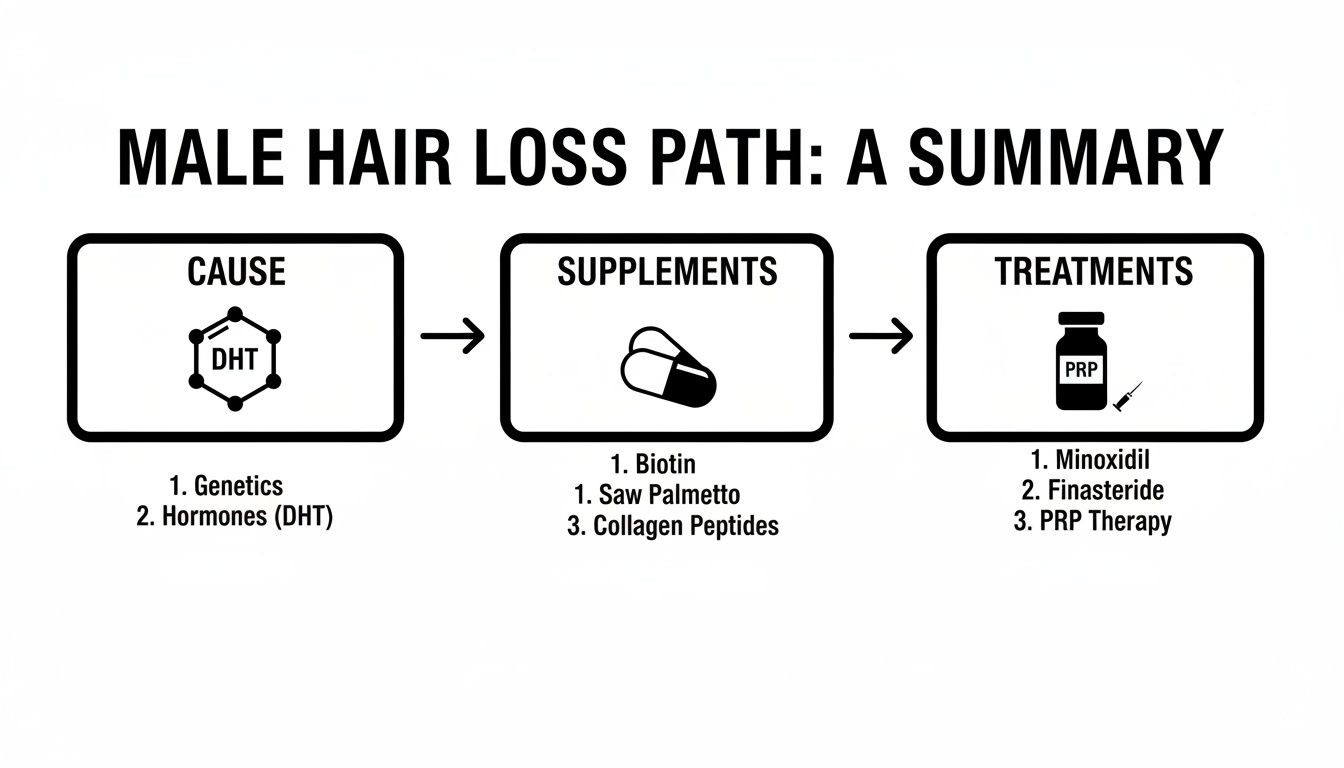
This flowchart paints a clear picture: DHT is the main culprit. Supplements and medical treatments are two different ways of fighting back. The crucial distinction is that supplements generally aim to create a better environment for hair to grow, while direct treatments go after the biological process causing the loss in the first place.
Saw Palmetto: The "Natural" DHT Blocker?
Saw palmetto is easily one of the most talked-about herbal supplements for hair loss, and it’s easy to see why. It’s marketed as a natural alternative to prescription drugs because it’s thought to interfere with 5-alpha-reductase. That's the enzyme responsible for converting testosterone into DHT, the hormone that miniaturizes hair follicles.
Imagine 5-alpha-reductase as a tiny factory converting testosterone into follicle-shrinking DHT. The idea is that saw palmetto slows that factory's production line, meaning less DHT gets made.
The theory makes sense, but the results in the real world are often underwhelming. While some supplements claim to mimic finasteride by blocking DHT, studies show that saw palmetto produces only modest regrowth in about 30-40% of men after a solid 6-12 months. It's not a miracle cure, and it can come with side effects like a dip in libido.
Key Insight: Think of saw palmetto as playing defense. It might help slow down the rate of thinning for some guys, but it's not powerful enough to regrow a significant amount of lost hair on its own.
Biotin: The Hair-Building Vitamin
Biotin, also known as Vitamin B7, has become the poster child for hair health. Its reputation comes from its role in producing keratin, the very protein that hair is made of. If you're truly deficient in biotin, your hair will absolutely become weak and brittle.
But here’s where the hype gets ahead of the science for male pattern baldness. If your biotin levels are already normal, taking more of it won't supercharge hair growth. It’s like trying to overfill a gas tank—once it's full, adding more doesn't make the car run better or faster.
A true biotin deficiency is actually quite rare for people who eat a reasonably balanced diet. It's been shown that only about 38% of people experiencing hair loss are deficient. For everyone else, recent large-scale trials found that biotin supplements didn't increase hair density any more than a placebo. It's a foundational nutrient, yes, but it's not a weapon against DHT.
The Unsung Heroes: Iron and Zinc
Beyond the marquee names like biotin, a couple of key minerals—iron and zinc—play a critical, often forgotten, part in the hair growth cycle.
Why Iron Matters
Iron is the key component of hemoglobin, which is what your red blood cells use to shuttle oxygen around your body. Your hair follicles are living tissues that need a constant oxygen supply to thrive.
- When Iron is Low: If your iron stores (known as ferritin) dip too low, your body gets smart. It redirects oxygen to your vital organs, and your hair follicles get put on the back burner.
- The Downside: This can kick off or worsen a type of shedding called telogen effluvium, which can happen right alongside genetic hair loss, making things look much worse.
Zinc's Role in Repair
Zinc is a jack-of-all-trades mineral. It's involved in everything from cell growth to hormone regulation. For your hair, its most important job is supporting tissue growth and repair, which includes making sure the oil glands surrounding your follicles are working as they should.
A zinc deficiency can throw a wrench directly into the hair growth cycle, causing noticeable thinning. In fact, some studies have linked alopecia to low zinc levels, showing that supplementation can help get hair growing again in those specific cases.
For a deeper look at how these herbal players stack up, our guide to the best DHT blocking supplements breaks down their specific mechanisms.
Vitamin D: The "Sunshine Vitamin"
We usually think of Vitamin D in the context of strong bones, but new research is highlighting its role in creating new hair follicles—the tiny pores in the scalp where new hair growth begins.
You can think of Vitamin D as helping to "wake up" dormant follicles, nudging them into a new growth phase. It's no surprise, then, that low Vitamin D levels have been linked to androgenetic alopecia and other types of hair loss.
While a bit of sunshine is the best natural source, many of us are deficient, especially in the winter. Supplementing can be a smart way to ensure your body has what it needs to support healthy follicle function.
Before starting any new supplement, you have to be sure you're getting a quality product. It’s worth learning about third-party tested supplements to make sure what's on the label is actually what's in the bottle. This simple step protects your health and your wallet.
Exploring Modern Nutraceuticals and Topicals
Beyond single-ingredient supplements, a new class of sophisticated formulas has entered the scene. These are often called nutraceuticals, and they’re designed to be multi-pronged attacks against hair loss, combining a whole host of vitamins, minerals, and plant extracts into a single, powerful dose.
Think of it this way: giving a hair follicle a single nutrient is like watering a plant. A nutraceutical is more like giving it a specialized, slow-release fertilizer packed with everything it needs to flourish.

These complex formulas are built on the idea of supporting hair health from every angle—tackling stress, shoring up nutritional deficiencies, and promoting hormonal balance all at once. Alongside these internal approaches, topical treatments that go to work directly on the scalp offer another powerful strategy.
The Rise of Nutraceutical Blends
Heavy hitters in this space, like Nutrafol and Viviscal, have created blends that are far more complex than your average multivitamin. A quick look at their labels reveals ingredients like marine collagen, powerful antioxidants, and adaptogens (herbs known for fighting stress) working alongside well-known players like zinc and vitamin D.
The philosophy here is solid: male pattern hair loss is rarely a one-dimensional problem. It’s usually a perfect storm of genetics, hormones, inflammation, and stress. By addressing these factors simultaneously, nutraceuticals aim to create an optimal internal environment where hair follicles can finally thrive.
Be prepared for the investment, though. These products aren't cheap, and they require patience. Most companies recommend sticking with it for at least six months to give the ingredients enough time to work before you can fairly judge the results.
A Closer Look at Viviscal
Viviscal is a great example of a targeted nutraceutical. Its formula is centered around a proprietary marine complex intended to feed hair follicles the specific proteins and nutrients they need.
One study, for instance, reported a 32% increase in hair count among 60 men who used it for a full year. That's certainly encouraging, but it's crucial to look at the fine print. The supplement didn't move the needle for men with more advanced hair loss (Norwood stage 4 and beyond). That’s a significant detail, considering this group includes roughly 40% of balding men by the time they hit their 40s.
The Takeaway: A nutraceutical like Viviscal can be a fantastic supporting player, particularly if you're in the earlier stages of thinning. Think of it as a way to stack the deck in your favor by optimizing your body's internal systems.
Shifting Focus to Topical Solutions
While oral supplements work from the inside out, topicals flip the script. By applying them directly to your scalp, you deliver active ingredients right where they're needed most: the hair follicle. This allows for a much more concentrated, localized attack on the problem.
Here’s a simple analogy: taking a supplement is like fertilizing the entire garden and hoping the right nutrients get to the struggling plants. Applying a topical is like walking over to that one wilting plant and giving it a direct shot of customized food and medicine at its roots.
This direct-to-scalp approach also bypasses the digestive system, which is a major plus for certain ingredients that aren't well-absorbed when you swallow them. Let's dig into a couple of popular topical ingredients.
Caffeine Shampoos and Serums
It might seem odd, but the same compound that powers your morning coffee can also give your scalp a much-needed jolt. When applied topically, studies suggest caffeine can help fend off the damaging effects of DHT on the hair follicle, which may help extend the hair’s growth phase.
Caffeine seems to work in a couple of key ways:
- Improving Blood Flow: Better circulation means more oxygen and nutrients can reach the follicles.
- Blocking DHT's Effects: It appears to help shield the follicle from DHT’s relentless signals to shrink.
A caffeine-infused shampoo isn't going to reverse significant balding on its own, but it’s an easy, low-risk tool to add to your arsenal. For anyone interested in this direct approach, it’s worth checking out all the options available, and you can start by finding the best hair growth serum for men in our other guides.
Pumpkin Seed Oil
Another natural topical that’s been getting a lot of attention is pumpkin seed oil. It’s loaded with antioxidants, healthy fatty acids, and compounds called phytosterols, which are believed to have mild DHT-blocking abilities. The research so far is promising, if a bit modest.
When massaged into the scalp, pumpkin seed oil can help nourish the skin, calm inflammation, and potentially interfere with the 5-alpha-reductase enzyme—the culprit that turns testosterone into hair-destroying DHT. It’s a gentle, natural option for anyone wanting to add another layer of defense to their routine without turning to more aggressive chemicals.
Understanding the Role of Clinical Treatments
After digging into the world of supplements, it's time we draw a clear line in the sand. Think of supplements as your supporters. They're fantastic for improving your scalp's overall health and patching up any nutritional holes in your diet. But they rarely get to the root cause of male pattern baldness.
That’s where clinical treatments come in. They aren't just supporters; they're potential game-changers. The difference is crucial. Male pattern baldness isn't caused by a biotin deficiency. It's a genetic sensitivity in your hair follicles to the hormone DHT, and that's the bullseye clinical interventions are designed to hit.
Supplements vs. Treatments: An Analogy
Imagine you're training for a marathon. Your diet—packed with the right carbs, proteins, and vitamins—is like taking hair supplements. It’s absolutely essential. It helps your body perform at its peak. But that diet alone isn’t going to win you the race.
To really compete, you need a specialized training plan from an expert coach—something that actively pushes your body to adapt and get stronger. Clinical treatments, like Platelet-Rich Plasma (PRP) therapy, are that expert coach. They are direct, powerful interventions that work on a biological level to change the game.
What Is PRP Therapy, Really?
PRP isn't about adding something foreign to your system. It’s about concentrating and redirecting your body's own incredible healing power. The process itself is surprisingly straightforward. We take a small sample of your blood and spin it in a centrifuge. This separates out the platelets and growth factors, creating a concentrated, golden serum.
We then strategically inject this "liquid gold" back into the areas of your scalp where the hair is thinning. Think of it as a wake-up call for tired, shrinking hair follicles. These growth factors signal the follicles to get back to work, stimulating repair, boosting blood flow, and encouraging them to re-enter and stay in their active growth phase.
By using your body's innate healing mechanisms, PRP directly targets the weakened follicles, helping to reverse the miniaturization process caused by DHT without introducing synthetic chemicals or hormones into your system. It's a regenerative approach focused on revitalizing what's already there.
The Evidence Behind Clinical Interventions
This isn't just theory; we have the data to back it up. Regenerative options like PRP are getting so much attention because they deliver real, measurable results. In Europe and North America, where baldness rates hover near 40%, more and more men are looking beyond pills toward treatments that harness their body’s own healing potential.
A recent large-scale meta-analysis covering 1,200 patients found that PRP increased hair diameter by an impressive 25%—a change that makes hair look and feel visibly thicker. You can explore more of these compelling baldness statistics and treatment trends for yourself.
Ultimately, grasping this difference is the key to building a strategy that actually works. Supplements create a healthy foundation, but treatments like PRP provide the direct stimulus needed to truly move the needle. And if you're serious about creating that healthy foundation, it's also worth investigating specific nutrient levels. We dive deeper into the connection between ferritin and hair loss in another one of our articles.
How to Build Your Smart Hair Health Strategy
Knowledge is powerful, but without a clear plan, it's just information. This is where we shift from learning about supplements to building a personalized strategy that actually makes sense for you. Moving from worrying about hair loss to proactively managing it all starts with a few deliberate, well-informed steps.

The single most important first move is getting a proper diagnosis. Before you even think about buying a supplement, book an appointment with a dermatologist or a hair loss specialist to confirm you’re actually dealing with male pattern baldness. Self-diagnosing is a classic mistake that can lead you down the wrong path, wasting time and money on solutions that don’t target the real problem.
Define Your Starting Point and Goals
Once you have a confirmed diagnosis, it’s time to take stock of where you are now and where you realistically want to go. This isn't about setting yourself up for disappointment with unrealistic expectations; it's about giving your efforts a clear direction.
A solid plan will look very different for a 25-year-old just noticing some temple recession compared to a 45-year-old with significant thinning at the crown.
Ask yourself:
- Your Age: Are you younger and focused on preservation and slowing things down?
- Stage of Hair Loss: Is your main goal to maintain what you have, or are you trying to regain some lost density?
- Personal Goals: Are you looking for a simple, low-maintenance routine, or are you willing to commit to more involved treatments?
Your strategy has to be tailored to your unique situation. There's no one-size-fits-all answer, which is exactly why a professional diagnosis is the non-negotiable foundation for any successful hair health plan.
This personalized approach helps you choose the right tools for the job from the very beginning.
Choosing Your Path: Supplements or Treatments
With a clear diagnosis and your goals in mind, you can finally make an educated decision on where to begin. Think of this as choosing your primary game plan—do you start with foundational support from supplements, or do you go straight for more direct clinical interventions?
Here’s a simple way to think about it:
Scenario 1: Supplements as a Starting Point
- Who it’s for: Men in the very early stages of thinning, those who have a known nutritional deficiency (like low iron or Vitamin D), or anyone looking to optimize their overall scalp health before things get worse.
- The Logic: If your hair loss is minimal or you have a clear nutritional gap to fill, starting with the best supplements for male hair loss can be a smart, low-risk first step. It just makes sure your body has all the raw materials it needs.
Scenario 2: Clinical Treatments as the Priority
- Who it’s for: Men with noticeable, progressive thinning where genetics and hormones are clearly the main drivers of the problem.
- The Logic: When hair loss is actively advancing, foundational support alone probably isn't going to cut it. This is where clinical options like PRP or prescription medications come in, as they directly target the biological mechanisms causing your follicles to shrink.
This decision is so important because androgenetic alopecia is incredibly common. It’s the culprit behind 95% of male hair loss, and for many guys, the clock starts ticking early. By age 35, roughly two-thirds of American men will be dealing with some degree of noticeable hair loss. You can understand how many men are impacted and see just how widespread this is.
How Supplements Support Clinical Treatments
Choosing a clinical treatment doesn't mean supplements suddenly become irrelevant. Far from it. In fact, they can play a fantastic supporting role, working alongside your primary treatment to enhance the results.
Think of it like gardening. A treatment like PRP is like planting new seeds for regrowth. Supplements are the fertilizer, making sure the soil—your scalp—is rich in all the nutrients those seeds need to sprout and really flourish.
A well-nourished scalp often responds much better to clinical interventions. It creates a powerful synergistic effect that can lead to better, more satisfying outcomes in the long run.
Your Questions on Hair Loss Supplements Answered
Even with all the science sorted out, you're probably left with a few practical questions. Let's be honest, figuring out which supplements to take for hair loss can feel like trying to solve a puzzle with half the pieces missing.
To help you put it all together, I’m going to tackle the most common questions that pop up. Think of this as the final, practical step to help you move forward with confidence and make smart decisions for your hair.
How Long Until Hair Supplements Actually Work?
This is the big one, isn't it? The straight-up, honest answer is: you need to be patient. There’s no single timeline because it all depends on what a supplement is actually doing inside your body.
If a nutritional gap—like low iron—is making your hair loss worse, you might start to see a change in shedding within 3 to 6 months of consistent use. Why so long? Your body has to refill its main stores first before it can start sending those precious resources back up to your hair follicles.
For supplements that work on hormonal pathways, like saw palmetto, the runway is even longer. Most studies show you’ll need to stick with it for at least 6 to 12 months to notice even a modest improvement. And for most guys, "improvement" means slowing the rate of loss, not dramatic regrowth. It’s a marathon, not a sprint.
It's crucial to set realistic expectations. "Working" often means pumping the brakes on hair loss and improving the health of the hair you still have. It rarely means regrowing a full head of hair lost years ago. This is a huge difference compared to clinical treatments like PRP, where patients often report visible changes in density and less shedding in just a few months.
Can I Combine Supplements with Clinical Treatments?
Absolutely. In fact, this is often the smartest way to go.
Think of your hair loss plan like building a house. Clinical treatments—like PRP or prescription meds—are the foundation and the frame. They do the heavy lifting by directly targeting the biological mechanism behind male pattern baldness.
Supplements are like the high-quality wiring and insulation. Core nutrients like vitamin D, zinc, and iron ensure your body has all the raw materials it needs to support healthy growth. A well-nourished scalp is simply going to respond better to the powerful signals sent by a clinical treatment.
When you put them together, you can get a synergistic effect where everything works better. But—and this is a big but—you absolutely must talk to your doctor before starting this kind of combined approach. They can help you create a plan that’s both safe and effective, ensuring your supplements are helping, not hurting, your primary treatment.
What Side Effects Should I Watch Out For?
While most hair supplements are pretty safe for healthy guys, don't let the word "natural" fool you into thinking there's zero risk. It’s smart to know what to look out for, especially with high doses or certain herbal extracts.
Here are a few things to keep on your radar:
- Too Much of a Good Thing: You really can overdo it. Extremely high doses of some fat-soluble vitamins, especially Vitamin A, can backfire and actually cause hair shedding.
- Skewed Lab Results: High-dose biotin is infamous for messing with important lab tests, including the ones doctors use to check for heart problems. You have to tell your doctor you’re taking it. For a deeper dive, you can read about the specific biotin side effects for men and how to handle them.
- Herbal Reactions: Even natural extracts can have side effects. Saw palmetto, for instance, might cause a bit of stomach upset or, in rare cases, mess with your libido.
The best approach is to play it safe. Stick to the recommended dose on the bottle, buy from reputable brands that are transparent about their testing, and keep your doctor in the loop on every single supplement you take. That simple conversation is your best line of defense.
At PRP For HairLoss, we believe in providing clear, evidence-based information to help you navigate your hair restoration journey. Our blog is a resource for men seeking to understand male pattern baldness and the most effective treatments available, including PRP therapy. To learn more about how to build a smart and effective hair health strategy, visit us at https://prpforhairloss.com.
 PRP For Hairloss
Leave a comment